PMDD Guide for Partners: The Complete Playbook for Her Hard Week and the Other Three
Two good weeks. Then a window opens, the floor drops out of the house, and the person you know gets replaced by someone in real pain who is convinced the relationship is over. Then her period starts, the sky clears, and she is back. Nobody hands you a manual for that, so here is one: a PMDD guide for partners that puts the whole thing in one place, from what is happening in her brain to what you actually do on a Tuesday night in week four.
This is the hub for everything we have written about premenstrual dysphoric disorder. Read the overview here, then jump straight into whichever deep dive you need tonight. Every claim here is sourced, and every section points to a longer piece if you want more than the summary.
One note before we start: we say “she” and “her” throughout, because that is who most of our readers are supporting. None of it depends on that. If you are supporting a wife, a girlfriend, a partner, a daughter, or a friend who menstruates, the biology and the playbook are the same.
What is in this PMDD guide for partners
- What PMDD actually is
- Why every article gives you a different number
- The signature: timing is the whole diagnosis
- PMS or PMDD: where the line actually sits
- What is happening in her brain
- The symptoms, one at a time
- What the hard week is like from her side
- Is she mad at me, or is it this
- What PMDD does to a relationship, according to the data
- The fights: what is real and what is volume
- What to actually say in the five hardest moments
- How a diagnosis actually happens
- What gets mistaken for PMDD, and what travels with it
- Treatment, rung by rung
- What changed in the last year
- Building the support plan
- Your month has four jobs
- Week four: holding the ground
- Week one: the repair nobody schedules
- Not losing yourself in the helper role
- The long run
- The safety part, which is not optional
- What is not your job
- If she has never named it
- Six things you will read that are not true
- If it is your daughter, not your partner
- Where we fit, and where we do not
- Questions partners actually ask
- The short version
What PMDD actually is
Premenstrual dysphoric disorder is a severe, cyclical mood condition tied to the second half of the menstrual cycle. The DSM-5, which is the manual clinicians diagnose from, files it under depressive disorders, and that is the detail most people miss: PMS has no formal psychiatric diagnosis while PMDD does (StatPearls).
The symptoms are not a heavier version of feeling grumpy. They are severe irritability or anger, deep depression, hopelessness, anxiety and tension, and a sense of being completely out of control, at a level that interferes with work, home, and the relationship itself. In the same window she may also get the physical load: bloating, breast tenderness, headaches, appetite and sleep going sideways.
Here is the sentence that changes how most partners read the whole thing. Her hormone levels are normal. The current understanding is not that she has too much or too little of anything, but that her brain responds abnormally to the ordinary rise and fall of the cycle (Cleveland Clinic). A National Geographic feature in May 2026 put it the same way, listing altered stress responses, GABA and serotonin differences, genetics and circadian rhythm as the pieces researchers are working with (National Geographic, 2026).
Two bad interpretations die right there. She is not choosing this, so “she just needs to get a grip” is off the table. And you are not causing it, so the week where everything you do lands wrong is not evidence that the relationship is broken.
Why every article gives you a different number
Search PMDD and you will be told it affects 1 percent of women, or 3 percent, or 5 to 8 percent. Every one of those numbers has been printed by a reputable source. They disagree because they are counting different things, and knowing which is which will save you a lot of doom-scrolling.
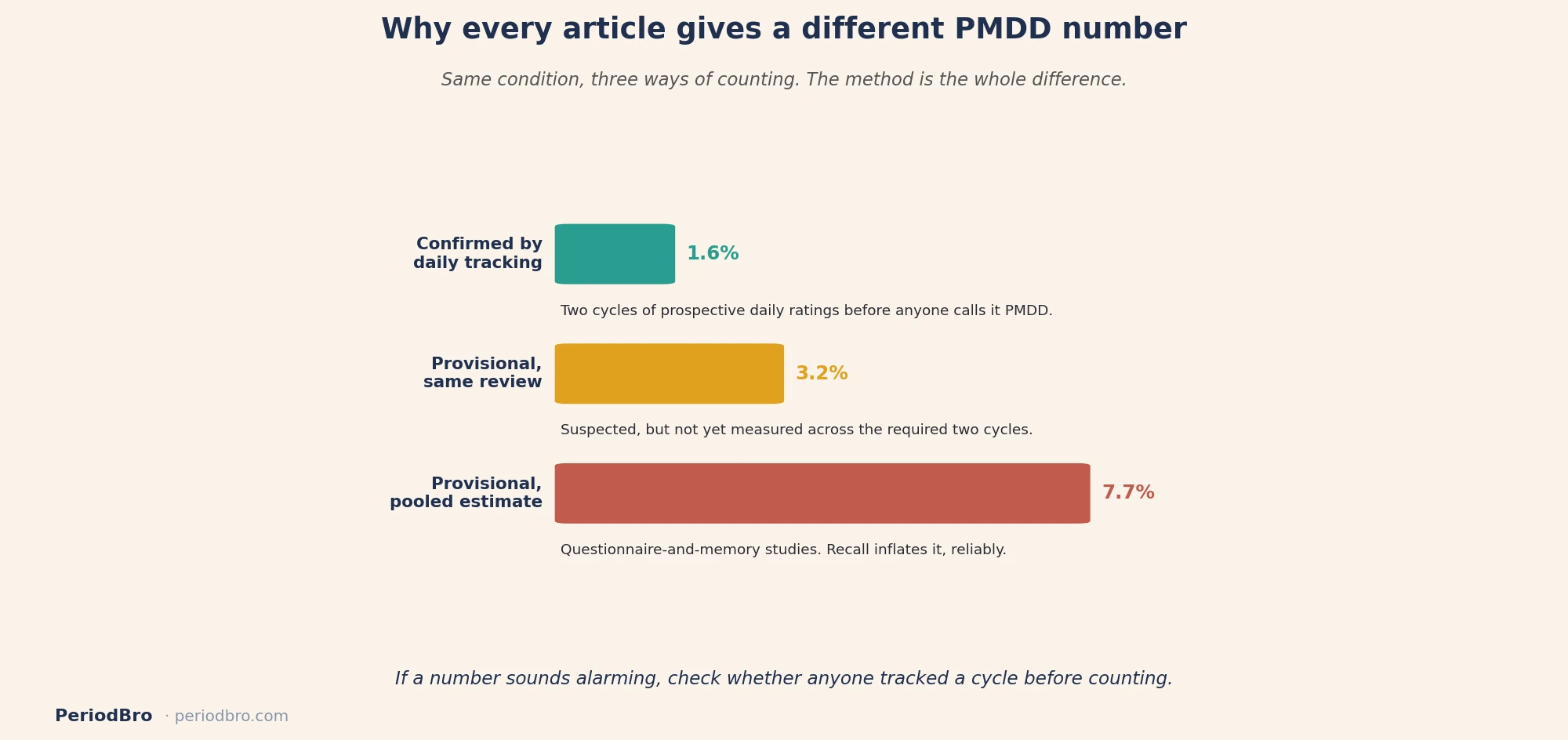
A global review led out of the University of Oxford separated the two kinds of estimate and found that about 1.6 percent of women and girls have PMDD confirmed the proper way, meaning symptoms were measured prospectively over time rather than recalled. In the same review, 3.2 percent had a provisional diagnosis, where it is suspected but has not been measured across the required window. Pooled across the questionnaire studies, provisional PMDD runs at 7.7 percent (University of Oxford).
The authors were blunt about why. Asking someone to remember how bad last month was produces false positives, reliably, because memory keeps the worst days and quietly drops the ordinary ones. That is not a criticism of anyone. It is how recall works for everybody, which is exactly why the diagnostic process refuses to run on it.
What this means for you is practical. If she has filled in an online screener and it came back positive, that is a provisional result and a good reason to start tracking. It is not a diagnosis, and treating it as one can send both of you down the wrong road. It also means the condition is genuinely uncommon, and the honest response to “is this PMDD” is usually “it might be, and there is a specific way to find out.”
The signature: timing is the whole diagnosis
If you take one structural idea from this guide, take this one. What makes PMDD PMDD is not how bad the bad days get. It is the shape of the month.
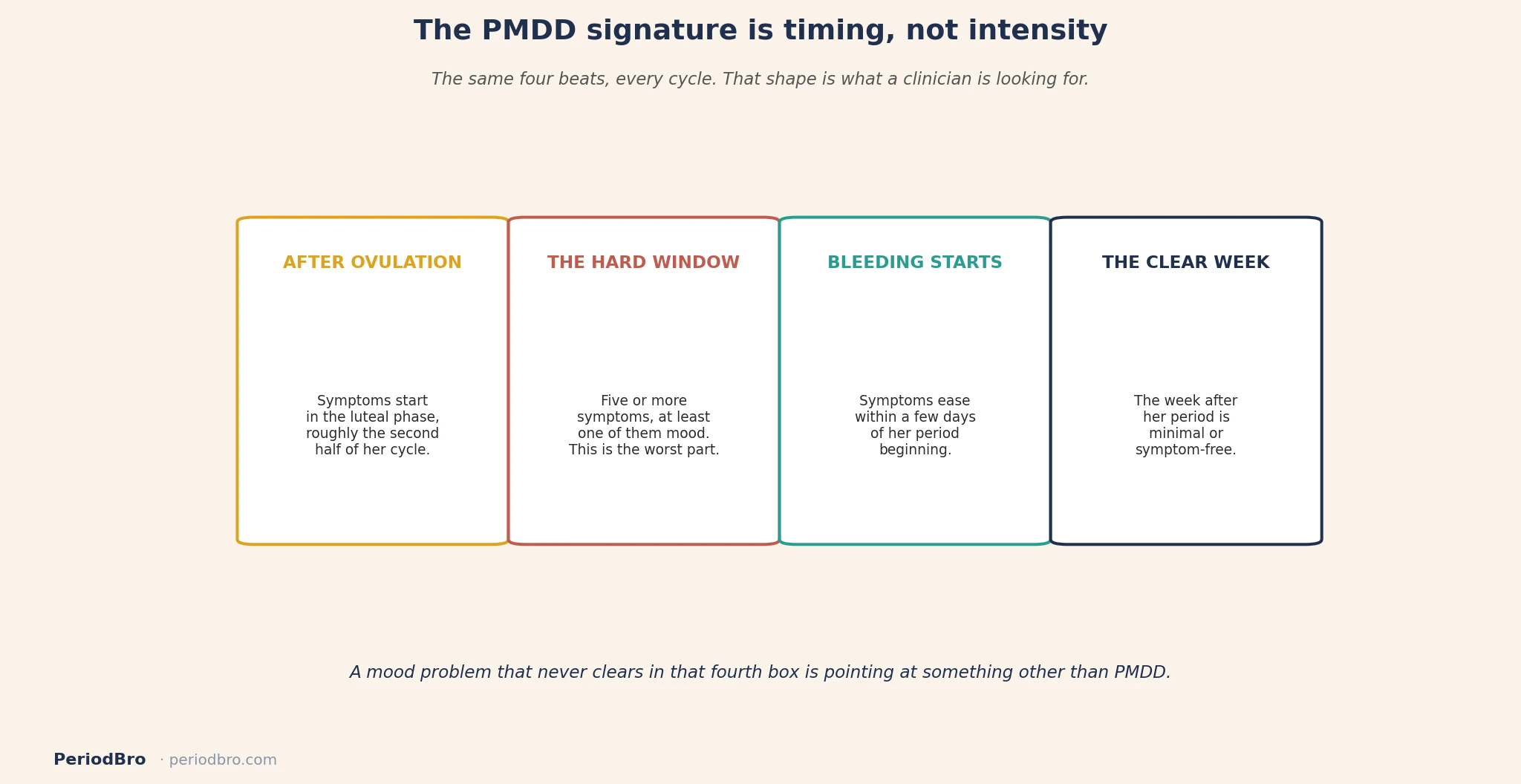
Symptoms arrive in the luteal phase, the stretch after ovulation. They peak in the last stretch before bleeding. They ease within a few days of her period starting. And the week after her period is minimal or clear (StatPearls). If you are hazy on which part of the month that is, we mapped it in what the luteal phase is, explained for partners.
That fourth beat is the one that does the diagnostic work. A low mood that never fully clears in the week after her period is pointing at something other than PMDD, or at PMDD sitting on top of something else. A clinician who understands this will not be interested in how dramatic one month was. They will be interested in whether the pattern repeats and resolves.
Which is why the useful thing you can hold in your head is not a symptom list. It is a calendar. Knowing that you are on cycle day 24, not falling out of love, changes what a hard evening means. That single reframe, from “what did I do wrong” to “ah, it is that week,” takes a surprising amount of poison out of the whole arrangement.
PMS or PMDD: where the line actually sits
Most premenstrual weeks are not PMDD. Some version of PMS touches the large majority of people who menstruate, with estimates commonly cited around 75 percent or higher (ACOG). Tired, tender, quick to snap, wanting an early night. Uncomfortable, and then it passes.
The ceiling on ordinary PMS is the thing to hold onto, because that ceiling is exactly where the line to PMDD gets crossed. With PMS, life mostly stays on its rails. She goes to work, holds a conversation, and knows the mood will lift. With PMDD, the bad stretch derails things. It strains the relationship, affects her job, and can come with a level of despair or rage that frightens her more than it worries you.
Frequency and wreckage are the tells. If every single cycle brings a few days that read as an emotional crisis rather than a slump, that is worth taking seriously rather than absorbing for another year. We walk the boundary in detail in PMS vs PMDD: the difference every partner should know, and if you are still at the earlier stage of the question, understanding PMS from a partner’s perspective is the gentler starting point.
Do not let “it is just PMS” become the reason a serious, treatable condition goes unaddressed for a decade. The label you both use shapes how seriously you both take it, and that is not a small thing.
What is happening in her brain
You do not need to be able to explain the neuroscience. You do need enough of it to stop reaching for the wrong explanations, because the wrong explanations are what make a hard week worse.
The mechanism researchers keep landing on is sensitivity to allopregnanolone, a byproduct of progesterone that acts on the same brain receptors as sedatives and alcohol. In most brains, the luteal rise and fall of that molecule passes without drama. In PMDD, the response appears to be abnormal, and the mood consequences are severe.
A 2025 study in Translational Psychiatry pushed this a step further. Researchers looked at the expression of GABA-A receptor subunits in circulating immune cells and matched it against brain imaging. Women with PMDD who had lower expression of the delta subunit showed higher emotion-related activation in the right amygdala during the luteal phase (Translational Psychiatry, 2025). Put crudely, the brake on the brain’s threat-detection system appears to work differently in that window, and it shows up on a scan.
The point is not the acronyms. The point is that when she tells you the anger or the despair feels chemical and enormous, she is describing something researchers can now partly see. “Just try to relax” is not only unhelpful, it is factually wrong about what is happening. If you want the week-by-week version of the hormone story without the receptor talk, we wrote how hormones drive her mood all month long and how hormones, the cycle, mood and energy actually connect.
The symptoms, one at a time
PMDD does not show up as one feeling. It shows up as a cluster, and different cycles can lead with different members of the cluster. Knowing them separately helps, because each one has a different thing that helps and a different way of going wrong when you guess.
Rage and irritability. The one partners find hardest, because it is aimed outward and often at you. It is a symptom with a mechanism, not a verdict, and the response that works is lowering the volume rather than matching it. Full treatment in period rage: why she gets irritable and snappy before her period.
Crying and tearfulness. Sometimes over things that would not normally register, which she usually knows and finds humiliating. Pointing out the disproportion is the single least helpful move available. See period crying: why she gets tearful before her period.
Anxiety and tension. A dread with no object attached, which is exactly why “what are you worried about” lands badly. There is often no answer to give. Period anxiety covers what actually settles it.
Depressed mood and hopelessness. The heaviest of the core four, and the one that carries the safety implications we cover further down. It is also the one most likely to get filed as “she has been down lately” without anyone checking the timing.
The cognitive and physical tail. Trouble concentrating, exhaustion, appetite swings, sleep falling apart, plus the physical premenstrual load. Sleep is worth singling out, because it degrades everything else and because it is one of the few levers you can actually help with. We wrote up how sleep changes through the cycle separately.
The diagnostic threshold is five or more of these in the premenstrual week, with at least one from the core mood group: marked irritability, mood swings, depressed mood, or anxiety and tension (StatPearls). You are not counting them. A clinician is. You are noticing whether they arrive and leave on a schedule.
What the hard week is like from her side
Everything above is written from where you are standing. It is worth spending a section on the other chair, because a lot of what looks like rejection from outside is something else entirely from inside.
The Durham survey asked people with PMDD about their own experience of relationships during the luteal phase, and the themes that came back were frequent conflict, emotional withdrawal, and fear of abandonment. Many described avoiding social contact and a persistent sense of relational instability (Durham University, 2025). Note the combination there. Fear of abandonment and withdrawal in the same window is a horrible pairing, because the behaviour that shows up looks exactly like not wanting you around while the underlying fear is the opposite.
That explains a pattern most partners have run into and misread. She pushes you away, you give her space because that is what the internet said to do, and the space registers as confirmation that you were looking for an excuse. Or you stay close, and the closeness registers as pressure. Both moves fail, which is why the plan built in a good week matters so much: it lets her tell you in advance which failure mode she is more likely to be in, so you are following an agreement rather than reading tea leaves.
The second thing worth knowing is how much of the load is shame. She usually knows the reaction is disproportionate while she is having it, and knowing does not stop it. That gap, between watching yourself react and being unable to intervene, is one of the most distressing parts of the condition and it is not something you can talk her out of. What helps is removing the audience quality from it: not treating each episode as a performance to be reviewed, not keeping a tally, not bringing it up as evidence later.
The third thing is the exhaustion of the reset. Every cycle she gets to come back to herself and survey the damage. If your reaction to her return is relief that reads as “thank god that is over,” she has to carry the sense of being a weather event that happens to you. If your reaction is repair, she gets to be a person you are on a team with. Same week, completely different month.
None of that means the strain on you is not real. It means the strain runs both directions, and the couples who do well tend to be the ones where both people know that.
Is she mad at me, or is it this
This is the question that brings most people to a page like this one, usually late at night, usually after a fight that came out of nowhere. It deserves a straight answer instead of a reassuring one.
Sometimes she is mad at you. Reaching for “she is premenstrual” as a universal explanation is a cheap dodge, and she will clock it immediately. It is also a fast way to make her feel unseen, which reliably makes the week worse.
The more useful frame is that the content of the fight and the volume of the fight are two different dials. The grievance is often real and worth hearing. The catastrophizing wrapped around it, the leap to “this whole thing is broken,” is the part the luteal phase is amplifying. Take the point seriously. Do not treat the conclusion as a verdict on the relationship.
The practical test is boring and works: does the same complaint still stand on day four of her period? If it does, it was real and it deserves a proper conversation. If it evaporates every month and comes back in the same window, you are looking at the cycle. We built that whole decision out in is she mad at me or is it her period, and the earlier-stage version of the same confusion is in why is my girlfriend so emotional before her period.
One rule with no exceptions attached: never deploy the calendar as a weapon mid-argument. “You are only saying that because it is day 25” may be technically accurate and it is still the worst sentence in the house. It teaches her that tracking is surveillance rather than support, and once she believes that, you lose the tool that makes the rest of this work.
What PMDD does to a relationship, according to the data
A lot of partners quietly feel crazy for finding this hard, so it is worth putting the evidence on the table. The strain is real, it is measurable, and somebody has now measured it on both sides.
A cross-sectional survey study out of Durham University, published in PLOS One in April 2025, compared 216 people with PMDD against 187 controls, and separately compared 92 of their partners against 59 control partners. On relationship quality, four domains came out significantly lower for both the PMDD group and their partners: satisfaction, intimacy, trust, and passion (PLOS One, 2025).
Two domains did not differ at all. Love and commitment held, in both groups, at the same level as couples without PMDD. That is worth holding onto at 11pm on a bad night. What erodes under PMDD is the satisfaction and the closeness, while the love and the commitment underneath tend to stay where they were.
The partner findings are the part almost nobody writes about. Partners reported lower quality of life across seven caregiving domains, including caring stress, personal growth, sense of value, and ability to care. Their scores on “support for caring” landed in the range the instrument treats as indicating significant problems (Durham University). In plain terms: the people doing the supporting are, on average, not being supported.
So if you have been feeling worn down and telling yourself you have no right to, the data disagrees with you. Being the steady one through a recurring hard week costs something. Naming that is not weakness and it is not disloyalty. Our fuller read on the relationship level is in PMDD and relationships: what partners need to know.
The fights: what is real and what is volume
Most PMDD conflict is not about the surface topic. During the luteal window, small frictions get amplified and the brain reaches for worst-case interpretations, so a normal-sized grievance can arrive at the door sounding like an ending.
Three things help more than anything clever you might say in the moment.
Move the conversation, do not cancel it. A lot of couples land on a rule that big relationship conversations get parked until day three or four of her period. Parked, with an actual date. Cancelled feels like dismissal. Parked feels like respect with a calendar attached. We wrote the mechanics up in how to handle PMS arguments and the fast version in how to handle arguments before her period.
Do not take the bait on relationship-ending statements. Things said at the bottom of the window are real feelings and unreliable conclusions, and she would usually be the first to say so afterward. Hear the pain without treating the verdict as final, and revisit anything that still stands once the phase lifts.
Check whether the same fight keeps recurring. If the identical argument shows up every cycle, the surface topic is almost never the subject. That is its own pattern, and we pulled it apart in the hidden cause of your recurring arguments.
What to actually say is its own skill, and most of it is subtraction. Fewer open questions, more small concrete offers. Less problem-solving, more staying nearby. What to say and not say when she has PMS is the script version, and when the answer is space rather than words, how to give her space and what to do when she pulls away cover the version where following her with demands for closeness backfires.
What to actually say in the five hardest moments
Principles are easy to nod at and hard to use at 11pm. So here are the five situations that come up most, with something concrete to say and, more usefully, the thing not to say. Steal what fits and make the wording sound like you rather than like a worksheet.
1. She snaps at you over something small.
Say: nothing much. “Alright.” Or absorb it and move on. If a response is needed, keep it flat and short: “Got it, I will sort it.”
Do not say: “Where did that come from?” or “Is it that time again?” The first invites her to justify a reaction she cannot justify. The second is the calendar as a weapon, and it costs you the tracking.
2. She says the relationship is not working.
Say: “I hear that this feels really bad right now. I am not going anywhere tonight, and if it still feels true next week we will talk about it properly.”
Do not say: “You do not mean that.” You are telling her that her feelings are not real, mid-crisis, which is the exact accusation the condition already makes at her. And do not counter-escalate with your own list of grievances, because both of you will be quoting that conversation for months.
3. She is crying and cannot say why.
Say: “You do not have to explain it. Do you want me here or do you want the room?” Then do whichever she says, without a face on.
Do not say: “But nothing happened.” Even when true. Especially when true.
4. She apologises afterward and calls herself a monster.
Say: “It was a hard week and it is over. I am not keeping score.” Then actually do not keep score, because she will find out if you are.
Do not say: “It is fine” while your face says otherwise, and do not use the apology as an opening to relitigate. If something genuinely needs raising, raise it as its own conversation later in the week, not attached to her apology.
5. She has gone quiet and you cannot tell if you are in trouble.
Say: one low-stakes concrete offer, then leave it. “Making tea, want one.” No follow-up interrogation.
Do not say: “Are we okay?” repeatedly. That question asks her to manage your anxiety on a day she has none spare. We wrote the longer version of this in why you should stop apologizing when she goes quiet.
The pattern across all five is the same and it is unnatural for most of us. Shrink your response, drop the need to be understood in that moment, and defer anything that needs both of you thinking clearly. It feels like doing nothing. It is not nothing, it is the hardest available option, and it is the one that stops a bad evening from becoming a bad month.
How a diagnosis actually happens
The path to a PMDD diagnosis is specific, it is slow, and the single most important part of it is the part you can genuinely help with. Knowing the shape of it in advance stops the whole thing feeling like a black box.
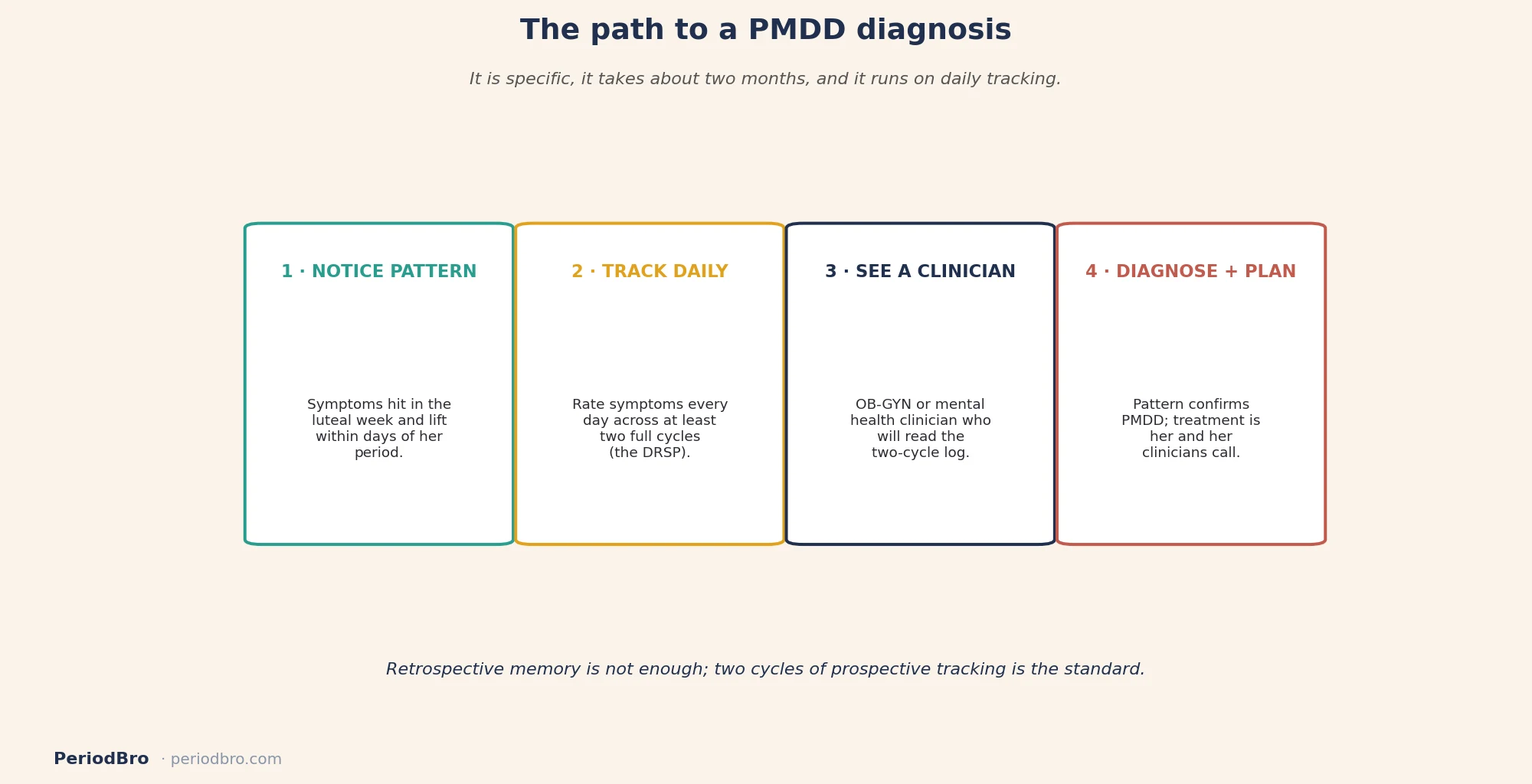
She rates her symptoms every day, across at least two full menstrual cycles, before anyone confirms anything. The instrument clinicians trust is the Daily Record of Severity of Problems, a 24-item daily questionnaire covering symptoms plus how much they interfered with work, relationships and daily life. A scoring system called the C-PASS turns two or more months of those ratings into a formal DSM-5 diagnosis (Eisenlohr-Moul et al., American Journal of Psychiatry, 2016).
Prospective is the operative word. A diagnosis cannot be made from memory, from one catastrophic month, or from your account of a bad week. Those two months of honest daily logging are not the paperwork before the diagnosis. They are the diagnosis.
Who she sees matters less than how they think. Her OB-GYN or primary care clinician is a reasonable starting point, and a mental health clinician can be part of the picture, particularly if depression or anxiety are tangled up in it. What matters is whether they will look at two cycles of daily data and reason from the pattern rather than waving it off as generic PMS or generic depression. She can ask directly whether they use prospective symptom tracking to assess PMDD. A no is a reason to find someone else.
Your job in this phase is logistics, not interpretation. Two months of daily ratings is a genuine chore when you feel awful, and making it easier to keep up is real help. Reading the ratings and announcing a conclusion is not. The full walk-through, including what to bring to the appointment, is in how to get a PMDD diagnosis.
What gets mistaken for PMDD, and what travels with it
PMDD gets misread in both directions, and both errors cost time. Understanding the near neighbours is part of supporting the process rather than accidentally derailing it.
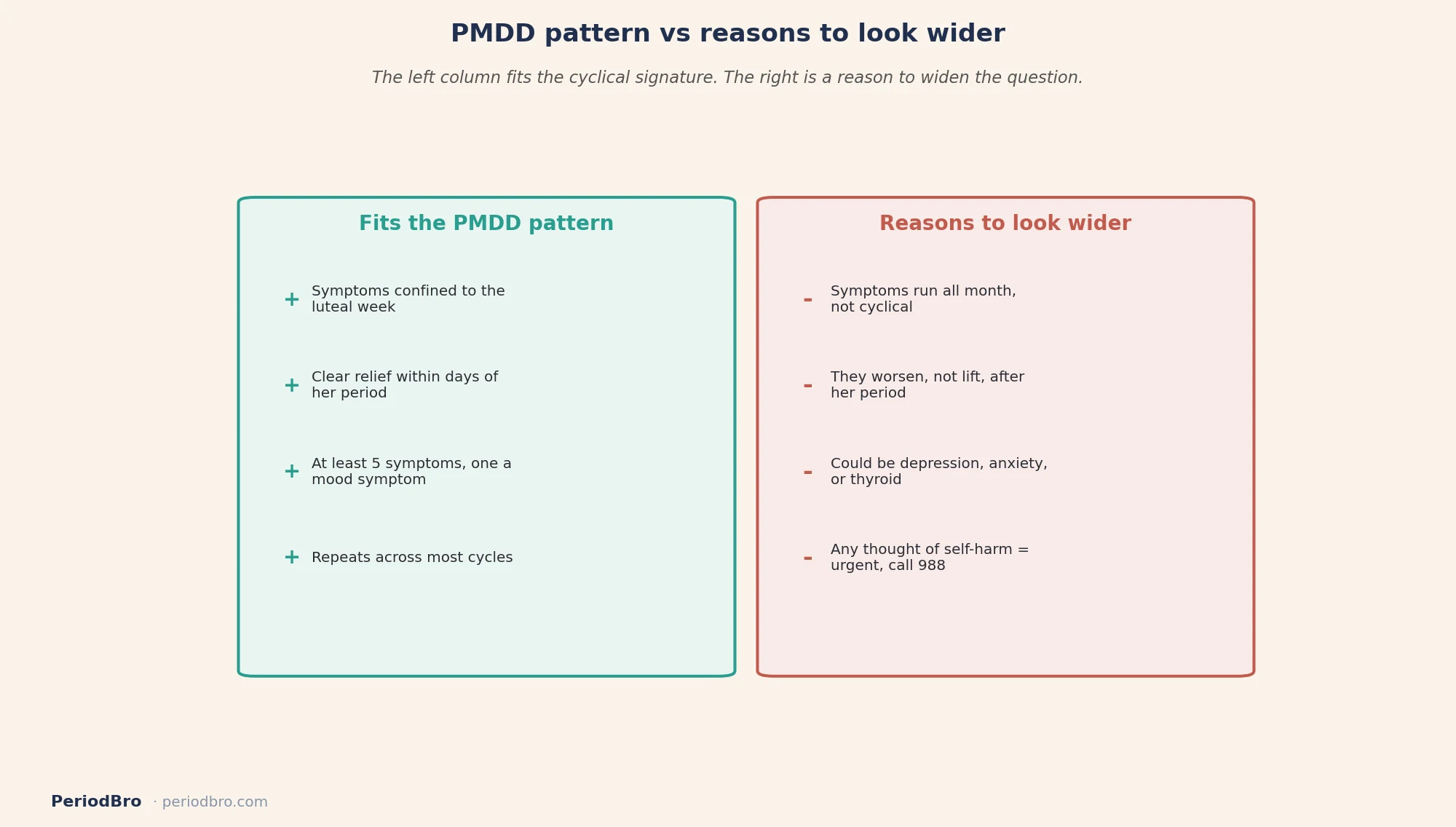
Depression and bipolar disorder. The mood symptoms can look identical, which is why women with PMDD are sometimes handed one of those labels and treated for the wrong thing. The tell a good clinician leans on is the timing. If the low mood clears reliably in the week after her period and returns the next luteal phase, that rhythm points somewhere a flat depression diagnosis does not.
Premenstrual exacerbation. This is the one that trips up couples who have done their reading. An existing condition, depression or anxiety or anything else, can get significantly worse in the luteal phase without the underlying condition being cyclical. That is not PMDD, it is PMDD-shaped noise on top of something that runs all month, and it needs a different plan. Only the daily log separates them.
ADHD. This is the newest piece and it surprised a lot of clinicians. A survey study of 715 women aged 18 to 34, published in the British Journal of Psychiatry in June 2025, found that 31.4 percent of those with a self-reported ADHD diagnosis screened positive for provisional PMDD, against 9.8 percent of the non-ADHD reference group. Screening for ADHD symptoms rather than relying on diagnosis pushed it to 41.1 percent, a 4.17-fold higher relative risk. Where depression or anxiety were also present, the risk climbed further (British Journal of Psychiatry, 2025). Note that this was provisional PMDD, screened rather than confirmed, so the headline number is inflated by the method described earlier. The association is still striking and worth mentioning to a clinician if ADHD is in her history.
Trauma history. The DBT-informed treatment paper we cover below notes that 83 percent of Australian women with PMDD in the cited work reported early life trauma, which is one reason trauma-informed care keeps coming up in newer treatment models (Australian and New Zealand Journal of Psychiatry, 2025).
Thyroid, anaemia, perimenopause, and the rest of the boring list. Cyclical mood symptoms sit near a lot of unglamorous medical explanations, and a decent clinician will rule some of them out with bloods rather than assume. This is another reason the answer to “is it PMDD” is a process rather than a verdict you reach at home.
Treatment, rung by rung
PMDD responds to treatment, and the treatments are better than most couples expect. None of the decisions are yours, and knowing that going in will save the two of you a lot of friction.
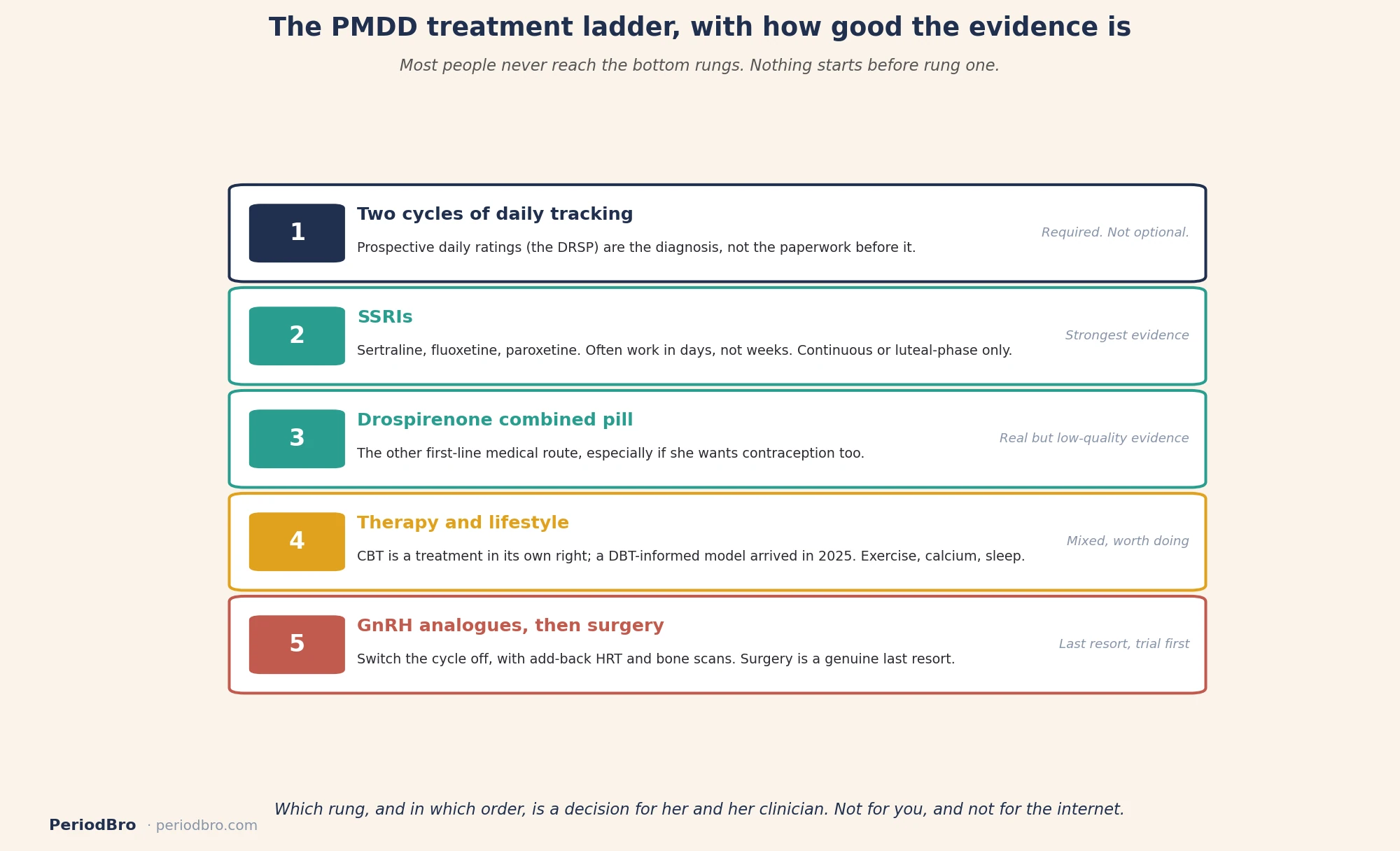
SSRIs are first line, and they behave strangely well here. Cleveland Clinic names sertraline, fluoxetine and paroxetine as the ones used for PMDD. A 2024 Cochrane review pooling 34 randomised trials and 4,563 women found them clearly better than placebo, with a standardised mean difference of −0.57 at moderate certainty. The timing is the part that confuses partners: for depression these take four to eight weeks, but for premenstrual disorders the same review notes effects within days to weeks, with some trial data putting onset inside 24 to 48 hours. That is why some people take them only in the second half of the cycle.
Whether luteal-only dosing matches continuous dosing is genuinely unsettled. One head-to-head meta-analysis of eight trials found no significant difference; the Cochrane subgroup analysis favoured continuous. Both are legitimate, and which suits her is a conversation for her and her clinician rather than something to lobby for at home. Side effects are worth expecting rather than fearing: Cochrane put nausea at roughly 7 percent on placebo rising to 20 percent on treatment. Worth knowing too that 68 percent of the trials in that review were industry-funded and the authors flagged suspected publication bias. Even good evidence has caveats.
The drospirenone combined pill is the other first-line medical route. A 2023 Cochrane review of five trials and 858 women found it better than placebo, with a standardised mean difference of −0.41, plus small improvements in productivity, social activities and relationships. The evidence was graded low quality and withdrawals due to side effects ran substantially higher than placebo. One number is worth carrying: in one trial 48 percent responded to drospirenone and 36 percent responded to placebo. Placebo response in this condition runs somewhere in the 36 to 43 percent range, which is a reason to keep tracking after starting something, not a reason to dismiss treatment.
Therapy is a treatment, not a consolation prize. UK guidance from the Royal College of Obstetricians and Gynaecologists says CBT should be offered as a treatment option in its own right. There is one trial that speaks directly to you: a randomised comparison of couple-based CBT against one-to-one CBT found both beat a wait-list on symptoms and distress, with no significant difference between them on symptom reduction. What the couple arm changed was everything around the symptoms. Increased partner support was reported by 84 percent in the couple arm against 39 percent in the one-to-one arm and 19 percent on the wait-list; improved relationship, 57 percent against 26 percent and 5 percent.
That is the honest version of the partner story. Your involvement has not been shown to make her symptoms smaller. It has been shown to change how supported she feels and how the two of you handle the thing, which is not nothing when it returns every month. The caveat is sharp: that evidence supports partner involvement in structured therapy run by a clinician. It does not support you running the therapy.
Lifestyle and supplements, honestly graded. Calcium at 1,200 mg a day cut total symptom scores by 48 percent against 30 percent on placebo in a trial of 466 women over three cycles, though a later trial found no significant difference, so treat it as promising rather than settled. Exercise came out well in a meta-analysis of 15 trials and 717 participants, with a large effect, but 87 percent of those trials were at high risk of bias. Chasteberry is where the internet gets ahead of the evidence: a review of 17 trials produced a big pooled effect with heterogeneity at 91 percent, most trials at high risk of bias, and the authors calling their own result exploratory and at best an overestimate. Beyond evening primrose oil for breast tenderness, RCOG says there is little evidence that supplements work.
The far end, so nothing blindsides you. If first-line options fail, GnRH analogues can switch the cycle off. Beyond six months they affect bone strength, so add-back HRT and regular bone density scans come with them. Surgery means removing the uterus along with both ovaries and tubes and is a genuine last resort. The detail worth knowing is that a trial run comes first: three to six months on GnRH analogues plus HRT, to see whether removing the cycle actually helps and whether HRT suits her, before anything irreversible happens. If you hear the word surgery, that trial period is almost certainly what is being described.
ACOG published a full clinical practice guideline on managing premenstrual disorders in December 2023, and it remains the backbone document clinicians work from (ACOG). The longer partner-facing walk-through of all of this, with the numbers laid out one by one, is in PMDD treatment options: what actually helps. If a hormonal contraceptive is already part of the picture, birth control and her cycle covers how that changes what you are both looking at.

What changed in the last year
PMDD research has been quiet for decades and is not quiet now. None of what follows is something to go asking a GP for tomorrow, but it is worth knowing the direction of travel, if only so the next few years feel less like waiting.
Drugs aimed at the actual mechanism. Rather than treating the mood downstream, several candidates target progesterone and allopregnanolone signalling directly. Sepranolone, an injectable neurosteroid, produced a significant improvement in total DRSP score against placebo in a phase 2 study dosed across one cycle. An extension running five to seven injections across three cycles then failed to beat placebo at its primary endpoint (MGH Center for Women’s Mental Health). Ulipristal acetate, a selective progesterone receptor modulator, has also been investigated with early promise (MGH Center for Women’s Mental Health). Read both as genuinely interesting and genuinely unfinished.
A psychological model built for PMDD specifically. In June 2025 the Australian and New Zealand Journal of Psychiatry published the first structured DBT-informed treatment framework for PMDD: ten fortnightly sessions across four stages, combining dialectical behaviour therapy with trauma-informed and feminist perspectives. The argument is that DBT’s emphasis on acceptance and coping fits a chronic, biologically driven, cyclical condition better than standard CBT does, and that it directly addresses emotional dysregulation and rejection sensitivity (Australian and New Zealand Journal of Psychiatry, 2025). It is a proposed model rather than a proven one, but it is the first thing in years that treats PMDD as its own psychological problem rather than depression with a timestamp.
Therapy that does not require finding a specialist. A Swedish randomised controlled trial protocol published in 2025 is testing emotion-regulation-based internet-delivered CBT for PMDD, with roughly 164 women randomised to eight weeks of therapist-guided self-help or a waitlist. Access is the real bottleneck for most couples, and a delivery format that does not depend on living near a clinician who has heard of the C-PASS matters more than it sounds.
Circadian approaches. Light exposure and melatonin timing are being looked at as levers, which follows from the sleep and circadian differences that keep showing up in the biology (National Geographic, 2026).
The consensus among the researchers quoted across this work is that this is an unusually promising stretch for PMDD. That is worth telling her during a good week, because one of the quieter costs of this condition is the sense that nobody is working on it.
Building the support plan
The single biggest mistake partners make is improvising support in the middle of the storm. Day 24 is the worst possible moment to ask what she needs. She may not know, she may not be able to say, and anything you try that misses will land as more evidence that nobody gets it.

So build it on a good week. That is rule zero. Sit down when she is herself, say you want to get better at the hard stretch, and make it a shared project rather than a list of demands. Four things go in it.
The window. Track a couple of cycles so you both know roughly when the hard days land. “Historically it runs from about day 21 to the start of her period, roughly five days” is more useful than any amount of vigilance.
The signal. One simple heads-up she can give when the window opens. A word, an emoji, a note in an app. Her call, her wording. The signal exists so she does not have to explain herself at the exact moment she is least able to.
The pre-decided actions. What gets dropped, what gets stocked, what you take over without being asked, and the rules about touch and space. Some people want holding, some want the room. Ask now, not then. And write down the conflict agreement: big relationship conversations parked until day three or four, not cancelled.
The review. After the window passes, five minutes on what helped and what to change. The plan is a living draft, not a stone tablet.
Write it somewhere you will both see it. A plan that lives in your head becomes an argument about what was agreed. The full version, including a sample plan you can copy and edit, is in building a PMDD support plan together.
Your month has four jobs
Almost everything written for partners of people with PMDD is about the hard week. That is the smallest part of the job, and treating it as the whole job is why so many couples grind down over years despite doing the hard week well.
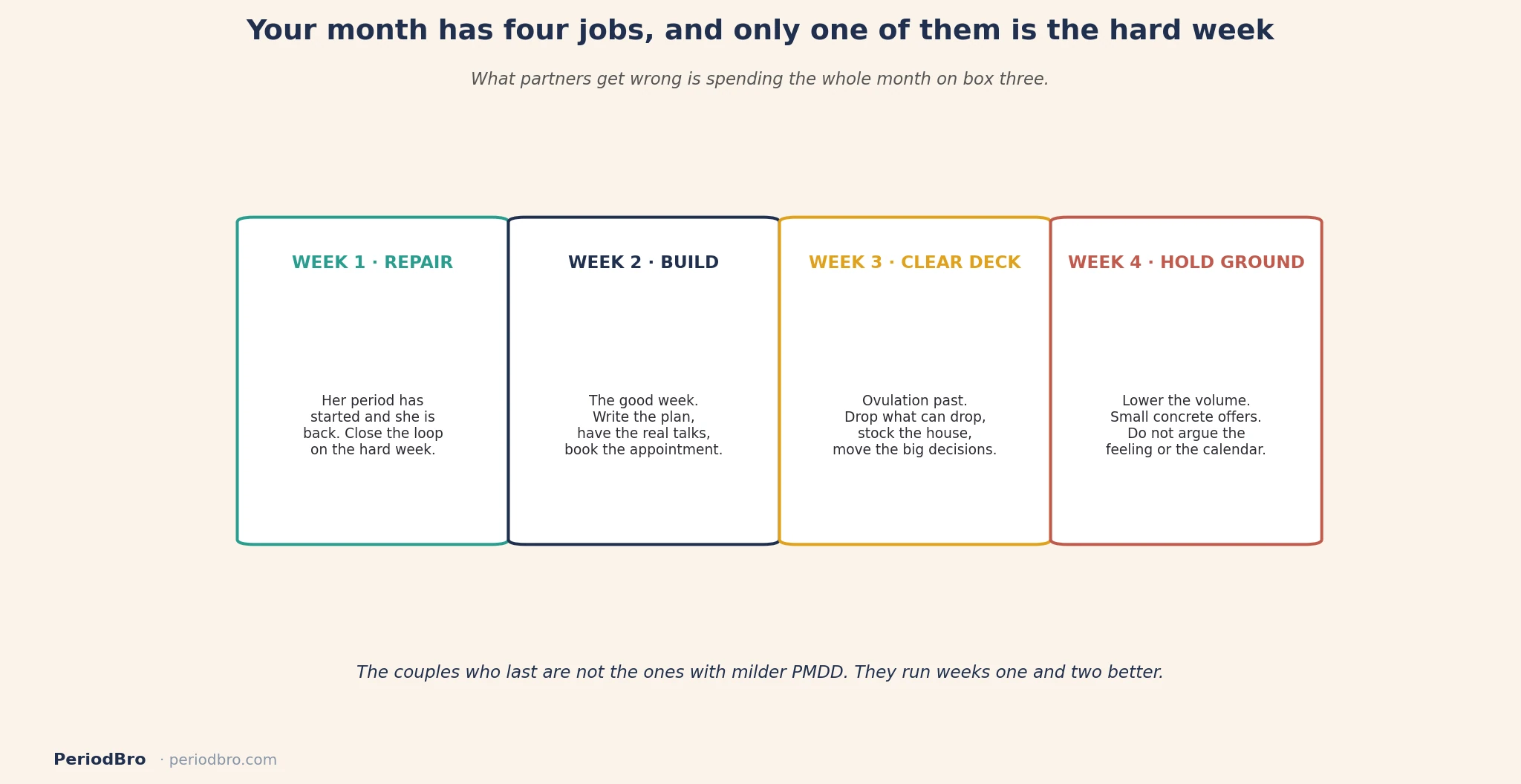
Week one, once her period has started and she is back, is for repair. Week two, the good week, is for building: the plan, the real conversations, the appointment. Week three, after ovulation, is for clearing the deck before the window opens. Week four is for holding the ground.
The weeks are approximate. Cycles run anywhere from 21 to 35 days and hers will have its own shape, which is the entire reason tracking beats guessing. But the sequence holds, and the sequence is what turns a recurring crisis into a routine you both know the steps to.
Week four: holding the ground
Inside the window your job shrinks to one thing: keep the ground steady. Fixing her mood is not on the list. Arguing her out of it is not on the list. Defending yourself line by line against every hard sentence is definitely not on the list.
What helps is lowering the volume of the household instead of raising it. Short concrete offers rather than open questions, because “what do you need” is a demand for executive function she may not have. “I am making tea, want one” is answerable. So is “I am doing dinner, do not think about it.”
Believing her is the other half. When she says the anger or the despair feels chemical and enormous, she is reporting accurately about her own experience, and the research backs the shape of what she is describing. The single most grounding thing you can offer is the opposite of reassurance: this is real, it has a name, and it is not your fault.
The list of things that make it worse is short enough to memorise. “Calm down” in any packaging, and quoting the calendar mid-argument. Taking the bait when she says something that sounds final. Following her into a room she has withdrawn to and demanding closeness, when withdrawal was the thing she needed. Matching her intensity, which is how one bad evening turns into a bad week.
The day-to-day version of all of this, with more of the practical texture, is in how to support a partner with PMDD without losing yourself and living with a partner who has PMDD. When the thing you cannot do is make the feeling stop, how to be supportive when you cannot fix it is the piece that reframes what support even means.
Week one: the repair nobody schedules
Here is the part that took us too long to understand, and it is probably the highest-leverage idea in this entire guide.
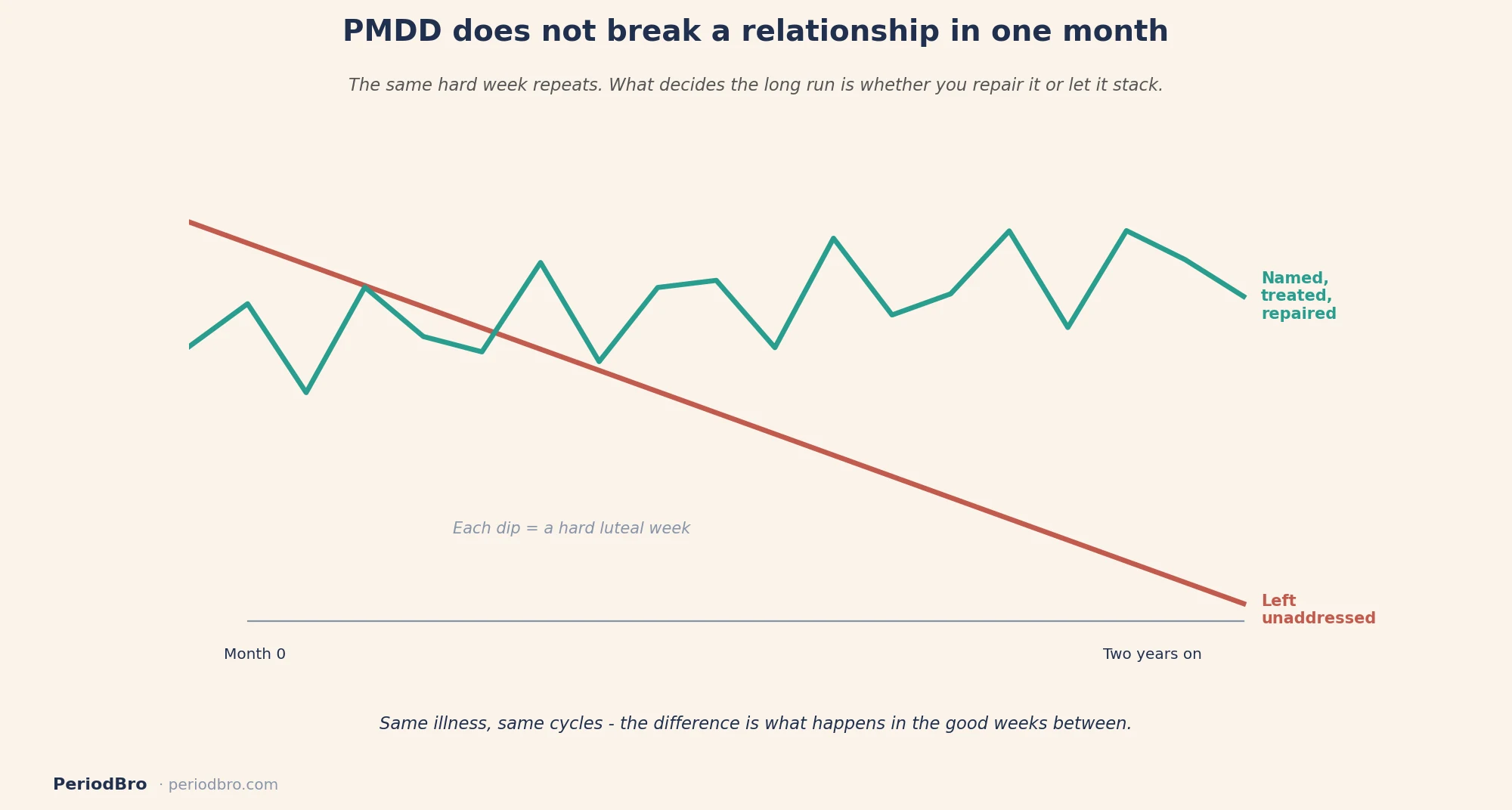
A single hard week does not end a relationship. What ends relationships is a hundred hard weeks that never got repaired. PMDD is cyclical, so the storm passes and she comes back to herself. If you use that return to reconnect, the month resets. If you spend the good week quietly stewing, or relitigating what she said at her worst, the resentment does not reset. It compounds.
So the shape of this over years is not a steady decline. It is a sawtooth: down in the luteal week, back up after her period, over and over. Whether the whole line trends up or down depends almost entirely on the recovery, not the crash.
Repair does not have to be a summit. Usually it is short and specific. Naming that the week was hard for both of you without assigning blame for it. Checking what helped and what did not, in the five-minute version rather than the post-mortem version. And, if something genuinely needs addressing, addressing it now, in the week where the conversation can actually land.
The couples still standing a decade in are not the ones with milder symptoms. They are the ones who treat week one as the repair window rather than the ceasefire before the next fight. We wrote that arc out in full in how PMDD affects a relationship long-term.
Not losing yourself in the helper role
Almost everything written about supporting someone with PMDD skips this, which is odd given the Durham data showed partners scoring in the problem range on support for caring. Loving someone with PMDD means absorbing a real, repeating strain. If you white-knuckle it in silence, you do not become a hero. You become resentful, then distant, then part of the problem.
So take your own maintenance as seriously as hers. Keep the friendships and the gym sessions and whatever else keeps you level, especially during her good weeks, so you enter the hard ones with a full tank. Have someone to talk to who is not her. Keep one or two things that are just yours, and do not treat “I absorbed all of it and said nothing” as the goal, because a partner who is quietly depleted is less useful than one who is honest about his limits in a calm week.
Boundaries are allowed, and they are not betrayals. “I love you, and I am not going to keep arguing at midnight” is a complete sentence. So is “I love you, and I am going to take a walk, and I will be back.”
Say true things kindly in calm moments. “That week is hard for me too, and I want us to have a plan” is not an accusation. And if the cycle is chewing through both of you, a couples therapist who knows premenstrual disorders is pit crew, not a verdict on the two of you. The trial data on couple-based CBT is the closest thing there is to formal permission for that.
The long run
The honest answer about the long haul is that it can go either way, and the thing that tips it is not how severe her PMDD is.
Start with the sobering part, because pretending it is easy helps nobody. A large prospective study following more than 15,000 women in Sweden over nine years found that those with severe premenstrual disorders had roughly a 20-plus percent higher risk of a relationship ending in separation or divorce (The Conversation, on the 2024 research). That is a raised risk, not a life sentence, and it is exactly the kind you can push back against once you know it is there.
What holds relationships together across years shows up repeatedly. They name it as the illness rather than as her, so the sharp words in a bad week do not get filed away as evidence. They back real treatment instead of white-knuckling, because tracking and a clinician and sometimes medication change the actual severity rather than just the mood in the room. And they repair every single time, rather than letting a hard week close without a conversation once she is back.
What erodes them is equally consistent: keeping score, absorbing everything silently until resentment leaks out sideways, treating every low mood as a personal attack, and refusing to bring in any help from outside the two of you. Enough of that and a strong bond wears through, not from one storm but from the slow drip.
The broader case for what cycle awareness does to a relationship over time, PMDD or not, is in how cycle awareness changes a relationship and how to be a better partner through her cycle.
The safety part, which is not optional
Skipping this to keep the article upbeat would be irresponsible, so here it is plainly. PMDD carries a suicide risk far higher than most partners realise.
In a global sample of 599 people with prospectively confirmed PMDD, 72 percent reported lifetime active suicidal ideation, 49 percent had made a plan, and 34 percent had attempted suicide. General population lifetime figures quoted in the same paper for comparison were 9.2 percent and 2.7 percent (BMC Psychiatry, 2022). That sample skews toward severely affected people who sought out research, so read it as the shape of the risk rather than a population rate.
A cleaner clinical figure comes from a separate study in which 39.1 percent of 110 women with confirmed PMDD had current suicidal ideation, with the elevated risk persisting in the 30 percent of participants who had no other psychiatric diagnosis, which suggests it tracks with PMDD itself rather than with comorbidity (Journal of Affective Disorders).
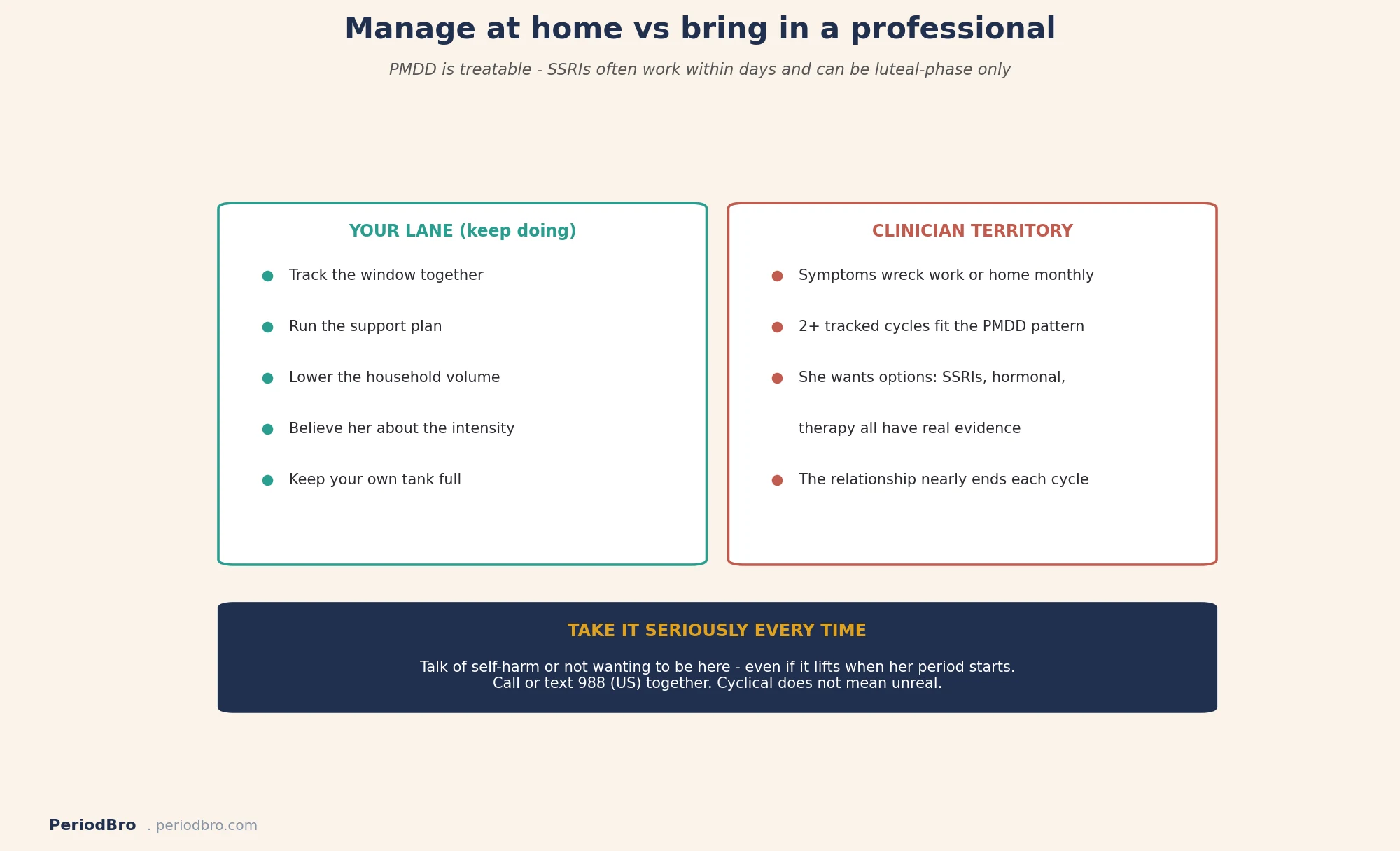
What this means in practice: if she ever talks about not wanting to be here, about being a burden, or about everyone being better off without her, treat it as urgent every single time, even if you know it tends to lift when her period starts. Do not wait for the next appointment and do not decide on her behalf that a bad luteal phase explains it. Cleveland Clinic lists severe depression or suicidal thoughts, thoughts of harming herself or others, and extreme anxiety or panic attacks as reasons to contact a provider.
In the US and Canada you can call or text 988 for the Suicide and Crisis Lifeline, any time, and you can do it together. In the UK and Ireland, Samaritans is 116 123. Anywhere else, use your local emergency number. Knowing where the line is does not mean you expect to cross it. It means you are not caught flat-footed if you do.
The other signals that it is time to push toward help rather than ride it out: no good week at all anymore, symptoms wrecking her work or the relationship, or either of you self-medicating to cope. Long-term struggle is usually a sign that the treatment plan needs attention, not that the relationship does.
What is not your job
A surprising amount of the damage partners do comes from doing too much rather than too little, so it is worth being explicit about where your lane ends.
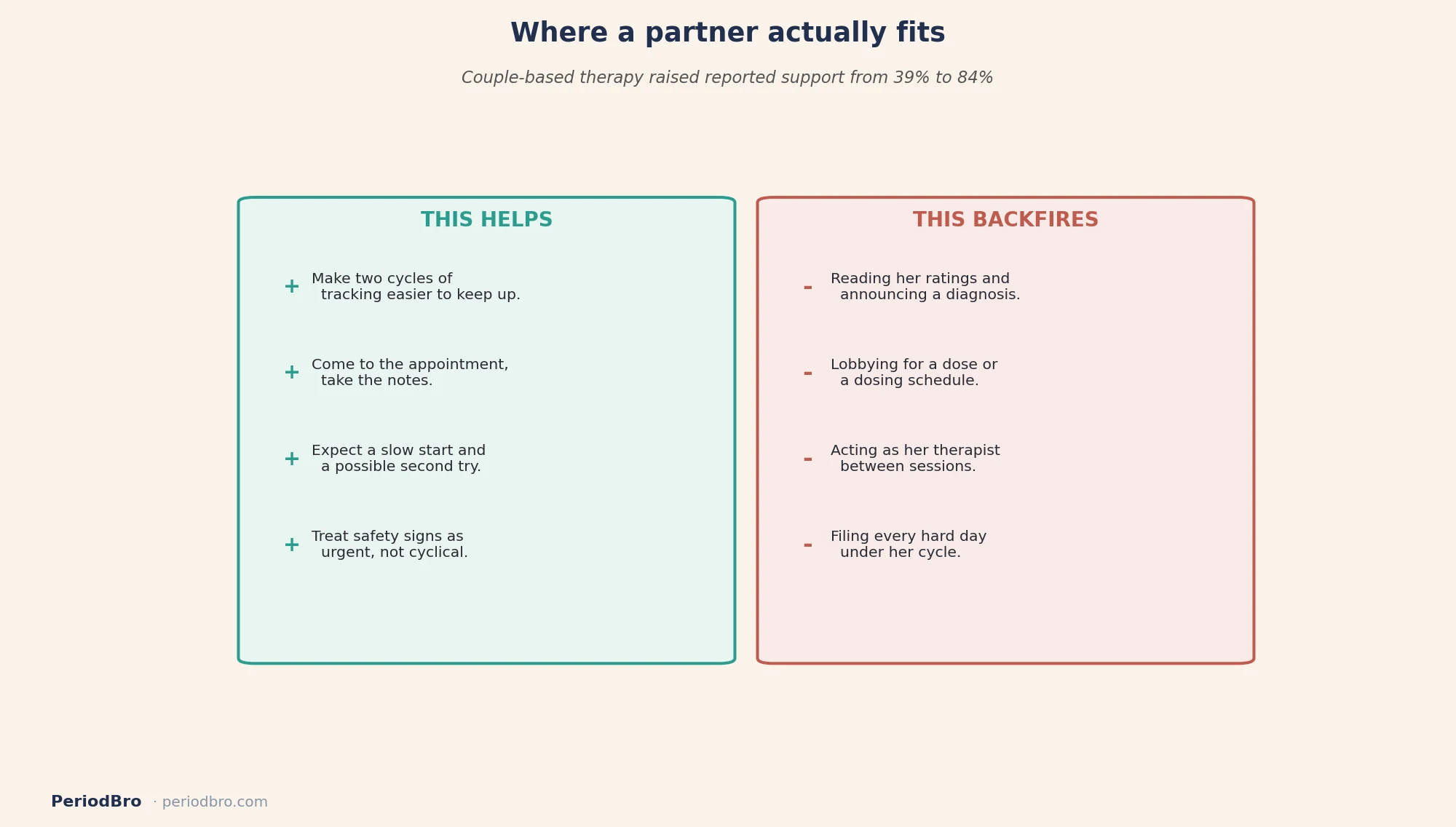
You do not diagnose. You do not read her daily log and announce a conclusion. You do not lobby for luteal-only dosing because you read a meta-analysis, and you do not suggest she stop something because month one did not feel different, given that placebo response in this condition runs at 36 to 43 percent and real effects sometimes need a second attempt. First-line does not mean first-try.
You are not her therapist either. The couple-CBT evidence supports partner involvement in structured therapy run by a clinician. It does not support you running sessions at the kitchen table, and the attempt usually costs you the thing you are actually good for.
What is in your lane is unglamorous and genuinely valuable. Make the two cycles of tracking easier to sustain. Go to the appointment if she wants you there and take notes so she is not carrying the whole conversation alone. Expect a slow start and a possible second attempt. Watch for the safety signs and treat them as urgent rather than cyclical. Lower the load in the window. Repair in week one. And keep every decision about starting, stopping or changing anything where it belongs, which is between her and her clinician.
If she has never named it
Plenty of people reading this are not supporting someone with a PMDD diagnosis. They are supporting someone who has a very hard week every month that nobody has ever put a word to. Raising it is delicate and worth doing carefully.
Timing first: never mid-window. Bringing up a psychiatric label during the worst three days of her month will land as an accusation no matter how gently you phrase it, and you will not get a second attempt for a while.
In a good week, lead with the pattern rather than the label. “I have noticed the same stretch is really hard every cycle, and I hate that you go through it alone. Would it help to track it together and see if there is a pattern?” That is a question about her experience. “I think you have PMDD” is a verdict, and you are not qualified to deliver it.
Expect that she may already know, or already suspect, and may have been dismissed before. A lot of women have taken cyclical mood symptoms to a clinician and been handed a generic depression label or told it is normal. If she has been told before that it is just depression but she can see it lift every month, that observation is exactly what is worth raising, log in hand.
And if tracking is part of the conversation, the consent piece matters more than the tool. Tracking her cycle is support when she knows and it is in service of preparing. It is surveillance when it is not. We drew that line carefully in tracking her cycle with consent and should you track your partner’s cycle.
Six things you will read that are not true
PMDD content online is a mix of good clinical information and confident nonsense, and the nonsense is usually more shareable. Here is the short list of things worth dropping.
“PMDD is just bad PMS.” It is a distinct diagnosis with formal criteria, filed under depressive disorders, requiring five or more symptoms including a core mood symptom, confirmed across two cycles. PMS has no formal psychiatric diagnosis. The distinction is the entire reason a diagnosis exists.
“Her hormones are out of balance.” This one is everywhere, including in places that should know better, and the research points the other way. Hormone levels in PMDD are typically normal. The difference is in how the brain responds to normal fluctuation, which is why “balancing her hormones” is not a coherent treatment goal and why products sold on that premise are selling a story.
“She can manage it with diet and yoga.” Lifestyle levers are real and worth doing, and they are not a substitute for treatment in a condition with these suicide statistics. Exercise came out well in a meta-analysis where 87 percent of the trials were at high risk of bias. That is a reason to move, not a reason to skip the clinician.
“Chasteberry fixes it.” The pooled effect looks impressive until you notice heterogeneity at 91 percent, most trials at high risk of bias, and the review authors describing their own finding as exploratory and at best an overestimate. RCOG says that beyond evening primrose oil for breast tenderness there is little evidence supplements are effective.
“If the first treatment did not work, nothing will.” Placebo response in premenstrual disorders runs at 36 to 43 percent, which cuts both ways: month one feeling better is not proof, and month one feeling the same is not a verdict. First line does not mean first try, and the ladder has several rungs.
“You just have to be patient.” Patience without a plan is how a decade goes by. The Swedish cohort showing raised separation risk, and the Durham data showing partners in the problem range on support for caring, both describe what happens when couples endure rather than treat. Endurance is not the strategy. It is what people do instead of one.
If it is your daughter, not your partner
Some of the people reading this are fathers, not partners, and the shape of the job is different enough to be worth its own section.
PMDD can start any time after periods begin, and adolescence is where it is most likely to be dismissed, because dramatic mood swings in a teenager are exactly what everyone expects to see. That expectation is the problem. The question that separates ordinary teenage volatility from something cyclical is the same question as everywhere else in this guide: does it arrive after ovulation and clear after her period, month after month. If nobody is tracking, nobody can answer it.
Your practical job is smaller than a partner’s and in some ways harder, because a teenager is not going to run a daily symptom log because her dad suggested it. What you can do is take the pattern seriously out loud, avoid the word “hormonal” as an explanation for anything, and get her in front of a clinician who will treat cyclical mood symptoms as a real question rather than as adolescence. We covered the day-to-day of that in teenage daughter mood swings: a dad’s guide, and the appointment side in when should a girl see a gynecologist.
Two things to hold onto. First, the safety section above applies with more force, not less, given adolescent risk generally. Any talk of self-harm is urgent regardless of where she is in her cycle. Second, if she has another parent or an adult woman in her life she would rather talk to about this, that is a good outcome and not a failure on your part. Your job is to make sure the question gets asked by someone, not to be the one who asks it.
Where we fit, and where we do not
Disclosure, since it would be strange not to: we build PeriodBro, a cycle-awareness app for partners, so read this section as the interested party talking.
Daily logging is the least glamorous thing we could possibly talk about, and for PMDD it is the one that matters most, because a diagnosis runs on it. What an app can do is make two months of daily ratings less of a chore, and put the window on your calendar so you stop being ambushed by the same week twelve times a year. What it cannot do is diagnose anything, replace the DRSP, or tell you what a given day means.
We would rather the log live somewhere she controls and trusts than nag her about a feature. If a paper diary or a free app works better for her, that is a completely fine answer, and if you want the honest comparison of what is out there we keep one at the best period tracker apps for partners.
Questions partners actually ask
Is the PMDD week the real her?
No, and it is not fake either. The kindest accurate frame is that it is her, under a neurochemical load you will never feel firsthand. The feelings in the window are real feelings. The conclusions drawn inside it are unreliable, and she would usually be the first to say so afterward.
Can a relationship survive PMDD?
Plenty do, for decades. The Durham data found love and commitment holding at control levels even while satisfaction, intimacy, trust and passion took a hit, and the Swedish cohort found a raised risk of separation rather than a guarantee. The couples who last are not lucky, they are deliberate.
Can PMDD be cured?
Managed, often very well. Between tracking, SSRIs, hormonal options and therapy, most couples can shrink the blast radius substantially. What does not work is assuming next month will be different on its own.
Does PMDD get worse over time?
The illness tends to track her cycle and her overall health. What can get worse is the relationship strain around it, if hard weeks pile up without repair. Handled well, many couples find the opposite: they get better at it, and the bad weeks lose their power to frighten either of you.
Is it normal to feel resentful sometimes?
Yes, and pretending otherwise is how resentment goes underground and turns toxic. The healthy move is not to feel nothing, it is to have somewhere to put it, a friend or a therapist or a journal, so it does not leak out sideways during a week she is already struggling.
Should I be the one to bring up PMDD with her?
Carefully, in a good week, and never mid-window. Lead with the pattern, not the label, and let a clinician do the diagnosing.
Is it wrong to track her cycle so I can see the window coming?
Not if she knows and it is in service of preparing rather than policing. Knowing the window is coming lets you plan instead of react. Using it as an argument-winner is how you lose the tool entirely.
Why do SSRIs work in days for PMDD when they take weeks for depression?
Because something different is going on. The 2024 Cochrane review notes effects within days to weeks for premenstrual disorders, with some trial data putting onset inside 24 to 48 hours, which is also why luteal-only dosing is even possible.
She got a positive result on an online PMDD screener. Is that a diagnosis?
No. That is a provisional result, and provisional estimates run several times higher than confirmed ones for exactly this reason. It is a good reason to start tracking properly and to book an appointment.
Her hard week does not line up neatly with the textbook. Does that rule it out?
Cycles run from 21 to 35 days and hers may not look like the diagram. What matters is not day numbers, it is whether the pattern arrives after ovulation and clears after her period. If it never clears, that is worth raising, because it points somewhere else.
The short version
PMDD is a severe, cyclical mood disorder tied to the luteal phase, filed under depressive disorders in the DSM-5. Her hormones are normal; her brain’s response to them is not. Confirmed prevalence is around 1.6 percent, and the bigger numbers you will read are screening estimates that recall inflates.
The signature is timing, not intensity: symptoms arrive after ovulation, ease within days of her period starting, and clear in the week after. Diagnosis runs on two cycles of prospective daily tracking, because memory is not reliable enough. Treatment works, with SSRIs first line and often fast, a drospirenone pill as the other first-line route, therapy as a real option, and the invasive end genuinely reserved for last.
Your month has four jobs and only one of them is the hard week. Build the plan in week two, clear the deck in week three, hold the ground in week four, and repair in week one. Protect yourself well enough to do it again next month. Take any talk of self-harm as urgent, every time. And keep the medical decisions where they belong.
You cannot take PMDD away from her. You can take away the ambush, the loneliness, and the monthly damage control, and that turns out to be most of what she needed.
This article is general information for partners, not medical advice, and it does not diagnose anyone. PMDD is a clinical diagnosis that requires prospective symptom tracking and a qualified clinician, and all treatment decisions belong to the patient and her clinician. This piece discusses suicide and self-harm: if you or your partner are in crisis, call or text 988 (US and Canada), call Samaritans on 116 123 (UK and Ireland), or contact your local emergency services.