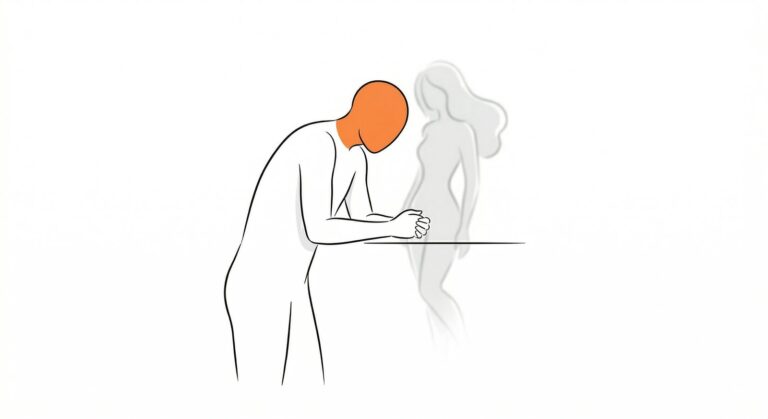

How to Handle PMS Arguments: A Calmer Playbook for the Hard Week
If you’re trying to figure out how to handle PMS arguments without making them worse, the first thing to know is this: most of the worst fights I’ve had with the women in my life followed a pattern I didn’t see for years. Same arguments, same week of the month, same dead-end. I’d come away convinced I had a relationship problem. I had a calendar problem.
Late-luteal arguments are common enough that almost every man in a long-term relationship has them, and most of us never notice the rhythm. The fights feel like proof of something. They’re not. They’re proof that her body is doing what it does, and that you, having no plan, react to it the same way every time.
This is how to handle those arguments differently — before, during, and after.
How to Handle PMS Arguments: The 30-Second Version
Three rules cover most of how to handle PMS arguments without making them worse:
- Don’t initiate hard conversations in her late-luteal window. Postpone the discussion of in-laws, money, kids, plans. Save it for the week after her period starts.
- When a fight does start, don’t try to win it. Slow down, acknowledge the feeling before defending the fact, and aim for a pause — not a resolution — in the moment.
- Never say “you’re just PMSing.” Even if it’s accurate, weaponizing her cycle in the middle of a fight turns a one-day argument into a three-day one.
The rest of this article unpacks each of those.
Why Fights Cluster in the Week Before Her Period
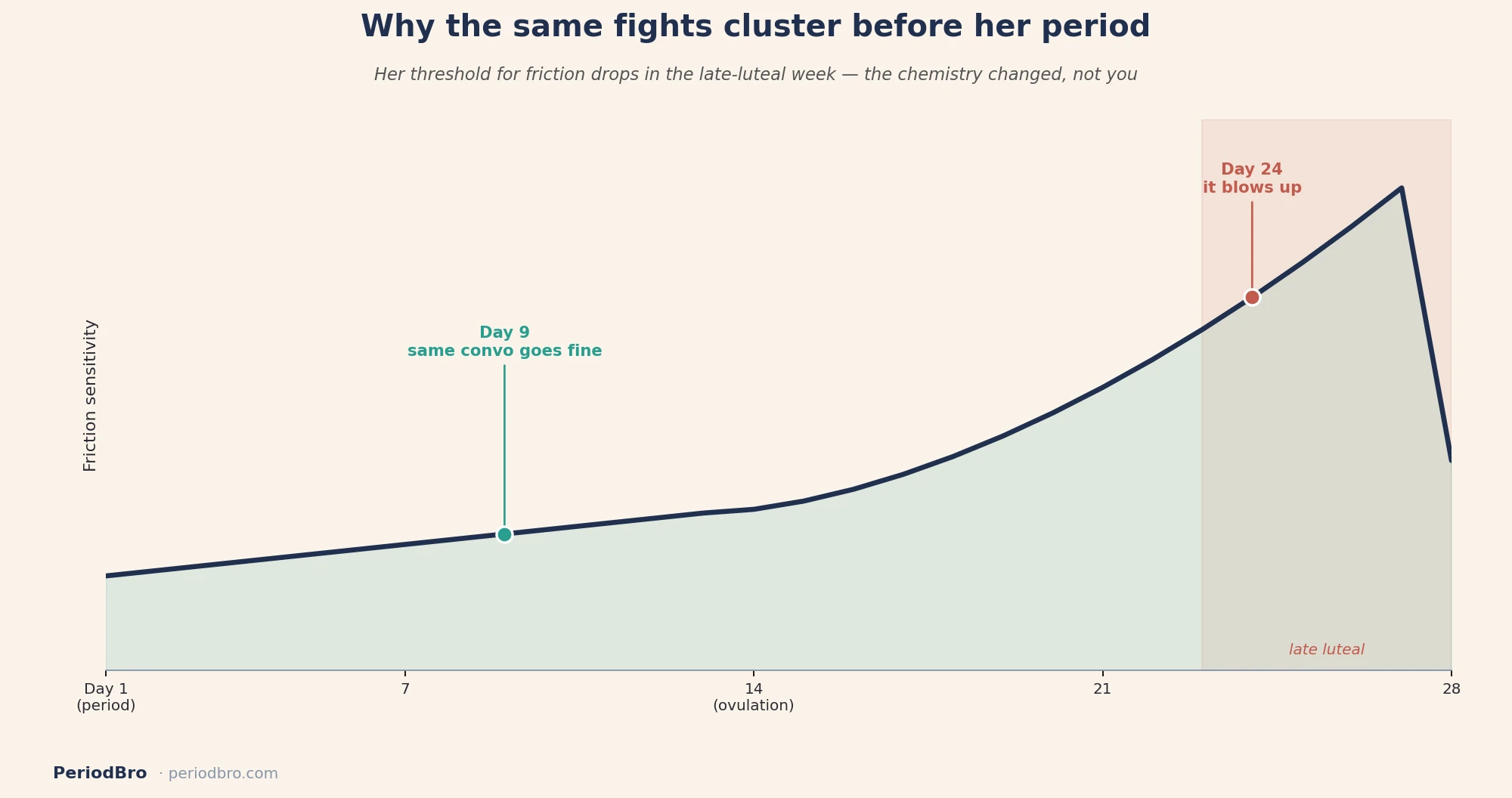
In the days leading up to menstruation — the late luteal phase, roughly the last five to seven days of her cycle — progesterone and estrogen drop sharply. Per ACOG’s guidance on premenstrual syndrome, this hormonal shift affects neurotransmitter systems, particularly serotonin, which is implicated in mood, irritability, and emotional sensitivity.
What this means in practice: she’s not “looking for a fight.” Her threshold for what registers as a problem has dropped, and her capacity to absorb friction is lower than it was last week. The same conversation that went fine on Day 9 of her cycle can blow up on Day 24. You haven’t changed. The chemistry has.
For deeper background, here’s the luteal phase explained and a piece on understanding PMS for men covering why she’s not actually mad at you when this happens.

(For the in-the-moment diagnostic — the 3 signals to check in the first 90 seconds — see how to handle arguments before her period: the 90-second read. This piece is the playbook; that one is the live read.)
Before the Argument: Setting the Week Up to Fail Less

Most of the work in how to handle PMS arguments happens before any fight starts.
1. Know when the window is. You don’t need an app. Note the day her period starts. The hard window is roughly the seven days before that date. Mark it mentally. Plan around it.
2. Don’t schedule hard conversations during the window. The discussion about the in-laws, the move, the money, the kid stuff — all of it lands better on Day 10 than Day 25. If the conversation can wait a week, let it.
3. Lower your standard for what counts as a “thing.” If she’s quieter than usual, snappier, more tired — that’s the chemistry, not a message. Don’t ask what’s wrong every twenty minutes. Don’t take quiet as criticism.
4. Pre-handle whatever you can. The dishes, the groceries, the small errands. Friction during her hard week feels twice as heavy. Absorbing the small stuff without comment buys both of you a calmer week.
None of this is doormat behavior. It’s the same calibration you’d do if your business partner was having a brutal sprint at work — you don’t pick this week to ask for a raise.
During the Argument: What to Actually Do

If you’re already in it, here’s how to handle PMS arguments in the moment.
Don’t say “you’re just PMSing.” Ever. Even if it’s true. Reducing her to her hormones in the middle of a fight is the single fastest way to turn a one-day argument into a three-day one. She knows where she is in her cycle. She doesn’t need you to weaponize it.
Slow down your responses. Whatever you were about to say in two seconds — wait ten. The argument is moving fast because emotional reactivity is high on both sides. You can be the slower one. It almost always helps.
Acknowledge the feeling before defending the fact. “I hear that you’re frustrated” before “but the thing I said was actually X.” If you skip the first half and lead with defense, the argument escalates. The order matters even when you’re factually right.
Don’t try to win. Late-luteal arguments very rarely resolve in the moment. The most productive outcome is usually a pause — “let’s come back to this tomorrow when we’ve both slept.” Coming back to it the next day, or two days later when she’s started bleeding and the chemistry has shifted, is when the actual conversation can happen.
Apologize for the small thing even if you don’t get the big one. If she’s mad about something you genuinely think was small, you can usually still find something inside it to honestly apologize for — your tone, your timing, the way you phrased it. That partial apology often lets her step down. Refusing to give an inch because you think she’s overreacting is choosing to fight instead of de-escalate.

After the Argument: How to Come Back to It

Once the hormonal window has shifted — usually once her period actually starts and progesterone is no longer dropping — you can revisit. This is the conversation worth having.
A few rules:
- Don’t blame the cycle. “You were being unreasonable because of PMS” is a guaranteed second fight. The first fight was about something. Find what was actually under it.
- Lead with curiosity, not accusation. “I want to understand what was going on for you earlier this week” works. “I want to talk about what you said” doesn’t.
- Bring your own piece. Even if 80% of the friction came from her side, find the 20% that’s yours — the tone you used, the timing, the thing you assumed instead of asked. Owning your share unlocks her ability to own hers.
- End with something forward-looking. “How can we do this week differently next month?” The pattern repeats. The plan to handle it doesn’t have to.
When the Argument Isn’t About the Cycle
This is the part most “cycle awareness” articles skip and it matters more than the rest.
Sometimes the fight in the late luteal week is real. The hormonal context makes the disagreement bigger and faster, but the disagreement itself is legitimate. The danger in how-to-handle-PMS-arguments advice is using it as a way to dismiss anything she says during that window. Don’t do that.
How to tell the difference:
- If she’s bringing up the same thing across multiple cycles — that’s a real issue. Hormones don’t invent grievances; they amplify existing ones.
- If she’s bringing it up calmly outside the window, too — that’s a real issue. Listen.
- If you find yourself saying “you only feel this way when you’re PMSing” — stop. That’s a tell that you’re using cycle awareness to avoid a conversation you should be having.
The right use of cycle awareness is “I’ll handle the timing of this conversation better.” The wrong use is “her concerns don’t count this week.”
FAQ
Why does she get so angry the week before her period?
In the late luteal phase (the last five to seven days before menstruation), progesterone and estrogen drop, which affects neurotransmitter systems including serotonin. Per ACOG, this can produce irritability, emotional sensitivity, and a lower threshold for friction. She’s not choosing to be angrier; her capacity to absorb stress is temporarily lower.
Should I tell her I think it’s her PMS?
No. Mid-argument, saying “this is just PMS” virtually always escalates the fight. She already knows where she is in her cycle. Use the knowledge to calibrate your own behavior — slow down, de-escalate, postpone the hard conversation — but don’t make her hormones a debate point.
What if she wants to talk about something during her hard week and I think we should wait?
If she’s bringing something up calmly and wants to talk, talk. The “wait a week” rule is for you deciding when to initiate hard conversations, not for shutting hers down. Listen, slow yourself, don’t try to resolve everything in one sitting.
Is it okay to keep my distance during her hard week?
Distance and absence are different things. Steady, low-key presence — handling the household, being available without hovering, not making the week about you — is the goal. Disappearing or going silent is read as withdrawal and usually makes the week worse.
What if the same argument keeps coming back every month?
That’s a sign there’s a real underlying issue, not just a cycle issue. The hormones may be amplifying it, but they’re not inventing it. Pick a calm, mid-cycle window and have a deliberate conversation about what’s actually under the recurring fight.
One Last Thing
The single biggest unlock in how to handle PMS arguments isn’t a tactic — it’s the framing. Once you understand that the fight clusters around predictable days, you stop treating each one as evidence of a doomed relationship. You start treating them as weather. You don’t try to argue with the rain; you put on a jacket.
PeriodBro tells you, plainly, when her hard window is starting — so you stop initiating decisions during it and start handling friction more deliberately. Start with PeriodBro →
PeriodBro provides educational information and is not a substitute for professional medical or relationship advice. If conflict in your relationship is constant, severe, or includes any abusive dynamic, the cycle is not the issue — please talk to a qualified therapist.