
How to Be a Better Partner Through Her Cycle: The Complete Playbook
For a long time, almost everything I did to support my partner happened in the same week of the month. The week she had her period, I’d notice, soften up, bring home the things she liked, take a few chores off her plate. The other three weeks I mostly ran on autopilot. It wasn’t that I didn’t care the rest of the time – I just hadn’t thought of support as something with a shape, so it pooled around the one part of the cycle I could see.
The thing that made it easier was small. Once I started paying attention to the whole month instead of one week of it, the support I already wanted to give had somewhere to go. Less guessing, fewer wrong moves at the wrong time. That’s all this guide is: a clear, practical take on how to be a better partner through her cycle – showing up across the whole month, phase by phase, plus what to do when it gets hard. You already care. This is just where to put it.
What this guide covers
We’ll go through four things. First, why thinking across the whole month beats reacting to the one visible week. Then the practical core: what good support actually looks like in each phase of the cycle. After that, the harder moments – conflict, space, and pain – which is where most of us fumble even when our intentions are fine. And finally the quieter stuff that holds it all together: how to talk about any of this without making it weird, and how to pay attention to her cycle without it turning into surveillance.
If you only want one phase or one situation, every section links down to a deeper guide on that specific thing. Treat this page as the map and follow the links to the detail you need.
Support works better spread across the month
Most support naturally clusters around her period, and that makes sense – the period is the visible part. It’s the part with a clear start, a clear set of needs, and a clear way to help. So that’s where attention lands.
The other three weeks aren’t empty, though. Her energy, mood, sleep, and appetite shift across the whole cycle, driven by hormones that rise and fall on a fairly predictable schedule (Cleveland Clinic). There’s a high-energy stretch after her period where she’s likely up for plans and big conversations. There’s a calmer, more inward stretch in the back half where small frictions land harder. None of that shows up the way a period does, so it’s easy to miss – not because you don’t care, but because nobody points to it.
Widening the lens to the whole month just gives the care you already have somewhere to land all month. You stop concentrating everything into one week and start matching what you do to where she actually is. The payoff is concrete: fewer wrong moves at the wrong time, fewer hard conversations scheduled on a bad day by accident, and a lot less walking-on-eggshells guesswork. (For the biology underneath all of this, the complete menstrual cycle guide for men covers what each hormone is doing; for the mindset side, cycle awareness for partners covers why paying attention this way changes the relationship.)
One guardrail before we go further. This is not about reducing her to her hormones or “managing” her mood. Nobody wants their feelings explained away with “you’re just premenstrual,” and that’s not what any of this is for. The goal is the opposite: understand the rhythm well enough that you stop taking the wrong things personally and start offering the right kind of help at the right time. Used well, paying attention makes you steadier, not more dismissive.
A simple rhythm you can actually run
The phase summaries below are useful, but they can feel like a lot to hold in your head. In practice it collapses into a short, repeatable rhythm, and once it’s a habit you stop thinking about it as “tracking her cycle” and just experience it as knowing your partner well.
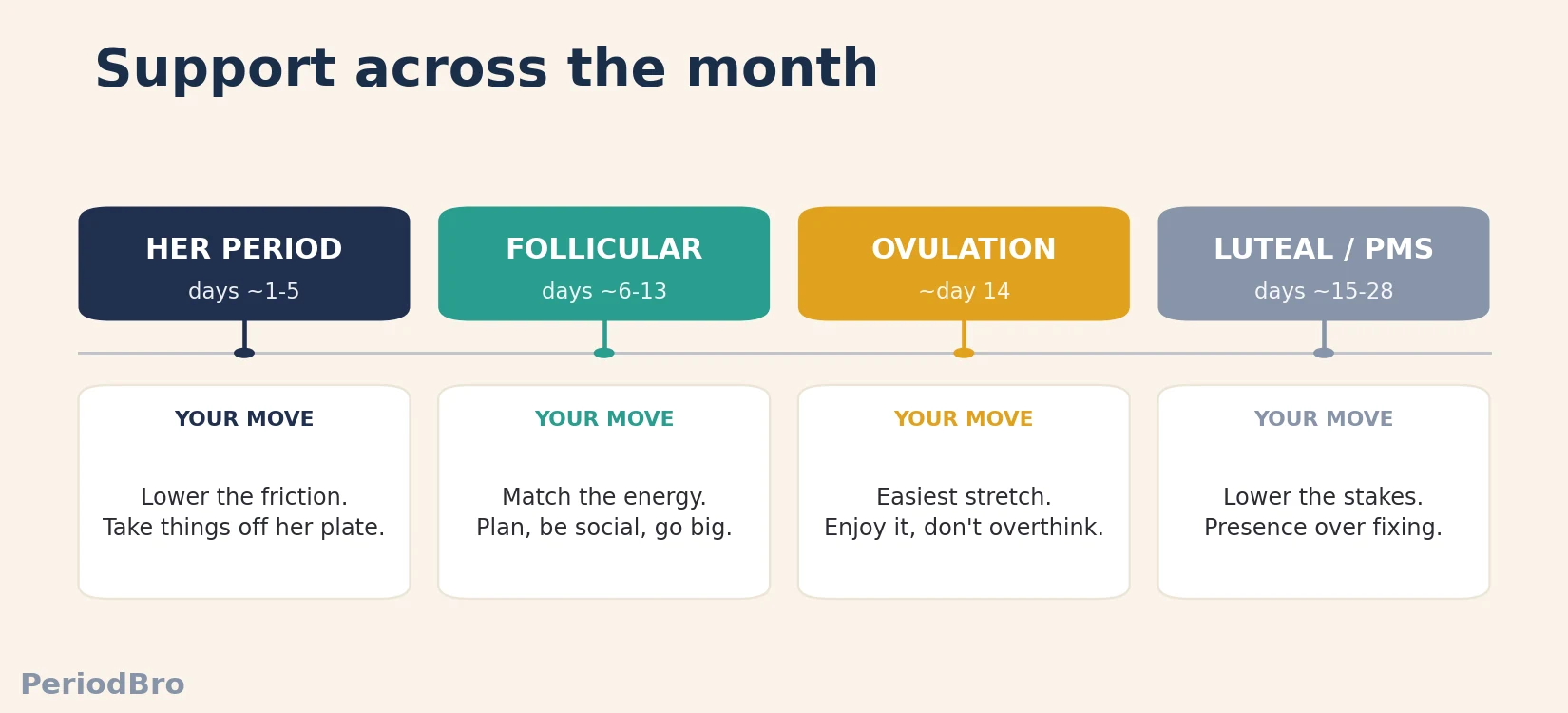
Think of the month in four moves. During her period, the move is to lower friction – take things off her plate, default to warmth, don’t make her manage you. In the week or so after, when energy tends to climb, the move is to match it – this is when to plan, do the social thing, and bring up anything that needs her at full strength. Around mid-cycle, when things are often easiest, the move is mostly to enjoy it and not overthink it. In the back half, especially the few days before her period, the move is to lower the stakes – postpone what can wait, keep your fuse long, and trade problem-solving for presence.
That’s the whole rhythm. Four moves, looping every few weeks. You don’t need an app to run it, though a quiet reminder of where she is in the month makes it easier to anticipate instead of react – which is exactly the part that’s hard to do from memory.
A few things make the rhythm stick. Pick the one or two phases where your current default does the most damage and fix those first – for most partners that’s the premenstrual week, where the autopilot move (engaging every friction head-on) is precisely the wrong one. Don’t try to overhaul everything at once. And give it a couple of months before you judge whether it’s working; you’re building a read on a pattern, and patterns take a few cycles to see clearly.
What good support looks like in each phase
Here’s the operational core. Each phase below is a short summary of what’s happening and what tends to help, with a link down to the full guide if you want the detail. You don’t have to memorize day numbers – cycles vary, and hers may not match the textbook 28-day version, which is normal (Cleveland Clinic). The point is the pattern, not the calendar.
During her period: lower the friction
This is the stretch you probably already read well. Estrogen and progesterone are at their lowest, energy often dips, and for some people cramps are genuinely painful – the result of the uterus contracting to shed its lining, driven by compounds called prostaglandins (Cleveland Clinic). Not a figure of speech, not “a little uncomfortable” for everyone.
What helps here is rarely dramatic. Take something off her plate without being asked – dinner, an errand, the kid logistics. Warmth helps cramps physically; so does not having to manage you on top of everything else. The move is to quietly do the thing, not to announce it.
A small amount of preparation goes a long way. Knowing the period’s roughly coming lets you stock the things she likes, keep the heating pad findable, and clear your own calendar of anything you’d resent giving up. None of it is grand. The partner who has the painkillers she prefers already in the drawer is doing more real support than the one who delivers a heartfelt speech and then asks where the ibuprofen is. (Full detail: how to support your girlfriend on her period, how to help with period cramps, and the best foods to have at home before her period.)
Follicular and ovulation: match the energy
After the period, estrogen climbs as the body prepares to release an egg, and for a lot of people this is the higher-energy, more outgoing stretch of the month (Cleveland Clinic; Endotext). Around mid-cycle, that rising estrogen triggers a surge of luteinizing hormone, which causes ovulation, with testosterone also at a relative high around this window – which for many people means more drive and more sociability (Cleveland Clinic; Endotext).
The move here is simple: match it instead of lagging behind it. This is the natural window for the trip, the ambitious plan, the social thing, the bigger conversation you’ve been meaning to have. If you tend to default to low-key, this is the part of the month worth leaning into. (Full detail: how to plan date nights around her cycle.)
The luteal and premenstrual week: lower the stakes
After ovulation, progesterone takes over. If no pregnancy happens, progesterone and estrogen drop sharply in the last few days before her period, and that drop is what drives PMS (Endotext; Cleveland Clinic). The premenstrual stretch can bring irritability, low mood, fatigue, bloating, and a shorter fuse for some people – though by no means everyone, and the intensity varies a lot (ACOG).
This is the week worth getting right, because it’s the one most easily misread as “she’s upset with me.” The move is to lower the stakes: postpone the fights you can postpone, don’t take a short fuse personally, and resist the urge to fix the mood. Presence beats problem-solving here. (Full detail: understanding PMS and how to handle PMS arguments.)
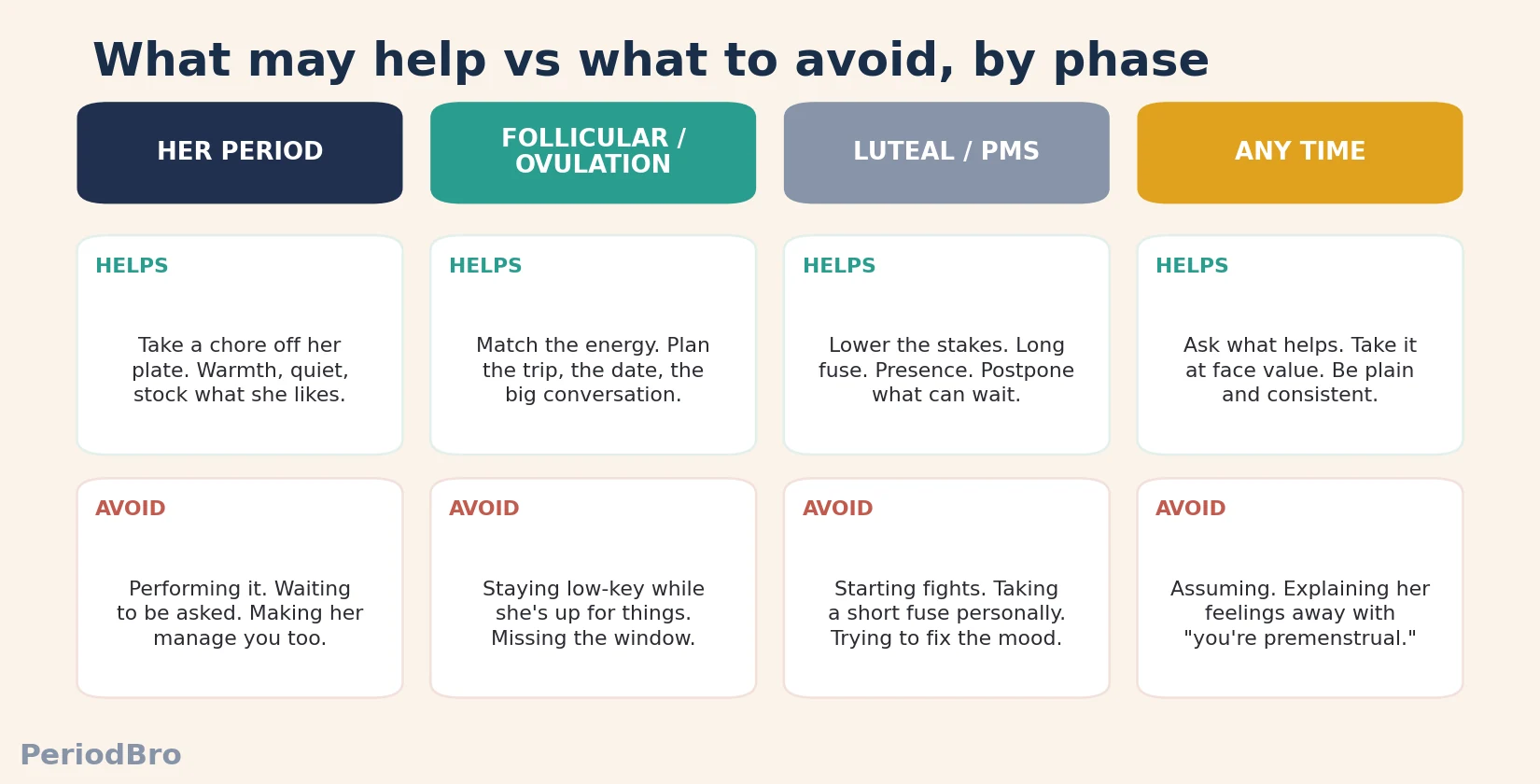
A quick reality check on phases: these are population patterns, not laws. Some people barely notice their cycle; others feel every shift. Cycle length varies, the back half is more consistent than the front half, and two people can have completely different premenstrual weeks (Cleveland Clinic). Use the pattern as a starting hypothesis you confirm by paying attention to her specifically, not a script you impose on her. The fastest way to get good at this is to watch what’s true for her over two or three months and adjust – the textbook gives you the shape, she gives you the detail.
Handling the hard moments without making them worse
Most of us can manage support when things are calm. The places we fumble are the harder ones – when she’s upset, when she pulls away, when she’s in pain and there’s nothing to fix. These deserve their own section because the instinct that serves you everywhere else (do something, solve it) often backfires here.
When she’s upset or short with you
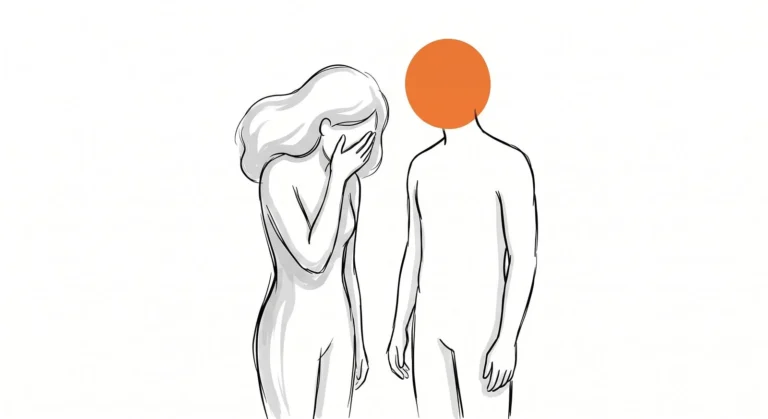
The first job is to figure out whether this is about you or about timing, and the honest answer is often “neither, exactly.” During the premenstrual stretch, a smaller thing can land harder, and a short fuse is frequently a physiological state rather than a verdict on you or the relationship (ACOG). That doesn’t mean you ignore real problems – it means you don’t escalate a hard-week moment into a referendum on the relationship.
The practical move is to slow down rather than match her heat. Don’t litigate who’s right in the moment. Acknowledge what she’s feeling, give the conversation room, and come back to the substance when the temperature drops. Most fights that feel urgent at 9pm on a hard-week evening look very different the next morning, and almost nothing real is lost by waiting for that morning.
It helps to separate the content of a disagreement from its timing. If there’s a genuine issue, it’ll still be there in a few days, and you can raise it when you’re both steadier – that’s not avoidance, it’s choosing your moment. What you want to avoid is letting a difficult week turn small things into big ones, because the resentment from a badly-timed fight outlasts the fight. (Full detail: how to handle PMS arguments and the quick version, how to handle arguments before her period.)
When she needs space
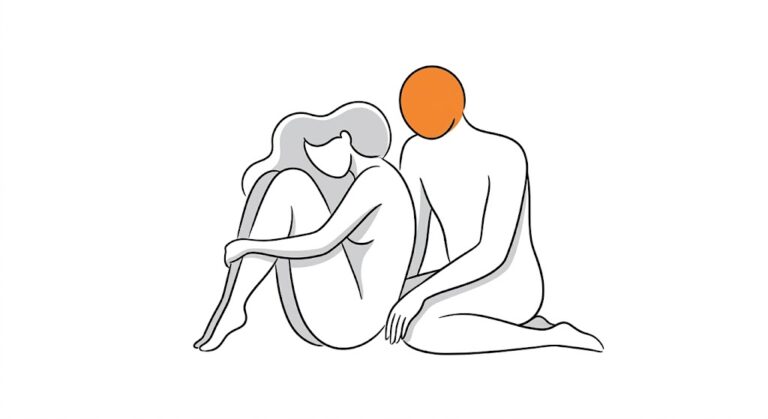
This is the one that trips up partners who genuinely want to help, because “help” and “space” can feel like opposites. They’re not. Pulling back when someone asks for room is a form of support – as long as you pull back without disappearing or sulking about it.
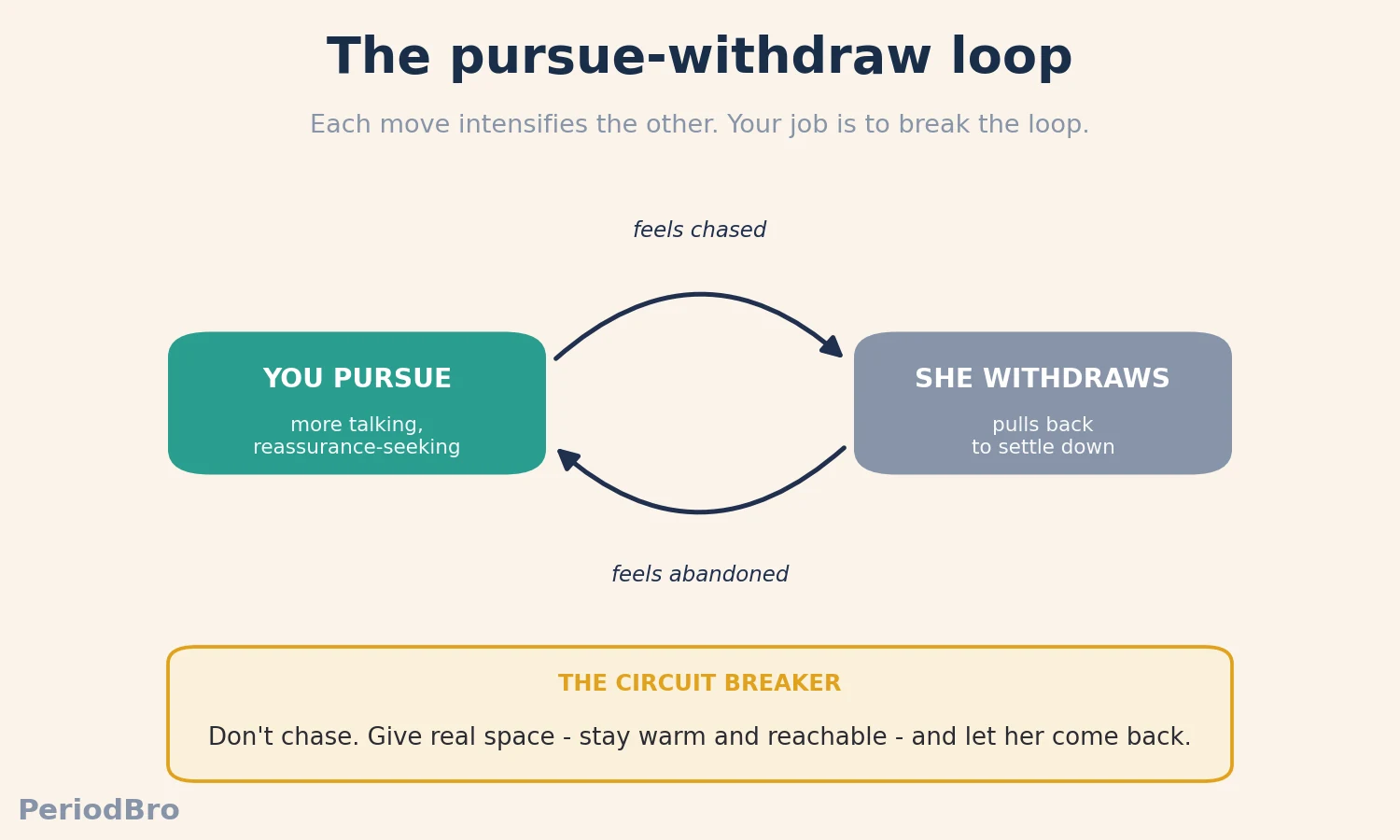
There’s a well-documented relationship pattern researchers call pursue-withdraw, or the pursuer-distancer dynamic: one partner moves toward conflict to resolve it, the other moves away to settle down, and each one’s move intensifies the other’s (The Gottman Institute). If you tend to be the pursuer – more talking, more reassurance-seeking, more “are we okay?” – the most useful thing you can do when she needs space is to not chase. Give the room, stay warm, stay reachable, and let her come back.
The distinction that matters is between giving space and withdrawing. Withdrawing is space with a charge on it – the silent treatment, the visible sulk, the message that you’re hurt and she should feel it. That’s not room, it’s pressure wearing room’s clothes, and she’ll feel the difference immediately. Real space is light: you back off the topic, you stay normal and available, and you make it clear without saying so that you’re not keeping score. A simple “take whatever time you need, I’m here” and then actually meaning it does more than any amount of working the problem. (Full detail: how to give her space without making things worse.)
When she’s in pain and you can’t fix it
Cramps, headaches, the bone-tired days – sometimes there’s no fix available, and that’s hard for a problem-solver to sit with. The instinct is to suggest remedies, and a few are genuinely worth offering (heat, rest, the painkiller she likes, taking tasks off her). But past the basics, the most useful thing is usually just presence: being there without turning her pain into a project to manage.
“Is there anything I can do, or do you just want me here?” is a better opening than a list of solutions she didn’t ask for. Sometimes the answer is “here,” and that’s a complete answer. (Full detail: how to be supportive when you can’t fix her pain.)
How to talk about it without making it weird
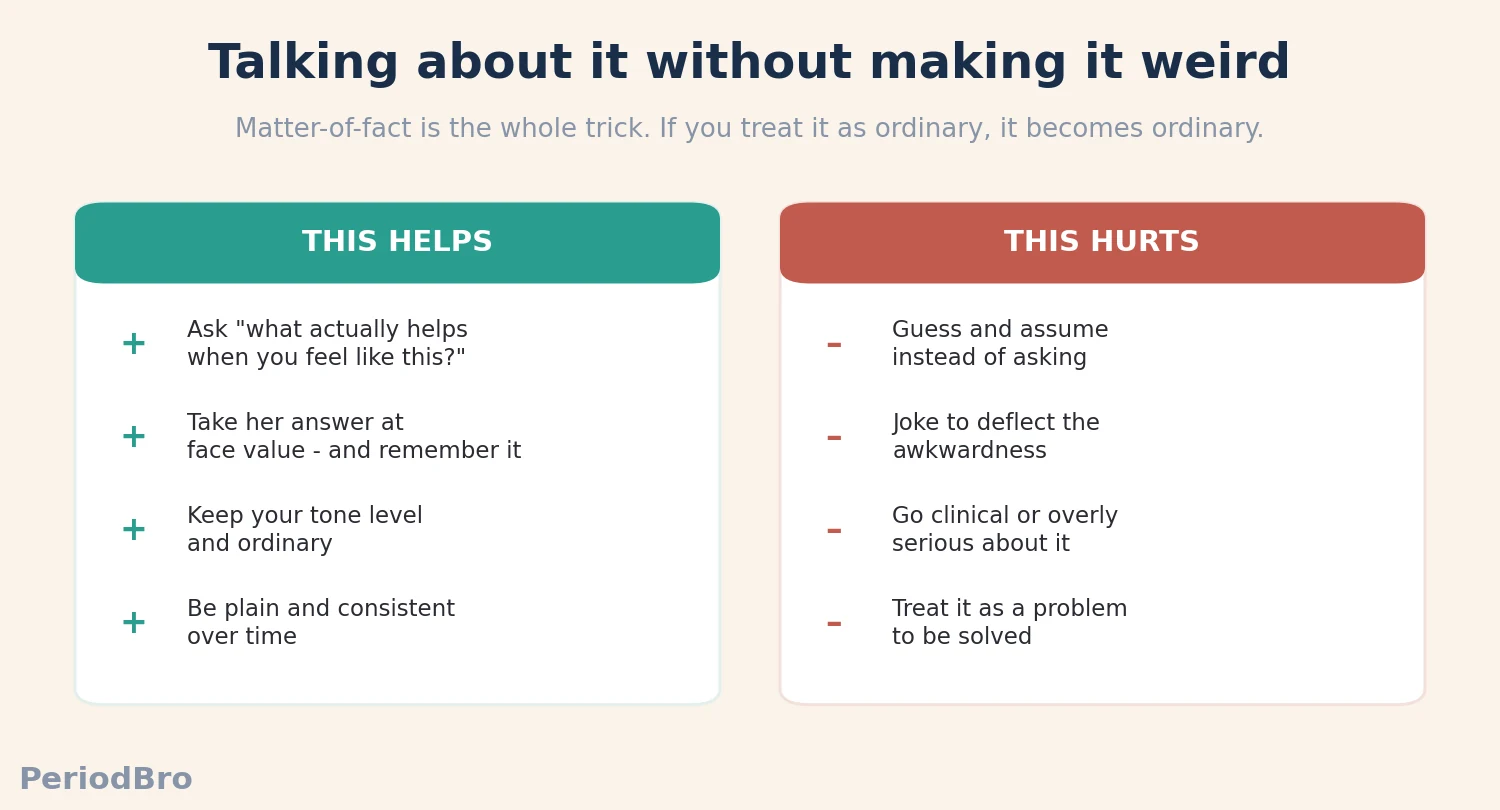
You can’t support someone well if you can’t talk about the thing, and periods come pre-loaded with decades of awkwardness for a lot of us. The good news is that the bar is lower than it feels. You don’t need clinical vocabulary or a serious sit-down. You need to be matter-of-fact, because matter-of-fact is what signals this is normal and not a topic to tiptoe around.
A few things that make it easier. Ask instead of assume – “what actually helps when you feel like this?” beats guessing, and the answer is often different from what you’d expect. Take the answer at face value and remember it, so she doesn’t have to re-explain every month. And keep your own tone level: if you treat it as ordinary, it becomes ordinary. (Full detail: how to talk to your partner about her period without making it weird.)
One note on register, since this guide is written partner-to-partner: none of this is about performing sensitivity or saying the perfect thing. Plain and consistent beats eloquent and occasional. She’ll trust the partner who reliably shows up in small ways over the one who delivers a great speech once.

Tracking and privacy: support without surveillance
A lot of partners reach a point where they want to keep loose track of where she is in her cycle – not to control anything, but so they can anticipate instead of react. That’s a reasonable instinct, and it’s the whole reason a tool like ours exists. But it comes with a line you don’t want to cross, and the line is consent.
Tracking someone’s cycle without their knowledge isn’t support, it’s surveillance, and it tends to feel that way to the person being tracked the moment they find out. The fix is simple: do it openly, or do it together. Tell her you’re paying attention because you want to show up better, ask if she’s comfortable with it, and let her set the terms. Most of the value comes from you being more aware anyway – she doesn’t have to hand over a data feed for you to notice patterns and plan around them. (Full detail: how to track your partner’s cycle without being creepy and tracking her cycle with consent.)
This matters more than it used to. In the post-Roe United States, reproductive health data is genuinely sensitive, and where it lives is a real question, not a paranoid one. Whatever you use to track, prefer tools that keep data private and on-device rather than monetizing it. Privacy here isn’t a feature to shop for – it’s the baseline.
For fathers: the same instinct, a different relationship
If you’re reading this as a dad rather than a partner, most of the underlying idea transfers – pay attention, normalize the topic, support without making it weird – but the relationship is different and the role is different. Supporting a daughter through her cycle is about education, steadiness, and not making her feel watched, not about partnership. It deserves its own playbook rather than a footnote here. (Start with the father’s role in menstrual education.)
PMS vs PMDD: know the difference
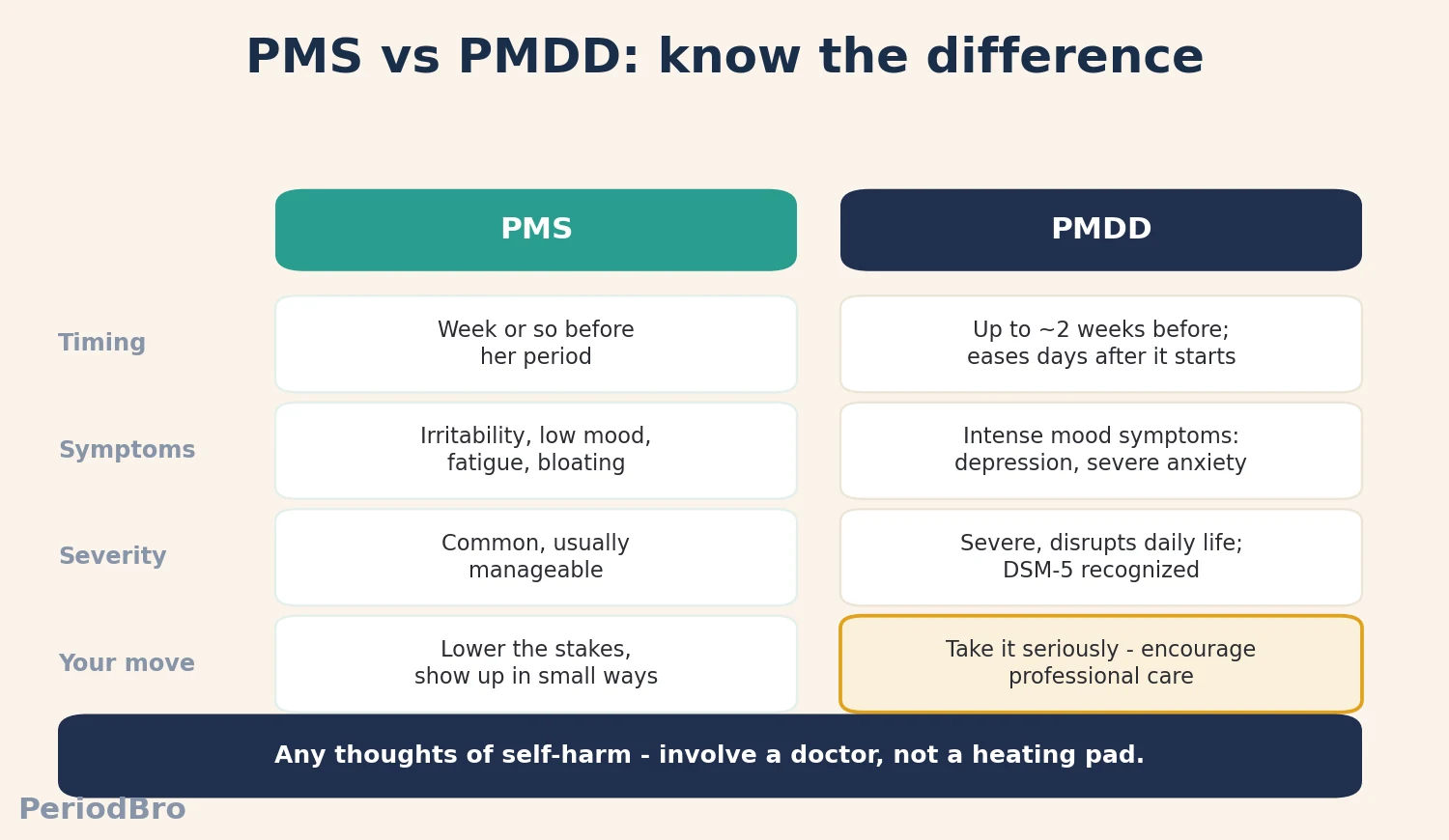
One distinction every supportive partner should know, because it changes what “support” means. PMS – the irritability, low mood, fatigue, and physical symptoms in the week or so before a period – is common and usually manageable (ACOG). But a smaller share of people experience premenstrual dysphoric disorder, or PMDD: a much more severe, DSM-5-recognized condition involving intense mood symptoms – sometimes including depression, severe anxiety, or thoughts of self-harm – that typically begin in the week or two before a period and ease within a few days of it starting, and that are serious enough to disrupt daily life (NCBI StatPearls).
The reason this matters for you: PMDD is not something to “support her through” with date nights and chores. It’s a recognized medical condition that responds to treatment, and the supportive move is to take it seriously and encourage professional care, not to manage it at home. If the premenstrual week regularly brings symptoms that feel disproportionate, overwhelming, or frightening – especially any thoughts of self-harm – that’s a signal to involve a doctor, not a heating pad. Knowing the line between common PMS and PMDD is part of showing up responsibly.
Frequently asked questions
What’s the single most helpful thing I can do?
Pay attention across the whole month, not just her period, and act on what you notice. Most of the value isn’t one big gesture – it’s small, consistent moves at the right time: taking something off her plate on a low-energy day, postponing a hard talk during a tense week, planning the fun thing when her energy’s up.
She says she’s fine but clearly isn’t. What do I do?
Don’t interrogate it and don’t ignore it. Stay warm and available, lower the pressure, and make it easy for her to come to you without forcing the conversation. “I’m around if you want to talk, no rush” lands better than “what’s wrong?” repeated five times. If something’s genuinely wrong beyond a hard week, it’ll surface when she’s ready.
How do I support her without being overbearing?
Ask what helps and follow her lead instead of imposing a plan. Support that ignores what she actually wants stops being support. When in doubt, offer rather than insist: “want me to handle dinner?” gives her a choice; taking over the kitchen unannounced takes one away.
Is it okay to track her cycle to be more helpful?
Yes, if you do it openly or together. Tracking without her knowledge crosses into surveillance and tends to damage trust the moment it’s discovered. Tell her why you’re paying attention, ask if she’s comfortable, and let her set the terms. See tracking her cycle with consent.
What if I always seem to say the wrong thing?
Lower the stakes on getting it perfect. Plain and consistent beats eloquent and rare. If you fumble a moment, a simple “that came out wrong, let me try again” is usually enough. Reliability over time matters more than any single line.
Is her bad mood always about her cycle?
No – and assuming so is its own mistake. The cycle is one input among many. Work stress, sleep, real relationship problems, and ordinary life all matter too. Use the cycle as context, never as a way to dismiss what she’s feeling.
How long before her period do symptoms usually start?
For people who get PMS, symptoms typically show up in the week or so before bleeding begins and ease once the period starts (ACOG). But timing and intensity vary a lot person to person, which is why paying attention to her specific pattern beats relying on a textbook calendar.
When should I be worried that it’s more than PMS?
If the premenstrual week regularly brings symptoms that feel disproportionate, overwhelming, or frightening – severe depression or anxiety, or any thoughts of self-harm – that points toward PMDD, a treatable medical condition, and the right move is to encourage professional care rather than handle it at home (NCBI StatPearls).
Where to go next
This page is the map. Here’s the rest of the cluster, grouped by what you need:
During her period
– How to support your girlfriend on her period
– How to help with period cramps
– The best foods to have at home before her period
Across the energy phases
– How to plan date nights around her cycle
PMS and conflict
– Understanding PMS
– How to handle PMS arguments
– How to handle arguments before her period (the 90-second version)
Space and pain
– How to give her space without making things worse
– How to be supportive when you can’t fix her pain
Talking, tracking, and privacy
– How to talk to your partner about her period
– How to track your partner’s cycle without being creepy
– Tracking her cycle with consent
The bigger picture
– The complete menstrual cycle guide for men – the biology underneath all of this
– Cycle awareness for partners – the mindset side
– The father’s role in menstrual education – if you’re doing this as a dad
You don’t have to get this perfect. You have to keep showing up.
That’s the whole skill, and it’s a learnable one – support across the whole month, in small reliable ways, paying enough attention that what you do lands where it’s actually needed. Some weeks that means matching her energy. Some weeks it means lowering the temperature and taking things off her plate. All of it starts with paying attention instead of guessing.
That’s exactly the part PeriodBro is built to make easy – it keeps this map in your pocket and quietly tells you roughly where she is, so you can act on it instead of trying to remember it. Built for partners and fathers, private by design, her data stays hers – never sold, ever. But the app isn’t the point; the habit is. Start anywhere on the list above, and start this month.