The Complete Menstrual Cycle Guide for Men: What’s Happening, and What to Do About It
I’d been married. I’d had girlfriends. I’d become a father. And somewhere around 35, standing in a pharmacy aisle holding a box I wasn’t sure was the right one, I realized I still couldn’t tell you the difference between ovulation and menstruation. Not because I didn’t care. Because no one ever told me I was supposed to know.
That’s the strange thing about the menstrual cycle. It runs the lives of the people closest to us for about a week out of every four, and most of us were raised to look away from it. We learned to hand over the box at the counter and not ask questions. This guide is the thing I wish someone had handed me back then. By the end of it you’ll understand the whole cycle – what’s happening, why, and most importantly what to actually do about it. No jargon you can’t use on a Tuesday. No jokes at your expense.
Let’s get into it.
Why a man should bother learning this at all
Here’s the reframe that changed it for me: understanding her cycle isn’t trivia, and it isn’t about being a “good guy.” It’s a skill. The same way learning to cook or read a room or sit with someone who’s upset is a skill. You’re not memorizing biology to pass a test. You’re learning to read the weather of someone you love so you can show up usefully instead of guessing.
Most men never learn it, and that’s not a personal failing – it’s just a gap nobody filled. The cost of the gap is real, though. You misread a hard week as “she’s mad at me.” You take fatigue personally. You offer the wrong kind of help at the wrong time, or worse, you offer no help because you didn’t notice anything was different. You schedule the stressful dinner, the hard conversation, the big ask on precisely the wrong day, then wonder why it went badly. None of that is malice. It’s just driving without a map.
Cycle awareness closes that gap, and once it’s closed you can’t really un-see it. You start noticing patterns, anticipating instead of reacting, and the whole relationship gets quieter and easier in a way that’s hard to describe until you’ve lived it. The arguments that used to feel random start to make sense. The weeks that used to feel like walking on eggshells become weeks you can actually plan around. You stop being a passenger in someone else’s month and start being a partner in it.
One thing this guide is not: it’s not about reducing her to her hormones, and it’s not a cheat code for “managing” her. People are more than their cycle, and nobody wants their bad mood explained away with “you’re just premenstrual.” The goal is the opposite of that. It’s to understand the physiology well enough that you stop taking the wrong things personally and start offering the right kind of support at the right time. Used well, this knowledge makes you less reactive, not more dismissive. (If you want the deeper version of that argument, I wrote about how cycle awareness made me a better partner.)
So that’s the deal. Learn the map, learn what to do with it. Let’s start with the map.
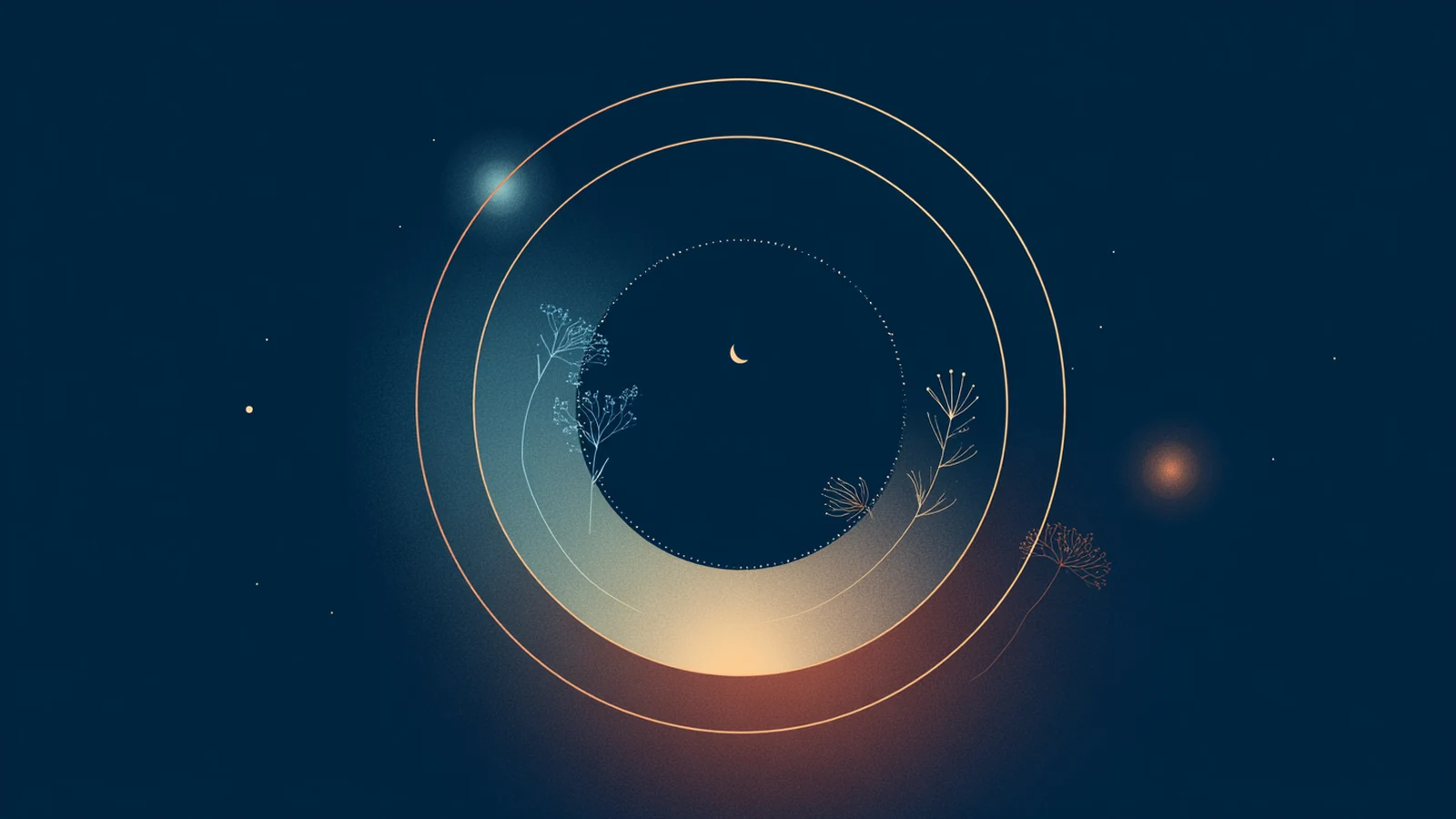
The cycle in one picture: four phases, about 28 days
The menstrual cycle is the roughly monthly sequence of hormonal changes that prepares the body for a possible pregnancy. A “textbook” cycle is 28 days, but textbook is rare. According to large real-world data and clinical sources, normal cycles run anywhere from about 21 to 35 days in adults, and the average across more than 600,000 tracked cycles sits close to 29 days, not 28 (Cleveland Clinic, large cycle-length study). Hers might be 26, might be 33. Both are normal. The number that’s surprisingly stable from person to person is the back half – more on that in a second.
People usually split the cycle into four phases: menstruation (the bleed), the follicular phase, ovulation, and the luteal phase. Clinically you’ll sometimes see it described as three phases, because menstruation is technically the first few days of the follicular phase (NCBI StatPearls). Four is the version that’s actually useful to you as a partner, so that’s what we’ll use.
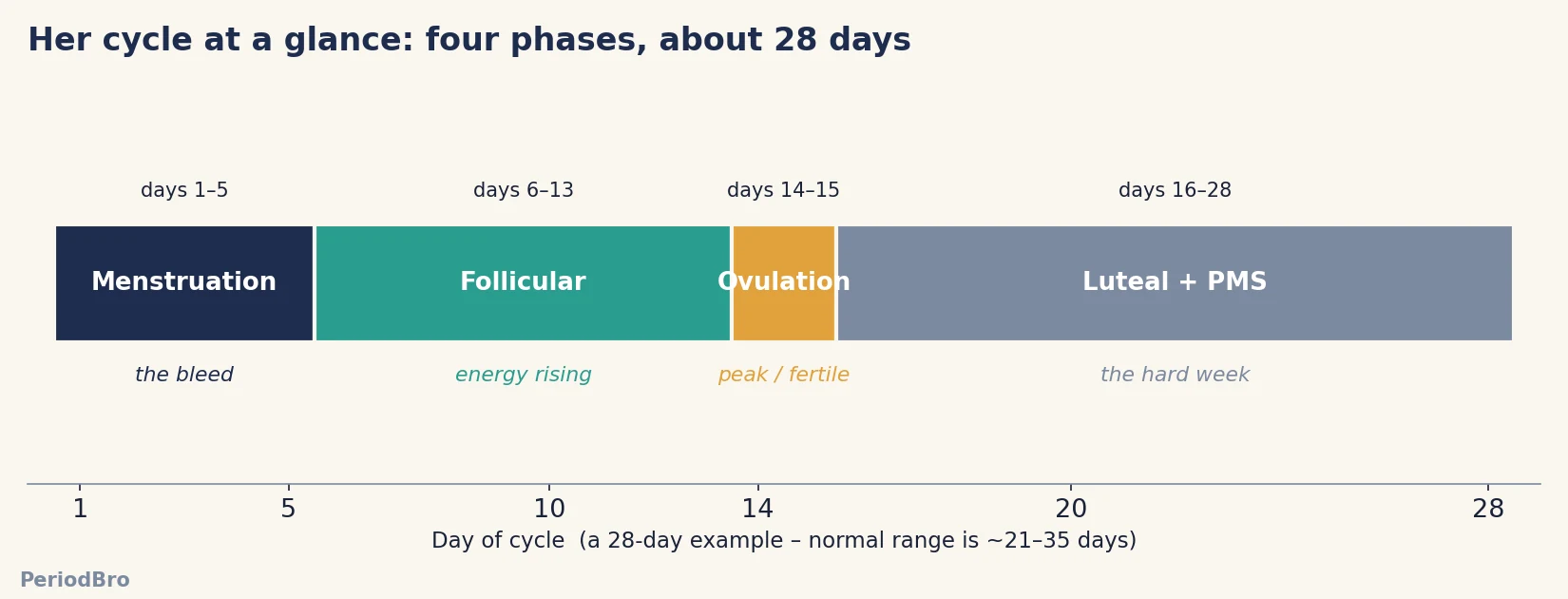
Here’s the one-paragraph version of each. Then we go deeper, and each phase links down to a full guide if you want it.
Menstruation (the bleed): roughly days 1 to 5
Day 1 is the first day of real bleeding, and it’s counted as the start of the whole cycle. The lining the body built up the previous month is shed because the pregnancy it was preparing for didn’t happen (Cleveland Clinic). Hormones are at their lowest point here, which is part of why energy can dip. Cramps are caused by the uterus contracting to shed that lining – driven by compounds called prostaglandins – and for some people they’re genuinely painful, not a figure of speech (Cleveland Clinic).
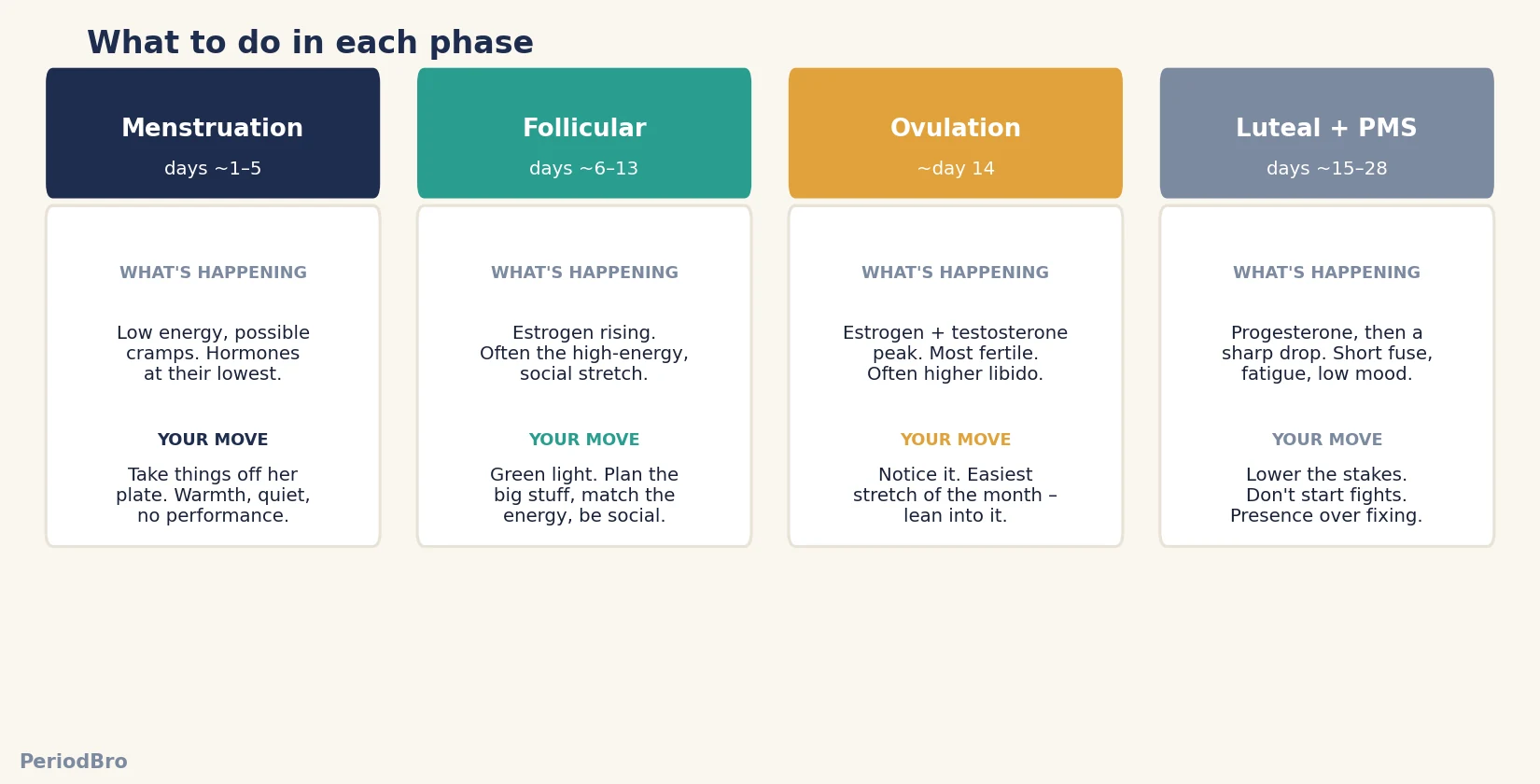
What to do: Lower the friction in her day. Take something off her plate without being asked – dinner, an errand, the kid logistics. Warmth helps cramps; so does not having to manage you on top of everything else. Don’t perform it. Just quietly do the thing. (Full version: what is the menstrual phase and how to support her right now.)
Follicular phase: roughly days 6 to 13
After the bleed, estrogen starts climbing as the body prepares an egg for release. Follicle-stimulating hormone (FSH) prompts follicles in the ovaries to mature, and rising estrogen rebuilds the uterine lining (Cleveland Clinic, NCBI Endotext). For a lot of people this is the high-energy stretch – more drive, more sociability, more appetite for plans and new things. The follicular phase is the most variable in length, which is the main reason whole cycles differ from person to person (Cleveland Clinic).
What to do: This is the green-light window for the big stuff. Plan the trip, have the ambitious conversation, start the project together, be social. Match the energy instead of dragging behind it. If you like a mental model for this, the rising-energy stretch maps onto what I call “spring” in the four seasons of her cycle.
Ovulation: around day 14 (give or take)
Mid-cycle, a surge of luteinizing hormone (LH) triggers the ovary to release an egg (Cleveland Clinic, NCBI Endotext). This is the most fertile window of the whole month – worth knowing whether you’re trying to conceive or trying not to. Estrogen and testosterone peak around here, which for many people means higher libido, more confidence, more outward energy. It’s brief, usually a day or so of release within a fertile window of a few days.
What to do: Mostly, notice it and don’t be oblivious. If you’re tracking together, this is the window that matters most for family planning either direction. Socially and romantically it’s often the easiest stretch of the month – lean into it. (Deeper dive: ovulation explained for men.)
Luteal phase + PMS: roughly days 15 to 28
After ovulation, progesterone takes over. The empty follicle becomes a structure called the corpus luteum that pumps out progesterone to maintain the lining in case of pregnancy (NCBI Endotext). Here’s the relatively stable part I promised: the luteal phase is fairly consistent, typically around 12 to 14 days in most people, regardless of how long the whole cycle is (Cleveland Clinic). If no pregnancy happens, progesterone and estrogen fall off a cliff in the last few days, and that drop is what triggers the next period – and what drives PMS.
This is the stretch men most often misread. The late-luteal hormone drop can bring irritability, low mood, fatigue, bloating, breast tenderness, and a shorter fuse. It’s not “her being difficult.” It’s a measurable physiological shift.
What to do: Lower the stakes. Don’t start fights you can postpone, don’t take the short fuse personally, and don’t try to “fix” the mood – presence beats problem-solving here. This is the single highest-leverage week to get right. (Full guide: the luteal phase explained for men.)
The engine underneath: hormones, mood, and energy
Everything above is driven by four hormones rising and falling in a sequence. You don’t need to memorize this, but seeing the shape once makes the whole thing click.
- Estrogen climbs through the follicular phase, peaks just before ovulation, dips, then has a smaller second rise in the luteal phase before crashing at the end. It’s broadly associated with energy, mood lift, and mental sharpness (NCBI StatPearls).
- FSH and LH are the trigger hormones. FSH matures the egg; a sharp LH surge releases it at ovulation (NCBI Endotext).
- Progesterone is low until ovulation, then dominates the luteal phase. It’s the calming-but-also-sluggish hormone, and its withdrawal at the end of the cycle is the main engine of PMS (NCBI Endotext).
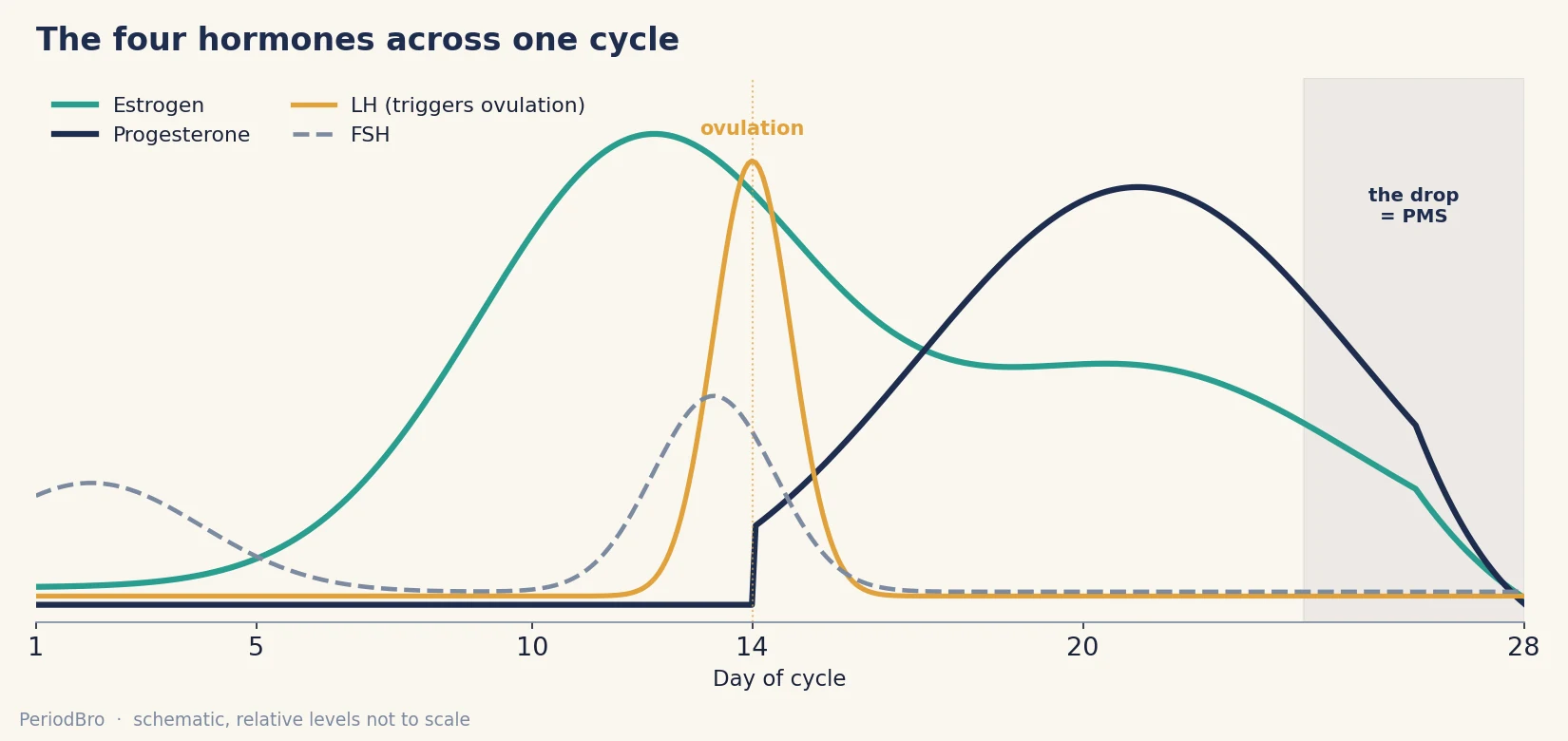
The practical takeaway: her mood and energy across the month aren’t random and they aren’t about you. They track these curves. High-estrogen days tend to feel up and outward; the late-luteal drop tends to feel down and inward. When you can see the curve, “why is she different this week” stops being a mystery and becomes a forecast. I mapped this out week by week in how hormones drive her mood all month long, and went deeper on the mechanism in hormones, the menstrual cycle, mood and energy.
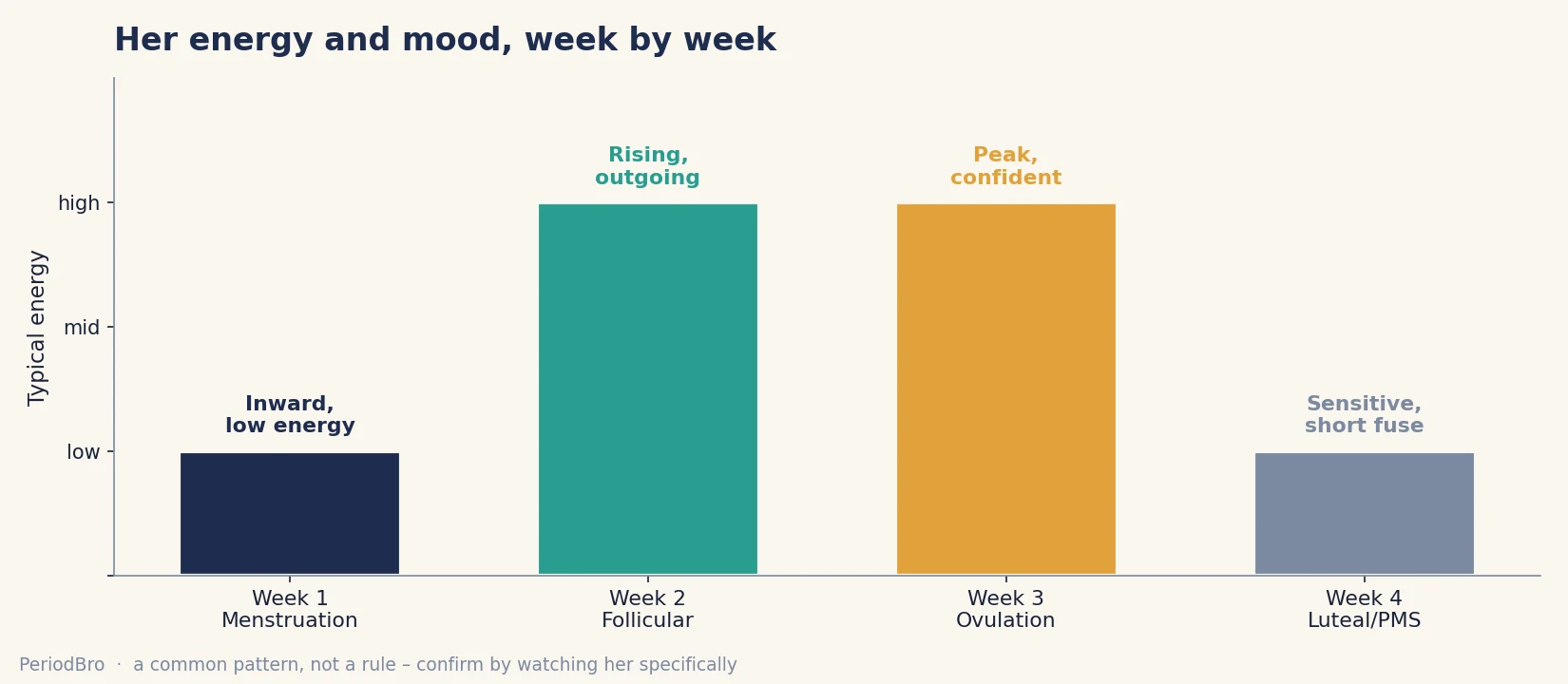
One honest caveat before we go further: these are population patterns, not laws. Not everyone gets PMS, symptoms vary enormously, and some people barely notice their cycle at all. Use this as a starting hypothesis you confirm by paying attention to her specifically – not a script you impose on her.

How the cycle shows up in daily life (and what you can actually do)
This is the part almost every other guide skips. They’ll tell you the biology and leave you standing there. So here’s where the cycle actually touches your week, and what to do about each one.
Sleep. Sleep quality genuinely shifts across the cycle, often getting worse in the late-luteal/premenstrual days as progesterone drops and body temperature stays elevated. If she’s sleeping badly the week before her period, that’s physiology, not insomnia she’s inventing. Protect her rest – take the early shift with the kids, keep the room cool, don’t start a heavy conversation at 11pm. (More: how sleep changes through her cycle.)
Cravings. The classic premenstrual pull toward chocolate and carbs is real and partly physiological, tied to the hormonal shifts of the luteal phase. Don’t comment on it, don’t police it. Just have the stuff she likes in the house before that week hits. (Practical list: the best foods to have at home before her period.)
Cramps and pain. Period cramps are caused by the uterus contracting and can range from mild to genuinely debilitating (Cleveland Clinic). Your job isn’t to cure them – it’s to make them easier to carry. Heat, ibuprofen if she uses it, a clear “what do you need” and then actually doing it. (Full guide: how to help your girlfriend with period cramps.)
Arguments. The late-luteal short fuse is the most common relationship flashpoint of the month. The move isn’t to win, it’s to not light the match. Postpone the heavy stuff, lower your own volume, and remember the timing. (Guides: how to handle PMS arguments and the 90-second version, arguments before her period.)
Libido and connection. Desire often tracks the cycle too, frequently rising around ovulation and dipping in the premenstrual stretch. Read the room, don’t keep score, and don’t treat a low week as rejection.
Focus and patience. It’s not just mood that shifts. Some people find their concentration, irritability threshold, and tolerance for small annoyances all move with the cycle, especially in the premenstrual stretch. If she’s snappier about things that normally wouldn’t register, that’s often the same late-luteal drop showing up as a thinner buffer rather than a real grievance. The move is to widen your own buffer to compensate – let the small stuff go, don’t match the friction, and save the “we need to talk about how you spoke to me” for a calmer week if it’s genuinely worth raising at all.
The thread through all of it: you’re not trying to be a hero who fixes her body. You’re trying to be someone whose presence makes a hard week 10% easier instead of 10% harder. That’s the whole game. And notice the symmetry – half the cycle is not the hard week. The follicular and ovulatory stretch is when you plan the good stuff, match the high energy, and bank the goodwill. Cycle awareness isn’t a month of bracing for impact. It’s knowing when to push and when to ease off, which is just what paying attention to anyone you love looks like. (The broader playbook lives in how to support your girlfriend on her period.)
What’s normal, and when something’s worth a doctor
Part of being useful is knowing the difference between “normal cycle stuff” and “this is worth getting checked.” You’re not diagnosing anything – that’s not your job and you’re not qualified. But you can be the person who gently says “hey, that sounds like a lot, maybe worth mentioning to a doctor,” which is sometimes the nudge that gets something looked at.
Broadly normal: cycles anywhere from about 21 to 35 days, periods lasting somewhere between 2 and 7 days, some cramping, some premenstrual mood and energy change, and a fair amount of month-to-month variation (Cleveland Clinic, large cycle-length study). Irregularity is also common and not automatically alarming in the first years after periods start, around perimenopause, after stopping hormonal birth control, or under heavy stress.
Worth encouraging a check: periods that are extremely heavy (soaking through protection hourly), cycles that suddenly change pattern, severe pain that stops her functioning, bleeding between periods, periods that vanish for months when she isn’t pregnant, or premenstrual mood symptoms severe enough to disrupt her life. None of these mean something is seriously wrong – lots of them have manageable explanations like PCOS, thyroid issues, fibroids, or endometriosis – but all of them are reasons to see a professional rather than ride it out. Your role is support and a calm nudge, never diagnosis.
Tracking her cycle without being creepy (consent and privacy)
Here’s where I have to be careful, because this is exactly where good intentions go sideways.
Knowing where she is in her cycle is genuinely useful. But there’s a line between being aware and surveilling, and it’s drawn by one word: consent. Tracking her cycle as a shared, talked-about thing is care. Tracking it secretly is a problem, no matter how good your reasons feel. The fix is simple and it’s just a conversation – “I’ve been reading about this because I want to be better at showing up for you; would it be weird if I kept track so I’m not clueless?” Most people, asked openly, are fine with it. Asked nothing and discovered later, not so much. I wrote the whole approach up in how to track your partner’s cycle without being creepy and tracking her cycle with consent.
The privacy piece matters more than it used to. In a post-Roe environment, reproductive data is sensitive in ways it wasn’t a few years ago, and “where is this data stored and who can subpoena it” is a fair question. A lot of the big cycle-tracking apps were built as data businesses first, which means the most intimate information about her body can end up on the same servers that sell ad targeting. The principle I’d hold to: her cycle data is hers, it shouldn’t live on someone’s ad server, and local storage beats cloud whenever you have the choice. Care and privacy aren’t in tension – privacy is part of the care. If you wouldn’t be comfortable with a stranger reading it, don’t put it somewhere a stranger could.
There’s a subtler version of consent too, beyond the data. It’s about how you use what you learn. Knowing she’s premenstrual is not a license to dismiss a real concern as hormones, and it’s not ammunition for an argument. The fastest way to make all of this feel creepy instead of caring is to weaponize it – “you’re only saying that because of your cycle” is the single worst sentence you can build out of this knowledge. Hold it lightly. It’s a tool for showing up better, not for winning.
For fathers: the same map, a different relationship
If you found this because of a daughter rather than a partner, the biology is identical but the job is different. You’re not reading the weather to be a better boyfriend – you’re trying to be a father who doesn’t go silent and useless the moment puberty shows up. The same four phases apply. What changes is that your role is calm presence, basic preparedness, and not making her feel like her own body is a topic too awkward to mention in her own home.
The bar here is genuinely low and most dads still clear it badly, which means just clearing it puts you ahead. You don’t need to deliver a biology lecture. You need to have the supplies in the house before she needs them, to react to the first period with calm rather than panic or a joke, and to make it obvious – by how you act, not by a speech – that this is a normal part of life she never has to hide from you. A daughter who learns that her father treats her cycle as no big deal carries that into every relationship after. That’s the whole opportunity, and it costs you nothing but a bit of comfort with your own awkwardness. There’s a whole side of this for dads, starting with the father’s role in menstrual education.
Frequently asked questions
How long is a normal menstrual cycle?
Roughly 21 to 35 days in adults, with the median close to 29. A “28-day cycle” is the textbook average, not the rule – hers being a few days shorter or longer is completely normal (Cleveland Clinic, large cycle-length study).
Can I just ask her what phase she’s in?
Yes, if you ask out of genuine interest rather than to explain away her feelings. “What phase are you in” lands very differently from “you’re just PMSing.” Curiosity good, gotcha bad.
Is it weird to track her cycle?
Not if she knows and is on board. Secret tracking is the weird version. Make it a conversation, keep her data private, and it becomes a thing she appreciates rather than something she’d be unsettled to discover. See the consent guide.
What if her cycle is irregular?
Common, especially in the first years after menstruation starts, around perimenopause, and with conditions like PCOS or thyroid issues. If cycles are wildly unpredictable, very heavy, or suddenly change, that’s a “worth seeing a doctor” signal – not something you diagnose, just something you can gently support her in checking.
Does every woman get PMS?
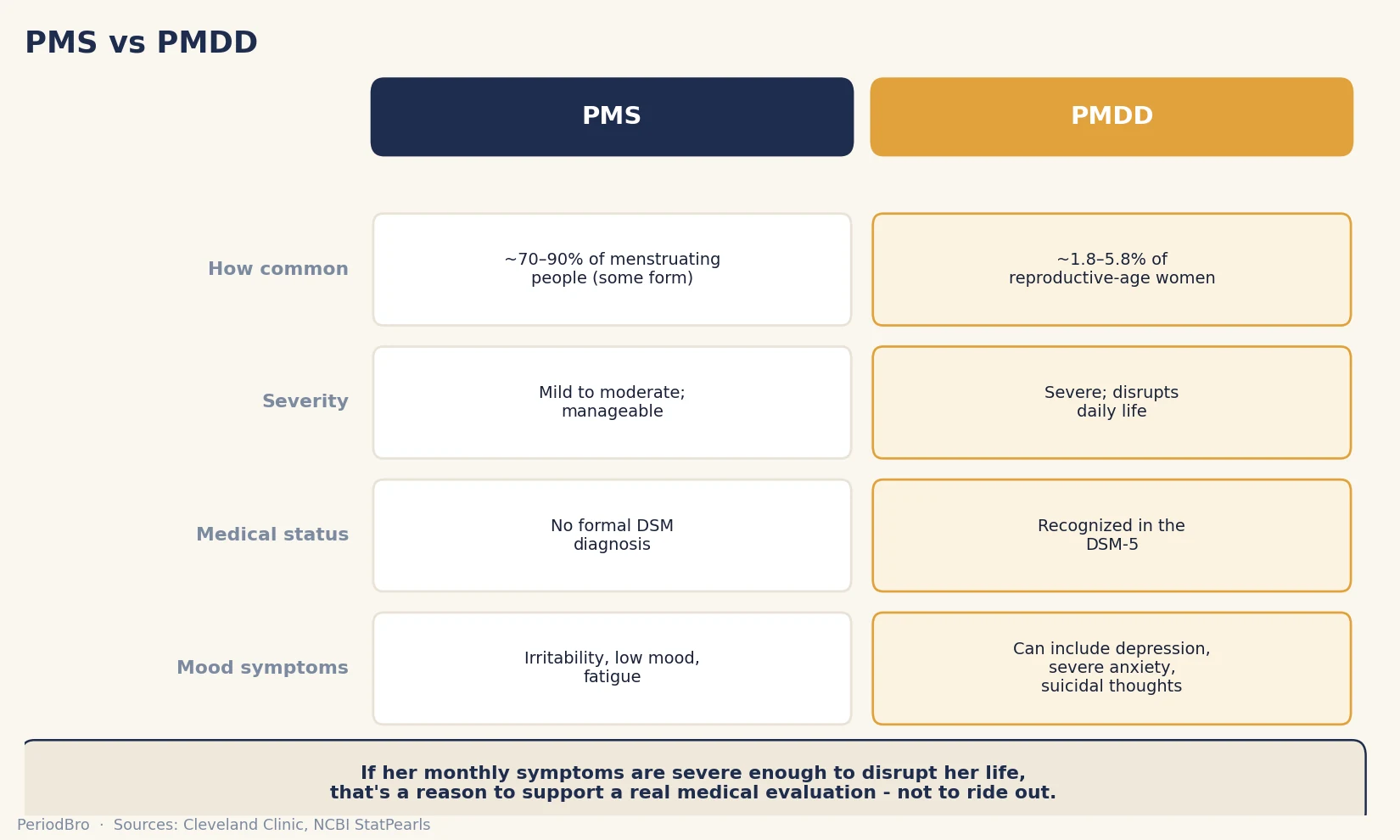
No. PMS in some form affects most menstruating people – estimates run as high as 70 to 90 percent – but severity varies hugely and some barely notice it (Cleveland Clinic). Don’t assume; observe.
What’s the difference between PMS and PMDD?
PMS is common and ranges from mild to moderate. Premenstrual dysphoric disorder (PMDD) is a distinct, more severe condition recognized in the DSM-5, affecting roughly 1.8 to 5.8 percent of reproductive-age women, with significant mood symptoms – including, in serious cases, depression or suicidal thoughts – that don’t occur in ordinary PMS (Cleveland Clinic, NCBI StatPearls). If what she’s experiencing each month is severe enough to disrupt her life or affect her mental health, that’s not something to ride out – it’s a reason to encourage and support a real medical evaluation. You’re not the doctor here; you’re the person who helps her get to one.
Does hormonal birth control change all of this?
Yes, often a lot. Most hormonal contraceptives work by overriding the natural hormone cycle, which can flatten the phase pattern, change or remove the “period” (the bleed on the pill is technically a withdrawal bleed, not a true menstrual period), and alter mood and libido for better or worse depending on the person. If she’s on the pill, an IUD, an implant, or similar, the four-phase map may apply weakly or not at all. The principle still holds though: notice her patterns specifically rather than assuming the textbook applies.
Can men track a cycle accurately without medical training?
You don’t need training to track dates and notice patterns – that’s just observation. What you can’t do is diagnose anything. Tracking tells you roughly where she is and helps you show up better; it doesn’t replace a doctor for anything that looks off.
How long does it take to actually get good at this?
Faster than you’d think. Once you’ve watched a single full cycle with this map in hand, the pattern starts to click – you’ll catch the energy lift after her period and the shorter fuse before the next one. A couple of months in, it stops being something you think about and becomes something you just notice, the way you notice the weather before you leave the house.
Where to go next
This page is the map. Each part of it has a full guide if you want to go deeper – pick whatever’s relevant to your week:
The biology, phase by phase
– Menstrual cycle phases explained for men – the clinical deep-dive on all four
– What is the menstrual phase – the bleed
– Ovulation explained for men – the fertile window
– Luteal phase explained for men – the hard week
– The four seasons of her cycle – the mental model
The hormones and mood
– Hormones, the menstrual cycle, mood and energy
– How hormones drive her mood all month long
– How sleep changes through her cycle
Showing up well
– How to support your girlfriend on her period – the support playbook
– Cycle awareness for partners – the mindset
– Tracking her cycle with consent – the ethics
For dads
– The father’s role in menstrual education
You don’t have to memorize this. You have to pay attention.
That’s the real takeaway. Nobody’s asking you to recite hormone curves. The whole skill is just: notice where she is, and let it change how you show up. Some weeks that means matching her energy. Some weeks it means lowering the temperature and taking things off her plate. All of it starts with paying attention instead of guessing.
That’s exactly the part PeriodBro is built to make easy – it keeps this map in your pocket and quietly tells you where she is, so you can act on it instead of trying to remember it. Built for partners and fathers, private by design, her data stays hers. But honestly, even if you never download a thing, you’re already further along than I was in that pharmacy aisle. You read the map. Now go pay attention.