Cycle Awareness for Partners: How It Made Me a Better One
Cycle awareness for partners is the thing nobody told me about for the first fifteen years of my adult relationships. For most of my marriage, I thought I was paying attention.
I asked her how her day was. I noticed when she was quiet. I tried to be supportive when things felt off. And every few weeks, without fail, there was a stretch of days where everything I did landed wrong. I’d ask what was wrong. She’d say “nothing.” I’d back off. The week would pass. Whatever it was would lift on its own. And I’d file the whole episode under “moods I don’t understand.”
It took me longer than it should have to realize the pattern wasn’t moods. It was a cycle.
I’m not going to write the version of this essay where understanding her cycle saved my marriage. It didn’t. By the time I figured it out, the marriage was already over. But the lesson stuck, and a few years later, in a new relationship with someone whose cycle was very different from my ex-wife’s, I started practicing cycle awareness for partners — not as a project, not as a fix, just as a quiet act of paying attention. And it changed how I showed up. Not magically. Specifically.
This is the article I wish I’d had ten years earlier.
Cycle Awareness for Partners: What I Didn’t Know at 35
Here’s a partial list of things I didn’t know at thirty-five:
- That the cycle has four phases, not two.
- That energy, mood, and patience genuinely shift across those phases, and the shifts are measurable.
- That the difficult days are clustered in a predictable window — the week or so before menstruation.
- That her behavior in that window wasn’t a character flaw, a relationship failure, or a sign she was unhappy with me.
- That none of this was secret. It’s in any biology textbook. I just never opened one with her in mind.
If you want the textbook version, here’s the four phases explained for men, written more clinically than this essay. I’ll keep this one personal. Per the ACOG framing of normal cycle variation, the rhythms differ between women — but the existence of a rhythm doesn’t.
How I Learned the Hard Way
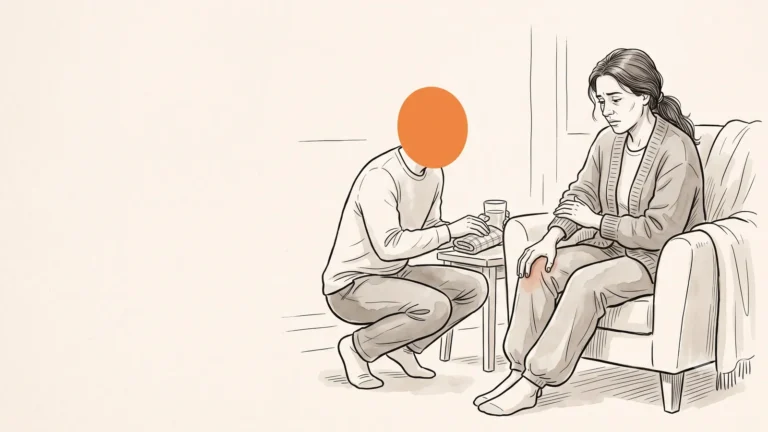
The first relationship after my divorce was with someone almost ten years younger than me. Her moods didn’t behave the way I expected. Most weeks she was warm, talkative, easy to be with. Then there’d be a stretch — three or four days, sometimes five — where she’d get quiet, then irritable, then exhausted, then somehow simultaneously fragile and impossible to please. I’d ask what I’d done. She’d say nothing. I’d assume she was tired of me. I’d start performing — bringing her flowers, planning dinners, doing the dishes with extra visibility — and somehow each gesture made it worse.
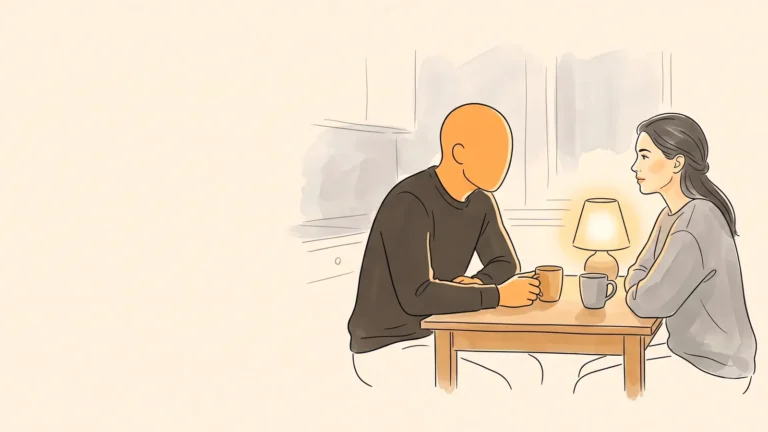
About four months in, she explained — patiently, calmly, on what I would later realize was probably a follicular-phase day — that this was just her cycle. That the bad days clustered. That she didn’t need me to fix it. She needed me to stop treating her like a problem.
I felt two things at once. Relief, because there was a pattern. And shame, because I should have known to look for one.
What Changed When I Started Practicing Cycle Awareness
The first thing that changed wasn’t her behavior. It was mine.
I knew when the difficult days were coming. Not because I was paranoid about her schedule, but because I had a calendar with a colored band on it. Three days a month, my own internal alarm system started going off about a week in advance: okay, the next few days might be heavy. Don’t take it personally. Don’t escalate. Make life easier where you can.
That re-framing changed everything. Before cycle awareness, every difficult day felt like a referendum on the relationship. After cycle awareness, the same difficult day felt like a Tuesday in February. Cold weather. Layer up. Move on.
The second thing that changed was that I stopped trying to fix what didn’t need fixing. The week before her period, she didn’t want me to do more. She wanted me to do less, but better. Fewer questions. Less performing. More steadiness. More handling whatever was already on the plate without making a production of it.
The third thing took me longer to notice: I became better at the rest of the cycle, too. When I knew the difficult days were a small slice of the month, I stopped treating the other three weeks as filler between conflicts. The ovulatory week — high energy, high warmth — became a real window I planned around. Conversations I’d been putting off, things I wanted to ask for, the kind of dates we should have been doing all along. They landed there. They didn’t always land elsewhere. The cycle was teaching me when to ask.
What Cycle Awareness for Partners Actually Fixed (and What It Didn’t)
I’m going to be specific about this part because I’m tired of essays that pretend a calendar app cures relationships.
Cycle awareness fixed:
- The “what did I do wrong” loop. When I had a pattern explanation, I stopped misreading hard days as personal failures.
- The mistimed conversations. Knowing the late luteal phase exists meant I stopped trying to renegotiate the relationship during it.
- The over-functioning. I stopped trying to compensate for her cycle and started just absorbing more of the household friction during her hard week.
- The performance of empathy. Steady, predictable presence beats theatrical concern. Cycle awareness made me steady.
Cycle awareness did not fix:
- Anything that wasn’t already mostly working. If the relationship had structural problems, knowing her ovulation window didn’t paper over them.
- My own emotional regulation. I still had to do that work separately. Cycle awareness made the trigger predictable; it didn’t change my reaction to the trigger.
- Communication problems. I still had to learn how to talk to her about hard things. Awareness just told me when to talk.
- The basics. Cycle awareness doesn’t replace listening, asking questions, taking her seriously, doing the dishes, showing up. It’s a layer on top, not a substitute.
If you read those two lists and the second one looks longer, that’s correct. Cycle awareness for partners is a force multiplier on a relationship that has the fundamentals in place. It’s not a fundamental.
Why I Track For Her, Not About Her
There’s a real ethical question buried in this, and I want to name it.
The line between attention and surveillance is the line between tracking for someone and tracking about them. I never wanted a dashboard of her body. I wanted a calendar that helped me show up.
The distinction matters in practice. Tracking for her means:
- She knows I’m tracking, and she’s fine with it.
- The data exists in my head as a soft pattern, not as a tool I use to win arguments.
- I never say things like “you’re just PMSing.” Knowing where she is in her cycle is for me, not for ammunition.
- If she ever asked me to stop, I would, immediately.
This is post-Roe America and a lot of people are appropriately wary of period data. I built PeriodBro deliberately as a partner-side app, not a women’s-cycle-tracking app, because I think the most respectful frame is: the person whose body it is doesn’t owe me anything. If I want to pay attention, that’s my work, not hers.
There’s a longer piece on how to track your partner’s cycle without being creepy and one specifically on tracking her cycle with consent — short version, the test is whether you’d be comfortable with her seeing exactly what you’re doing. If yes, you’re tracking for her. If no, you’re tracking about her.
If You’re Starting From Where I Was
You don’t need an app to do cycle awareness for partners. You can start with a paper calendar and ten seconds of observation a day.
Here’s the smallest possible starter:
- Note the day her period starts. That’s it. One date, every month. Three months in, you’ll have a rough cycle length.
- Mark the seven days before that date as the “go easy” window. Don’t schedule hard conversations there. Don’t take small frictions personally.
- Mark roughly two weeks before the period as the “easy” window. That’s where ovulation tends to sit. Plan things together. Ask about hard topics. Connect.
- Don’t tell her about any of this for a while. Just watch. See if the rhythm matches your lived experience. After a month or two, you can mention it casually if it feels right.
Most of the gains are in the framing, not the precision. You don’t need to know which hormone is rising on which day. You need to know that the difficult days aren’t random and aren’t about you.
If you want to go deeper later, there’s a piece on the luteal phase — the phase that explains most of what you’ve probably been confused about. Read that one second.

What I’d Say to My Younger Self
If I could go back to thirty-two-year-old me — newly married, paying attention but not really, baffled by the recurring bad weeks — I’d say one thing:
The pattern you’re missing is a calendar, not a mystery.
Spend twenty minutes learning the basics. The four phases. The luteal week. The fact that her body is doing something legible, every month, that affects mood and energy in ways no one bothered to teach you. You’ll stop misreading the hard days. You’ll plan around them instead of into them. You’ll show up as someone who has done the homework instead of someone who is hoping to luck into the right week.
This isn’t a fix. It’s a foundation. The fix is everything you do on top of the foundation — listening, presence, restraint, generosity, the slow work of being a steady person to live with. Cycle awareness for partners doesn’t replace any of that. It just stops you from doing those things into a headwind you didn’t know was there.
FAQ
Does cycle awareness for partners actually improve relationships?
For most men with otherwise-functioning relationships, the answer is yes — but mostly because it changes your framing, not hers. You stop misreading hard days as personal conflict. You time your asks better. You absorb friction during her hard week instead of compounding it. That’s a real improvement, but it’s downstream of a calmer, more informed partner, not the calendar itself.
Should I tell her I’m tracking?
Yes. Tracking your partner without her knowledge crosses the line from attention to surveillance. A short, casual conversation — “I’m using this thing to keep track of where you are in your cycle so I can be less of an idiot during the hard days” — usually goes well, especially if you’ve already been showing up better.
What if she doesn’t want me tracking?
Stop. The point of cycle awareness is to make her life easier, not yours. If tracking makes her uncomfortable for any reason, the right move is to stop and lean on the soft pattern in your head instead of a logged calendar.
How long before I see results?
You’ll feel the framing shift within a single cycle — about a month. The behavior change in the relationship typically takes two or three cycles, because the trust builds slowly. She has to see the pattern of you not escalating during her hard week before she stops bracing for it.
What if my partner’s cycle is irregular?
Track anyway. Even a rough rhythm is more information than no rhythm. If her cycle is genuinely all over the place — varying by more than a week between cycles, repeatedly — that’s worth a doctor visit, not because tracking is failing but because irregularity itself can be a signal worth looking at.
One Last Thing
Most of the men I know who have figured out cycle awareness are private about it. They don’t post about being “cycle-aware partners” on social media. They don’t lecture their friends. They just quietly get easier to live with.
That’s the model. You’re not trying to become an expert. You’re trying to stop being baffled.
PeriodBro is built for that. Add a profile for the person whose biology you’ve been confused by, log a single date, and start. Start with PeriodBro →