PMDD and Relationships: What Partners Need to Know
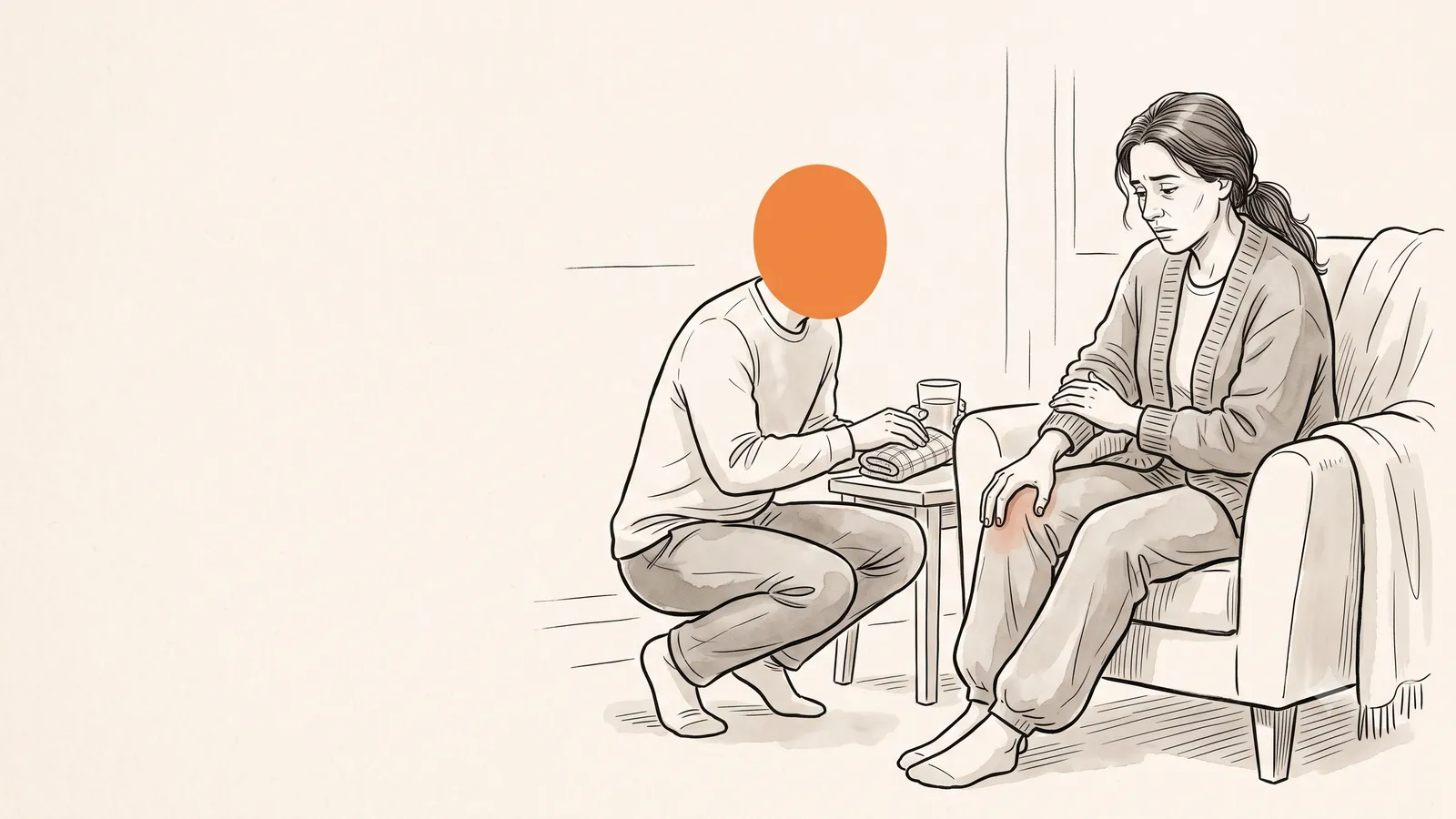
There’s a particular kind of confusion that comes with loving someone who has PMDD. For most of the month things are good, sometimes great. Then a window opens, usually the week or two before her period, and the person you know seems to get replaced by someone in real pain who’s convinced the relationship is falling apart. Then it lifts, and she’s back. If that pattern sounds familiar, you’re not imagining it, and you’re not the problem.
This piece is about PMDD and relationships, specifically what a partner needs to understand to stop guessing and start showing up. Not a clinical lecture, and not the “just be patient” advice that treats you like furniture. What’s actually happening, what the research says it does to couples, and where the durable parts of a relationship survive it.
What PMDD is, in one honest paragraph
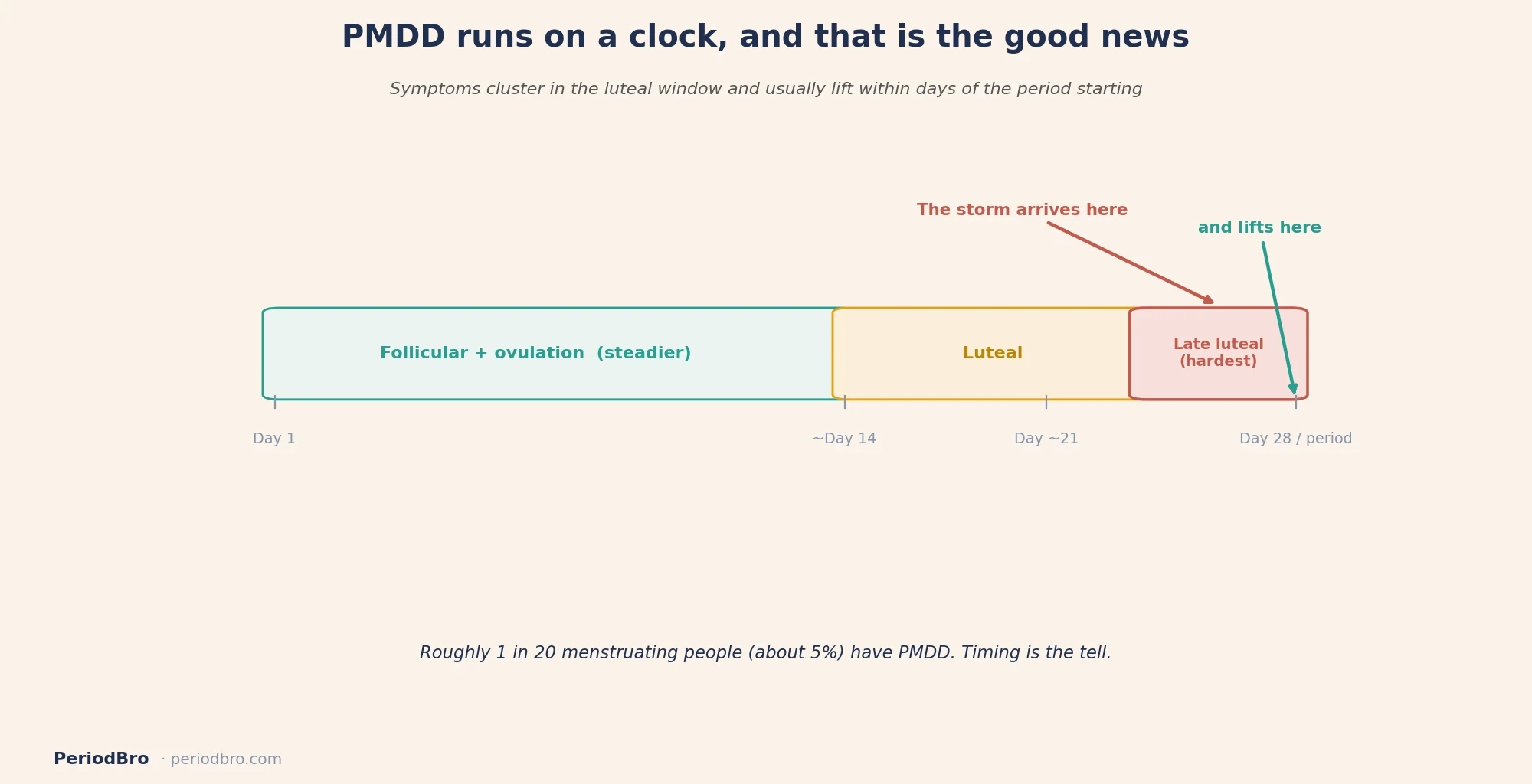
Premenstrual dysphoric disorder is the severe end of premenstrual symptoms, and it affects roughly 5% of menstruating people, about 1 in 20 (ACOG). The key detail: it’s tied to the luteal phase, the one-to-two weeks after ovulation and before the period. Symptoms show up in that window and typically fade within a few days of bleeding starting. It’s not a mood she’s choosing and it’s not a character flaw. The current understanding is that her hormones are usually normal, but her brain is unusually sensitive to the normal rise and fall of them, which is why the timing is so clockwork-like. If you want the plain-language version of that mechanism, we broke down how hormones drive her mood separately.

What the research says it does to a relationship
This is where a lot of guys quietly feel crazy, so it’s worth saying plainly: the strain is real and it’s documented. A 2025 study from Durham University, surveying over 400 people, found that those with PMDD reported serious emotional strain in their relationships during the luteal phase, including frequent conflict, emotional withdrawal, and fear of abandonment (Durham University). The same body of work found that partners take a hit too, reporting lower quality of life across things like caregiving stress and their own sense of value (PLOS One).
So if you’ve been feeling worn down and telling yourself you have no right to, the data disagrees. Being the steady one during a recurring hard week costs something. Naming that isn’t weakness, and it isn’t disloyalty.
Here’s the part that actually matters, though. The same research found that while conflict and closeness swung hard with the cycle, the deep structural things, love and commitment, stayed stable. The storm is loud but it tends to sit on top of a foundation that holds. That’s not a small thing to know at 11pm during a bad night.
The pattern under the fights
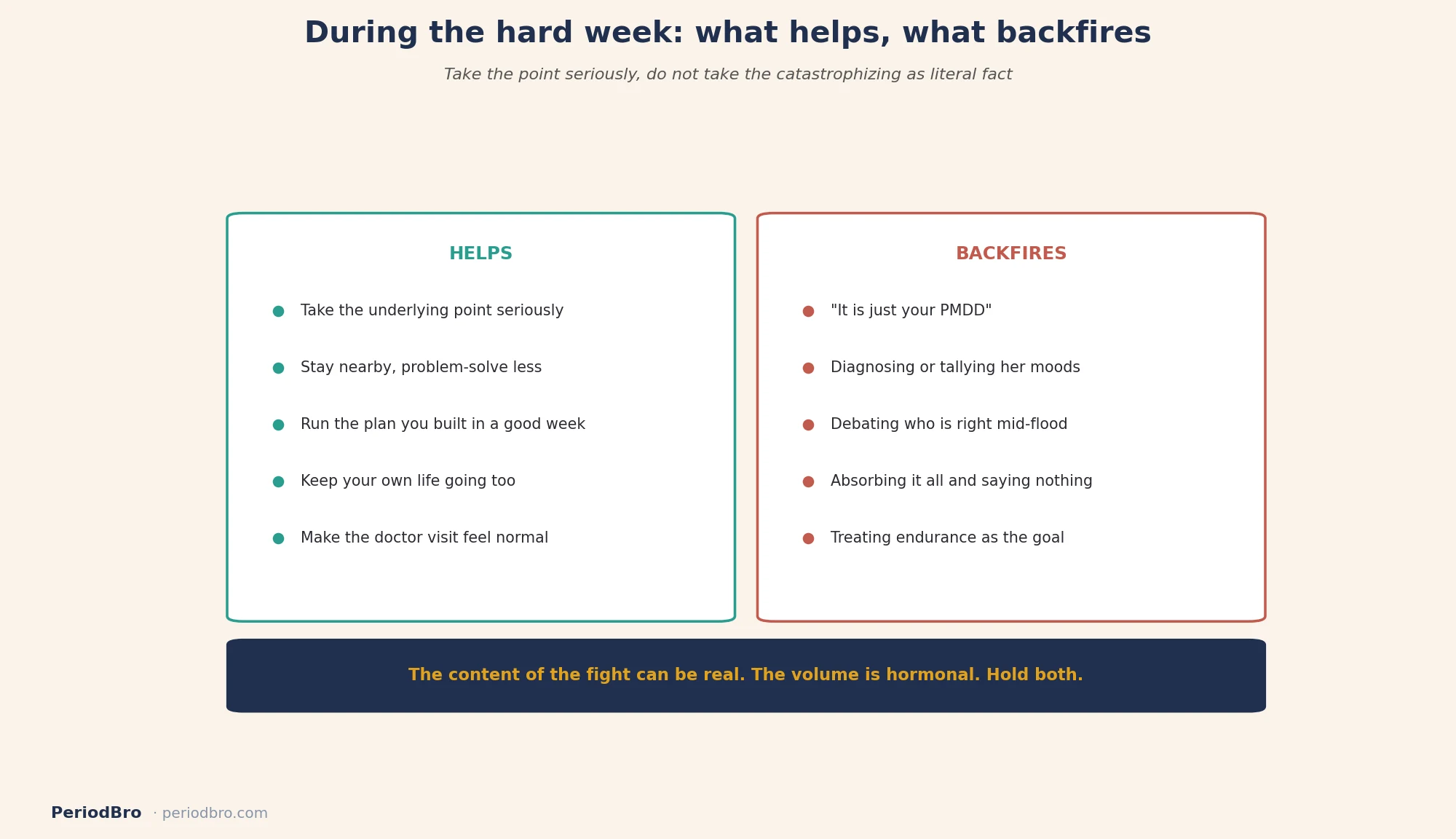
Most PMDD conflict isn’t really about the dishes or the tone or whatever the surface fight names. During the luteal window, small frustrations get amplified and the brain reaches for worst-case interpretations, so a normal-sized grievance can arrive at the door sounding like “this whole thing is broken.” The content of the fight is often real. The volume is hormonal.
The useful move is to hold two things at once. Take the underlying point seriously, because dismissing it as “just your PMDD” is its own kind of insult, and it’s a fast way to make her feel unseen. But don’t take the catastrophizing as literal fact about the relationship. When the rage spikes specifically, the same logic applies, and we went deep on that in why the anger spikes.
What this doesn’t mean
A few guardrails, because this is easy to get wrong. This doesn’t mean every conflict is PMDD; sometimes you actually messed up, and reaching for “she’s just premenstrual” is a cheap dodge. It doesn’t mean you should diagnose her, keep a secret tally, or announce mid-argument that she’s hormonal. And it doesn’t mean the goal is to endure. PMDD is treatable, and the direction of travel should be toward help, not toward you white-knuckling it forever. The difference between ordinary PMS and PMDD is worth understanding clearly, which is what PMS versus PMDD is for.

Don’t lose yourself being the steady one
Here’s the part the couples advice usually skips. Being the reliable presence through a recurring hard week is a real load, and if you carry it silently for long enough, resentment starts leaking out sideways, usually at the worst possible time. The research backing this up is the same study that measured her strain, and it found partners reporting lower quality of life across caregiving stress and personal wellbeing (PLOS One). You’re allowed to find this hard.
Practically, that means keeping your own life running through her luteal window instead of putting everything on hold, having someone you can talk to who isn’t her, and not treating “I absorbed all of it and said nothing” as the goal. A partner who’s quietly depleted is less useful than one who’s honest about his limits in a calm week. Protecting yourself isn’t the opposite of supporting her. It’s what makes the support last past a few months.
Plan it in a good week
The single highest-leverage move is to build the plan when things are calm, not mid-storm. In a good week, ask her what actually helps during the hard stretch and what makes it worse, and write it down together. For a lot of couples the answer is specific and a little surprising: less problem-solving, more just staying nearby; a heads-up text instead of a big talk; permission to name the window out loud without it being a weapon. When the luteal phase arrives, you’re both running a plan you agreed to, instead of improvising while flooded. That one shift turns the recurring fight into a recurring routine.
When it’s time to get help, and one line you can’t skip
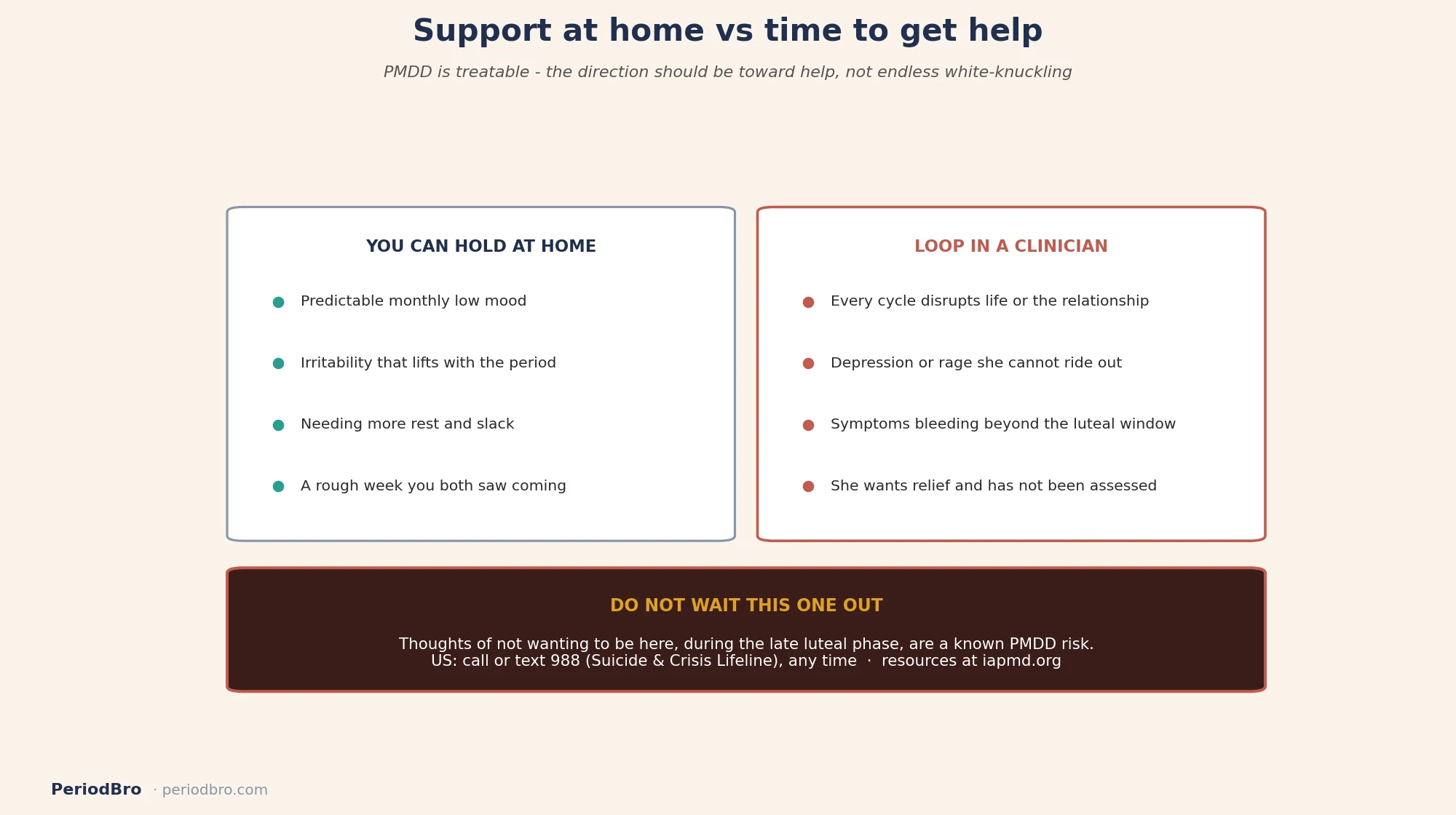
PMDD responds to treatment. SSRIs, sometimes dosed only during the luteal window, can work quickly, and there are hormonal and lifestyle routes too. That’s a conversation for her and a clinician, not for you to prescribe, but you can be the person who makes the appointment feel normal instead of shameful.
One thing you cannot treat as ordinary: PMDD carries a real risk of suicidal thoughts during the late luteal phase. If she ever talks about not wanting to be here, or you feel genuinely scared for her, that’s not a cycle thing to wait out. In the US she can call or text 988 for the Suicide and Crisis Lifeline, any time. The International Association for Premenstrual Disorders is a good resource for both of you. Knowing where the line is doesn’t mean you expect to cross it. It means you’re not caught flat-footed if you do.
FAQ
Can a relationship survive PMDD? The research is oddly reassuring here: couples report real cyclical strain, but love and commitment tend to stay intact. Survival usually comes down to understanding the pattern and getting her real support, not to gritting through it.
Is it wrong to track her cycle so I can see the window coming? Not if she knows and it’s in service of preparing rather than policing. Knowing the luteal window is coming lets you plan instead of react.
Should I bring up PMDD if she’s never named it? Gently, and as a question, not a verdict. “I’ve noticed a pattern around this time of the month, is that something you want to look into together?” lands very differently than telling her what she has.
Bottom line
PMDD is a cyclical, treatable condition that makes a hard week genuinely hard, for her and for you. The relationship-level truth is that the surface swings are real but the foundation usually holds, and the job isn’t to endure quietly. It’s to understand the pattern, take her seriously, protect yourself too, and steer toward real help. That’s a job you can actually do.
This article is educational and not medical advice. PMDD is a clinical diagnosis, so any decisions about treatment belong with a qualified professional. If you or your partner are in crisis, contact the 988 Suicide and Crisis Lifeline (US) or your local emergency services.