
Is She Mad at Me or Is It Her Period? How to Tell the Difference
She’s short with you at dinner. One-word answers, no eye contact, the kitchen drawer closes harder than it needs to. And somewhere in your head a little courtroom convenes: is she mad at me or is it her period? I spent years handling that question the worst possible way, which is silently. I’d tiptoe for two days, guess wrong in both directions, and manage to be annoying when she wanted space and absent when she wanted backup.
There’s a better way to run this, and it takes about ninety seconds. Three checks, one honest question, and a calendar. Let’s go.
Why guessing makes it worse
When you guess, you can fail in two directions, and both are expensive.
Guess “it’s her period” when something real is wrong, and you’ve dismissed a legitimate grievance with biology. Nothing lands worse than “is it that time of the month?” delivered to a person who’s upset because you forgot something that mattered. You didn’t just miss the problem. You added a second one.
Guess “she’s mad at me” when it’s actually her cycle, and you start apologizing for crimes nobody charged you with, which reads as guilty, which invites a search for what you’re guilty of. We wrote a whole piece on why reflex apologies backfire, and this is the classic setup.
The numbers say this ambiguity will visit most couples: up to 90 percent of people who menstruate report at least one premenstrual symptom, and 20 to 30 percent meet criteria for PMS. Mood shifts before a period are common. So are real grievances. Your job is telling them apart without insulting her in the process.

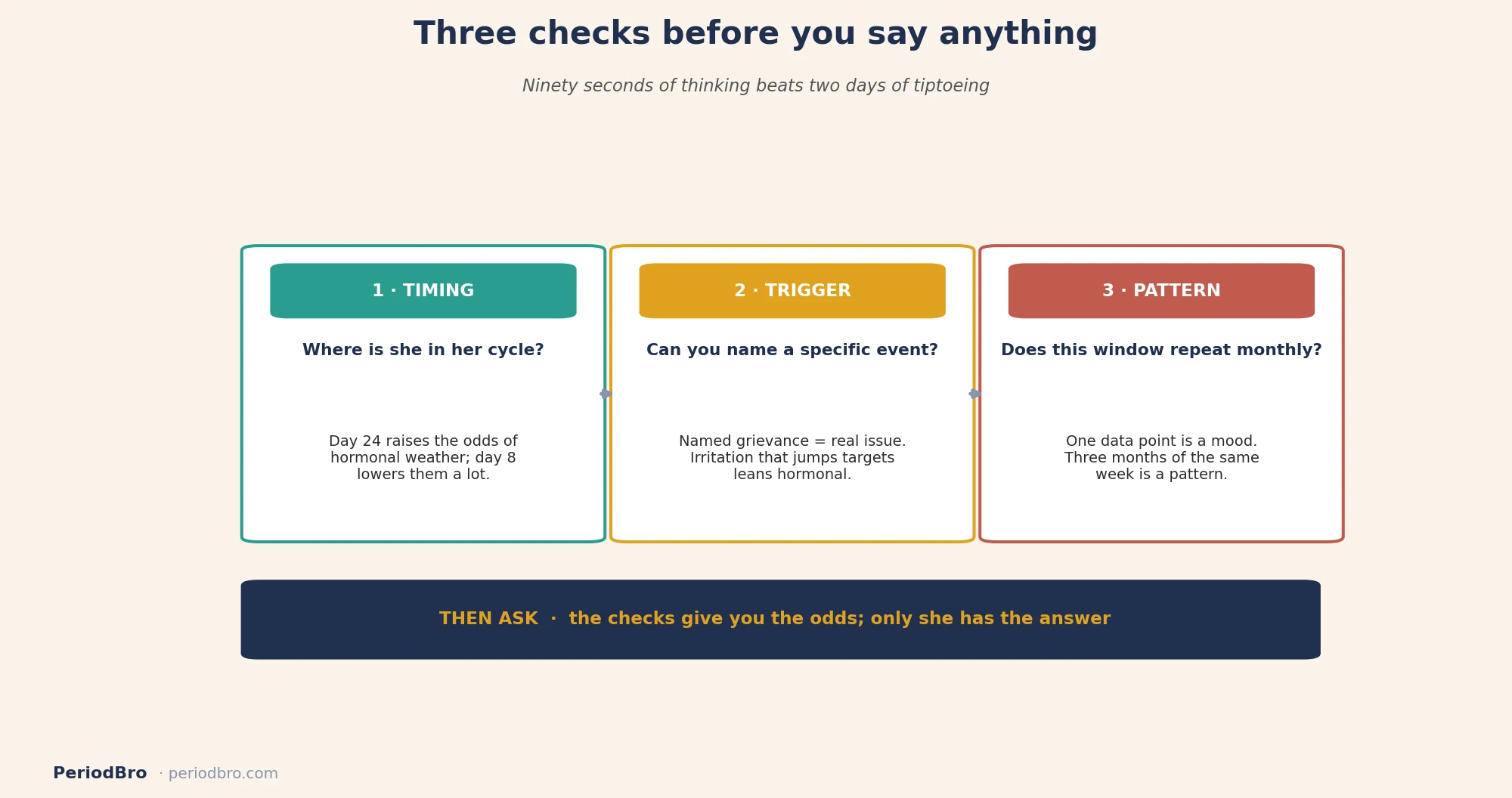
Three quick checks before you say anything
Check 1: the timing
PMS has a signature schedule. By the clinical definition, symptoms show up in the days before her period and ease within a few days after it starts. If you know where she is in her cycle, you have real information: day 24 raises the odds it’s hormonal weather, day 8 lowers them a lot. If you don’t know where she is in her cycle, that’s fixable, and it’s the whole reason cycle awareness for partners exists.
Check 2: the trigger
Ask yourself what happened in the last day or two, concretely. A named, specific event (you cancelled plans, you made a joke that landed wrong, the thing she asked you to handle is still not handled) points to an actual grievance, whatever the calendar says. No identifiable trigger, plus irritation that jumps between targets (you, traffic, her boss, the drawer), leans hormonal. Researchers consistently find irritability and mood swings are among the most common premenstrual emotional symptoms, and they characteristically lack a single clean target.
Check 3: the pattern
Zoom out three months. Does friction between you two spike in the same window each cycle? One data point is a mood, three is a pattern. This is the check that guessing can never do and tracking does automatically. It’s also the one that saves you from the recency trap of treating this week’s coldness as brand new information about your relationship.
It can be both, and often is
The “it’s just PMS” crowd and the “never blame hormones” crowd miss the same thing: the late luteal phase rarely invents problems out of nothing. It amplifies the ones already there. The drop in estrogen before her period pulls down serotonin along with it, which shortens fuses and darkens filters. A dish you left in the sink in week two is a dish. The same dish in week four is evidence of everything wrong since the wedding.
So the answer to “is it real or is it hormones” is frequently: the grievance is real, the volume is hormonal. Treat the content seriously and the intensity gently. That single move, taking the complaint seriously without matching its temperature, resolves more of these evenings than any script.

How to actually ask
After the three checks, you still ask. The checks tell you the odds; only she knows the answer. The trick is asking in a way that doesn’t accuse her of malfunctioning.
The script: “Hey, you seem off tonight. Did I do something, or is it just a heavy day? Either answer is fine, I just want to get it right.”
Why it works: it names what you observed without diagnosis, it offers both doors so she doesn’t have to volunteer the vulnerable one, and it makes your motive explicit. Compare it to the crime-scene versions: “what’s wrong NOW” (accusation), “are you PMSing?” (dismissal), and silence (abandonment dressed as politeness).
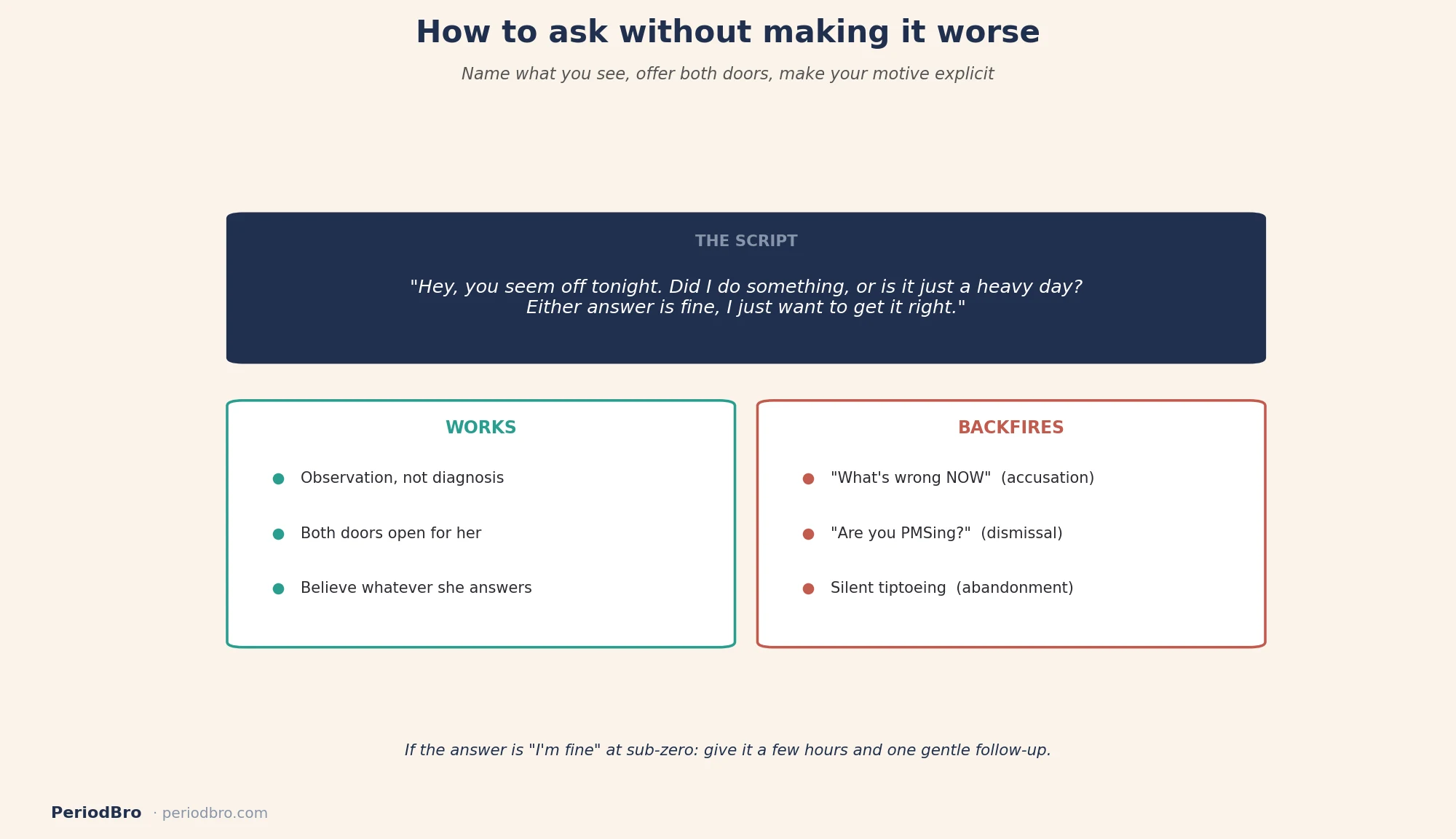
Whatever she answers, believe it. If it’s “I’m fine” delivered at sub-zero temperature, give it a few hours and one gentle follow-up, and see our guide on not taking it personally when she pulls away. And whatever you do, stay off the list of the worst things to say on her period.
What tracking tells you that guessing can’t
Everything above works ten times better with a calendar behind it. Tracking her cycle (with her knowledge, on your own phone) turns check 1 from a guess into a lookup and check 3 from vague memory into visible pattern. It means you walk into that dinner already knowing it’s day 25, so the coldness reads as information instead of ambush, and you adjust before the courtroom in your head even convenes.
It also changes what you do beforehand. Knowing the window is coming means the dishwasher gets emptied, the plans stay light, and the hard conversation about the in-laws waits until next week. We covered why she gets angry before her period and what to say when she has PMS if you want the full playbook for those days.
When it’s more than PMS
One flag worth knowing about. If the premenstrual window at your place isn’t “short-tempered and tired” but “the relationship nearly ends every month,” you might be looking at PMDD, a severe form that affects roughly 2 to 6 percent of people who menstruate and deserves a doctor, not just a patient boyfriend. Here’s how to tell PMS from PMDD. Severe symptoms that wreck her life every cycle are treatable, and taking them to a clinician is an act of support, not betrayal.
FAQ
So is she mad at me or is it her period?
Run the checks: timing (where is she in her cycle), trigger (can you name a specific recent event), pattern (does this window repeat monthly). Then ask her the two-door question and believe the answer. If it’s cycle-related, support mode. If it’s a real grievance, repair mode. If it’s both, fix the real thing gently.
Is it ever okay to mention her cycle during an argument?
During? Almost never; mid-conflict it always sounds like “you’re being irrational.” The place for cycle talk is a calm moment later: “I noticed that week is often rough. Anything I can do differently next time?”
What if she says “I’m fine” but clearly isn’t?
“I’m fine” often means “I can’t get into this right now.” Don’t drill. Stay warm, stay nearby, lower the household load, and let her come to it. Pressure to talk is still pressure.
How do I know what cycle day she’s even on?
You track it, openly. If she already uses a tracker and shares the basics, work from that. If not, note the first day of her period whenever it comes up naturally (she mentions it, the supplies run low) and count forward on your own phone. You’re keeping the same kind of calendar you’d keep for anything that matters in your shared life, and she should know it exists. We wrote a full guide to tracking her cycle with consent if the idea makes either of you hesitate.
The short version
Guessing punishes you twice: you miss real problems and you invent fake ones. Timing, trigger, pattern, then one honest question. And if you’d rather look at data than read tea leaves, PeriodBro tells you where she is in her cycle, so you can stop guessing and just ask the right way.
This article is for information only and isn’t medical advice. If premenstrual symptoms are seriously disrupting her life or your relationship, a clinician is the right next step.