
Hysterectomy Recovery for Partners: What the Weeks at Home Look Like
The surgery takes a couple of hours. The recovery takes weeks, and most of it happens at home, on your couch, in your kitchen, with you around. If your partner is about to have a hysterectomy, or just had one, this guide to hysterectomy recovery for partners covers what the weeks actually look like, which rules matter, and where you come in.
Short version: she’ll be told to rest and to stay away from anything heavy. Home life makes both harder than they sound, and most of that load is something you can take over.
What a hysterectomy is, in plain terms
A hysterectomy removes the uterus. Sometimes the cervix goes too, sometimes the ovaries and fallopian tubes, depending on why she’s having it. Common reasons include fibroids, heavy bleeding that hasn’t responded to other treatment, endometriosis, adenomyosis, prolapse and some cancers (Cleveland Clinic). If you’ve been living with one of those for a while, our guides on fibroids and heavy periods and adenomyosis for partners may sound familiar.
Two facts are worth having straight before the surgery date. First, her periods stop for good once the uterus is gone. Second, whether she goes into menopause depends on the ovaries, not the uterus. If both ovaries are removed, menopause starts right away. If they stay, her hormones usually keep cycling, though some people notice menopause arriving a little earlier than it otherwise would (Office on Women’s Health). Ask her surgeon which applies, because it changes what the next few months look like.
Hysterectomy recovery for partners: the timeline
How long recovery takes depends mostly on how the surgery is done. Vaginal and laparoscopic (keyhole) operations usually mean a shorter hospital stay and a faster recovery. An abdominal hysterectomy, with a larger cut across the lower belly, typically means up to five days in hospital and around six to eight weeks before she feels fully recovered (NHS). Cleveland Clinic gives four to six weeks as a typical range overall.
A few milestones come up for almost everyone:
- Walking starts early, often the same or next day. Short walks help with circulation and gas pain.
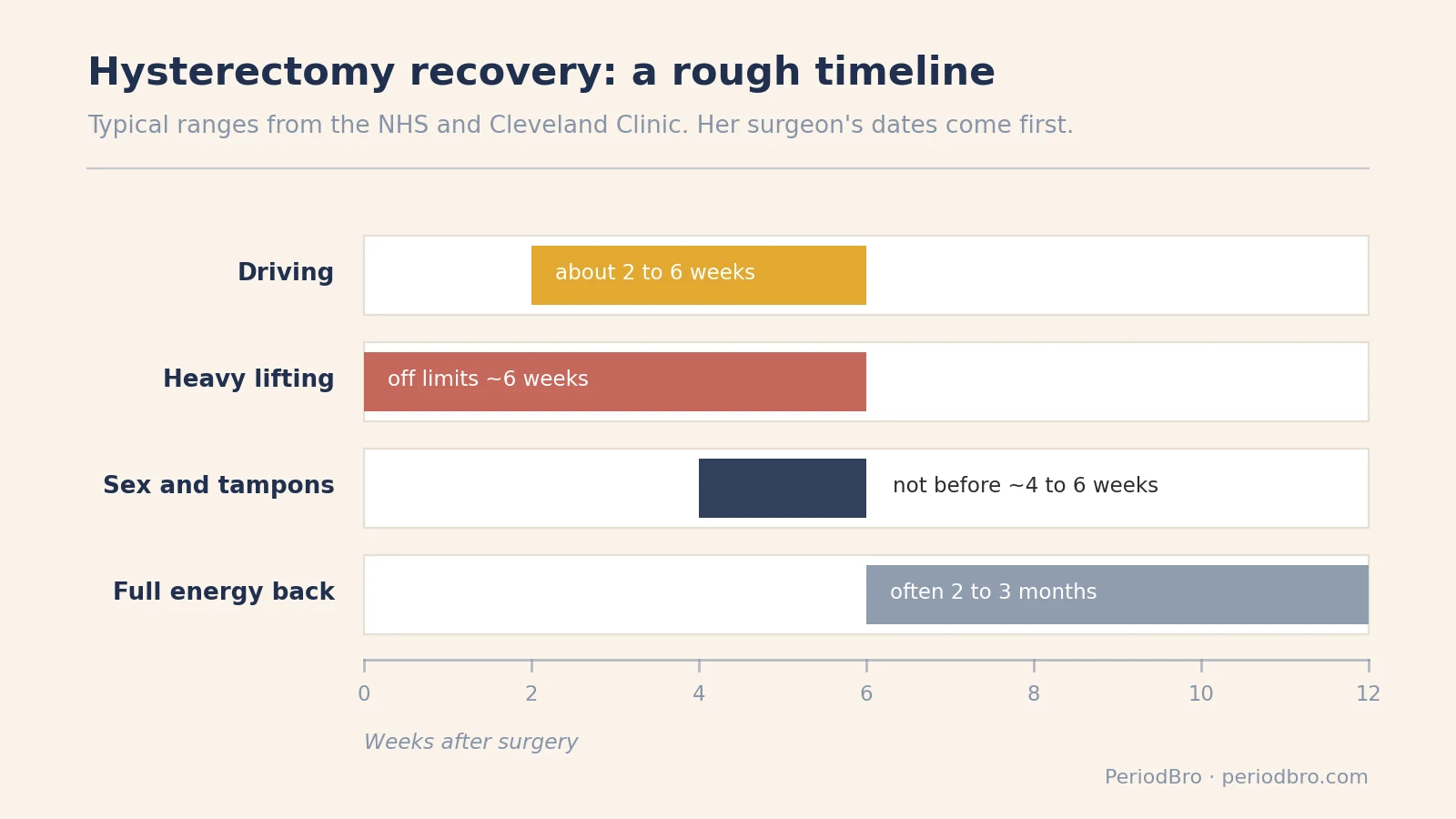
- Driving usually waits until she can wear a seatbelt comfortably and do an emergency stop without pain, roughly two to six weeks in (NHS).
- Sex and tampons wait until the internal stitches have healed, usually at least four to six weeks, and often longer if her surgeon says so.
- Work may be possible after six to eight weeks for a desk job, longer if the job is physical.
Her surgeon’s instructions win over anything you read here, including this. Write them down at discharge, because she’ll be groggy and you won’t remember them either.
The lifting rule, and why it’s harder than it sounds
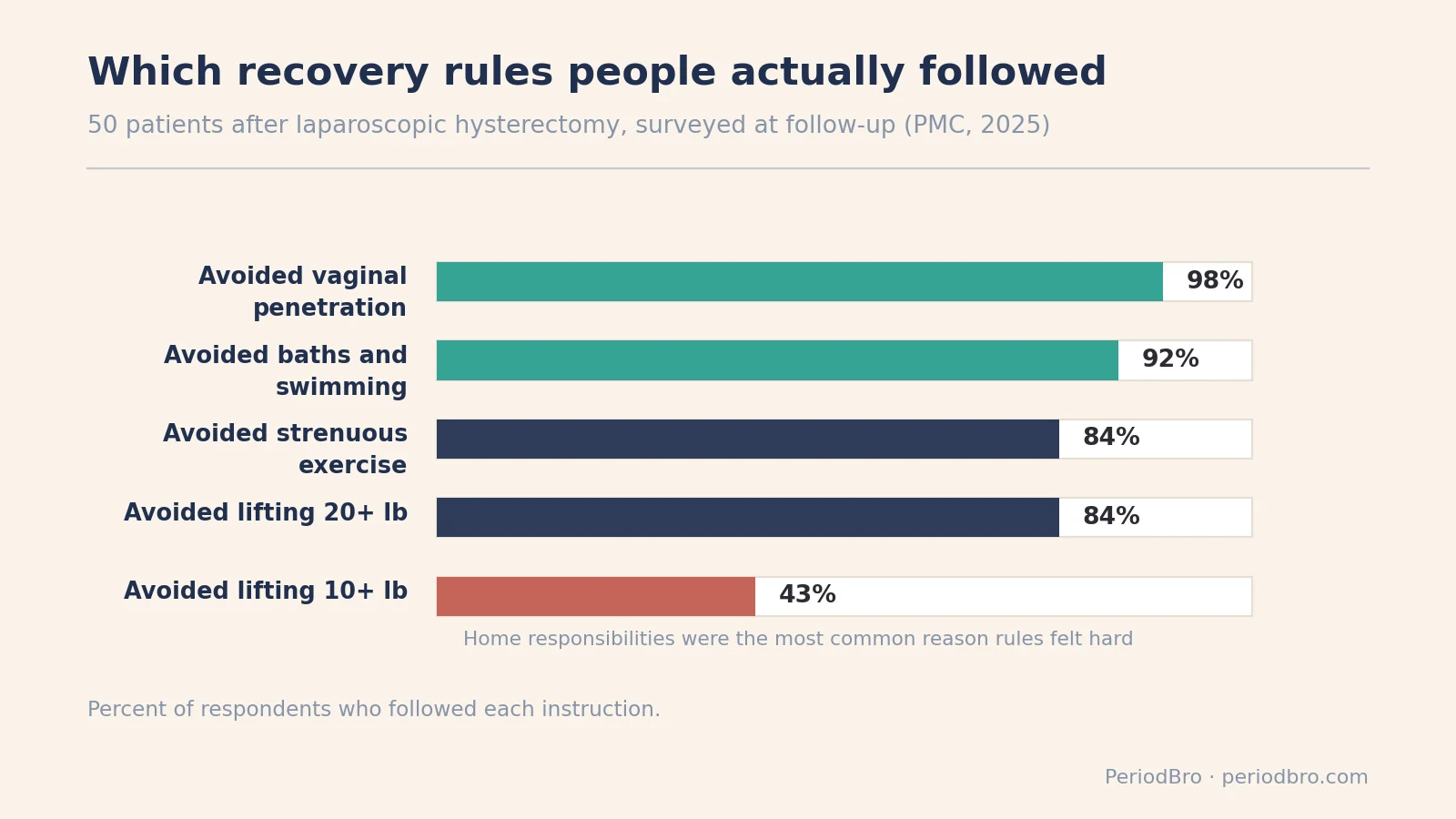
Most surgeons tell patients not to lift more than about ten pounds for several weeks. Ten pounds is a full laundry basket, a big bag of groceries, a toddler, or a large bag of cat litter. It’s surprisingly easy to break this rule without noticing.
A 2025 survey of 50 people recovering from a laparoscopic hysterectomy found that only 43% stuck to the ten-pound limit, even though they’d been told to. Nearly all of them followed the rule about no vaginal penetration. About 45% said the restrictions were at least a little hard to follow, and the most common reason they gave was responsibilities at home (PMC). The same paper points out that the evidence for exact lifting limits is thin, so nobody’s sure ten pounds is the magic number. It’s still the instruction she’s been given, and the reason people break it is mostly the household.
For the first month, those jobs are yours: laundry, shopping bags, the bins, lifting the kids, the dog food, the vacuum. If something heavy needs moving, it waits for you.

The first two weeks at home
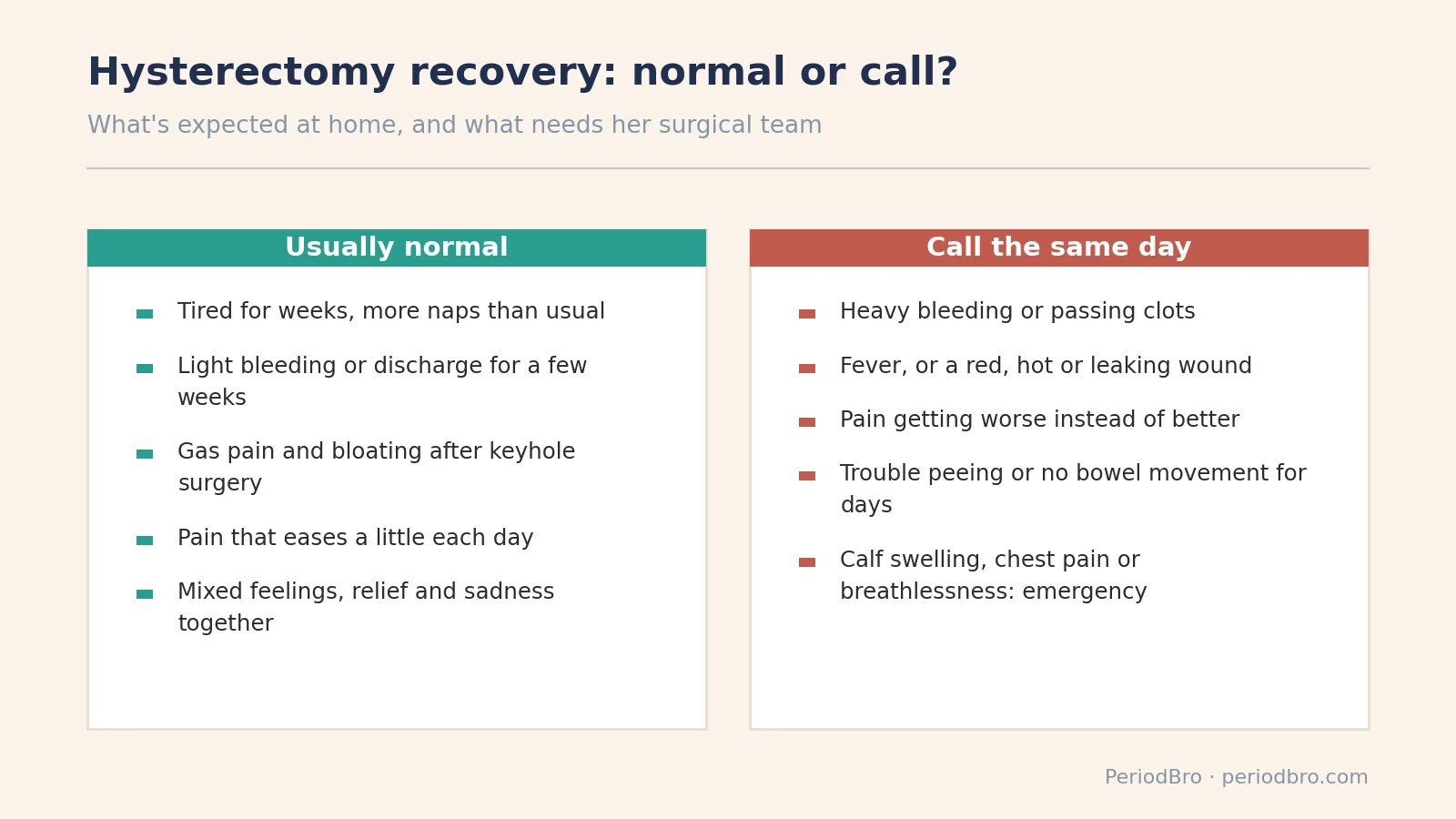
Expect her to be tired in a way that sleep doesn’t fully fix. Anesthesia, blood loss and healing all take energy. Pain usually improves day by day, though gas pain and bloating can surprise people after keyhole surgery. Some light bleeding or discharge for a few weeks is normal.
Practical things that help:
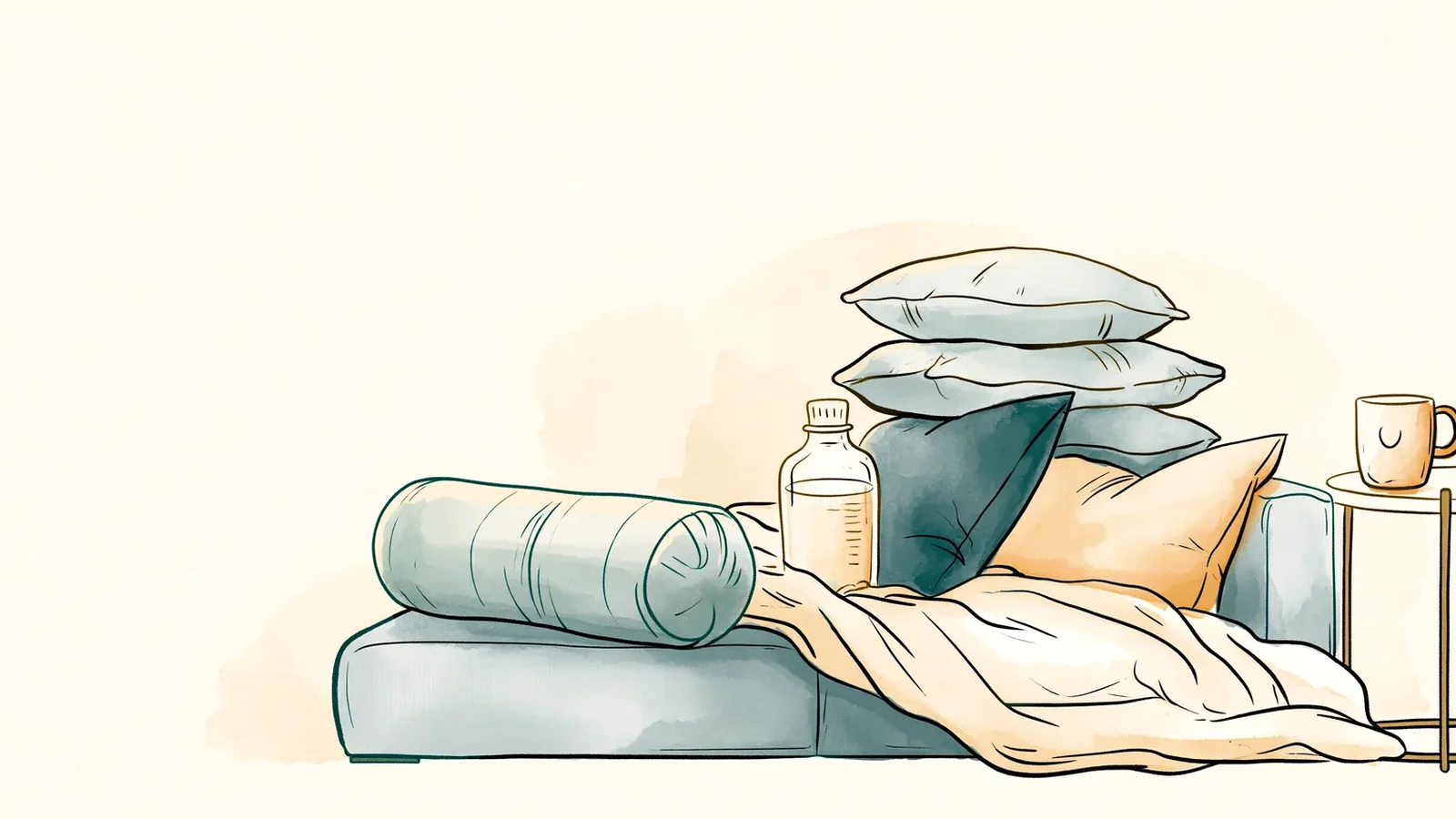
- Set up one rest spot with pillows, water, phone charger, painkillers, snacks and the remote within reach, so she isn’t getting up and down for small things.
- Keep the medication schedule on your phone. Painkillers work better taken on time than chased once pain is bad.
- Make walking easy. A slow loop around the block together counts.
- Handle the gatekeeping. Visitors are nice for 20 minutes. You can be the one who says she’s tired.
- Prep food in advance or line up a few people to drop meals. Bending to the oven and lifting pots is the kind of thing she’ll try to do “just this once.”
One of my buddies went through this with his wife a couple of years ago. His big lesson was that she felt fine around day ten, cleaned the kitchen top to bottom, and spent the next two days flat on the couch. After that he started taking the hard jobs off the list before she could reach them, and swapped “do you need anything?” for quietly doing the next obvious thing.
Warning signs to call the surgeon about
Most recoveries are uneventful. A few things are worth a same-day call, and it helps if you both know them before discharge:
- Heavy bleeding, passing clots, or discharge with a strong smell (NHS).
- Fever, chills, or a wound that’s getting redder, hotter or leaking.
- Pain that’s getting worse instead of better.
- Trouble peeing, burning when peeing, or no bowel movement for several days.
- A swollen, painful calf, chest pain or sudden shortness of breath. These need emergency care, not a callback.
The emotional side nobody puts on the discharge sheet
For some people a hysterectomy is pure relief. Years of pain or heavy bleeding are over. For others it’s mixed. The NHS notes that a sense of loss is common, especially for anyone who’d hoped to have children or who feels the surgery changes how they see themselves (NHS). Plenty of people feel both at once.
There’s also longer-term data worth knowing about. A Mayo Clinic study that followed about 2,000 women for over 20 years found that those who had a hysterectomy with their ovaries kept had a modestly higher risk of developing depression and anxiety later, and the risk was higher for those who had surgery before 35 (Mayo Clinic via Newswise). That’s an association, not proof the surgery causes it, and most people don’t develop either. It does mean low mood that lasts for weeks deserves a doctor’s attention instead of a “give it time.”
If her ovaries were removed, menopause symptoms can arrive quickly: hot flashes, poor sleep, mood swings, vaginal dryness. Hormone therapy is often an option and is worth asking about early. Our piece on perimenopause for partners covers what those symptoms feel like from the other side of the bed.
What helps here is mostly listening. You don’t have to fix the feeling or argue her out of it. “That makes sense” goes further than “but you’ll feel so much better now.” If you struggle with that, we wrote how to be supportive when you can’t fix her pain for exactly this.
Sex after a hysterectomy
The surgeon will give a clear “not before” date, usually around six weeks or later. After that, go slow and let her lead. Some people find sex better once the pain that led to surgery is gone. Others notice dryness or lower desire, especially if their ovaries were removed (NHS). Lubricant helps. So does treating the first few times as a gentle check-in with no pressure attached. If sex hurts after she’s been cleared, that’s worth raising with her doctor, and why sex hurts her covers the usual reasons.

After the six-week mark
Being cleared by the surgeon doesn’t mean full energy. Many people say it takes two to three months before they feel properly like themselves again. Keep taking the heavier jobs for a while after you technically don’t have to. If she still has her ovaries, she may still notice cycle-related mood and energy changes, without a period to mark them. That surprises a lot of couples, and it’s where paying attention to her patterns still helps. Our guide on how partner support affects her period explains why the steady background stuff matters more than the grand gestures.
I built PeriodBro so partners have a simple way to stay on top of what’s going on in her body and what might help today. If that’s useful to you, you can try it free here.
PeriodBro provides educational information and is not a substitute for professional medical advice. Always follow her surgical team’s instructions and consult a qualified healthcare provider for personal medical decisions.