Fibroids and Heavy Periods: What Partners Should Know
She soaks through a super tampon in under an hour. She doubles up on protection to leave the house. She sets an alarm to change things at 3am. If that sounds like her, fibroids and heavy periods is a conversation worth having, because a bleed like that usually has a cause sitting behind it.
Fibroids are the most common one, and almost nobody explains them to the person standing next to it. So: what they are, what they do to a cycle, and where you come in.
What fibroids are
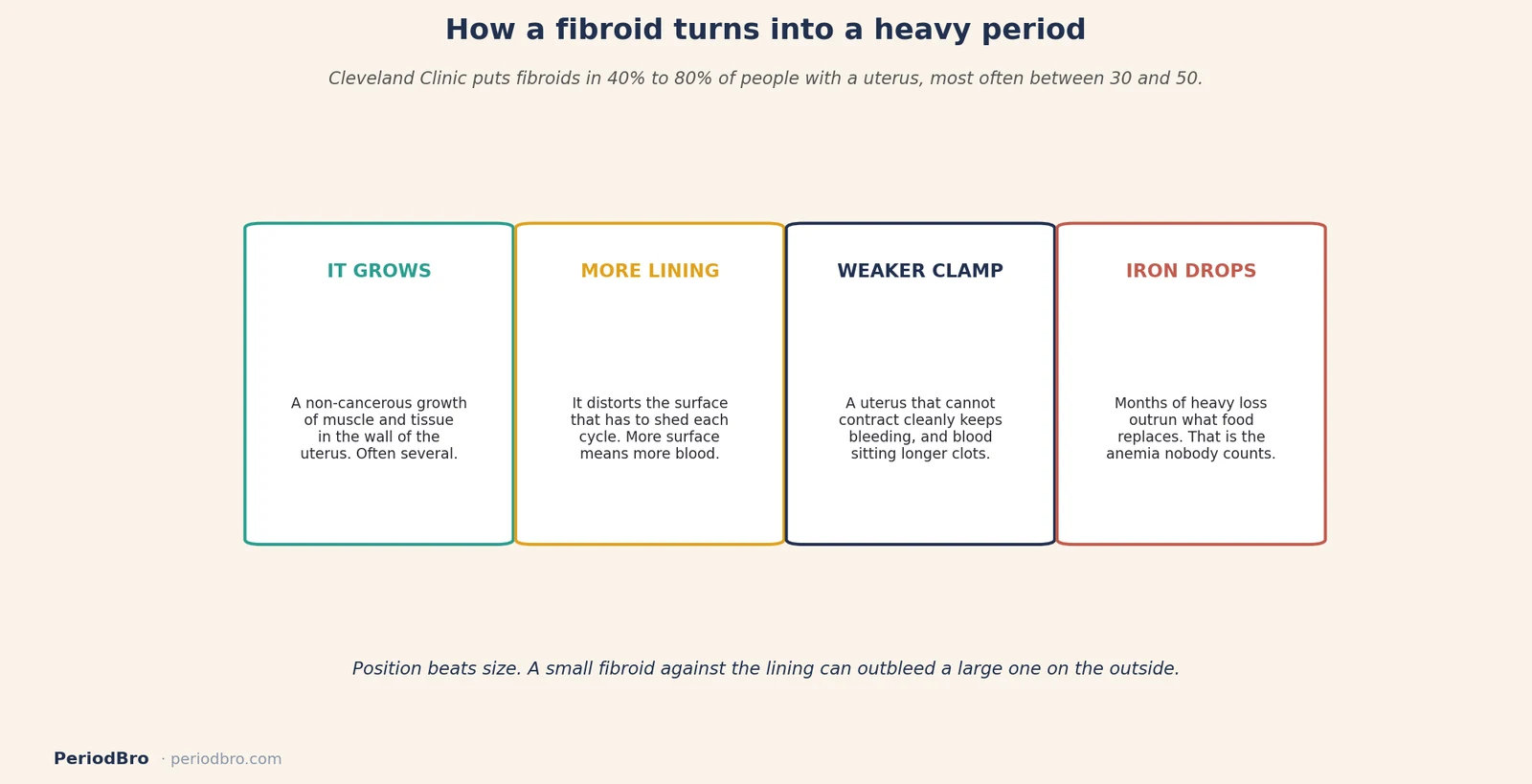
Fibroids are non-cancerous growths of muscle and tissue in the wall of the uterus. Cleveland Clinic puts them in 40% to 80% of people with a uterus, most often between the ages of 30 and 50, and they shrink after menopause when the hormones driving them drop off.
That number surprises most people. Fibroids are not rare and they are not a diagnosis of something ominous. Plenty of people have them and never know, because a fibroid only causes trouble depending on where it sits and how big it gets.
Size varies wildly. Cleveland Clinic describes them running anywhere from a millimeter to more than 20 centimeters across. And there are four types by position: intramural inside the uterine wall, which is the most common, submucosal pushing into the cavity itself, subserosal on the outer surface, and pedunculated hanging off a stalk.
Position matters more than size for bleeding. A small submucosal fibroid sitting right against the lining can cause more chaos than a much larger one growing on the outside.
Why fibroids and heavy periods go together
The mechanism is mechanical, and once you see it the whole picture makes sense.
Every cycle, the uterine lining builds up and then sheds. A fibroid distorts the surface that has to shed and the muscle that has to clamp down to stop the bleeding. More surface area, plus a uterus that cannot contract cleanly, equals more blood and a longer period. That is also why clots show up. Blood sitting in the cavity longer has time to clot before it leaves, which we covered in our piece on period blood clots.
Bleeding is not the only symptom. Cleveland Clinic also lists bleeding between periods, pain during sex, low back pain, needing to pee constantly when a fibroid presses on the bladder, and a bloated or enlarged look to the abdomen that does not track with what she has eaten.
The bloating one gets misread constantly. If she says her stomach looks different and it has nothing to do with what she ate, she may be describing a symptom rather than being hard on herself about her body.
The part nobody warns you about: the iron
Heavy bleeding month after month drains iron faster than food replaces it, and the result is iron-deficiency anemia. That is what turns fibroids from a period problem into a whole-life problem. The Office on Women’s Health flags menorrhagia from fibroids as severe enough to cause it, and notes iron supplements as part of standard management.
Anemia does not feel like a bleeding problem. It feels like being tired in a way sleep does not fix, being cold, getting winded on stairs that used to be nothing, brain fog, and a heart that pounds after minor effort. Any of that can get chalked up to stress, work, or getting older.
The pattern worth watching for is heavy periods running alongside exhaustion that never lifts. If you have already read our piece on period fatigue, this is the version that does not stop when the period does.
A friend of mine watched his wife get gradually more wiped out over about two years. They both put it down to a demanding job. A blood test at an unrelated appointment found her ferritin near the floor, and the ultrasound after that found the fibroid. Two years of “she is just tired lately” was actually a slow bleed nobody was counting.

What counts as heavy enough to get checked
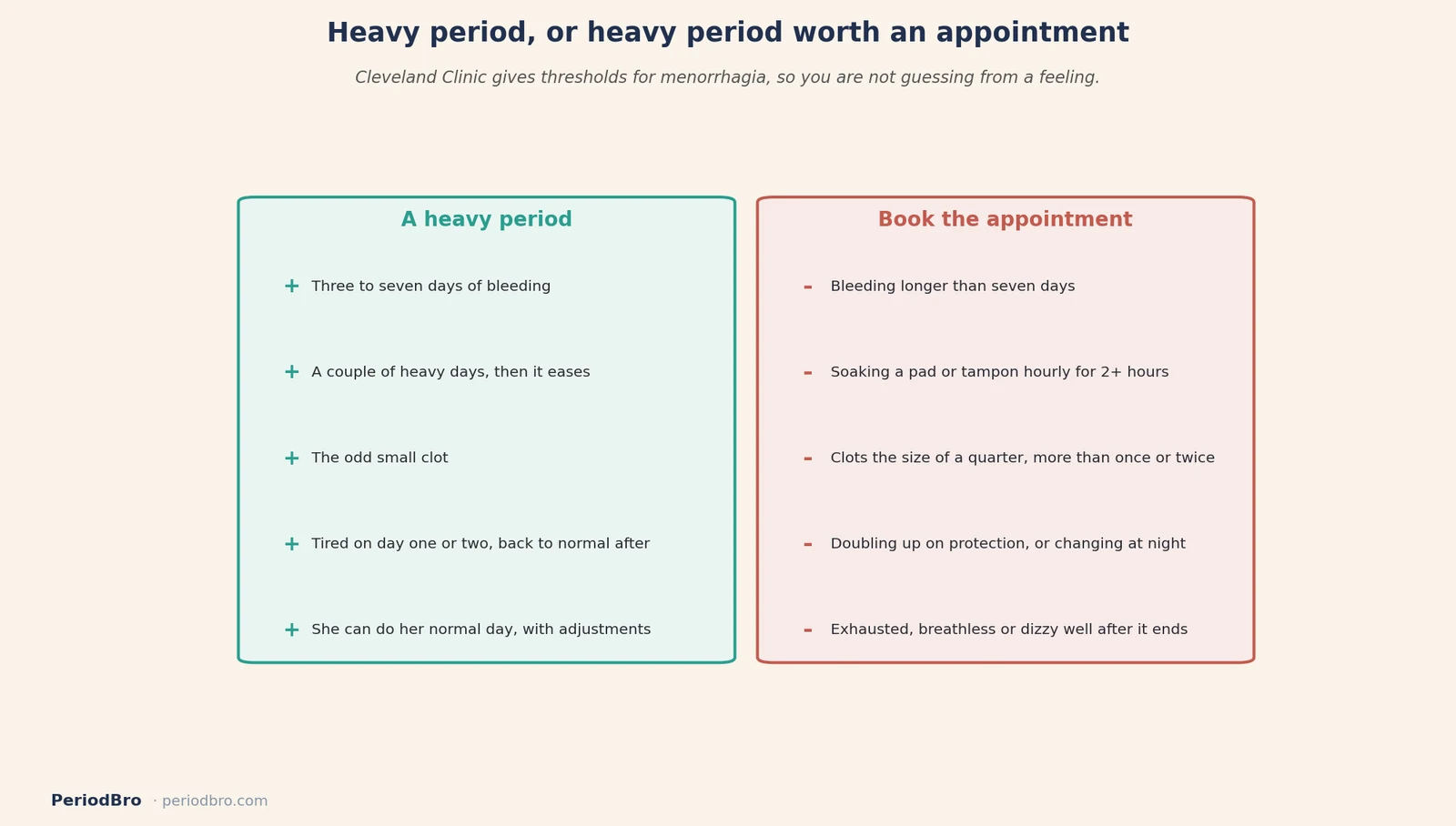
“Heavy” is useless as a word because everyone calibrates against their own normal. Cleveland Clinic’s criteria for menorrhagia are specific, and they give you something concrete instead of a vibe:
- Periods lasting longer than seven days
- Soaking through one or more pads or tampons every hour for more than two hours in a row
- Doubling up on protection to get through the day
- Waking up at night to change
- Passing clots the size of a quarter or bigger, more than once or twice
- Not being able to do ordinary things during her period
Cleveland Clinic also flags bleeding through two or more pads or tampons an hour for two to three hours running as a reason for emergency assessment rather than a wait-and-see.
Fibroids are one cause of heavy bleeding among several. Polyps, adenomyosis, thyroid problems, ovulation disorders, PCOS, and bleeding disorders like von Willebrand disease are all on the same list. That is exactly why the answer is an appointment rather than an internet diagnosis from you.
How it actually gets diagnosed
Usually with a pelvic ultrasound, which is quick and available anywhere. Cleveland Clinic also lists MRI, CT, hysteroscopy, and specialized X-ray imaging for cases that need a better look, and bloodwork typically goes alongside it to check whether she is anemic.
The single most useful thing anyone can bring to that appointment is a record. Dates, how many days of heavy flow, how often she was changing protection, whether there were clots, and how she felt in the week after. Six months of that turns “my periods are really heavy” into data a clinician can act on in ten minutes. Our guide on helping with heavy periods covers the tracking side in more detail.
What treatment looks like
There is a lot more middle ground than most people assume, and the fear that stops people booking is usually the assumption that it goes straight to surgery.
Cleveland Clinic lists over-the-counter pain relievers, iron supplements for the anemia, hormonal birth control to control bleeding, and GnRH agonists that shrink fibroids temporarily. Then there are procedures that keep the uterus: myomectomy to remove fibroids, uterine fibroid embolization to cut off their blood supply, and radiofrequency ablation. Hysterectomy is the definitive option and it is the end of the list, not the start of it.
Which one fits depends on her symptoms, the size and position of what is there, and whether she wants a pregnancy later. That is a conversation between her and her clinician, and your job is not to have an opinion about which one she picks.
What you can actually do
Believe the description. Someone who has bled heavily since her teens has no baseline to compare against and often assumes this is what everyone deals with. Hearing “that sounds like a lot, is that normal for you?” from a partner is frequently what starts the process.
Count something. Not because she cannot, but because when you are bleeding heavily and running on low iron, you are not in a great position to keep records. Cycle dates and heavy-day counts are the two most useful.
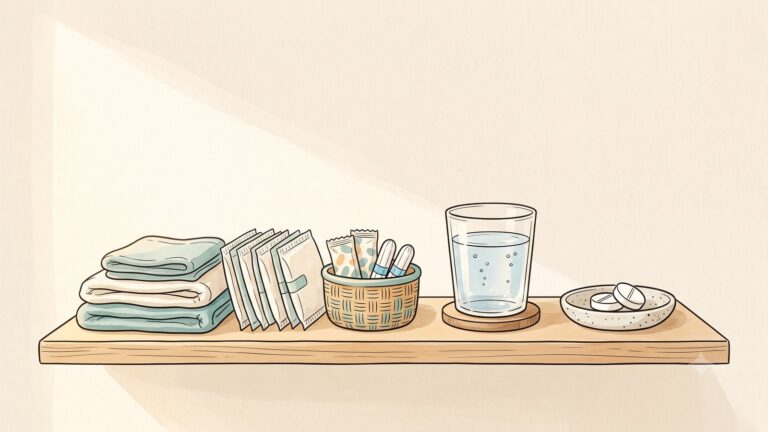
Handle the logistics without commentary. Extra supplies in the bathroom and the car, dark sheets, laundry done without a discussion. This is the same principle as being supportive when you cannot fix her pain: remove friction rather than offering solutions.
Ask to come to the appointment. Ask, do not announce. If she says yes, you are there to remember what was said, not to speak for her.
Do not turn it into a project. Nobody wants their body researched at them. One clear “this seems worth getting checked, and I will come with you if you want” does more than a folder of printouts.
All of this is the same muscle we keep coming back to in being a better partner through her cycle, applied to something with a name and a treatment path.
Common questions
Are fibroids cancer?
No. Fibroids are non-cancerous growths. Cancerous ones exist but they are rare, and a fibroid found on an ultrasound is overwhelmingly likely to be exactly what it looks like.
How common are they, really?
Cleveland Clinic puts the range at 40% to 80% of people with a uterus. The Office on Women’s Health cites 20% to 80% developing them by age 50. Wide ranges, because plenty of fibroids are found by accident in people who had no symptoms at all.
Can fibroids affect getting pregnant?
They can, depending on size and position, and the Office on Women’s Health notes a higher likelihood of a cesarean delivery. If pregnancy is part of the plan, that belongs in the conversation with her clinician early rather than later.
Do fibroids go away on their own?
They usually shrink after menopause as hormone levels fall. Before that, they tend to stay or slowly grow, which is why treatment is about managing symptoms rather than waiting it out.
Is heavy bleeding always fibroids?
No. Polyps, adenomyosis, thyroid conditions, PCOS, and bleeding disorders can all do it, and endometriosis shows up in the same conversation for pain. The overlap is the reason for imaging instead of guessing.
She has had heavy periods forever and says it is fine. Now what?
Say it once, clearly, without a campaign. That her periods sound heavier than the standard definition, that heavy periods have treatable causes, and that you will go with her if she wants. Then leave it with her.
What should I track if she is open to it?
Cycle start and end dates, days she called heavy, roughly how often she changed protection on the worst day, clots, and energy levels in the following week. That last column is what catches the anemia. Our overview of what counts as normal period pain pairs with it if pain is part of the picture.
This article is general information, not medical advice. Heavy menstrual bleeding has several possible causes and needs assessment by a clinician. Bleeding through two or more pads or tampons an hour for two to three hours in a row, or heavy bleeding with dizziness or shortness of breath, should be treated as urgent.