Period Crying: Why She Gets Tearful Before Her Period (and How to Help)
The first time it happened, I genuinely thought I’d done something. We were watching a show we’d already seen twice, a dog got reunited with its owner on screen, and she just quietly started crying. Not big sad crying. More like the tears showed up before she did. She laughed at herself, wiped her face, and said “I don’t even know why.” A few days later her period started, and the penny dropped.
That’s the thing about period crying. The tears often don’t come with a reason attached. A coffee ad, a slightly short text from a friend, the milk running out – and her eyes fill up over something she’d shrug off any other week. If you’ve ever stood there wondering what you missed, the honest answer is usually that you didn’t miss anything. You’re watching her run low on the brain chemistry that normally keeps her even, and it happens on a schedule.
I’m not writing this to teach you to manage her. I’m writing it because nobody ever sat me down and explained that period crying is a real, physical thing with a real, physical cause. Once I understood that, I stopped treating her tears as a problem I’d caused or had to solve, and started treating them as weather I could see coming. That one shift made me a calmer, better partner. Here’s what’s actually going on.
Why period crying happens
The week or so before a period is the late luteal phase, and it’s when estrogen and progesterone both drop off sharply. Those two hormones aren’t only about reproduction. They’re tangled up with the brain chemicals that regulate mood, which is why so many people feel the back half of their cycle in their feelings, not just their body (ACOG).
Estrogen helps your brain make and use serotonin, the neurotransmitter most tied to feeling steady and okay. When estrogen falls in the back half of the cycle, serotonin activity tends to dip with it – and lower serotonin doesn’t just make you feel down. It nudges the whole system toward reading things as worse than they are (StatPearls, NIH). A neutral comment lands as a criticism. A small letdown feels like proof the day is ruined. And the tears come fast, because the buffer that usually holds them back has thinned out.

Progesterone has a hand in it too. As progesterone rises and then crashes across the luteal phase, so does a calming compound your body makes from it called allopregnanolone, which acts on the same brain system as a stiff drink or an anti-anxiety pill. In brains that are sensitive to that swing, the come-down leaves her more raw, more easily moved, quicker to well up (Frontiers in Psychiatry review, 2023). None of this is weakness, drama, or manipulation. It’s a measurable shift in brain chemistry on a predictable timetable. If you want the bigger picture of how this hormonal swing drives her mood across the whole month, I wrote that up here, and the phase it all happens in is broken down here.

Is it normal to cry before your period?
Short version: extremely. Up to 90% of women report at least one premenstrual symptom, and the mood symptoms – tearfulness, irritability, feeling low, mood swings – are consistently rated the most distressing of the bunch (ACOG). Crying spells specifically show up on basically every clinical list of PMS symptoms there is (Mayo Clinic).
So if the person you love turns into someone who tears up at a phone commercial for a few days each month, she isn’t unusual and she isn’t broken. She’s having one of the most common experiences there is. Period crying that feels like it came from nowhere is, statistically, about as ordinary as cramps – it just gets talked about less, because tears are harder to admit to than a sore stomach.
It also tends to follow a pattern once you know to look for it. The weepiness usually shows up in the last several days before her period and then lifts within a day or two of bleeding starting, as the hormones reset (Cleveland Clinic). That timing is the tell. Sometimes the same swing shows up as worry rather than tears – if that sounds more like her, I covered period anxiety separately. Sadness that has a clear cause and sticks around no matter where she is in her cycle is a different thing, and we’ll get to that.
What actually helps when she’s tearful
Here’s the part most of us get wrong: we try to fix the crying. We ask what’s wrong, we try to solve the thing she’s crying about, we point out that the thing isn’t really that big a deal. All of that, however well-meant, tells her the feeling is a problem to be argued down. It isn’t. The feeling is real even when the trigger is small. A few things that land better:

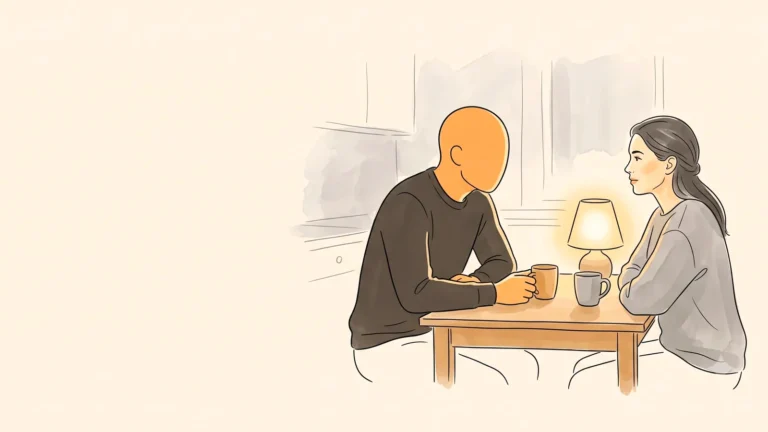
Don’t interrogate the tears. “What’s wrong?” puts her on the spot to justify something she can’t explain. “I’m right here” – or just sitting down next to her – does more. You don’t need a diagnosis to be a steady presence (more on that here).
Don’t argue her out of it. If she’s crying because the milk ran out, this is not the moment to point out that you can buy more milk. The milk isn’t the point. The chemistry is.
Lower the load without being asked. The premenstrual stretch is a rough week to leave the whole mental to-do list sitting on her. Take something off her plate – dinner, a chore, a kid’s bedtime – without turning it into a thing she has to thank you for.
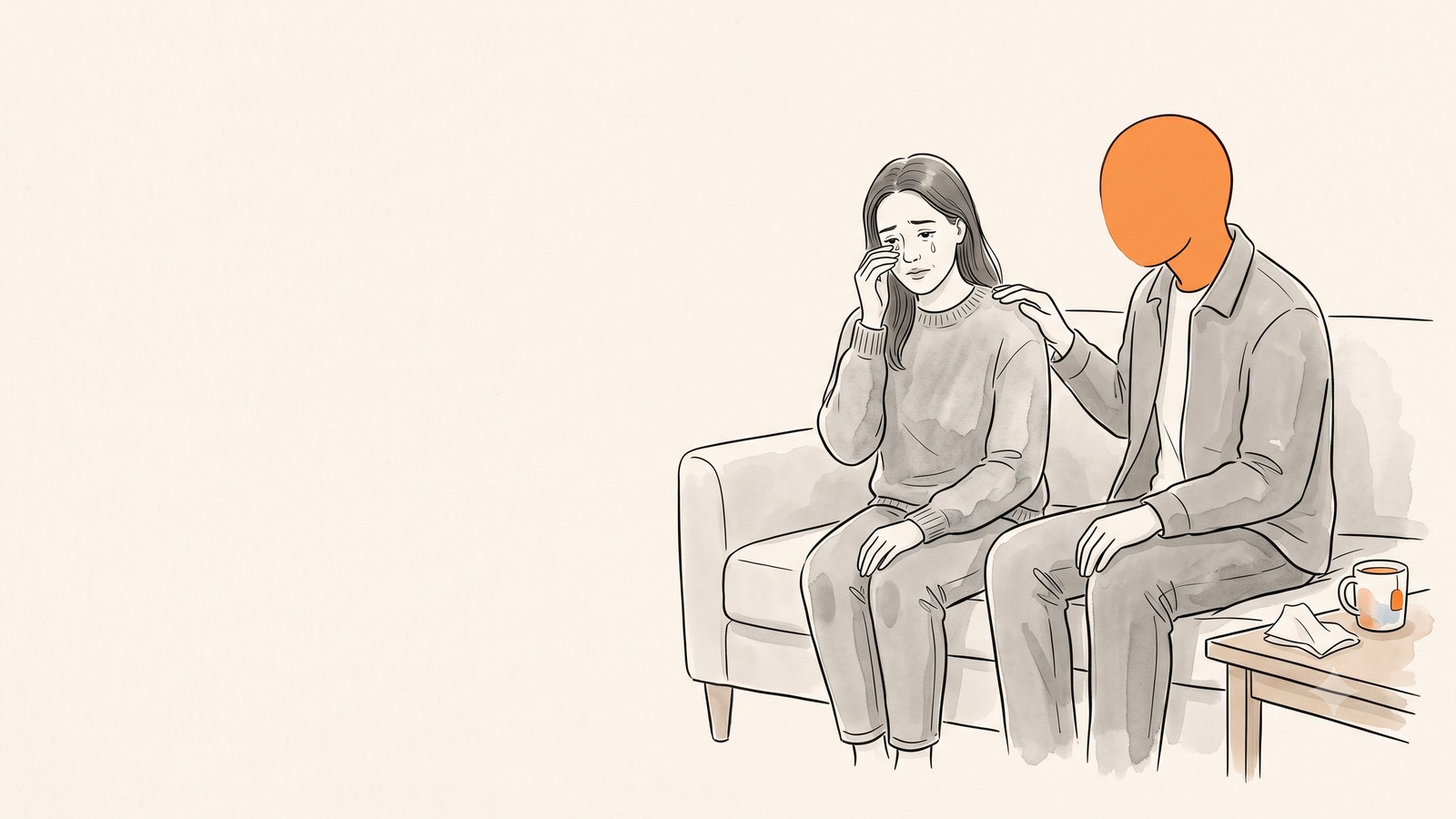
Small kindness beats the right speech. A made cup of tea, a blanket, putting on the show she likes. You’re not trying to talk her into feeling better. You’re making a few raw days softer.

Don’t take it personally when it points at you. Sometimes the tears come with a sharp edge, and it’s aimed your way. As best you can, don’t bite back. You’re usually not the cause, and the argument she’s picking tends to evaporate once her period starts.
And the quiet superpower underneath all of this: know roughly when it’s coming. If you have a rough idea of where she is in her cycle, the teary Tuesday stops being a mystery you have to decode in real time. You can soften the week before it lands instead of scrambling once she’s already crying on the couch.
When period crying is worth a doctor’s look
Most premenstrual weepiness is just that – a few rough days that pass. But there’s a more severe version worth knowing about. Premenstrual dysphoric disorder, or PMDD, affects a smaller share of women – estimates land around 3 to 8% – and it’s not simply extra tears. It’s depression, hopelessness, severe anxiety or anger, and a sense of being out of control that shows up on the cycle’s schedule but genuinely disrupts her work, her relationships, and her life (Cleveland Clinic). The hallmark is the gap between the premenstrual stretch and the rest of the month: someone with PMDD can feel genuinely unlike herself for those days. I broke down the difference between ordinary PMS and PMDD here.
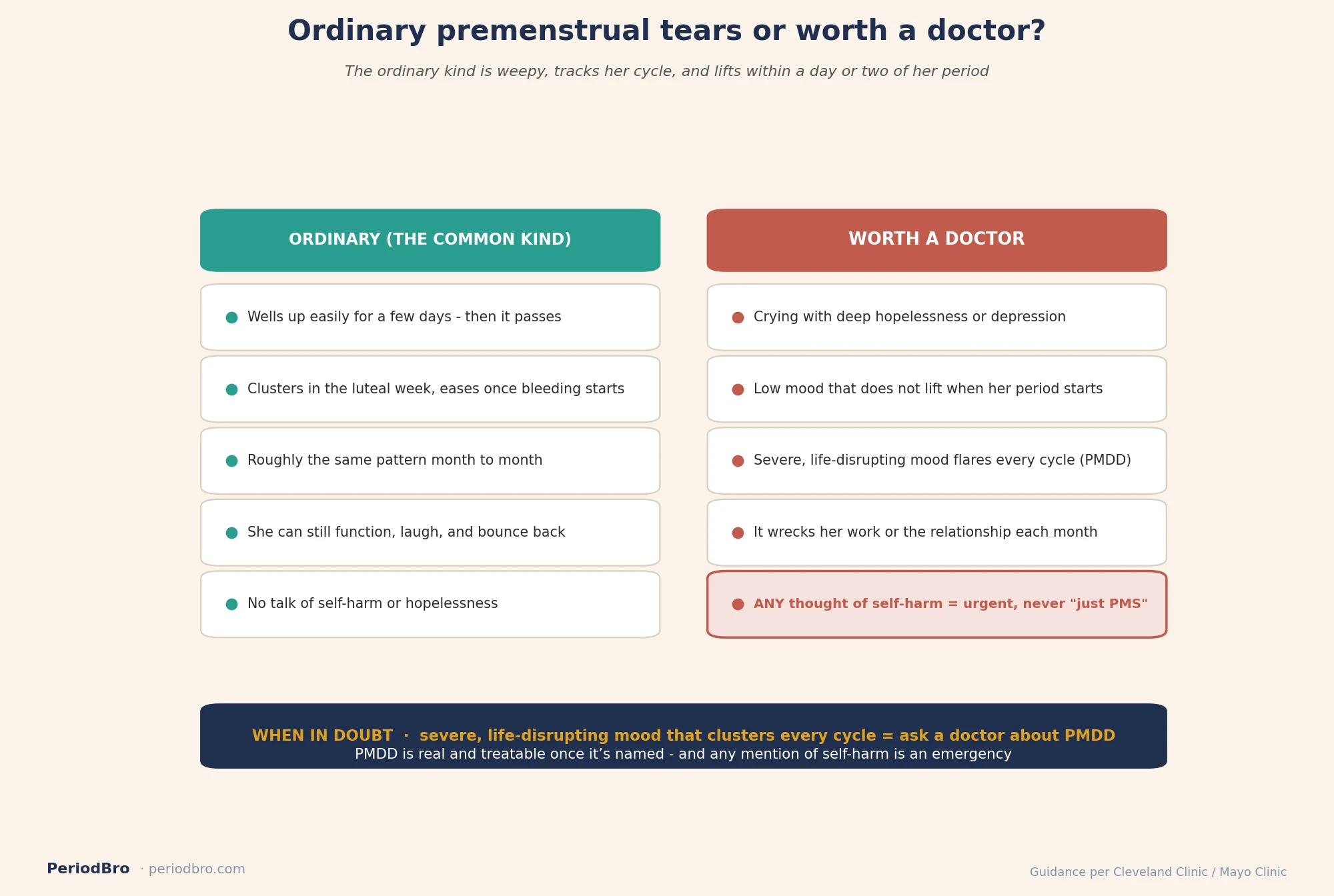
It’s worth gently raising the idea of a doctor’s appointment if the low mood is severe, if it’s wrecking her relationships or her job every single month, or if it doesn’t lift once her period arrives. PMDD is real and it’s treatable, usually with options that steady serotonin or hormone levels, so it’s not a conversation to avoid out of awkwardness.
One thing is never “wait and see”: if she ever talks about not wanting to be here, or about hurting herself, take it seriously right away and help her get support that day. Premenstrual mood symptoms can turn dark for some people, and that’s a moment for professional help, not for waiting out the cycle.
The one thing to remember
If you take nothing else from this: when she cries over something small in the days before her period, the small thing is not the story. The story is a predictable dip in the brain chemistry that keeps her steady, and it will pass. Your job isn’t to fix the tears or explain them away. It’s to be a calm, soft place for a few raw days – and to see it coming so she doesn’t have to explain herself.
The simplest way to do that is to know roughly where she is in her cycle, so a teary evening reads as “ah, it’s that week” instead of “what did I do?” That’s most of the battle, and it’s exactly what quietly tracking her cycle, on your own side, is for.

This article is for general information and isn’t medical advice. Crying and low mood around the cycle are common, but persistent or severe depression – and any thoughts of self-harm – deserve prompt support from a qualified healthcare professional. If you’re worried about her or about yourself, please reach out to one.