Period Anxiety: Why She Gets Anxious Before Her Period (and How to Help)
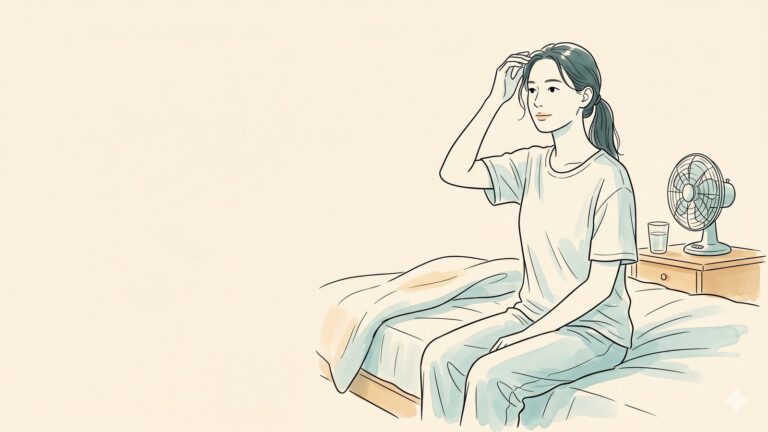
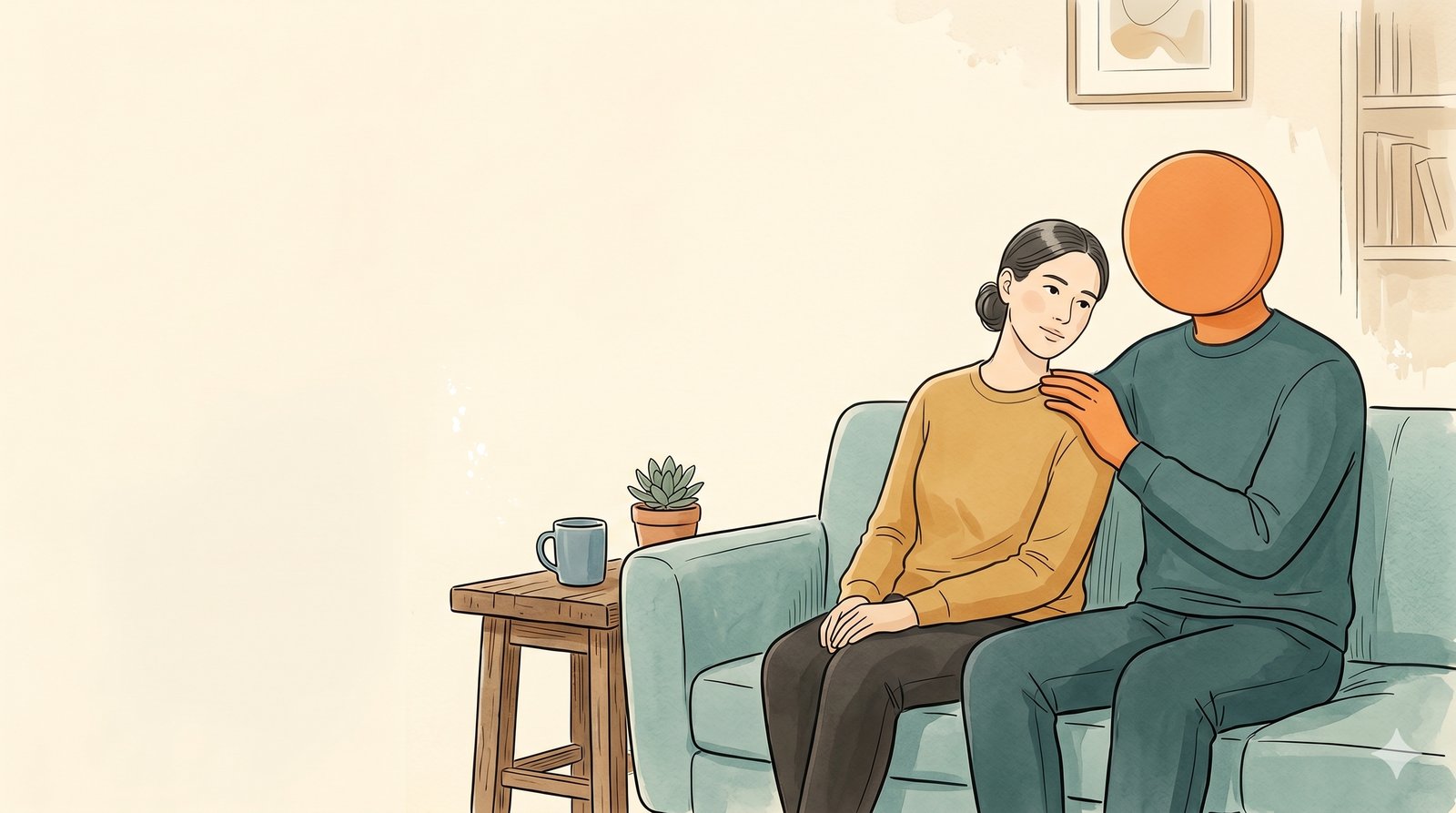
A few days before her period, she’s wound tighter than usual. Worried about an email that would’ve rolled right off her last week. Replaying a conversation from two days ago. Restless at night, snappy in the morning, convinced something’s wrong even when she can’t name what. If that pattern sounds familiar, what you’re watching is period anxiety, and it’s one of the most common and least talked about parts of the cycle.
Here’s the part nobody tells the person standing next to her: this isn’t her being dramatic, and it isn’t something you caused. It’s a real, hormone-driven shift that tends to land in the same window every month. Once you can see the pattern, you stop taking it personally and start being useful. So let’s walk through what period anxiety actually is, why her brain does this, and the handful of things that genuinely help.
What period anxiety actually is
Period anxiety is the spike in worry, tension, dread, or being on edge that shows up in the week or two before her period and then eases off once bleeding starts. It can look like racing thoughts, a short fuse, trouble sleeping, a knot in her chest, or a low-grade sense that something bad is about to happen. Sometimes it comes with the physical premenstrual stuff you might already recognize, and sometimes the anxiety arrives mostly on its own.
The timing is the giveaway. This anxiety rides the second half of her cycle, the part doctors call the luteal phase, which runs from ovulation to the first day of her period. If you want the full map of where that sits in her month, here’s what the luteal phase is, explained for partners. The anxiety tends to climb as her period gets closer, peak in the last few days before it, and fade within a day or two of bleeding starting. That on-then-off pattern, tracking the calendar instead of life events, is what separates premenstrual anxiety from anxiety in general.
Why her brain gets anxious before her period
The short version: it’s a hormone running off a cliff. After ovulation, her body ramps up progesterone through most of the luteal phase, then both progesterone and estrogen drop sharply in the last days before her period. Her brain has to adjust to that swing fast, and for a lot of people the adjustment shows up as anxiety and irritability (Cleveland Clinic).
There’s a more specific mechanism worth knowing, because it explains why this can feel so out of proportion. Progesterone gets broken down in the body into a neurosteroid called allopregnanolone. Normally allopregnanolone acts on the brain’s main calming system, the GABA receptors, and has a soothing, anti-anxiety effect, a bit like the body’s own chill pill. But in people who are sensitive to it, the response flips: instead of calming the nervous system, those shifting allopregnanolone levels seem to destabilize it, and the result is anxiety, irritability, and mood swings during the luteal phase (Frontiers in Psychiatry review, 2023). So the same chemistry that calms one person down can wind another person up, depending on how her brain is wired to respond.
Serotonin is in the mix too. The brain chemical that helps regulate mood and worry appears to function differently in people with premenstrual mood symptoms, which is part of why the late-luteal drop in hormones can tip into real anxiety rather than a mild mood dip (Cleveland Clinic). The same hormone shifts drive a lot of the rest of the premenstrual picture, which is why anxiety so often travels with the foggy, off feeling I wrote about in period brain fog, and with the broader mood swings covered in how hormones drive her mood. Different symptoms, one underlying rhythm.

Is period anxiety normal, and how common is it
It’s extremely common. Anxiety and tension are among the most frequently reported premenstrual symptoms, and most people who menstruate get at least some emotional shift before their period. For many it’s mild and manageable. For a smaller group it’s heavy enough to interfere with work, sleep, and relationships, and that’s where it starts to have a name beyond ordinary PMS.
When the anxiety is severe, predictable, and cyclical, doctors call it premenstrual dysphoric disorder, or PMDD, a more intense form of PMS that affects an estimated 5% of women of reproductive age (Johns Hopkins Medicine). There’s also a real link between premenstrual mood disorders and anxiety conditions in general, so if she already lives with anxiety, the premenstrual window can crank it up a notch (PMC, diagnostic interview study). I get into the line between the everyday version and the clinical one in PMS vs PMDD.
The practical takeaway: a wave of anxiety that shows up before her period and clears when it starts is normal and common. Anxiety that never really lifts, or that gets dark, is a different conversation, and we’ll get to the signs in a minute.

What actually helps when she’s anxious before her period
You can’t rebalance her hormones, and you can’t talk her out of an anxiety that’s chemical at the root. What you can do is lower the load and be a steady, predictable presence while the wave passes. That’s not a small thing. It’s most of the job.
Start by not arguing with the feeling. When someone’s anxious, “you’re overthinking it” or “there’s nothing to worry about” lands as dismissal, even when it’s technically true. It tells her the feeling is wrong, which adds a layer of being misunderstood on top of the anxiety she already has. Try the opposite: “that sounds stressful, what would help right now?” You don’t have to agree that the worry is rational to take her seriously.
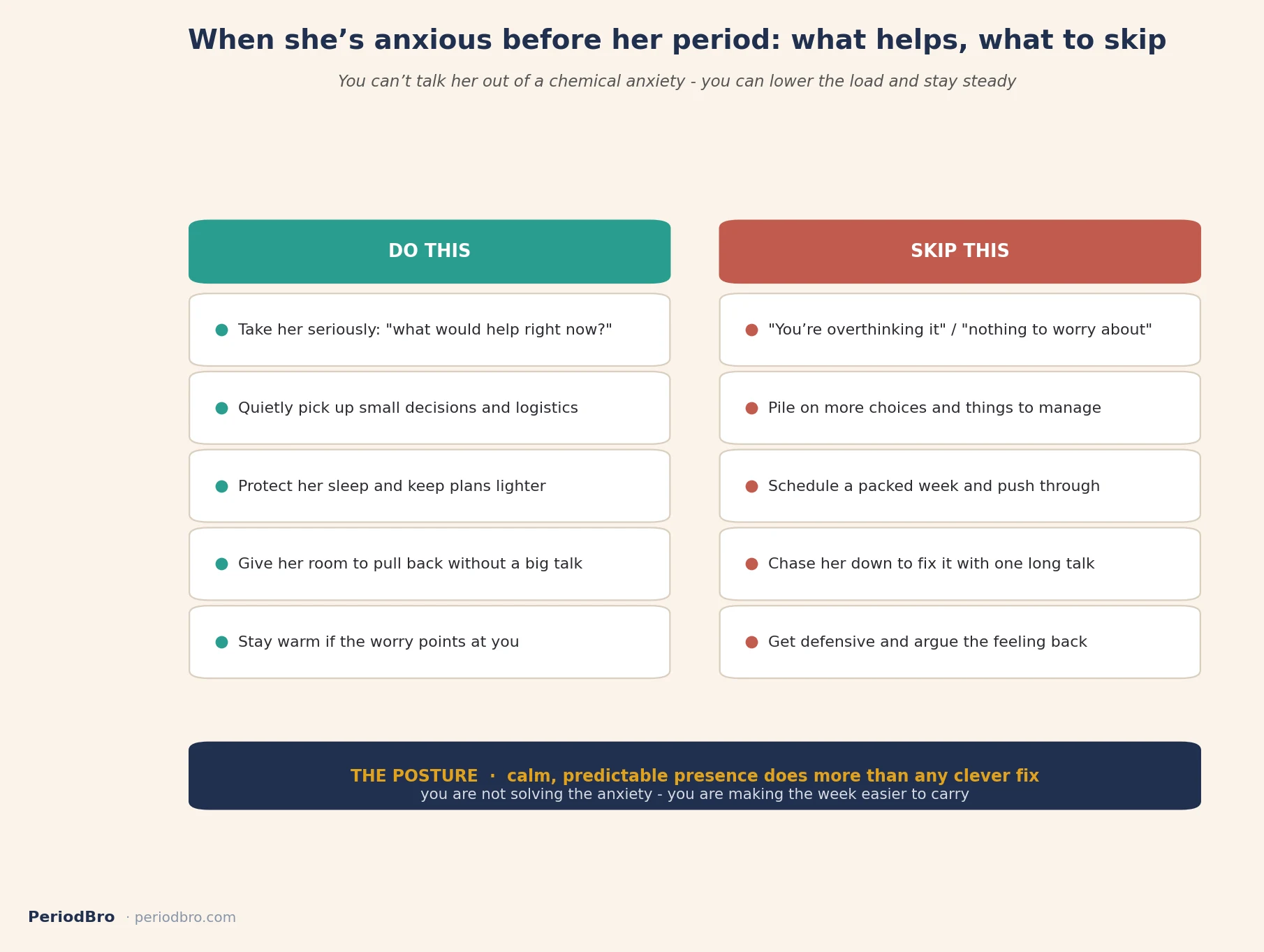
Then reduce friction where you can. Anxiety eats mental bandwidth, so this is the week to quietly pick up the small decisions and logistics: handle dinner, take something off her plate, lower the number of things she has to manage. Protect her sleep, because being short on sleep and high on anxiety feed each other. Keep the plans lighter than usual if she wants them lighter. And if she pulls back, give her room without making it a thing. The instinct to fix it with a big talk usually backfires; what tends to work is the calm version of showing up that I describe in being supportive when you can’t fix her pain.
One honest note from my own relationship: the hardest part for me wasn’t doing any of this, it was not getting defensive when her anxiety made me the nearest target. Some months the worry would point at me, at us, at something I’d said. Learning to hear that as the hormones talking, not a verdict on the relationship, and to stay warm instead of arguing back, did more for both of us than any single helpful gesture. The calm is the gift.

When period anxiety is worth a doctor’s look
Most premenstrual anxiety doesn’t need treatment beyond support and good habits. But some of it does, and a partner is often the first person to notice the pattern, so it’s worth knowing the signs. It’s worth a conversation with a doctor if her premenstrual anxiety is severe enough to disrupt her work, sleep, or relationships month after month; if it doesn’t fully lift once her period starts; if she also gets deep low mood, hopelessness, or panic attacks in the luteal window; or if it’s clearly getting worse over time. Those are the markers that push past ordinary PMS toward PMDD or an anxiety disorder, and both are very treatable, often with approaches as straightforward as targeted lifestyle changes, therapy, or medication (MGH Center for Women’s Mental Health).
One thing to take seriously without panic: if she ever talks about hurting herself, or you sense she’s in real crisis, treat that as urgent and help her reach a professional or a crisis line right away, regardless of where she is in her cycle. The cyclical pattern doesn’t make those feelings less real or less deserving of help.
You don’t have to diagnose anything. The useful move is gentle and concrete: “I’ve noticed this hits hard around the same time every month, and I read that there’s real help for it. Want me to help you find someone?” That frames it as care, not criticism.
One thing to remember
If you do nothing else, do this: track the timing, even loosely, so the anxiety stops blindsiding both of you. When you know the wound-up week is coming, you can lower the stakes ahead of it instead of scrambling inside it. You stop reading her anxiety as a problem with the relationship and start reading it as weather you can both prepare for. That shift, from surprised every month to ready every month, is the whole game.
That’s the bet behind PeriodBro: when you can see the rhythm coming, you show up calmer and earlier, and the hard week gets easier for both of you. You can try it free and start learning her pattern this cycle.

This article is for general education and isn’t medical advice. Every person’s cycle is different, and persistent or severe anxiety should be discussed with a qualified healthcare provider. Mental health is a sensitive topic; if you or someone you love is struggling with anxiety, low mood, or thoughts of self-harm, reaching out to a doctor, therapist, or a crisis line can help.