
Period Nausea: Why She Feels Sick to Her Stomach Around Her Period (and How to Help)
The first time I really noticed it, we were halfway through dinner and she set her fork down. Nothing dramatic. She just went a little still, pressed two fingers to the middle of her chest, and said she felt off. Not sick, exactly. Just off. I asked if the food was bad. It wasn’t the food. Her period was due in a couple of days, and her body seemed to know it before the calendar did.
For a long time I filed that under “one of those things.” It turns out period nausea is one of the better-understood things her body does. And once you know what’s actually driving it, you stop guessing and start being useful.
What period nausea actually is
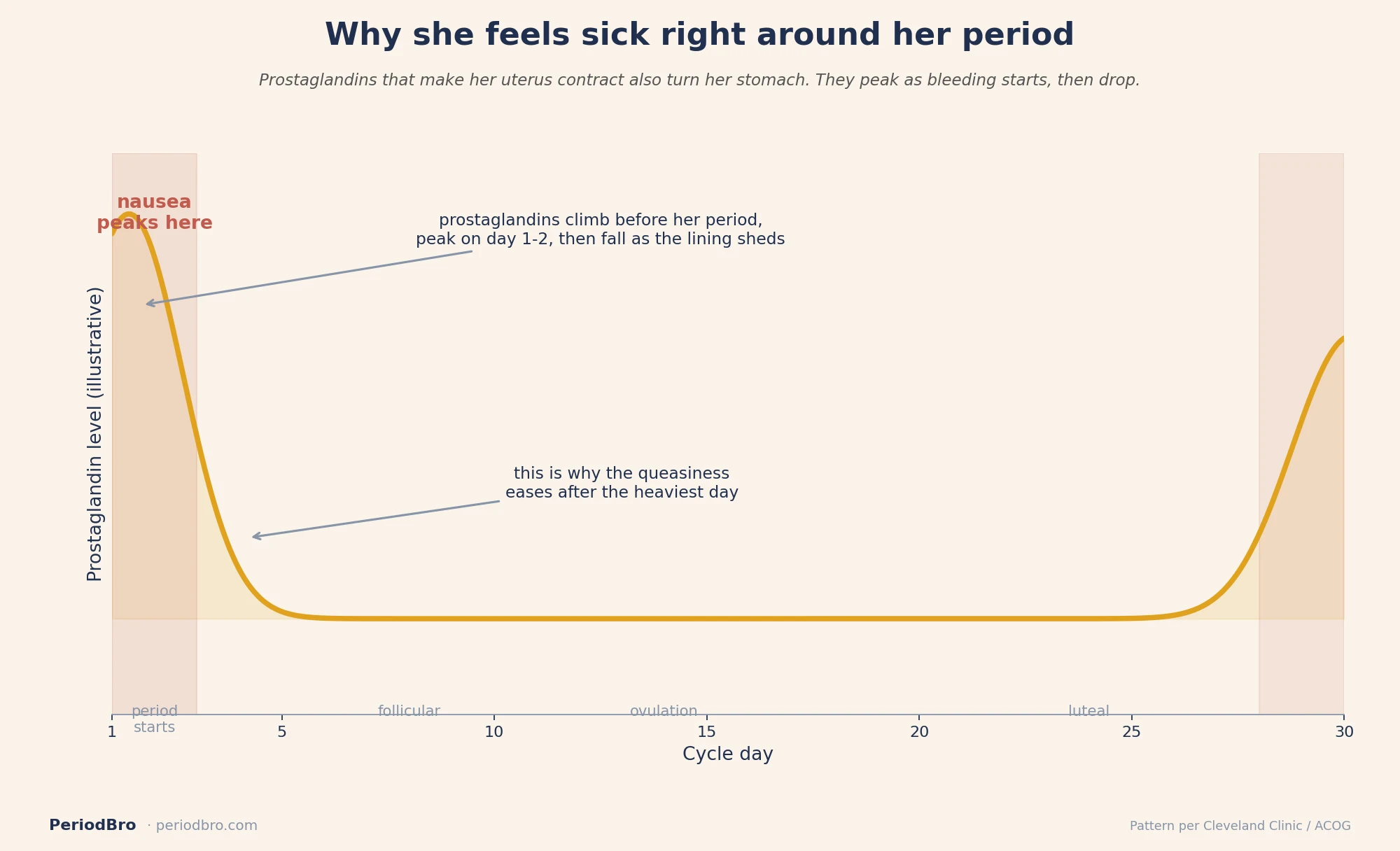
In the days before her period, the lining of her uterus starts releasing chemicals called prostaglandins. Their main job is to make the uterus contract so it can shed that lining. That’s what cramps are. But prostaglandins don’t stay politely in one place. They spill over to the smooth muscle nearby, including her stomach and intestines, and that’s where the queasy, sick-to-her-stomach feeling comes from. According to Cleveland Clinic, higher prostaglandin levels can trigger nausea, cramps, diarrhea, and even a low-grade fever right around the start of her period.
Here’s the part that helps you time it. Prostaglandin levels climb right before the bleeding starts and tend to peak on the first day or two, then drop off as the lining sheds. That’s why the nausea, like the cramps, usually eases once the heaviest day has passed, as the American College of Obstetricians and Gynecologists (ACOG) explains. So if she feels worst the day before and the first morning of her period, that’s not random. That’s the curve doing exactly what it does.

Why she’s not imagining it
If part of you has quietly wondered whether the nausea is in her head, let me put that to rest. Nausea is one of the gastrointestinal symptoms commonly tied to painful periods, alongside bloating, diarrhea, and vomiting. And painful periods are not rare. Primary dysmenorrhea, the medical name for ordinary period pain that isn’t caused by another condition, affects somewhere between 45% and 95% of people who menstruate, per the clinical reviews summarized in StatPearls (NCBI).
So feeling sick around her period isn’t a personal quirk or a sign she’s being dramatic. It’s a normal, well-documented response to a normal hormonal event. The most useful thing you can do with that fact is simple: believe her the first time. She shouldn’t have to perform her nausea to be taken seriously, and she definitely shouldn’t have to convince you it’s real.
The other reasons she might feel sick
Prostaglandins are the headline act, but they’re not the only thing that can turn her stomach around her period. A few others worth knowing about:
Menstrual migraines. If she gets headaches that cluster around her period, nausea often rides along with them, because nausea is a core feature of migraine itself, not just a side effect. If that’s her pattern, the queasiness and the headache are two symptoms of the same event. I wrote a whole piece on menstrual migraines and how to help if that sounds familiar.
Strong cramps. Pain itself can make a person nauseous. When cramps are intense, the body’s response to that pain can include a wave of queasiness, which is part of why the worst cramp days and the worst nausea days tend to line up. The same prostaglandins drive both, so a lot of what helps her cramps also helps the nausea. Our guide on helping with period cramps covers the overlap.
The rest of the gut cluster. Nausea often travels with other digestive symptoms in the same window, which is why she might feel queasy and also be dealing with period diarrhea or the wrung-out, feverish “period flu” feeling. It’s all part of the same late-luteal shift, the stretch of the cycle I break down in the luteal phase explained.

What actually helps when she feels sick
You can’t switch the nausea off, but you can make her a lot more comfortable, and most of it is low effort. The trick is to have the right things ready before she needs them, not to scramble once she’s already green around the gills.
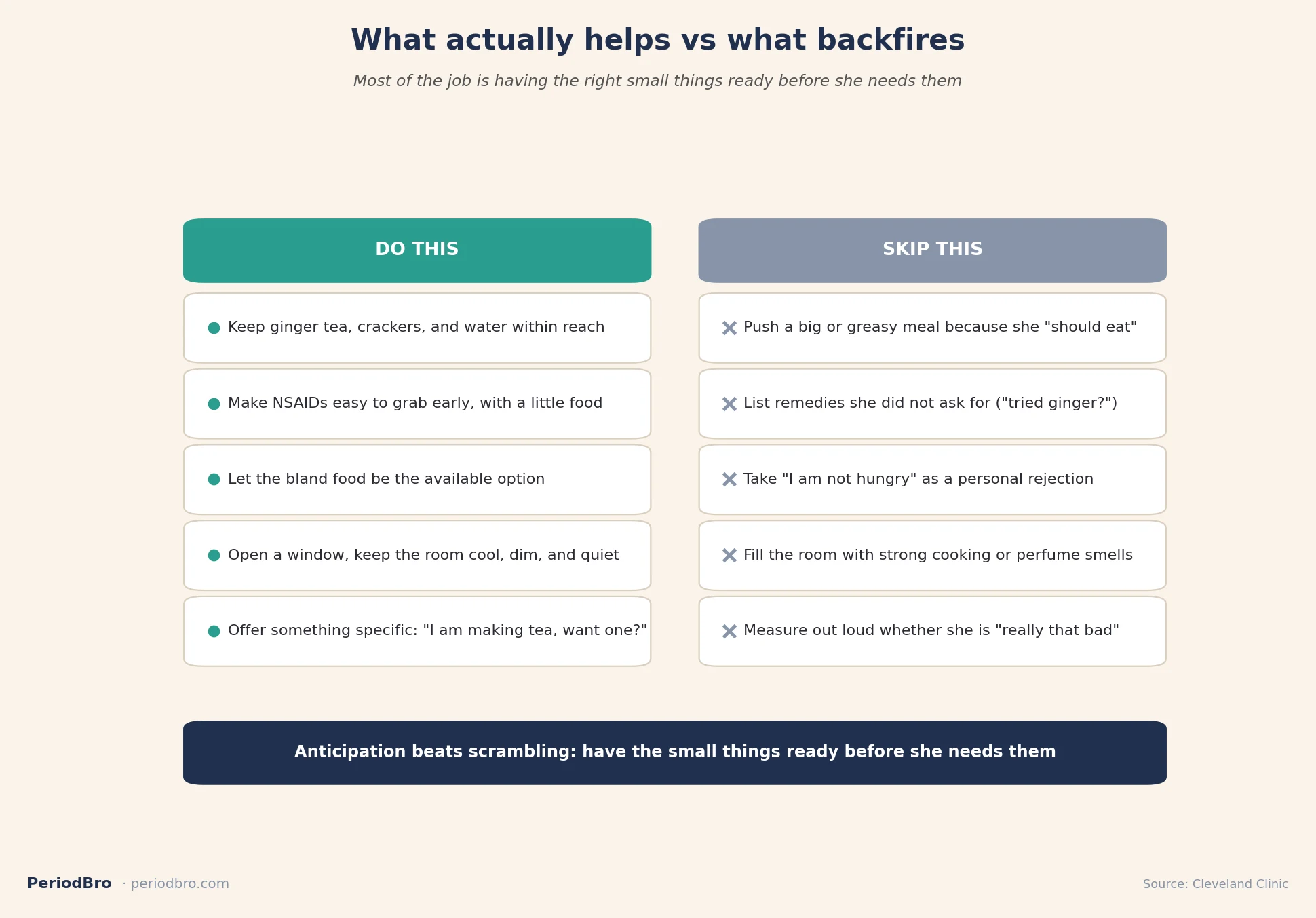
Keep small, bland options within reach. Plain crackers, toast, rice, a banana. The instinct to “get some real food in her” usually backfires when she’s nauseous, so let the gentle stuff be the available stuff and don’t push a big meal. Ginger is the one home remedy worth keeping stocked, since ginger tea or ginger chews are widely recommended for settling a queasy stomach, and they’re easy to have on hand.
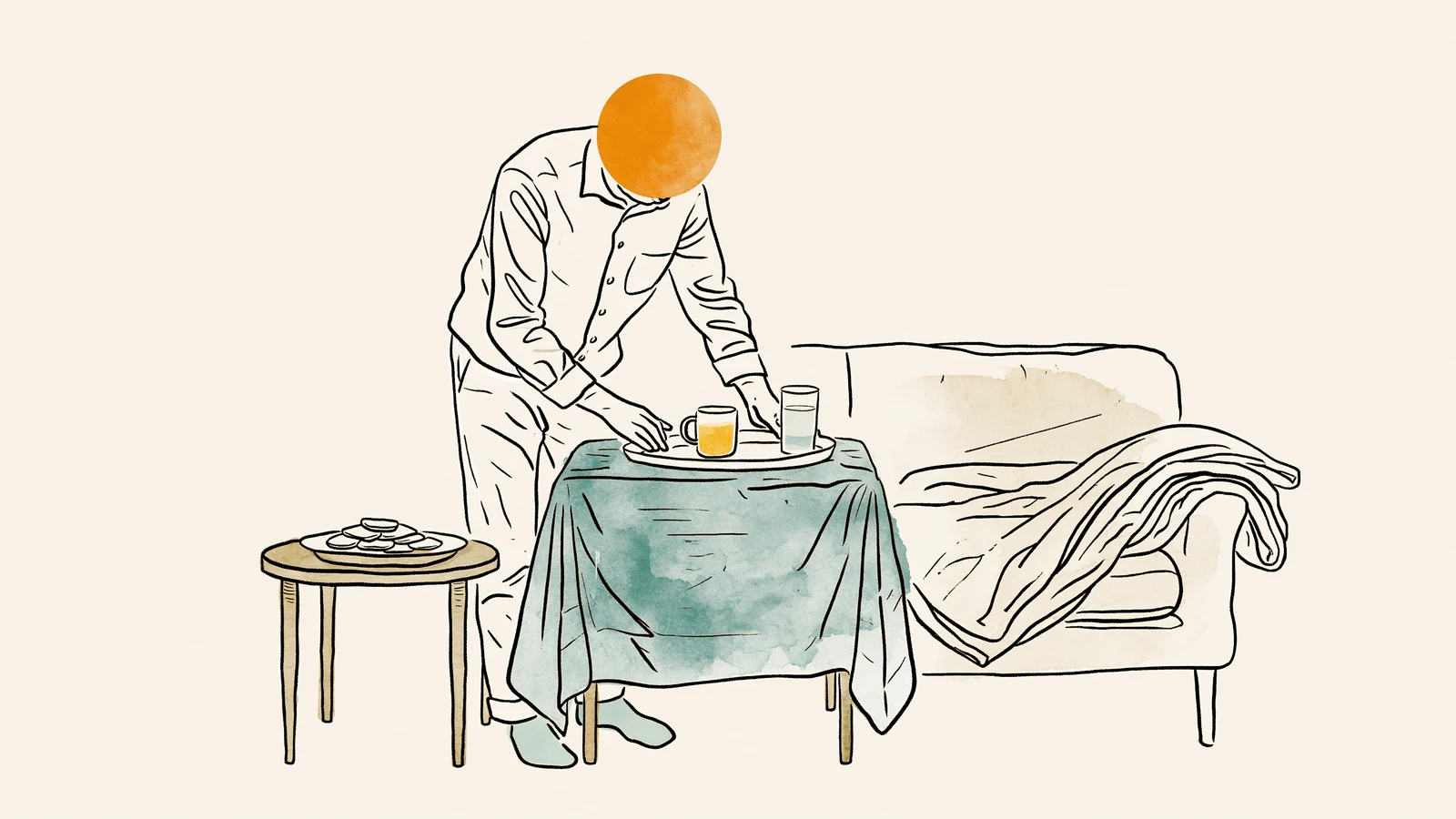
Keep water near her and let her sip slowly rather than chug. If her doctor is fine with it, an anti-inflammatory like ibuprofen taken early, with a little food, can blunt the prostaglandins that are causing the cramps and the nausea at the same time. A cool, dim, quiet room helps too, especially if a migraine is part of the picture. A cold cloth on the back of the neck is a small thing that lands surprisingly well. So does opening a window, since stuffy air and strong cooking smells can tip a queasy stomach right over the edge.
The other half of the job is timing. Because prostaglandins follow a schedule, you usually have a day or two of warning. Use it. Buy the ginger tea before the week she needs it, not at 9pm when she’s already lying down. Move the heavy plans off her worst two days if you can, so she isn’t white-knuckling a dinner party while her stomach is in revolt. Anticipation is the difference between scrambling and simply being ready, and she’ll feel that difference even if she never says so.
And here’s the one that matters most: don’t take “I’m not hungry” or “I feel sick” personally. It isn’t a rejection of the dinner you made or the plans you had. It’s chemistry. Match her pace, lower the stakes on the evening, and let the night be small.
What to say, and what to skip
You don’t need a script, but a couple of instincts are worth correcting. Skip the problem-solving reflex, the “have you tried ginger?” the first time she mentions feeling sick. She knows about ginger. What she’s telling you is how she feels, and the useful answer is closer to “that sounds rough, what would help right now?” than a list of remedies she didn’t ask for. Skip anything that sounds like you’re measuring whether she’s really that bad, too. “It can’t be that different from a normal stomachache” is the kind of line that makes a person stop telling you things.
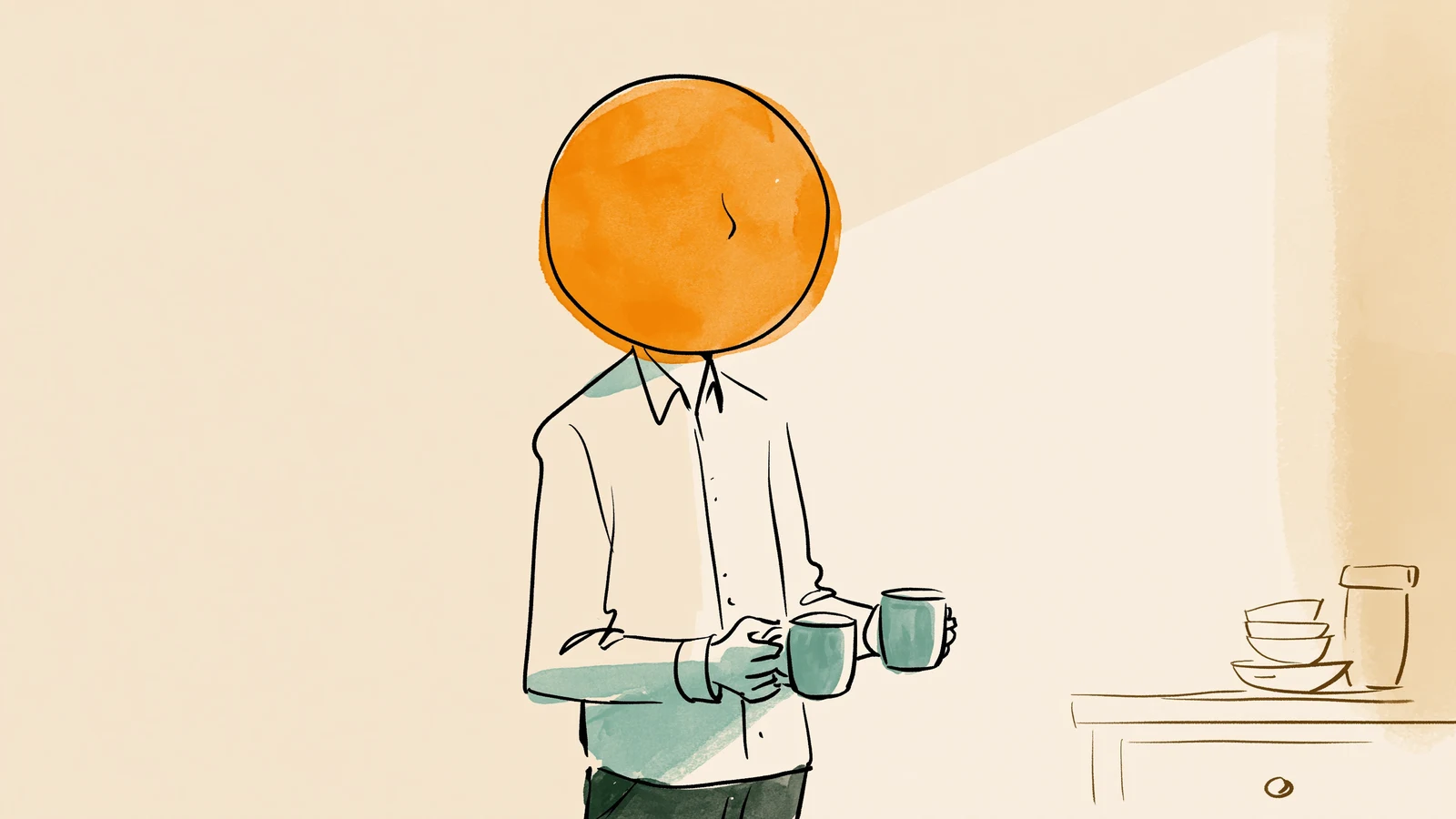
The good version is short and low-key. Offer something specific instead of a vague “let me know if you need anything,” which quietly hands her the work of managing you. “I’m making tea, want one?” or “I’ve got dinner, you rest” gives her one less decision to make on a day when even small decisions feel like too much.
When period nausea is worth a doctor’s look
Most period nausea is ordinary. It shows up with her period, it’s manageable, and it fades after a day or two. But a few patterns are worth a real conversation with a doctor rather than waiting them out.
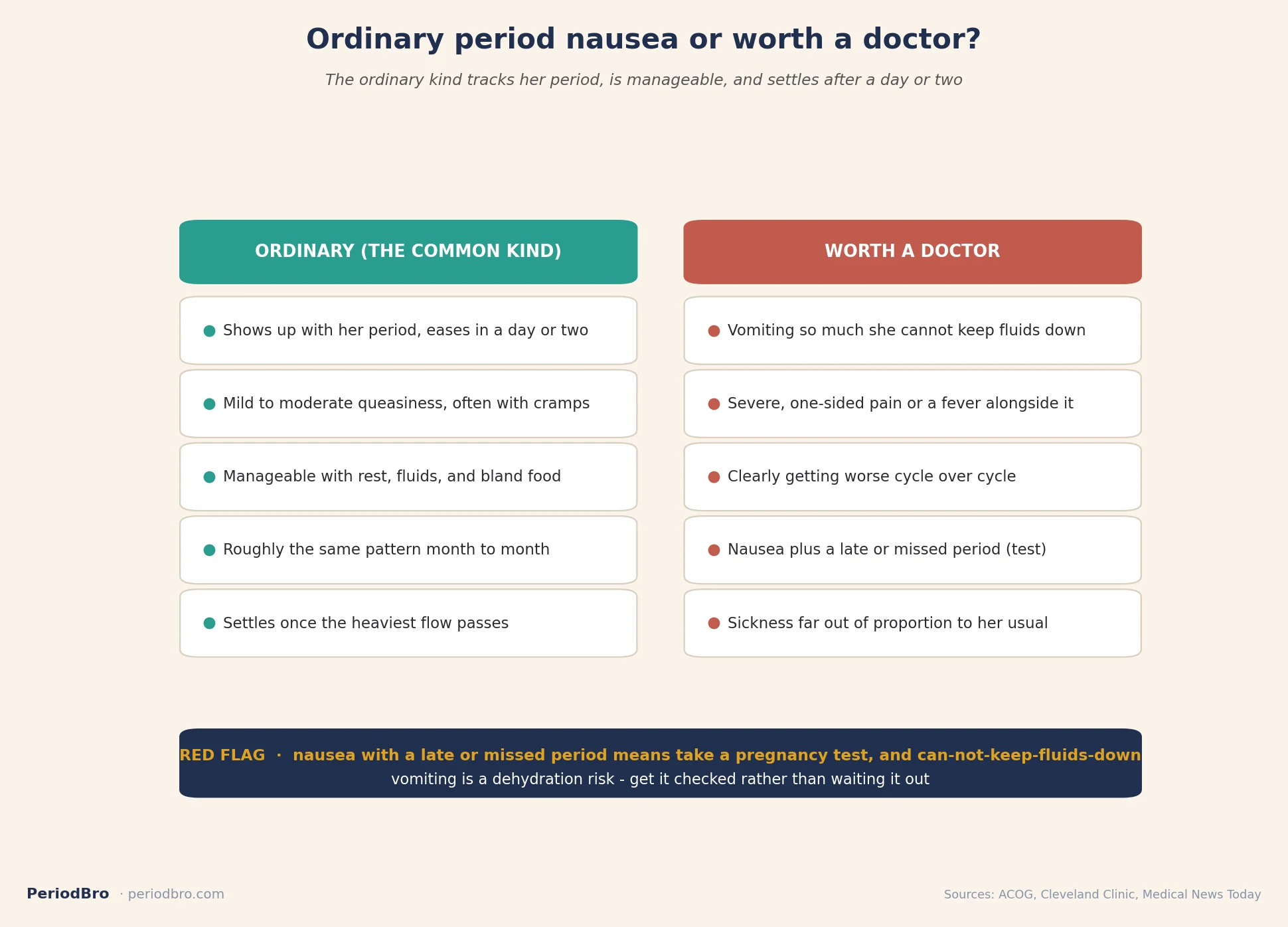
If she’s vomiting so much she can’t keep fluids down, that’s a dehydration risk and a reason to call someone, not tough it out. Nausea that’s clearly getting more severe cycle after cycle, or that comes with intense one-sided pain or a fever, can point to something beyond ordinary period pain, like endometriosis, or to a problem that has nothing to do with her cycle at all. When pain and sickness are out of proportion to her usual, getting it checked is the move.
And one more that a lot of guys never think about: nausea plus a late or missed period deserves a pregnancy test. Persistent nausea, especially first thing in the morning, is far more typical of early pregnancy than of ordinary PMS, which is a distinction Medical News Today lays out clearly. So if “she always feels a bit sick before her period” collides with a period that just isn’t showing up, don’t quietly assume it’s hormones. A test costs almost nothing and answers the question. That’s not a scary conversation, it’s a practical one.
The one thing to remember
Period nausea isn’t a mystery and it isn’t a mood. It’s prostaglandins doing predictable work on a predictable schedule, and that predictability is your advantage. You can know roughly when it’s coming, keep the ginger tea and crackers stocked, take the heavy logistics off her plate that week, and be the person who already had it handled before she had to ask.

That’s the whole game. Not fixing her, not hovering, just paying enough attention that the rough day lands a little softer. If you want help seeing the window coming, that’s exactly what PeriodBro is built to do: turn the science of her cycle into a quiet heads-up, so you can show up ready instead of surprised.
This article is for general education and isn’t medical advice. Period nausea is common, but severe or persistent vomiting, dehydration, sudden or one-sided pain, or nausea alongside a missed period should be discussed with a qualified healthcare provider.