Ovulation Pain: Why She Hurts in the Middle of Her Cycle
She texts you from work saying she has a weird ache low on one side. Her period finished about a week ago, so it is not cramps. Before you start googling appendicitis, there is a much more ordinary explanation: ovulation pain, the mid-cycle twinge that shows up when an ovary releases an egg.
It has a name, it is common, and most of the time it is nothing. Knowing what it is saves you both a spiral of worry, and knowing the handful of signs that make it worth a phone call covers the rest.
What that mid-cycle ache actually is
Doctors call it mittelschmerz, which is German for “middle pain.” It is pelvic or lower-abdominal pain that shows up around the time her ovary releases an egg, and it usually sits on just the side that is doing the releasing, according to Cleveland Clinic.
It is not rare. Cleveland Clinic puts it at up to 40% of people who ovulate. A clinical review in StatPearls goes a bit higher, over 40% of women of reproductive age, and notes it tends to recur almost every month in the people who get it. So if she gets it, she will probably get it again, and the pattern itself becomes useful information.
Why ovulation pain lands in the middle of her cycle
Every cycle, a follicle in one ovary grows, stretches, and eventually breaks open to release an egg. Both the stretching and the bursting can hurt, which is the classic explanation for the ache. The StatPearls review adds a second layer: the luteinizing hormone surge that triggers ovulation also ramps up smooth-muscle contraction in the ovary through prostaglandins, so part of the pain is contraction, not just rupture.
Timing follows the same logic. In a textbook 28-day cycle, ovulation lands around day 14, roughly halfway between periods. But “normal” cycles run anywhere from 21 to 35 days, and ovulation moves with the cycle rather than sitting on a fixed date. StatPearls describes mid-cycle pain showing up anywhere between days 7 and 24 depending on the person. If you want the full map of what happens when, we broke it down in our menstrual cycle guide for partners.
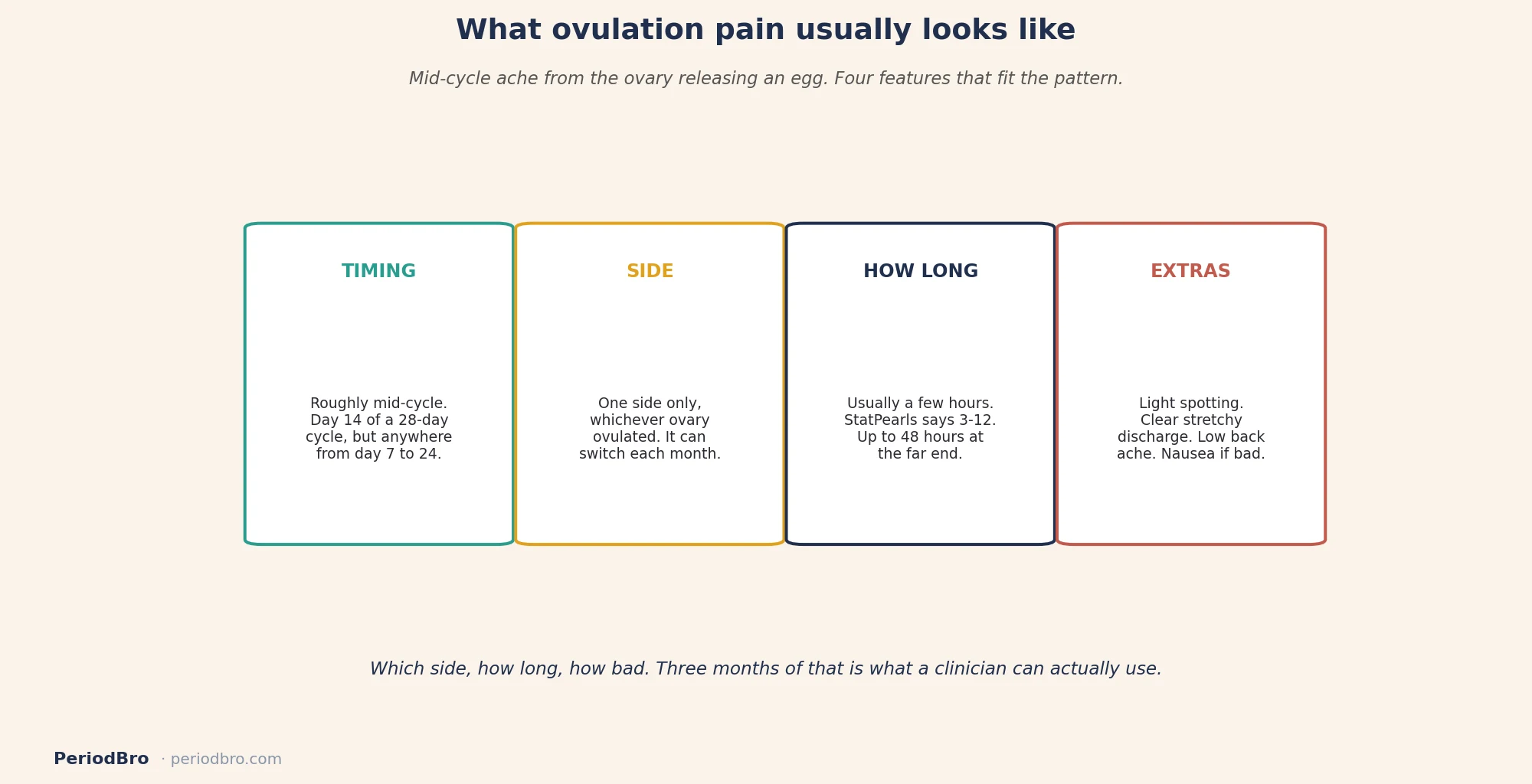
This is also why the side can switch. It hurts on whichever side ovulated, and that is not always the same ovary. A left-side ache one month and a right-side ache the next is normal, not a sign that something is spreading.
What it feels like and how long it lasts
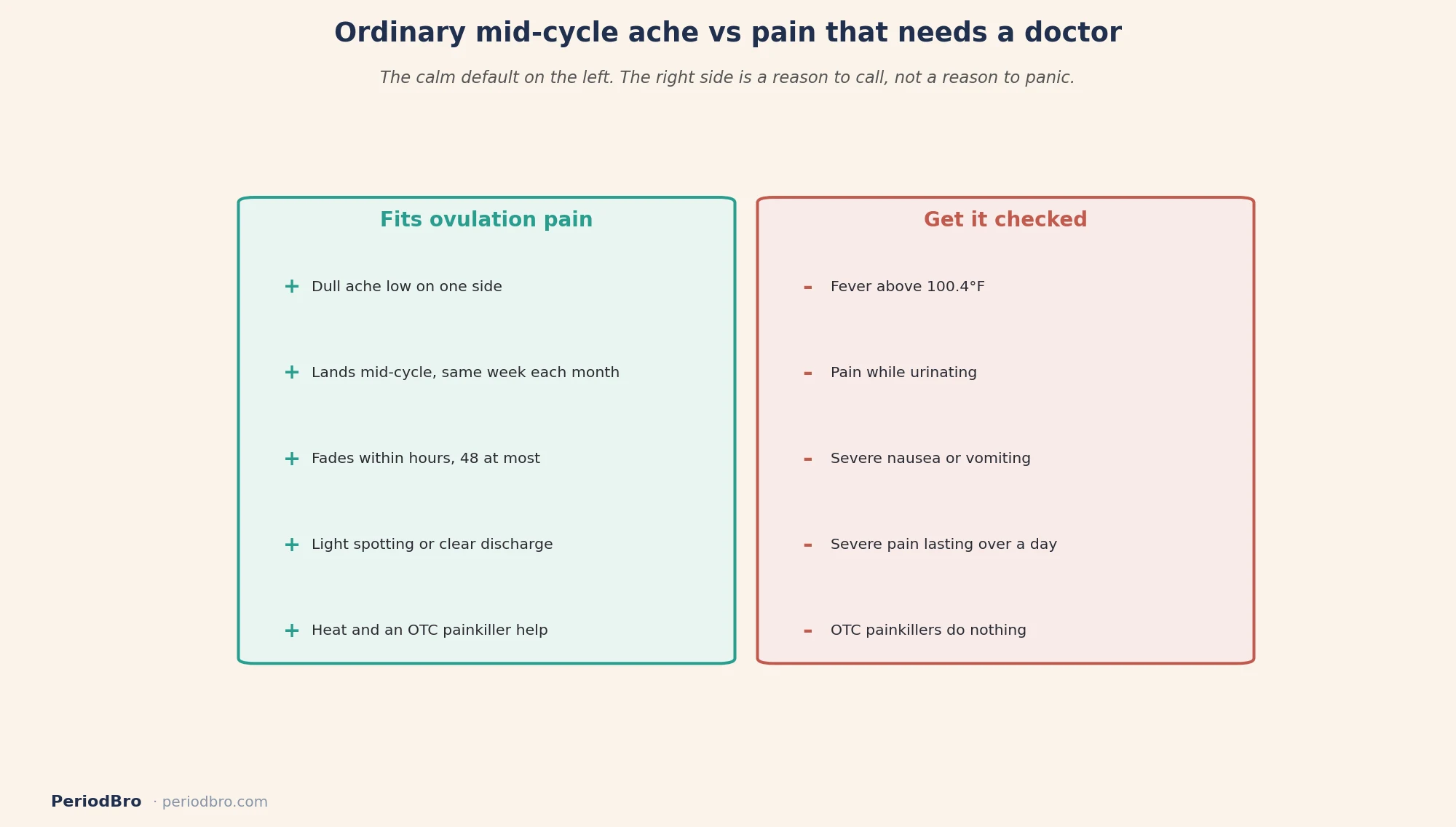
Most people describe a dull ache or a cramping pull low on one side. Some get a sharper, shorter stab. Cleveland Clinic lists a few things that often ride along with it: light vaginal bleeding, clear stretchy discharge like egg whites, low back pain, and nausea if the pain is severe.
Duration is your best sanity check. Ovulation pain typically lasts a few hours and can stretch up to 48 hours at the outside. StatPearls puts the usual window even tighter, three to twelve hours. Anything that drags on for days, or gets worse instead of fading, has moved out of ordinary territory.
That clear stretchy discharge is not a coincidence either. Cervical mucus turns clear and slippery right before ovulation, and basal body temperature rises about half a degree to a degree afterward, which is how ovulation is usually tracked. The ache is simply the signal she can feel without a thermometer.
What usually helps
Cleveland Clinic’s list is over-the-counter pain relief such as ibuprofen, naproxen, or acetaminophen, plus heat and warm baths. For people whose ovulation pain is genuinely disruptive every month, hormonal birth control is an option worth raising with a doctor, since methods that suppress ovulation remove the event that causes the pain in the first place.
The practical version for you: heat and a couple of hours of low expectations cover most of it. A heating pad she already owns beats a trip to the store, and if you are shopping anyway, our heating pad guide saves you the research. Timing matters more than product choice. Pain relief taken early works better than pain relief taken after two hours of toughing it out.

When mid-cycle pain is worth a doctor visit
Cleveland Clinic flags a specific set of signs that mean stop treating it as ovulation pain and get it looked at: a fever above 100.4°F, pain while urinating, severe nausea or vomiting, severe pain lasting longer than a day, or pain that over-the-counter medication does not touch.
There is a good reason those thresholds exist. Mittelschmerz gets mistaken for acute appendicitis often enough that StatPearls calls it out directly, and the mistake runs both ways. Sharp one-sided lower-abdominal pain is a symptom that several urgent conditions share, and none of them care that it is day 14. If the pain is severe and new, the cycle calendar is not the deciding evidence.
The same logic applies to bleeding. A little spotting around ovulation fits the pattern. Bleeding that keeps going, or shows up with pain and fever, does not, and we walk through that distinction in our guide to spotting between periods. If her period pain in general has you wondering where the line sits, this piece on normal versus not-normal period pain covers it.
The part you can actually do
A friend of mine spent two years assuming his wife’s mid-cycle ache was a stomach thing she got sometimes. He noticed it always landed the same week and mentioned it. She started paying attention, saw the pattern, and a doctor later called it textbook mittelschmerz. Medically nothing changed, but she stopped wondering whether something was wrong and he stopped guessing.
Most of the job comes down to two habits and one thing to avoid saying.
Know where she is in her cycle. If you know she is around day 14, a one-sided ache stops being mysterious. It is also the difference between “are you okay?” asked usefully and asked vaguely.
Log the pattern, not just the pain. Which side, how long, how bad, what came with it. Three months of that is genuinely useful to a clinician and takes about ten seconds a month to record. Memory alone will not reconstruct it.
Do not talk her out of getting it checked. “It is probably just ovulation” is a fine thought and a bad thing to say when she is doubled over. The red-flag list above exists precisely because the ordinary explanation is not always the right one.
Knowing her cycle turns a scary symptom into a predictable one, which is most of what showing up well through her cycle comes down to. If you want that context without asking her every month, that is the whole point of tracking together.
Common questions
Can you feel ovulation happen?
Some people can. Up to 40% report mid-cycle pain, and for many it recurs monthly. Plenty of people feel nothing at all, and that is equally normal.
Does ovulation pain mean she is fertile that day?
It is a rough signal, not a precise one. The egg survives about 12 to 24 hours after release, and the fertile window runs roughly five days before ovulation through a day after, because sperm can last three to five days. Pain that you notice after the fact is not a reliable way to plan around any of that.
Should the pain always be on the same side?
No. It hurts on whichever ovary released the egg, and that varies. Alternating sides across months is expected.
How long is too long?
Ovulation pain usually resolves within a few hours and rarely runs past 48. Severe pain lasting more than a day, or pain with fever, vomiting, or pain on urination, is a call-the-doctor situation rather than a wait-it-out one.
Can birth control stop it?
Methods that suppress ovulation remove the trigger, and Cleveland Clinic lists birth control pills as an option for severe cases. That is a conversation for her and her doctor, not a decision you make together at the pharmacy.
If you are the partner trying to figure out what to actually do when this happens, we cover that side directly in how to support her through ovulation pain.
This article is general information, not medical advice. Sudden or severe pelvic pain, pain with fever or vomiting, or any concern about pregnancy needs a real clinician, not a blog post. When in doubt, get it checked.