
Spotting Between Periods: What It Means and When to Worry
She mentions there was a little blood a week before her period was due, or you spot it yourself and your stomach drops a bit. Spotting between periods sounds alarming and most of the time it is not serious, though the word “most” matters here. Knowing the difference between the ordinary kind and the kind worth a phone call is what actually helps, and it is not complicated once someone lays it out plainly.
I run a cycle app, so I get asked the panicky version of this question a lot: she is bleeding and it is not her period, what does it mean. The honest answer is that light bleeding outside her normal cycle has a short list of common, harmless causes and a shorter list of reasons to get it checked. Here is the calm version, so you can be useful instead of anxious.
What spotting between periods actually is
The clinical name is intermenstrual bleeding, and it just means light vaginal bleeding that shows up outside her expected period. Cleveland Clinic describes it as bleeding between the periods you would normally expect, and the key word is light. We are talking about a few spots, a pink or brown tinge, maybe enough to notice on toilet paper, not a full flow arriving two weeks early. A normal cycle itself can run anywhere from about 24 to 38 days, so some of what looks like “between” is really just her cycle being a bit shorter or longer than the textbook 28 days. If you have never mapped this out, our plain guide to the menstrual cycle is the place to start.

When it happens tells you most of what you need to know
The single most useful clue with spotting is timing. Where it lands in her cycle points fairly reliably at the likely cause, which is why logging the date matters more than most people realize.
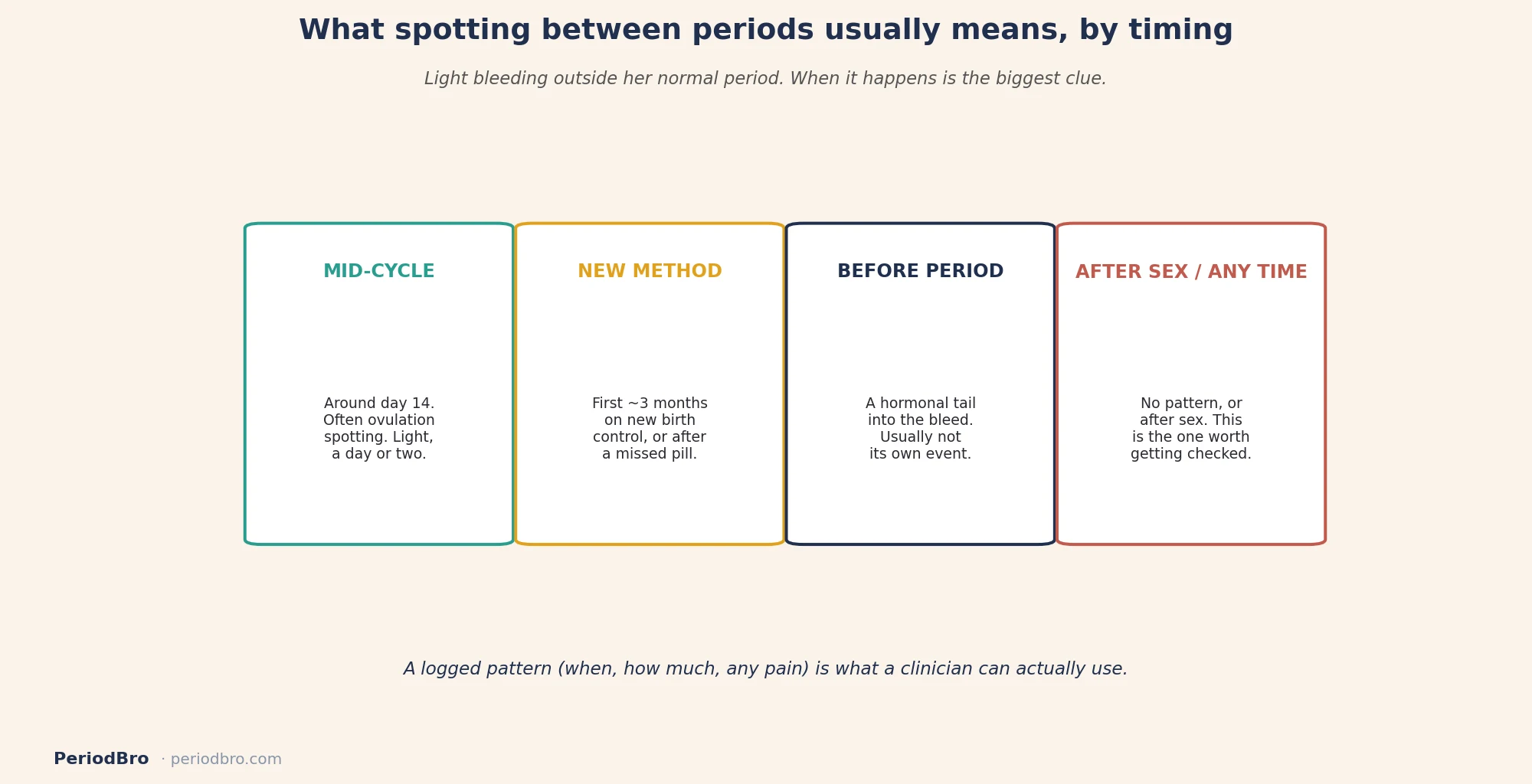
Spotting right around the middle of her cycle, roughly day 14, is often ovulation spotting. As Cleveland Clinic notes, the brief hormone shift around ovulation can cause a small amount of bleeding, and it is generally light and short-lived. Spotting in the days just before her period usually is not its own event at all, it is the hormonal tail end sliding into the bleed. Both of those are the boring, expected kind.
The usually-ordinary causes
Most spotting traces back to a handful of everyday things. New or changed birth control is a big one. If she has just started a pill, patch, ring, implant, or hormonal IUD, breakthrough bleeding in the first few months is common and expected while her body adjusts, and a missed pill can trigger it too. We covered how contraception reshapes her bleeding in what actually changes on birth control, and spotting is often part of the settling-in period.
Stress, a bout of illness, big changes in sleep or weight, and hard training loads can all nudge the hormones enough to produce a one-off spot. Early pregnancy can cause light implantation bleeding around the time a period would be due, which is worth knowing if pregnancy is on the table. And sometimes there is a physical, benign cause like a cervical or uterine polyp. The common thread in the ordinary version is that it is light, brief, and it settles down on its own. If her period is simply not showing up rather than spotting, that is a different question we unpack in why her period might be late.

When spotting is a reason to book an appointment
Here is the part worth actually remembering. Cleveland Clinic is clear that some patterns are a reason to see a clinician, not to panic, but not to wait around either. Bleeding after sex is on that list. So is any bleeding after menopause, which should always be checked. Spotting that comes with pain, fever, dizziness, easy bruising, or an unusual discharge deserves a call, as does bleeding that is heavier than a few spots, lasts more than a couple of days, or keeps recurring with no clear explanation. And if pregnancy is possible, any bleeding is a same-day question for a clinician, not a wait-and-see.
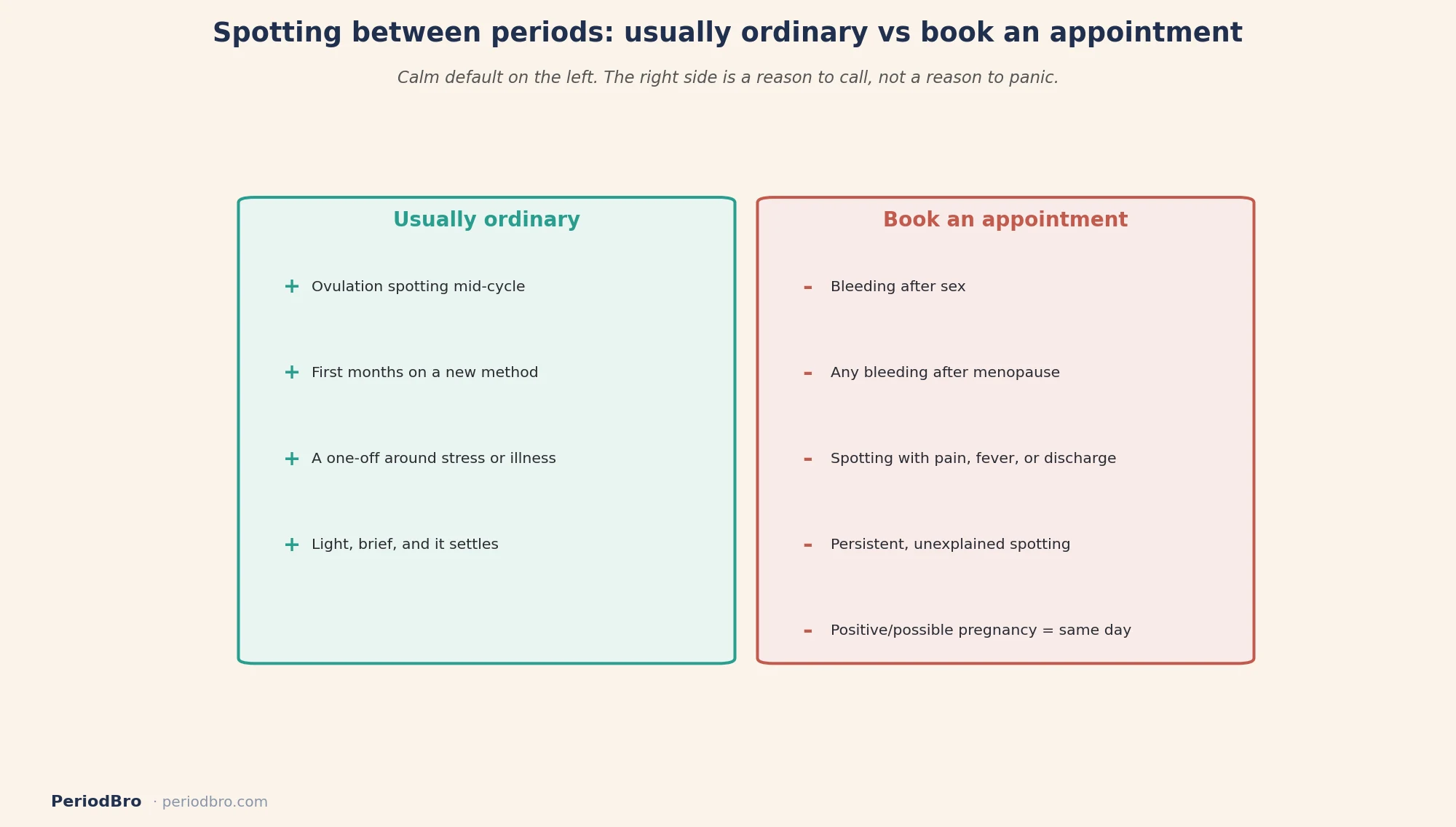
None of this means the worst case. It means the body has a symptom that a professional can read better than an app or a search bar can, and a quick visit either clears it or catches something early. That is a good trade either way.
How to be useful without being alarming
Your job here is not to diagnose anything. It is to be the calm one and to make the practical stuff easier. The most helpful thing you can do is help her have an answer ready if she does see someone: when the spotting happened relative to her period, how much there was, how long it lasted, and whether there was any pain. That handful of details is exactly what a clinician wants, and it is the kind of thing that is annoying to reconstruct from memory. A shared cycle log turns “I think it was a week ago, maybe” into a clear picture.
If she does book a visit, it helps to know it is usually low-drama. Cleveland Clinic notes a clinician may do a pelvic exam, take cultures, or order blood tests or imaging to look closer, and may adjust a medication if birth control is the cause. Knowing that in advance takes some of the fear out of the appointment. Beyond that, the ordinary support playbook applies: do not make it a big anxious thing, do not interrogate, and let her lead on whether and when to get it looked at. If you want the wider version of showing up well here, it is all in being a better partner through her cycle.
One quiet note on when pain is part of the picture: cramping and spotting together can be nothing, but persistent or severe pain is its own flag, which we get into in whether her period pain is normal.
Where I land on this (founder note)
Disclosure: I build PeriodBro, so treat this as the interested party talking. The reason I keep coming back to logging is that I watched my own worry go down once there was a record instead of a guess. When you can see that the spot landed on day 14 and lasted a few hours, the worry has a fact to hold instead of a vague bad feeling. The app is not there to turn you into a doctor. It just helps you both walk into a real conversation, or a real appointment, with the details in hand.
The short version
- Spotting is light bleeding outside her period; timing is the biggest clue to the cause.
- Mid-cycle, new birth control, stress or illness, and early pregnancy are the common, usually-harmless causes.
- Bleeding after sex, any bleeding after menopause, or spotting with pain, fever, or unusual discharge is a reason to get checked.
- If pregnancy is possible, any bleeding is a same-day question for a clinician.
- Help by logging when, how much, and any pain, and by taking the friction off getting it looked at.
Spotting between periods is common, and most of the time it is the ordinary kind. The useful move sits somewhere between panic and a shrug: notice the pattern, know the short list of reasons to call, and be the person who makes the next step easy.
This article is general information, not medical advice. Bleeding patterns have many causes, and only a qualified clinician can assess her situation. If anything here matches what she is experiencing, the right next step is to ask a professional.