Weight Gain Before Period: Why the Scale Jumps and When It Drops
My partner once stepped off the bathroom scale, looked at me and said, “Three pounds. In four days. How?” I didn’t have an answer then. I do now. Weight gain before a period is common, and almost all of it is water and timing rather than fat. Knowing that changes how you both react to the number, and it can save a week of feeling bad about something that will undo itself.
This guide covers why weight gain before period days happens, how much is normal, how long it lasts, what helps, and when a change on the scale is worth a doctor’s visit.
Weight gain before period: what’s actually on the scale
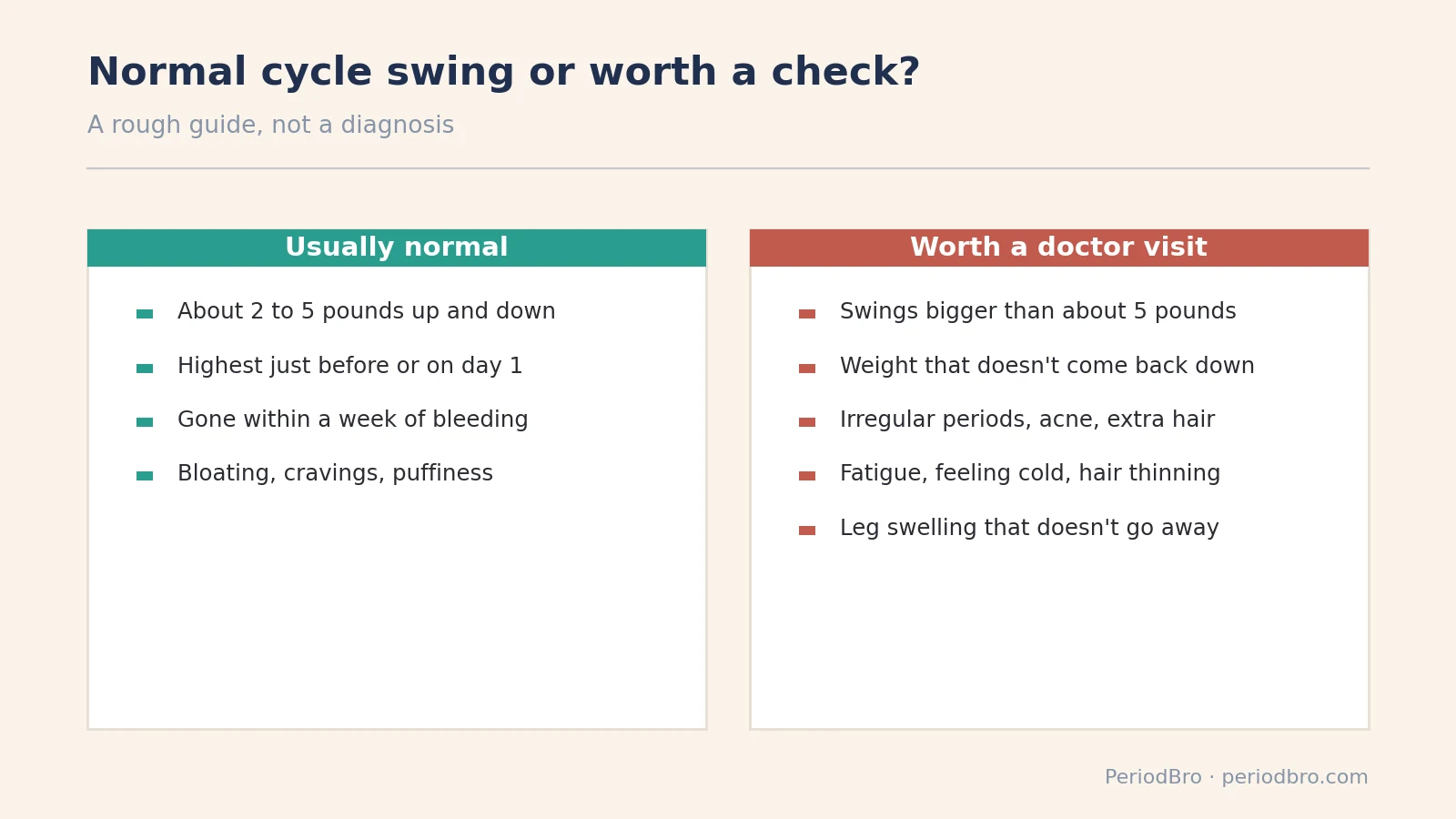
Cleveland Clinic ob/gyn Dr. Alison Stalzer puts the normal range at roughly 2 to 5 pounds of fluctuation across the cycle, and suggests talking to a provider if the swings are regularly bigger than that (Cleveland Clinic). Smaller studies that weigh people through the cycle often find gains around a pound, with plenty of variation from person to person.
Most of that number is fluid. After ovulation, progesterone rises during what’s called the luteal phase, and then both progesterone and estrogen drop in the days before bleeding. These shifts affect how the kidneys handle salt and water, and many people hold on to extra fluid as a result. Our explainer on the luteal phase covers the rest of what changes in those two weeks.
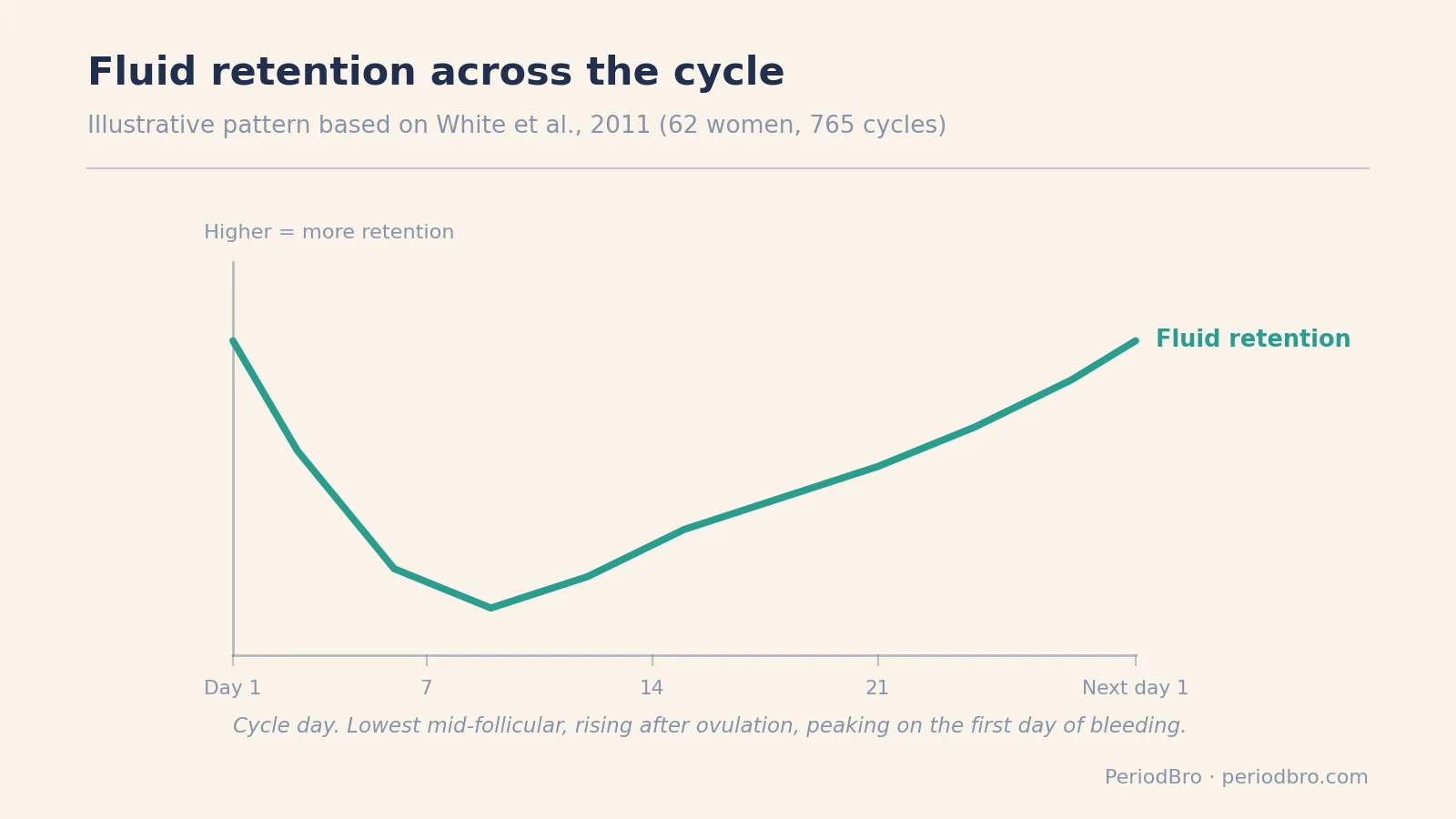
The timing is a bit different from what most people assume. A year-long study that followed 62 women across 765 cycles found that self-reported fluid retention climbed gradually after ovulation and peaked on the first day of bleeding, not before it (White et al., 2011). So if the scale is highest on day one of her period, that’s normal too.
It isn’t just water
A few other things tend to stack on top of the fluid.
Appetite goes up. A 2025 meta-analysis of 15 datasets found that people ate around 170 more calories a day on average in the luteal phase than in the follicular phase, though the studies varied a lot in how they measured it (Nutrition Reviews, 2025). That’s a small daily difference, and our piece on why she craves chocolate before her period explains the cravings side.
Salty and sweet foods hold more water. Cleveland Clinic notes that cramps and fatigue push a lot of people toward salty snacks and sweets, while making them less active, which adds to the fluid and the number (Cleveland Clinic).
Digestion slows down. Progesterone can slow the gut, so constipation and gas are common in the days before a period. Food and stool sitting in the bowel weigh something. Our guide to period constipation covers that part.
Put together, it’s easy to see a few pounds appear in under a week without any change in actual body fat.
Is any of it real fat?
Very little, if any. Some rough math: if she eats about 170 extra calories a day for the two weeks of the luteal phase, that adds up to roughly 2,400 calories. Using the common rule of thumb of about 3,500 calories per pound of fat, that’s well under a pound in the most extreme case, and in real life appetite usually evens out again in the follicular phase.
Compare that with the 2 to 5 pounds the scale can show in a few days, and it’s clear most of the jump is fluid, food and digestion. The number goes up fast because water is heavy. It comes back down just as fast once her body lets go of it.
That matters for how she feels. Many people get discouraged or start restricting food when they see the scale climb before a period, especially if they’re working toward a weight goal. Knowing it’s temporary takes most of the sting out.
How long it lasts
For most people, the extra weight starts coming off once bleeding begins and is gone within a few days to a week, as hormone levels settle and the body releases the stored fluid (Cleveland Clinic). Some people notice they pee more in the first days of their period. That’s the fluid leaving.
If she weighs herself in the week before her period and again a week after, those are two different bodies as far as water goes. Comparing them tells you very little about fat gain or loss.

What helps (and what doesn’t)
There’s no trick that stops cycle-related water weight, but a few habits can soften it:
- Drinking enough water. It sounds backwards, but staying hydrated helps the body let go of excess sodium.
- Going easier on very salty and highly processed food in the week before her period.
- Gentle movement, like a walk or stretching, even when she doesn’t feel like a full workout. Our guide to working out on her period has options for low-energy days.
- Fiber and fluids to keep things moving if constipation is part of it.
- Weighing at the same point in the cycle, or looking at a monthly trend rather than daily numbers, if she tracks weight at all.
What doesn’t help: crash dieting for that week, diuretic pills or “detox” teas, or skipping meals. They can leave her dehydrated and miserable without changing anything that matters. Cleveland Clinic specifically suggests not fixating on daily weigh-ins during this part of the cycle.
How to read the scale across a month
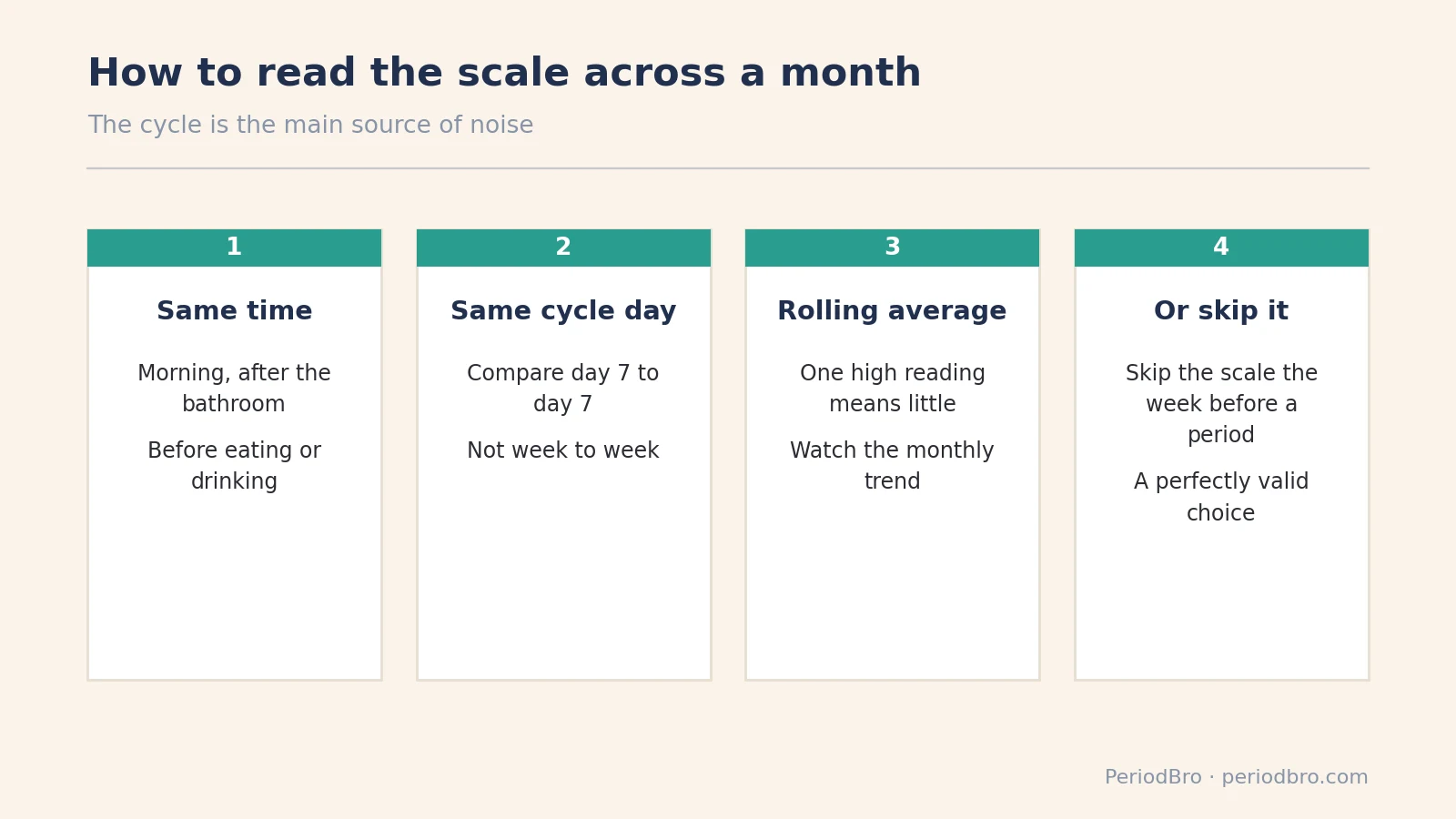
If she tracks her weight, the cycle is the main source of noise. A few habits make the data more useful:
- Weigh at the same time of day, ideally in the morning after using the bathroom.
- Compare the same cycle day month to month, for example day 7 of each cycle, instead of week to week.
- Look at a rolling average if her app or scale offers one. A single high reading means almost nothing.
Some people find it easier to skip the scale entirely in the week before their period. That’s a reasonable choice too.
Your part: say less about the number
For a partner, the useful move is mostly about what you don’t say. Don’t comment on her weight, her jeans fitting differently or what she’s eating that week. Even a joke lands badly when she already feels puffy and uncomfortable. If she brings it up, the honest answer is the helpful one: “That’s probably water. It usually drops off a few days into your period.”

You can also make the week easier in practical ways. Cook something that isn’t salty, keep water and fruit around, and suggest a walk together instead of a couch night. Our list of food to buy before her period has a few ideas. If bloating is the bigger complaint, our guide to period bloating goes into that separately.
When weight changes aren’t about the cycle
Cyclical weight gain comes and goes. Gain that stays, keeps climbing or arrives with other symptoms is worth checking. A visit makes sense if:
- The swings are regularly more than about 5 pounds, or the weight doesn’t come back down after her period.
- Weight gain comes with irregular or missed periods, acne or extra hair growth, which can point to PCOS. Our guide to PCOS and periods covers the signs.
- She has fatigue, feeling cold, hair thinning or heavier periods, which can be thyroid-related. See thyroid and periods.
- There’s swelling in the legs or ankles that doesn’t go away, or sudden swelling with shortness of breath. That needs prompt medical attention.
- The premenstrual week also brings severe mood symptoms. ACOG notes that bloating and weight gain are common PMS symptoms, but mood changes that disrupt daily life may be PMDD (ACOG).
The three pounds, explained
Back to the bathroom scale. Once we looked at her tracking app, it was obvious: every month the number rose in the last few days before her period and fell off in the first week after. She started weighing herself once a month, on the same cycle day, and the three-pound panic stopped. I learned to keep my mouth shut and the salt shaker a little further away.
The scale shows her weight on one morning, and her cycle explains most of the swing. For the full picture of how each phase works, read menstrual cycle phases explained for men.
I built PeriodBro so partners can see where she is in her cycle and what tends to come with each phase. If that sounds useful, you can try it free here.
PeriodBro provides educational information and is not a substitute for professional medical advice. Always consult a qualified healthcare provider for personal medical decisions.