
Ovarian Cysts and Periods: What That Word on the Scan Actually Means
Someone says the word cyst and the room changes temperature. She got a scan for something unrelated, the report came back with a measurement on one ovary, and now you are both reading the same sentence for the fourth time trying to work out how worried to be. The relationship between ovarian cysts and periods is closer than the word suggests: her ovaries build one of these on purpose, every single month.
A friend of mine went through this last winter. His partner had an ultrasound for a stomach thing, got told there was a 3 cm cyst on the left ovary, and spent nine days assuming the worst before a follow-up scan showed it had already gone. Nine days of that were a vocabulary problem.
Her ovaries build a cyst every month by design
A cyst is a fluid-filled sac, and the word carries no verdict about what caused it or what happens next. That is why it lands so badly when a radiologist writes it down.
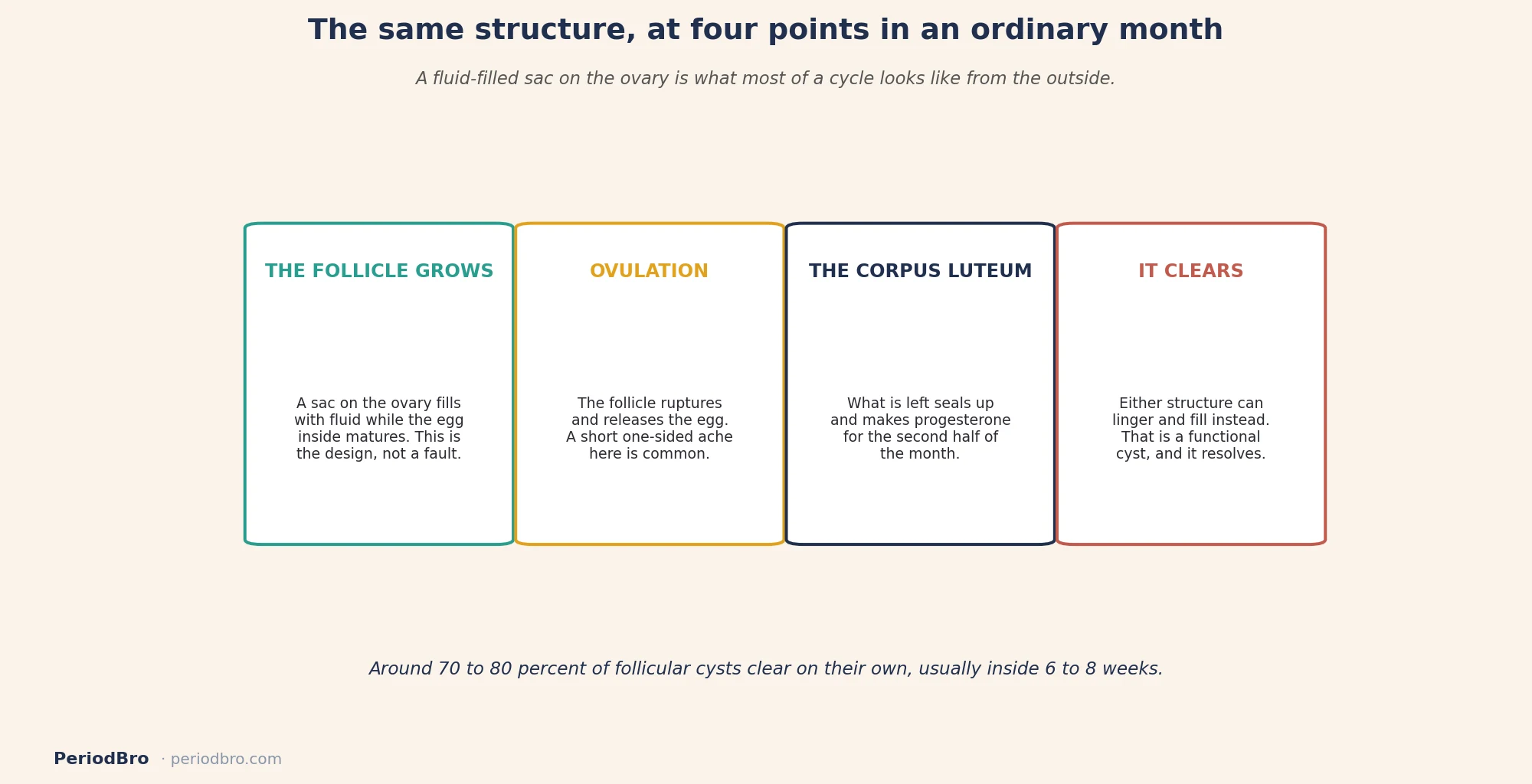
Every cycle, a follicle on one ovary grows and fills with fluid while the egg inside matures. That follicle is a fluid-filled sac on the ovary. At ovulation it ruptures and releases the egg, then the leftover structure seals up, becomes the corpus luteum, and produces progesterone for the back half of the month. If you want the full sequence, ovulation explained for men walks through it.
Two things can go slightly off script in that sequence, and both have names. If the follicle never releases the egg and just keeps filling, that is a follicular cyst. If the corpus luteum seals up and fills with fluid instead of dissolving on schedule, that is a corpus luteum cyst. Cleveland Clinic describes both as functional cysts, meaning they came out of ordinary ovarian function rather than out of a disease process.
When a scan finds one, the likeliest story is that it caught last month in the middle of tidying up.

What ovarian cysts and periods have to do with each other
The link runs in one direction: the cycle makes the cyst, and the cycle usually clears it.
Functional cysts generally shrink on their own, usually within about 60 days and with no treatment at all. ACOG puts the typical window at six to eight weeks, which is one or two more periods. The clinical review in StatPearls puts numbers on it: 70% to 80% of follicular cysts resolve spontaneously.
This is why the standard next step is so often a repeat scan rather than anything dramatic. ACOG calls it watchful waiting, and the logic is that time is the cheapest diagnostic test available. A functional cyst behaves like a phase of the cycle, because that is what it is. Something that is still sitting there unchanged after several cycles is telling you it was never functional in the first place, and that is the point at which a clinician looks harder.
Worth knowing if the conversation turns to treatment: hormonal contraception can prevent new functional cysts from forming, since it suppresses ovulation, but it does not make an existing one clear any faster. That distinction gets muddled constantly, including by people who should know better.
One more piece of context that helps with the panic. Fewer than 1% of ovarian cysts are cancerous, and simple cysts under 6 cm carry a malignancy risk below 1%. Ovarian cysts are extremely common in anyone who has not gone through menopause. Common enough that finding one is closer to a weather report than a diagnosis.
The kind that does not clear on its own
Not every cyst is functional, and the ones that are not tend to announce themselves by sticking around.
Endometriomas, dermoid cysts and cystadenomas all sit in this category. They do not arise from ovulation, so a cycle does not resolve them. Endometriomas are worth naming specifically, because they show up alongside endometriosis, and the pain pattern that comes with them is often the thing that finally gets the underlying condition looked at.
Duration is the tell, more than size and more than how much it hurts. Something that has not changed across three scans is a different conversation from something that halved between two. That is also why a follow-up ultrasound is worth putting in the calendar the day it is recommended, rather than treating it as optional because she feels fine now. Feeling fine is normal for both kinds.
And if her pain has been waved off before, that history matters here. We wrote about what changes the next appointment when that has happened, because a cyst on a report is unusually good leverage: it is an objective finding, and objective findings are harder to shrug at.

The two situations that are actually urgent
This is the part to hold in your head, because it is the only part where speed changes the outcome.
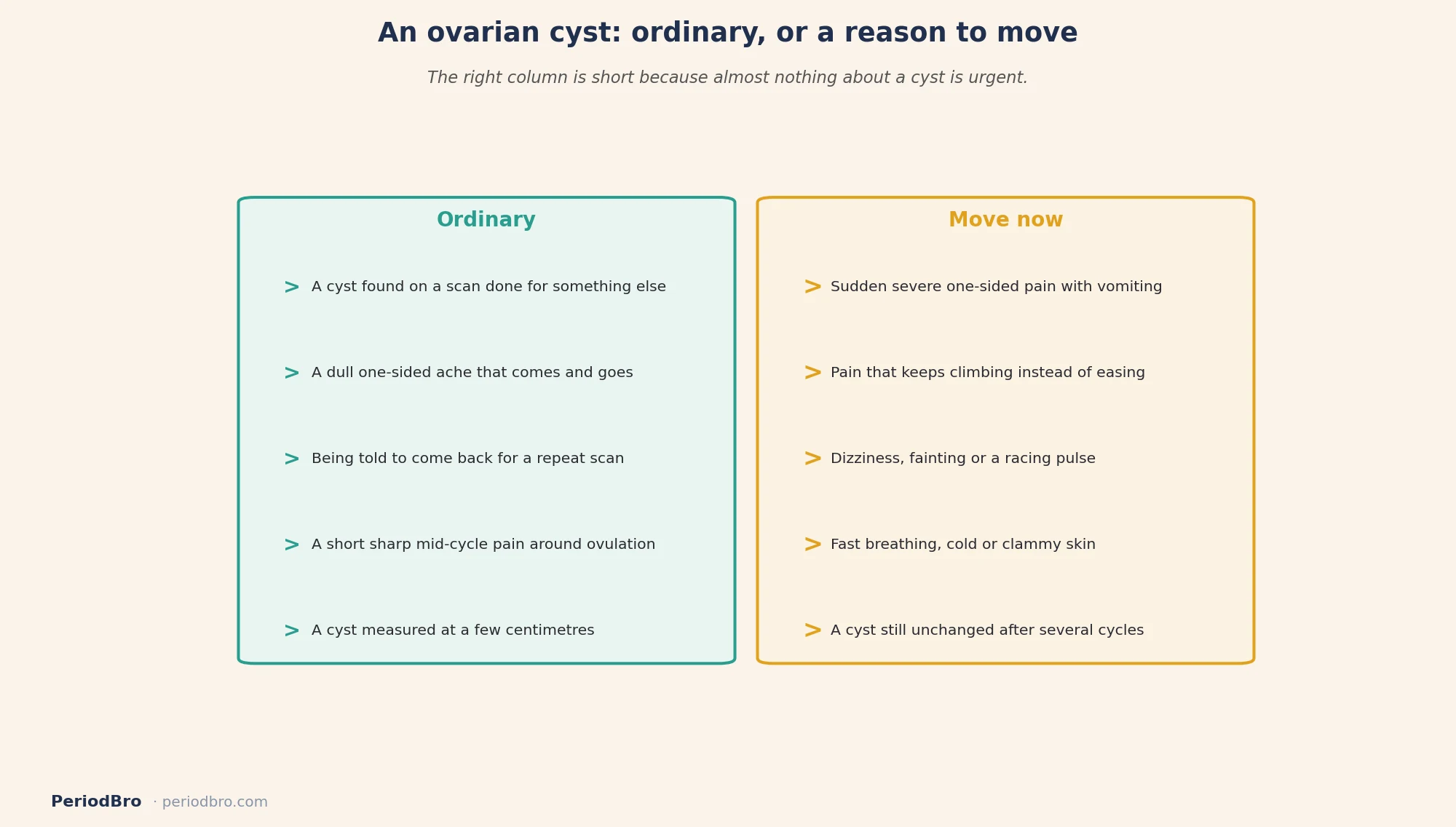
A cyst that ruptures. Functional cysts rupture routinely, and most of the time it registers as a bad hour, or as nothing. Sudden sharp one-sided pain, sometimes with nausea or a bit of spotting. Most ruptures are uncomplicated and get managed with rest and painkillers if she is otherwise stable. What turns it into an emergency is bleeding: pain that keeps escalating rather than easing, dizziness, fainting, a racing pulse, fast breathing, or skin that has gone cold and clammy. That combination means the ER, not a call in the morning.
Ovarian torsion. The ovary twists on the ligaments holding it, and the twist cuts off its own blood supply. A cyst makes this more likely because it gives the ovary weight to swing on. It presents as sudden severe pain on one side, usually with vomiting, often in waves. Cleveland Clinic is direct about what is at stake: the tissue can die without emergency surgery, and she can lose the ovary. StatPearls lists torsion as the fifth most common gynecological emergency, so it is rare, but it is not exotic.
The useful filter is the shape of the pain rather than how high she rates it. Ordinary cycle pain has a shape you both recognise by now, and pain that arrived out of nowhere, on one side, with vomiting, and is getting worse rather than settling, does not fit it. If you find yourself building an argument for waiting until morning, that is usually the answer.
Two things that get confused with all of this
PCOS is not “having cysts.” The name has caused a decade of confusion. Polycystic ovary syndrome is a hormonal condition, and the follicles that show on a scan are not the same object as a functional cyst that needs watching. Someone can have PCOS with no cysts in the sense used here, and someone can have a cyst with no PCOS. If that is the live question in your house, PCOS and periods covers what it actually is.
Mid-cycle pain is usually just ovulation. One-sided ache around day 14, lasting hours to a day or so, arriving roughly on schedule each month, is far more likely to be the follicle rupturing normally than anything that needs a scan. We covered that in ovulation pain. And if the underlying question is whether her period pain in general is inside the normal range, that has its own answer, and it is not the same question as this one.
Heavy bleeding pushed the conversation somewhere else again, by the way. That is more often fibroids than cysts, and the two get swapped in conversation constantly because both are described as growths.
What you can usefully do
The job here is small and specific, which is worth saying because the instinct is to do something large.
Do not run the search. You will find the 0.9% and read it as the headline, and then she has your anxiety to manage on top of her own. If you want the background, read the cycle itself instead: the menstrual cycle guide will do more for you than any forum thread.
Put the follow-up scan in your calendar as well as hers, because that appointment is the entire plan and it is the easiest one to let slide once the fear fades.
Know the two emergency shapes above without rehearsing them at her. She does not need a briefing on torsion while she is already unsettled. She needs you to recognise it if it happens, which is a thing you can do quietly.
And take the word out of the middle of the room. For most people, most of the time, ovarian cysts and periods are the same story told twice: hers built one last month on purpose, and will build another one next month, and the report is usually describing housekeeping rather than a problem.

PeriodBro gives you a plain daily read on where she is in her cycle, which makes it easier to tell an ordinary mid-cycle ache from something that does not belong. Try it free.
This article is general information, not medical advice. Anything found on a scan belongs in a conversation between her and a clinician who can see the images.