
When a Doctor Waves Off Her Period Pain
She spent about six months working up to booking it, rehearsed what she was going to say in the car, and came out eleven minutes later holding a leaflet and a suggestion to try ibuprofen. Nothing rude happened. Nothing got written down either. And now the thing you have to manage at home is not the pain, it is her deciding she was making a fuss.
That second part does the lasting damage, and it is why this is worth getting right. A doctor dismissed her period pain without saying a single thing you could build a complaint out of, which is what makes it so hard to push back on, and the odds are decent that she does not go back for another two years.
Why “it’s normal” gets said so easily
The least satisfying explanation is also the main one: period pain has no test.
There is no scan that shows it, no bloodwork that flags it, and no number she can point at. All the clinician has is what she says, filtered through an appointment that runs about eleven minutes, in a subject where a huge amount of pain genuinely is ordinary. Say “bad cramps” in that room and you have said the same words as the hundred people that month whose cramps really are the usual thing. The default answer is calibrated to the average case, and it is right most of the time, which is exactly what makes it so hard to get past when she is not the average case.
She also arrives having already talked herself down. Most people with heavy or painful periods have been told since they were fourteen that this is what it is like, so by the time she is in the room she is presenting a softened version of her own month. Our piece on whether her period pain is normal covers where the actual line sits.

The number that should be sitting in the back of your head
Endometriosis is the condition this pattern most often hides, and its signature is delay.
Across the developed world, the time from first symptom to diagnosis runs somewhere between five and twelve years. A large French cohort published this year put the average at ten years for endometriosis and eleven for adenomyosis. An Australian study came out at 12.3 years, and when researchers asked people what caused the delay, the most common answer was being dismissed or disbelieved rather than anything technical about the disease.
Read those numbers as a decade of exactly the appointment described at the top of this article, repeated. Nobody in that decade did anything obviously wrong on any given day. A ten year delay gets built out of visits that all looked reasonable on the day. We wrote up what the condition actually does in endometriosis for partners, and its close relative in adenomyosis for partners.
Guidance has moved, which helps. Diagnosis no longer requires surgery first, which means treatment can start on a presumptive basis instead of waiting years for a laparoscopy slot.
It is not only about her doctor
Worth knowing so that neither of you concludes she picked a bad clinician and the next one will be fine.
The pattern shows up in settings with no relationship history at all. In a study of nearly a thousand people arriving at an emergency department with acute abdominal pain, men and women reported the same average pain scores, but women were less likely to get any painkiller at all and noticeably less likely to be given an opiate. The gap held when conditions specific to one sex were taken out of the analysis.
That is one study in one department, and walking into a surgery braced for a fight helps nobody. What it should change is what she brings, because the fix is making her case hard to file under average rather than hunting for a better doctor.
What to do when a doctor dismissed her period pain
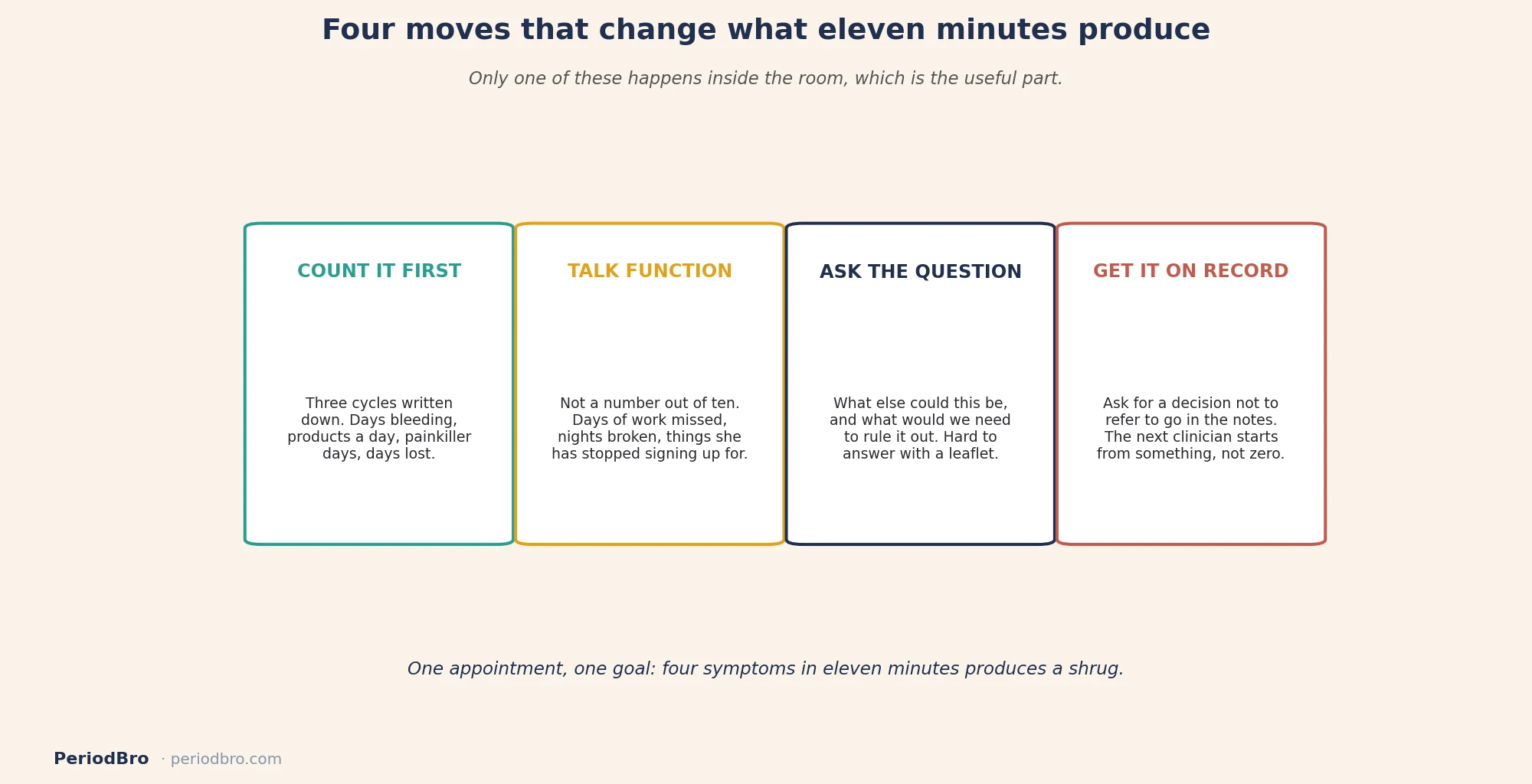
Four things change the outcome, and only one of them happens in the room.
Count it before you go. Three cycles, written down. Days of bleeding, how many pads or tampons a day, days she took painkillers, days she missed or cut short work or school. A page of numbers is a different clinical object from “they are really bad.” It gets read as data instead of as a description.
Talk about function, not severity. Pain scales flatten. “It’s an eight” lands as an opinion. “I missed two days of work last month and I have used the same sick days every month since March” lands as a fact with a shape. Period pain and work goes into how much of it gets absorbed silently.
Ask for the differential out loud. One question does most of the work: what else could this be, and what would we need to do to rule it out? It moves the conversation from whether her pain is bad enough to what the plan is, and it is very hard to answer with a leaflet.
Ask for the decision to be written down. If nothing is being offered and no referral is being made, ask, politely, for that to go in the notes. Not as a threat. It just changes the register of the visit, and it means the next clinician sees that this has been raised before rather than starting from zero.
One appointment, one goal. Trying to cover pain, mood, bleeding and fatigue in eleven minutes produces a shrug. Trying to cover pain produces a plan.

Where you help, and where you take up her air
Partners get this part wrong in good faith, so it is worth being blunt.
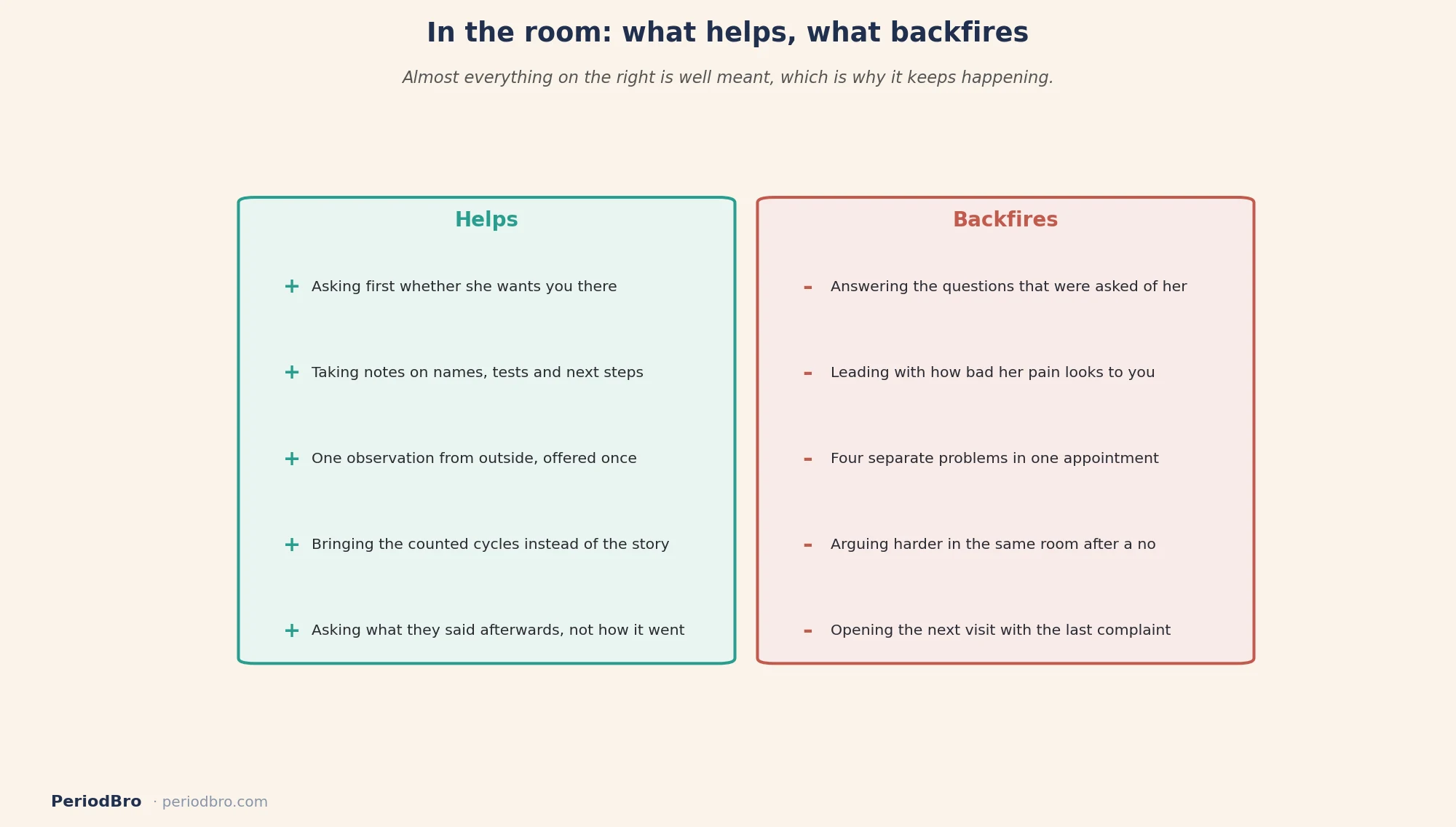
Do not speak for her. A man answering on behalf of the patient is the fastest way to have the whole account discounted, and worse, it confirms the thing she is already afraid of, which is that her own version does not carry. If you are in the room, you are there to remember, not to narrate. Take notes. Names, what was said, what was ruled out, what happens next. She will be running on adrenaline and will lose half of it by the car park.
The one line worth having ready, if it stalls, is the observational one. Not “she’s in agony,” which is her territory, but “for what it’s worth, she’s been going to bed at eight for the last four months and that’s new.” You are describing what you have seen from outside, which is information nobody else in the room has.
And ask her first whether she wants you there at all. Some people want a witness and some want the room, and getting that wrong is its own small injury.
If she does not want you involved at all
That is a legitimate answer, and it comes up more than partners expect.
Some of it is privacy, some of it is not wanting to be handled, and some of it is that having someone else invested makes a bad appointment harder to come home from. If that is where she is, the job shrinks to two things and both of them are unglamorous. Keep the record going, because three cycles of numbers are useful whether or not you are in the room. And do not ask how it went in a way that requires a good answer, because “fine” is what she will say to close the subject, and then neither of you knows anything.
Better: leave it a day, then ask what they said rather than whether it worked. It is a smaller question and it gets a real answer.
When it stalls anyway
Sometimes it stalls. Then the move is not to argue harder in the same room.
A second opinion is not an accusation. Asking to see someone with a specific interest in menstrual health is normal and reasonable, and a good clinician will not take it personally. Bring the same three cycles of numbers to the new appointment rather than starting the story again, and skip the editorial about the last visit, because the notes are more persuasive than the grievance.
Watch for the things that change the category rather than the intensity: soaking a pad or tampon in an hour for several hours running, pain that has started coming outside her period, pain during sex, new bowel or bladder symptoms that track her cycle. Those are the details that reopen a closed door, and the full cramps field guide lists them properly.
The part that outlasts the appointment
Whatever the surgery does or does not do, the more important thing is happening at home.
Ten years of being told it is normal teaches a person to stop reporting accurately, including to you. The useful thing is being reliably the person who does not need convincing, which matters more than any of the advocacy. Believe the account the first time. Do not audit it against how she looked yesterday. When she says this month was worse, say what do you need rather than are you sure. Being supportive when you cannot fix the pain is most of the job.
She can lose an argument with a doctor and still walk back into a house where the account is not up for debate. That is what makes going back a third time possible.

PeriodBro keeps a plain record of her cycle over months, which is the thing that turns “they’re really bad” into something an appointment can act on. Try it free.
This article is general information, not medical advice. If her pain is severe, changing, or new, that is a reason to be seen rather than a reason to read more articles.