
Adenomyosis for Partners: The Condition That Takes Years to Name
Her periods got worse. Not overnight, just steadily worse year over year, until the first two days stopped being something she could work through. Maybe a scan came back clean. Maybe nobody ordered one. If that is the shape of it, adenomyosis for partners is worth ten minutes of your time, because this one is common, it hides inside the muscle where a quick look does not find it, and almost nobody explains it to the person standing next to it.
Here is what it is, why it takes so long to get named, and where you come in.
What adenomyosis is
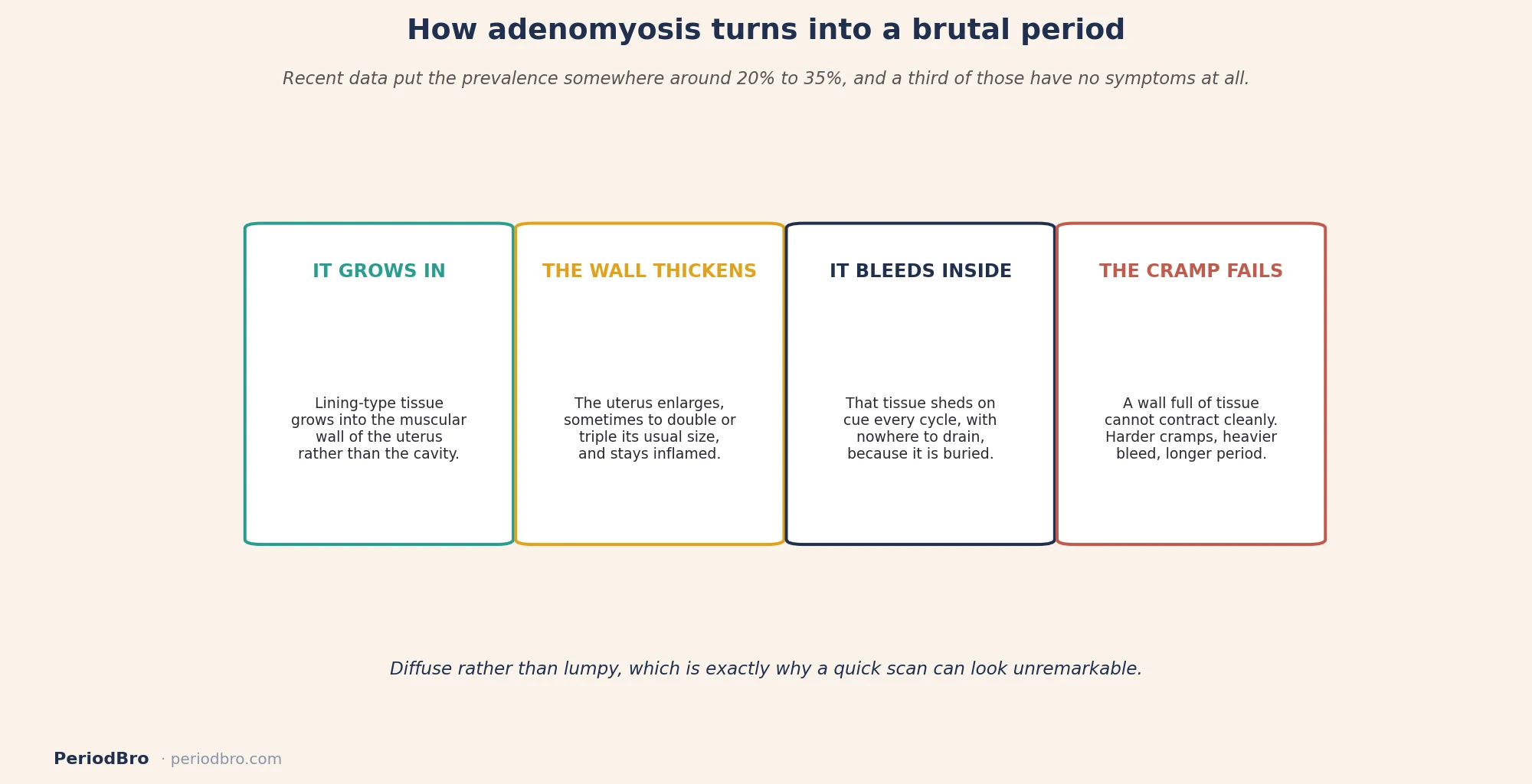
Adenomyosis is when tissue similar to the uterine lining grows into the muscular wall of the uterus itself. Cleveland Clinic describes the result plainly: the wall thickens and the uterus enlarges, sometimes to double or triple its usual size.
Every cycle, that trapped tissue responds to the same hormones as the lining. It builds, it tries to shed, and it has nowhere to go, because it is buried in muscle rather than sitting in the cavity. So it bleeds into the wall. The muscle around it swells and becomes inflamed, and then it has to contract through all of that to push a period out.
How common is it? Honestly, nobody has a clean number. StatPearls notes that reported prevalence has ranged from 5% to 70% depending on how you count, with more recent data landing somewhere around 20% to 35%. Even the low end of that puts it in the same bracket as conditions everyone has heard of.
The reason the range is so wide is that for decades the only certain diagnosis came from examining a uterus after it had been removed. You cannot count a condition accurately when the confirmation is a hysterectomy.

Why it makes periods heavier and more painful
Two mechanisms stack, and they explain almost every symptom she has.
First, surface area. More lining-type tissue means more tissue trying to bleed each month, which is why heavy bleeding is one of the signature symptoms. If you have read our piece on heavy periods, the practical side of that is the same here.
Second, the muscle. A uterus with tissue growing through its wall cannot contract cleanly. It cramps harder and less efficiently at the same time, which is a fair description of what she is trying to tell you when she says the pain is different now.
Cleveland Clinic lists the rest of the picture: pelvic pain with severe cramping, pain during sex, an enlarged uterus, difficulty getting pregnant, and a bloated or full feeling in the belly that has nothing to do with what she ate. That last one gets misread constantly. When she says her stomach looks different and it is not food, she may be reporting a symptom rather than being hard on herself.
Worth holding onto: about 1 in 3 people with adenomyosis have no symptoms at all. It is not a condition where the severity of the disease and the severity of the day line up neatly. Her experience is the data point, not the scan.
Adenomyosis for partners: why this one takes years to name
Three things conspire to keep it unnamed, and knowing them changes how useful you can be at an appointment.
It is invisible on a quick look. There is no growth to point at the way there is with a fibroid. The uterus is diffusely thickened, which reads as unremarkable unless someone is specifically looking for it.
It arrives gradually. Cleveland Clinic puts it most commonly between ages 40 and 50, more often in people who have given birth or had a uterine procedure, though it is increasingly diagnosed in people in their 30s. Nothing about that timeline announces itself. Periods get worse slowly enough that recalibration happens instead of alarm, and by the time it is bad, the memory of normal is gone.
It travels with company. StatPearls reports adenomyosis alongside fibroids in about 50% of cases, endometriosis in 11%, and polyps in 7%. When there is a fibroid on the scan, the fibroid gets the credit and the treatment, and the pain that does not resolve afterwards gets treated as bad luck.
A friend of mine went through eleven years of this with his wife. Two different doctors, one fibroid removed, a stretch where the working theory was stress. She was told her periods were heavy but within range often enough that she stopped raising it. The MRI that finally named it happened because she pushed for it herself, at 41, after reading about it online. The thing he says now is that he spent a decade agreeing with whoever was in the room instead of with her.

Adenomyosis, endometriosis and fibroids: same neighbourhood, different addresses
These three get muddled in every waiting room, and the difference is really just location.
Adenomyosis is lining-type tissue growing into the wall of the uterus. Endometriosis is similar tissue growing outside the uterus, on ovaries, tubes and elsewhere in the pelvis. Fibroids are something else entirely: benign growths of muscle and tissue, discrete lumps rather than diffuse infiltration.
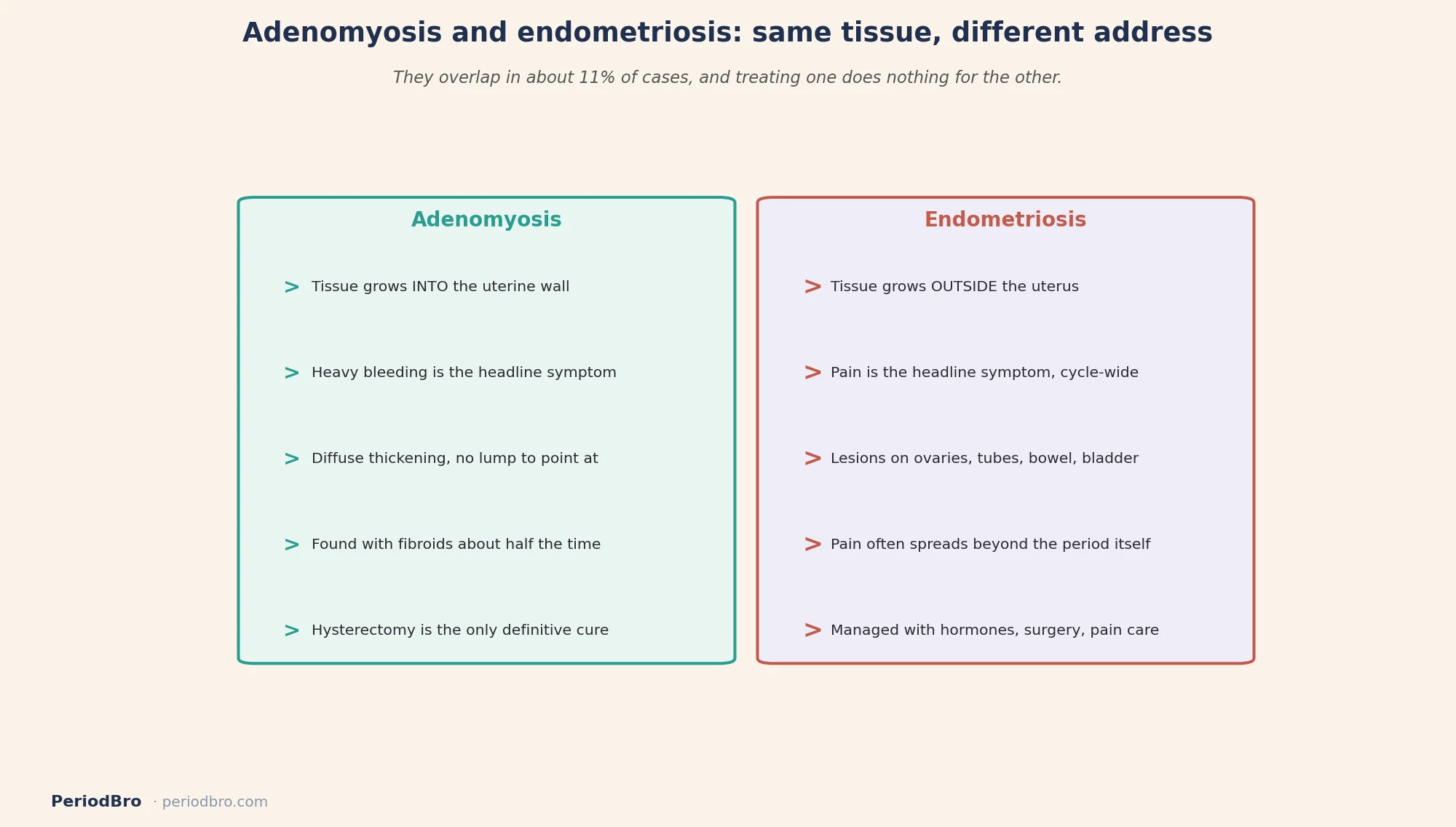
Why it matters to you: she can have more than one, and treating one does not treat the other. Half of adenomyosis cases come with fibroids. Removing a fibroid and being told the problem is solved, then finding the periods are still brutal, is a common and demoralising sequence. She is not being ungrateful about a surgery that worked. There was a second thing in there that nobody went looking for.
One more thing, because it is the fear sitting under all of this and it deserves a direct answer: adenomyosis does not cause cancer and does not turn into cancer.
How it actually gets diagnosed
The good news is that it no longer takes a hysterectomy. StatPearls describes transvaginal ultrasound as the preferred first imaging step, with MRI offering higher diagnostic accuracy when the picture is unclear. Both are outpatient. Neither is exotic.
What makes those scans useful is a written record going in. Dates, days of bleeding, how often she is changing protection on the worst day, pain scored out of ten, days she could not do her normal thing, and whether sex hurts. Six months of that turns a ten-minute appointment into a conversation with evidence in it, and it is a job you can do without being asked. A shared cycle log is one of the few genuinely useful things a partner can contribute to a medical process, which is most of the reason our own app exists.
If she has already been told her periods are within normal range and she does not believe it, the record is what lets her say so without arguing about memory. Our guide on whether her period pain is normal covers the thresholds worth writing down.
What treatment looks like
Management, not cure, unless she is done with her uterus. Cleveland Clinic’s list runs roughly in this order:
- NSAIDs such as ibuprofen or naproxen, started before the worst day rather than during it
- Hormonal options including combined pills, injections and hormonal IUDs, which thin the lining and often cut bleeding substantially (see our guide to birth control and her cycle for what each one does to a cycle)
- Tranexamic acid, a non-hormonal drug taken during the bleed specifically to reduce blood loss
- Adenomyomectomy, surgical removal of affected tissue where it is localised enough to target
- Hysterectomy, the only definitive cure, and the reason many people spend years managing instead
Symptoms typically settle after menopause, since the tissue depends on estrogen. That is real, and it is also cold comfort to someone who is 38.
Watch the iron. Months of heavy bleeding drain it faster than food replaces it, and the resulting anaemia feels like exhaustion that sleep does not fix, breathlessness on stairs, and brain fog that gets blamed on work. If that sounds familiar, our piece on period fatigue is the version that stops when the period stops. This one does not.
Your part
You cannot fix this. Say that to yourself once so you stop trying, because trying to fix an unfixable thing is how partners end up making it worse. Our guide on being supportive when you cannot fix her pain goes deeper on that.
What is left is not small:
Believe her the first time. A condition invisible on a quick scan gets doubted by default. Do not add to that. When she says this period is different, ask her how, and resist the urge to measure it against the last one.
Keep the record. Dates, flow, pain, days lost. Six months of it is the single most useful thing anyone brings into that appointment.
Go to the appointment. Not to speak for her. To hear what was said, so that afterwards there are two memories of it instead of one.
Do not read painful sex as rejection. Painful intercourse is on the symptom list. If it stops, that is information about her uterus, not about you.
Plan the month around the worst two days. If the pattern is predictable, use it. That is the whole idea behind tracking her cycle as a partner, and it is more useful here than almost anywhere else. If you want the underlying mechanics, start with our menstrual cycle guide.
Eleven years is the number my friend uses. Not because the medicine failed him, but because nobody in the room was keeping score across the years. That part was always available to him. It is available to you now.

This article is for general information and is not medical advice. Adenomyosis, endometriosis and fibroids overlap in symptoms and can occur together, and heavy bleeding has other causes worth ruling out. If she is soaking through protection hourly, passing large clots repeatedly, or in pain that stops her normal day, that is a conversation for a clinician rather than a blog.