
What Happens to Her Cycle When She Comes Off Birth Control
She finished the last pack and did not start a new one, and now there is a question sitting in the house that neither of you knows how to answer. The pregnancy side of it is obvious enough. The harder one is what her body is going to do for the next few months, and how much of that is worth worrying about. Her first period after stopping birth control is only one marker in that, and it arrives later than the thing that actually matters.
I got this wrong the first time it happened to us. My partner came off the pill in March and I spent about six weeks quietly convinced something had gone sideways, because nothing looked like it had looked before and neither of us had any idea what the baseline was supposed to be. The information exists. It just never gets handed to the person standing next to her.
The bleed she had on the pill was not really a period
Combined hormonal contraception works mainly by switching off ovulation. No egg is released, the lining stays thin, and the bleeding she got in the placebo week was a withdrawal bleed: her body responding to the hormones stopping for seven days, not the end of a natural cycle. It is lighter and more punctual than a real period because it is engineered to be, which is exactly why people describe the pill as making their periods “regular.”
So “her period coming back” is the wrong picture. What has to come back is the whole cycle underneath it. The brain has to start signalling again, a follicle has to mature, ovulation has to happen, and roughly two weeks after that, bleeding follows. If you want the full version of that sequence, the menstrual cycle guide for men walks through it. The short version is that a period is the last event in a chain, not the first, and the chain takes a while to restart.

How soon a period after stopping birth control usually shows up
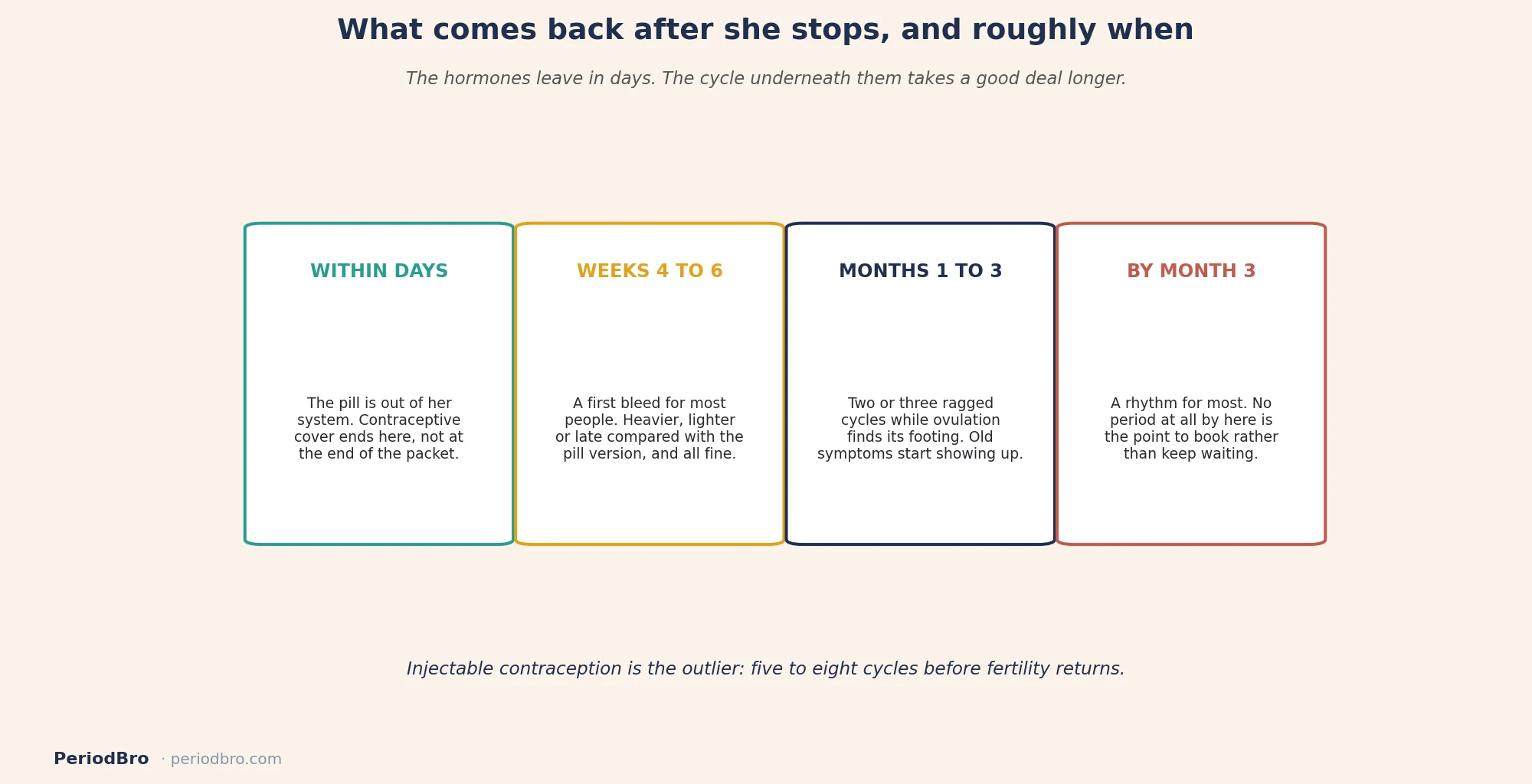
The hormones themselves clear fast. With the combined pill they are out of her system within days, which is why contraceptive cover ends immediately and not at the end of the month.
The cycle is slower. Cleveland Clinic’s version is the most honest framing I have found: some people go straight back to a regular cycle, and others do not see a period for around three months. Most land somewhere in between, with a first bleed four to six weeks out and a couple of ragged months after that before anything settles into a rhythm. Heavier than she remembers, or lighter, or arriving on a day that makes no sense, all sit inside ordinary.
The number worth keeping is three months. If there is no period at all by then, that is the point where it stops being patience and becomes an appointment, and ACOG’s guidance on absent periods is the reason. Three months of nothing has causes worth naming, and most of them are easy to check.
The method matters more than how long she was on it
The finding that surprises most people, including me, is that the years do not stack up.
A study of nearly 18,000 people planning pregnancies in North America and Denmark, summarised by Boston University’s School of Public Health, sorted the delay in returning fertility by method. Injectable contraception was the slowest by a distance, at five to eight cycles. The patch took about four. Pills and the vaginal ring took around three. Hormonal and copper IUDs and the implant took about two.
And the part everybody gets wrong: how long she had used the method made no difference. Ten years on the pill did not put her further back than one year on it. The “I have been on it since I was sixteen, it must be in there somewhere” worry, which is extremely common and which I have heard from more than one friend, does not survive contact with the data.
If she was on the injection, budget for a longer wait and do not read the silence as a problem. That one is slow by design and stays slow for months after the last shot.
The symptoms that come back were hers all along
Couples get into trouble here, and it is usually a language problem rather than a medical one.
Plenty of people are on hormonal contraception for reasons that have nothing to do with pregnancy: crushing cramps, heavy bleeding, acne, cycles that arrived whenever they felt like it, premenstrual weeks that flattened them. The pill did not cure any of that. It suppressed the cycle that was producing it. Take the suppression away and the original pattern comes back, usually within a few months, and Cleveland Clinic says exactly this in plain language: the symptoms she went on it to manage will probably return.
That is the original pattern becoming visible again rather than a withdrawal reaction, and the difference is worth holding onto. One version sounds temporary. The other tells you what you are planning around. Our piece on birth control and her cycle covers what each method was doing while it was on board.
There is also no detox. The hormones are gone in days. Anything sold as a post-pill cleanse is selling the wait back to her at a markup.

If she came off it because of how it made her feel
Not everybody stops for pregnancy. A large share stop because they had spent years feeling slightly not themselves and finally decided to find out whether the pill was the reason.
Expectations are harder to set there, because the answer is individual in a way the timeline questions are not. Some people describe mood lifting within a couple of months. Some notice their sex drive coming back and being tied to a point in the month rather than sitting flat, which is what a natural cycle does and which we went through in when desire drops before her period. And some find that the premenstrual week off the pill is considerably harder than anything they had on it, which is a real outcome rather than a failure of nerve.
The thing to avoid is deciding on her behalf which of those happened. A few months in, the temptation to say “you seem better since you stopped” or, worse, “you’ve been rough since you stopped” is strong, and both versions hand her a conclusion about her own head that she did not reach. Ask what she has noticed. Keep your theory to yourself unless she wants it.
If the premenstrual weeks turn out to be genuinely disabling rather than just present, that is worth naming to a clinician rather than absorbing, because it has treatments of its own.
Fertility restarts before the first bleed
If pregnancy is not the plan yet, this is the practical bit.
Ovulation runs roughly two weeks ahead of any bleeding. That means she can ovulate, and therefore conceive, before she has had a single period off the pill. Waiting for a period as the signal that fertility is back is reading the wrong end of the sequence. It is the same timing quirk that catches people out after a birth, which we covered in her first period after the baby, and the mechanics are laid out in ovulation explained for men.
If pregnancy is the plan, the flipside applies. There is no medical reason to wait an arbitrary number of cycles before trying, though a couple of natural cycles make dating a pregnancy easier later. What to actually do with the tracking data once you are trying is its own subject, and we went through it in trying for a baby.
What is ordinary and what is worth a call
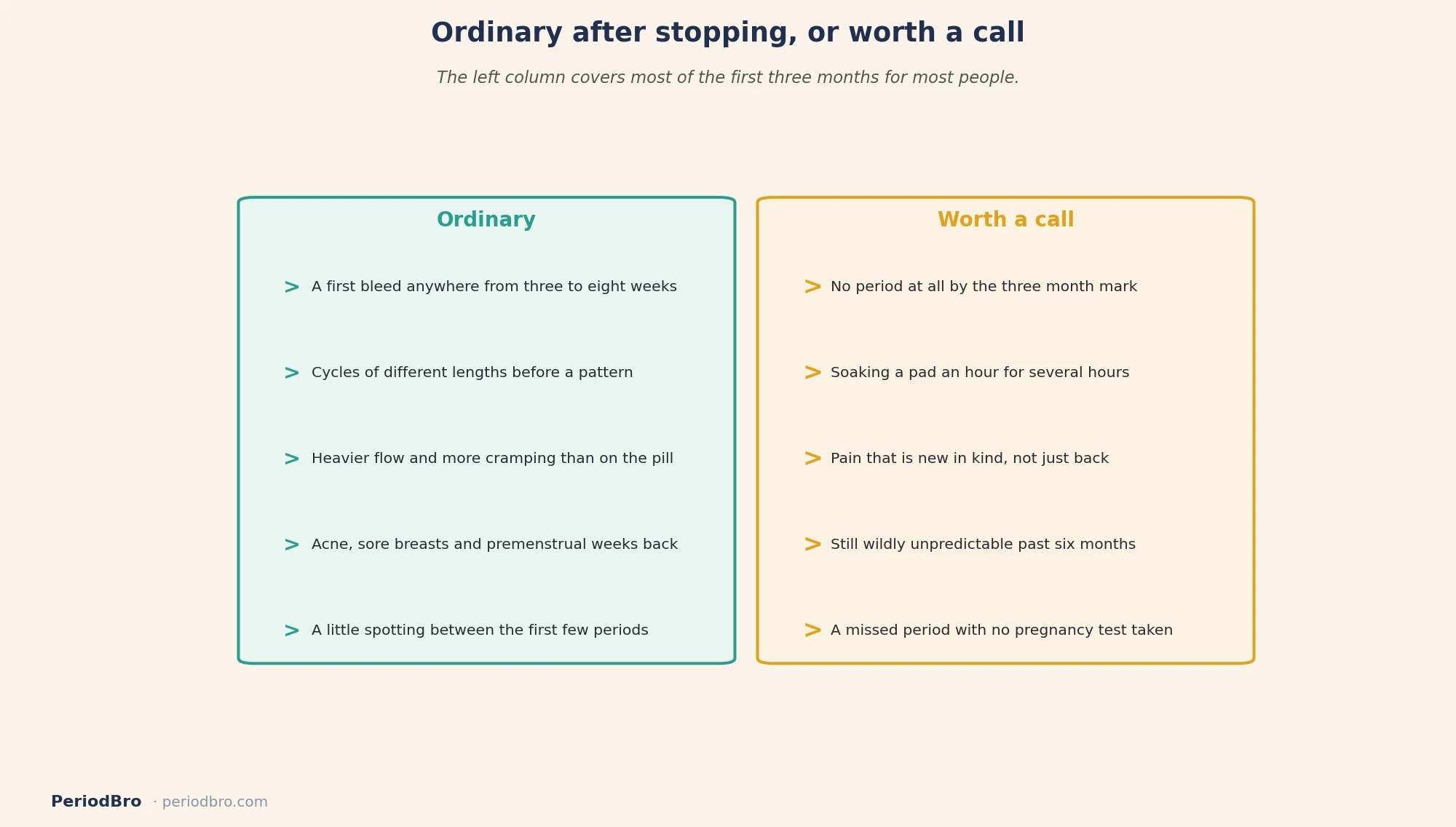
Ordinary covers more ground than people expect. A first bleed anywhere from three to eight weeks out. Two or three cycles of different lengths before a pattern appears. Heavier flow, more cramping, spots of bleeding between periods in the first couple of months, and the reappearance of premenstrual symptoms she had forgotten about.
Worth a call is short and specific. No period at all by three months. Pain that is new in kind rather than just back to old levels. Soaking through a pad or tampon in an hour for several hours running. Cycles that stay wildly unpredictable past six months, which is one of the ways PCOS shows up once the pill stops covering for it. And a period that never arrives with a pregnancy test that has not been taken, because that is the first thing any clinician will ask about and there are several reasons a period runs late.
What you can usefully do
Less than you would like. Most of the job is not adding noise.
Do not narrate her body back to her. “Is this the pill thing?” every time she is tired stops being curiosity by about the third time. If she is tracking, let the app be hers rather than a scoreboard you check. Take the practical load in the messy months, because a cycle that has gone unpredictable means she is carrying supplies she did not need to carry for years and getting caught out in ways she had forgotten about.
And do not compare this month to the pill version. That comparison always loses, because the pill version was a flat line by design and a real cycle is not supposed to be flat.
Most of this settles. Give it three months before treating anything as a problem, keep the short list above in your head, and let the rest be what a cycle actually looks like when nothing is holding it still.

PeriodBro turns her cycle into a plain daily read, which is useful in the months after stopping hormonal contraception, when nothing is predictable yet. Try it free.
This article is general information, not medical advice. Decisions about starting or stopping contraception belong between her and a clinician who knows her history.