
Trying for a Baby: What to Do With Her Cycle Data
The first month we were properly trying, I got a notification that said “peak fertility today” and I treated it like a fire alarm. Second month, same notification, and I noticed it had arrived on exactly the same calendar day as the first one, which is not how bodies work. That was the month I actually learned what the app was doing, which is roughly what this article is.
Cycle tracking trying to conceive is worth doing. It is just that most of what people rely on tells you about a month that has already finished, and the two signals that genuinely look forward are the two nobody bothers with.
Cycle tracking trying to conceive: the window is six days long
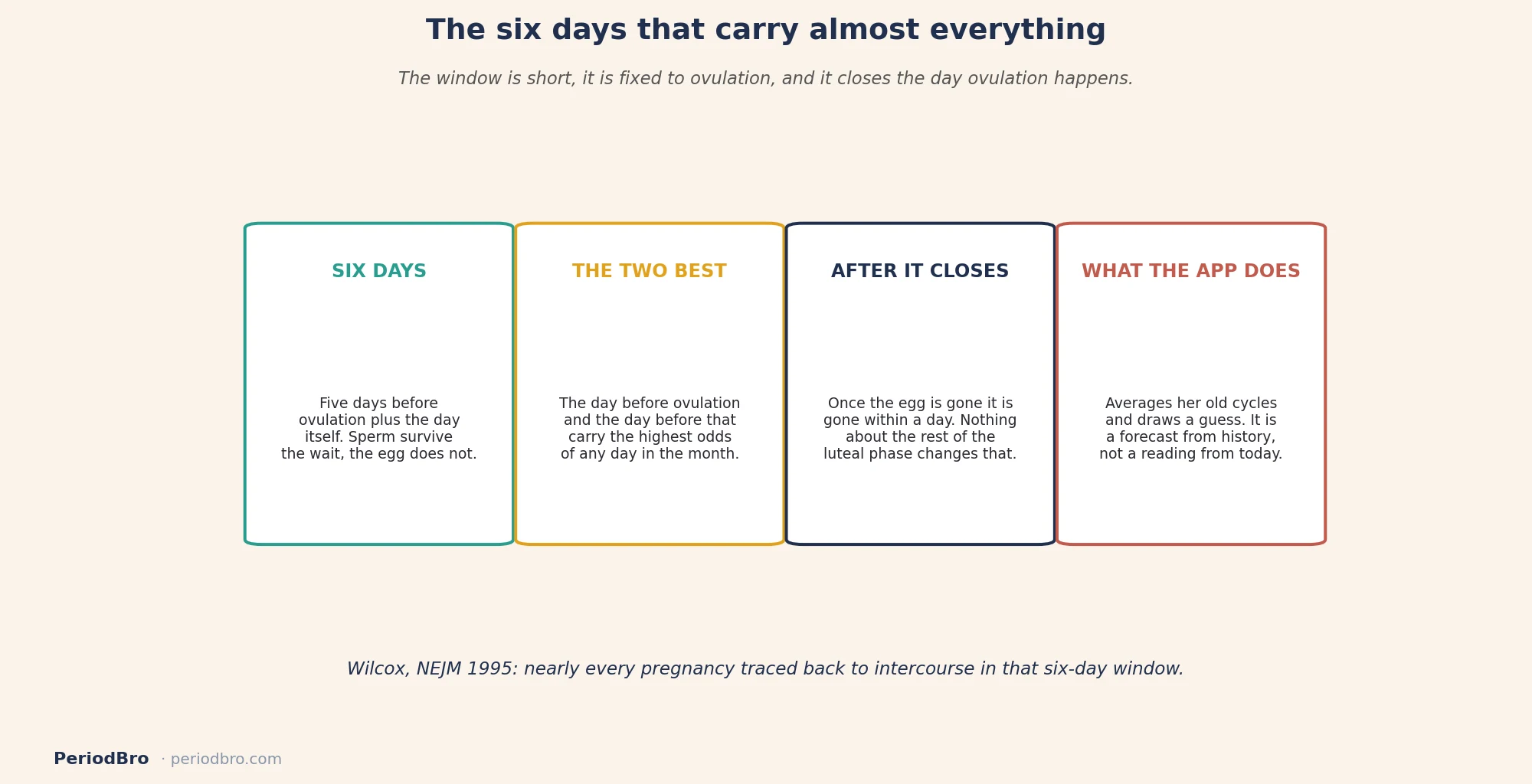
Almost every pregnancy in healthy couples traces back to sex in a six day stretch: the five days before ovulation, plus the day of ovulation itself. That is the finding from Wilcox’s 1995 study in the New England Journal of Medicine, and thirty years of guidance has been built on top of it without much amendment.
The asymmetry matters. Sperm can wait around for several days. The egg cannot. Once ovulation has happened, that cycle is essentially finished as far as conception goes, within about a day. So being a day early is fine and being a day late is not, which is the opposite of how most people plan.
ASRM puts the peak in the two days before ovulation, with the highest single day being the day before it happens.

What the app is actually doing when it says “peak”
It is averaging. A standard calendar app takes her last few cycle lengths, assumes ovulation lands about fourteen days before the next period, and draws a window around that. It is a forecast built from history, not a reading taken from her body this month.
When cycles are regular, that guess is decent. When they are not, it falls apart, and the way it falls apart is worse than useless. A German study that scored twelve cycle apps against fertility awareness criteria gave every calendar based app in the set zero points out of thirty. Even the ones taking temperature scored badly: Natural Cycles came out at 2, Ovy at 3. The apps that did reasonably well were the symptothermal ones, which ask the user to enter observations rather than predicting from averages, and those topped out around 20 out of 30.
The authors made a point that is easy to skip past: an app that puts the fertile window in the wrong place does not merely fail to help, it sends couples to have sex on the wrong days. A confident wrong answer stops you looking for a better one.
None of that makes the app useless. It makes it a logbook rather than an oracle. Six months of honest logging is genuinely valuable, and it is exactly what a clinician will want if this goes on longer than you hoped. The prediction line on the front screen is the part to stop trusting. There is more on how far these predictions can be pushed in do period tracker apps work.
The two signals that look forward
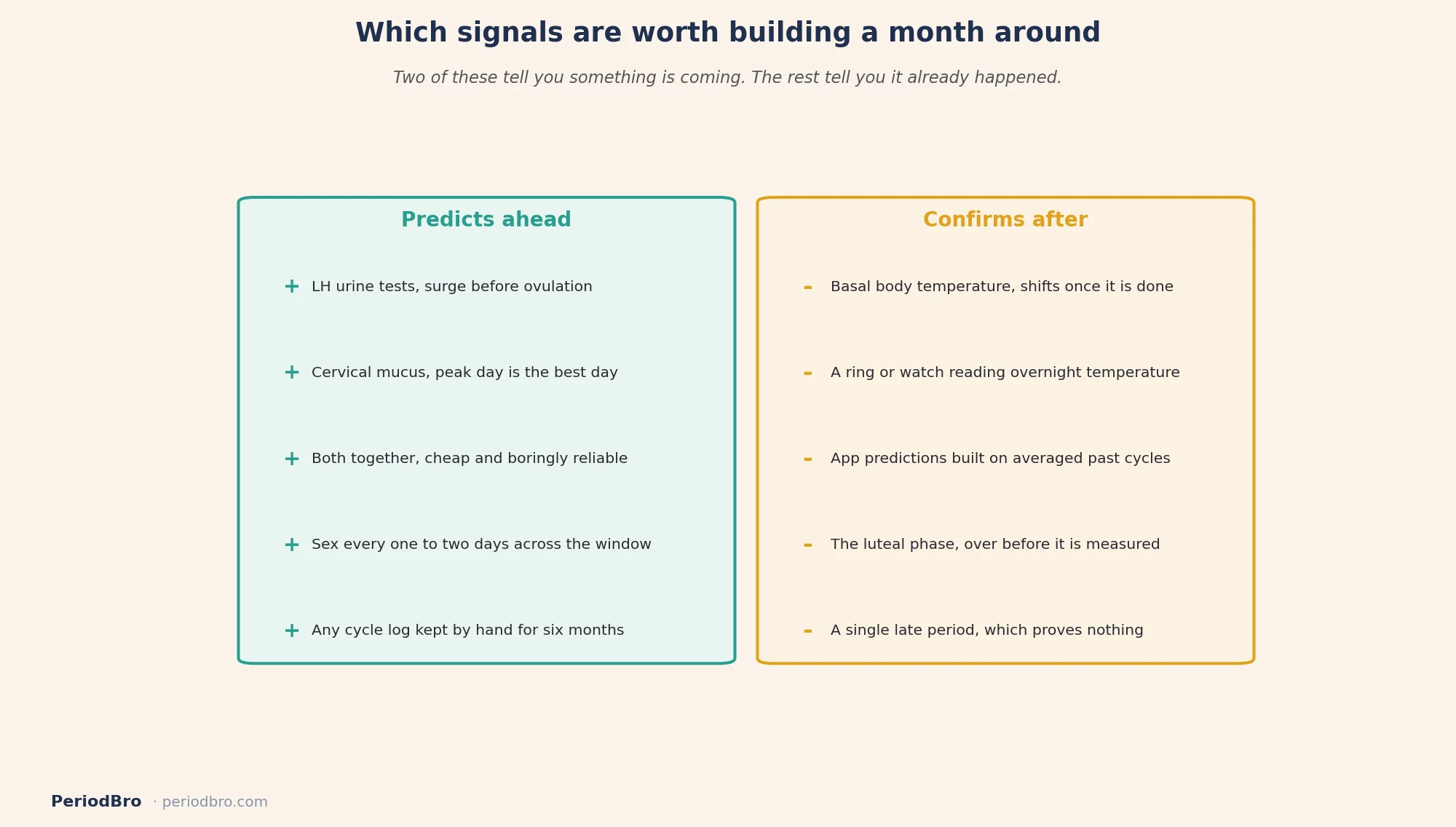
Only two things tell you ovulation is coming rather than that it went.
LH urine tests. Luteinising hormone surges a day or two before ovulation, and a cheap strip picks it up. ASRM notes these have validated accuracy for detecting the surge, and a randomised trial found they shorten time to pregnancy. Two caveats worth knowing: ovulation can happen any time in the two days after a positive, and roughly 7% of results are false positives. So a positive means the window is open now, not that today is the only day.
Cervical mucus. Unglamorous, free, and the best predictor in the set. It changes across the cycle and reaches a peak day of clear, stretchy, slippery fluid right before ovulation. Sex on the peak mucus day carried a pregnancy rate around 38% in the research ASRM cites, and mucus observation predicted the day specific probability of conception as well as or better than temperature did.
Everything else confirms after the fact. Basal body temperature rises after ovulation, so a chart tells you last week what you needed on Tuesday. Same for a ring or watch reading overnight temperature: useful for confirming a pattern across months, no good for tonight. That is a real capability and a real limit, and I went through it properly in smart ring cycle tracking.
How often, actually
Every one to two days across the fertile window gives the best odds. Every two to three days across the whole month gives results that are close to identical, and it is a lot more sustainable.
ASRM is explicit that couples should not restrict frequency, and about 80% of couples conceive within six months of trying. Which means the most likely reason this has not worked yet is that it has been three months, and not that you got the timing wrong.
The reason to prefer the every two to three days version is not biological. It is that it does not require anyone to be on standby. If you want the biology of why interest tends to rise around ovulation anyway, ovulation explained for men covers it.
Four things to stop doing
Stop assuming day 14. The two week rule describes the gap between ovulation and the next period, not the gap between the last period and ovulation. On a 33 day cycle, ovulation is nearer day 19. On a 24 day cycle it is nearer day 10. Counting forward from her last period is where most of the misses come from.
Stop saving up. Abstaining for several days to build a better sample is folklore, and ASRM says plainly that couples should not restrict frequency while trying. Longer gaps do not improve the odds and they make the timing harder to hit.
Stop treating a negative LH strip as a closed day. Surges can be short, and a strip tested once a day can miss one entirely. If she has tested negative all week and there is mucus, that is the mucus talking, and mucus is the better predictor.
Stop measuring the month by the app’s confidence. Prediction lines get more assertive as they collect data, not more accurate. If the underlying cycles vary by a week, no amount of history fixes that, which is worth knowing before you pick one and stick with it. The tracker comparison for partners goes through which ones handle irregularity honestly.

The part that goes wrong between the two of you
Nobody warns you that timed sex is its own small stress test.
It shows up in a specific way. Sex becomes an item with a deadline attached. She gets a notification and feels obliged. You feel evaluated, which is not a great state to be in. One of you starts checking the app in bed. Something that was yours becomes scheduled, and then a month goes by without conceiving and the schedule feels heavier the next time round.
A few things help, and they are all boring.
Own the tracking, not the schedule. Knowing where the window is falls to whoever wants to hold it. Announcing that tonight is the night falls to nobody.
Agree the frequency once, in advance, out of the bedroom. Every two days through the middle of the month, decided on a Sunday, spares both of you from negotiating it at eleven at night.
Keep a night in the window that is not about this. It is the only reliable way to stop the whole subject becoming transactional.
Do not narrate her body back to her. This is the same rule as everywhere else on this site. Data about her cycle does not entitle either of us to tell her what is going on inside it, and the wider version of that principle is in tracking her cycle with consent.
When it is time to ask someone
The standard line: an evaluation after twelve months of trying if she is under 35, after six months if she is 35 or over. That is ACOG and ASRM in agreement, and the shorter clock for 35 and over is not a scare tactic, it is arithmetic about how long an investigation itself takes.
Go earlier than either number if there is a reason. Cycles that are wildly irregular or absent, known endometriosis or PCOS, previous pelvic surgery or infection, or anything on your side you have quietly wondered about. Roughly a third of the time the finding is on the male side, and the test involved is a sample in a cup rather than anything invasive. Being the one who books that first is a decent thing to do.
We got the timing right eventually and it still took another five months, which is completely ordinary and felt like nothing of the sort at the time. The tracking helped in the end, just not the way I expected. It stopped being a prediction engine and became a record, and the record was what the doctor actually wanted.
If you want the underlying map of what the month is doing, start with the menstrual cycle guide for men. I built PeriodBro so the pattern lives on your phone without turning into another thing to perform.

This is general information, not medical advice. Fertility questions belong with a clinician who can look at both of you, and nothing here replaces that.