Do Period Tracker Apps Work? An Honest Look for Partners
You download a cycle app, she logs a few periods, and it starts confidently telling you she is fertile on Tuesday and due on the 14th. So do period tracker apps work, or is it a well-designed guess dressed up as a fact? The honest answer is that they work well for one job and badly for another, and knowing which is which saves you a lot of misplaced confidence.
I build one of these apps, so I have every reason to oversell them and I am going to do the opposite. A straight yes or no misses the point. What matters is understanding what the math behind a prediction can and cannot know, because that is the difference between a tool that helps you show up and a number you trust more than you should.
Do period tracker apps work? Yes for periods, shakily for ovulation
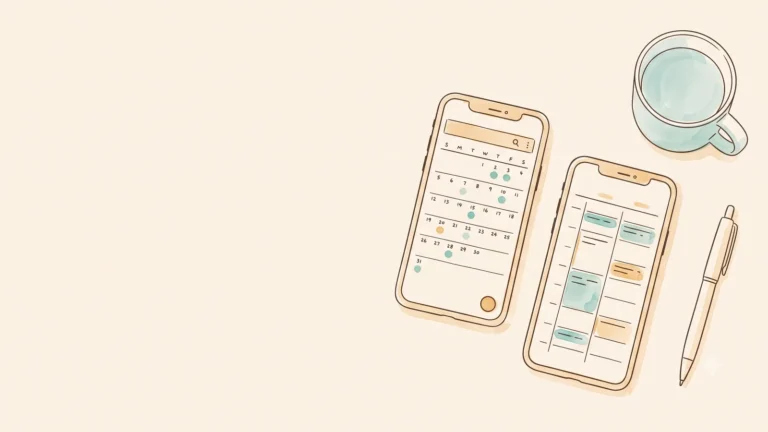
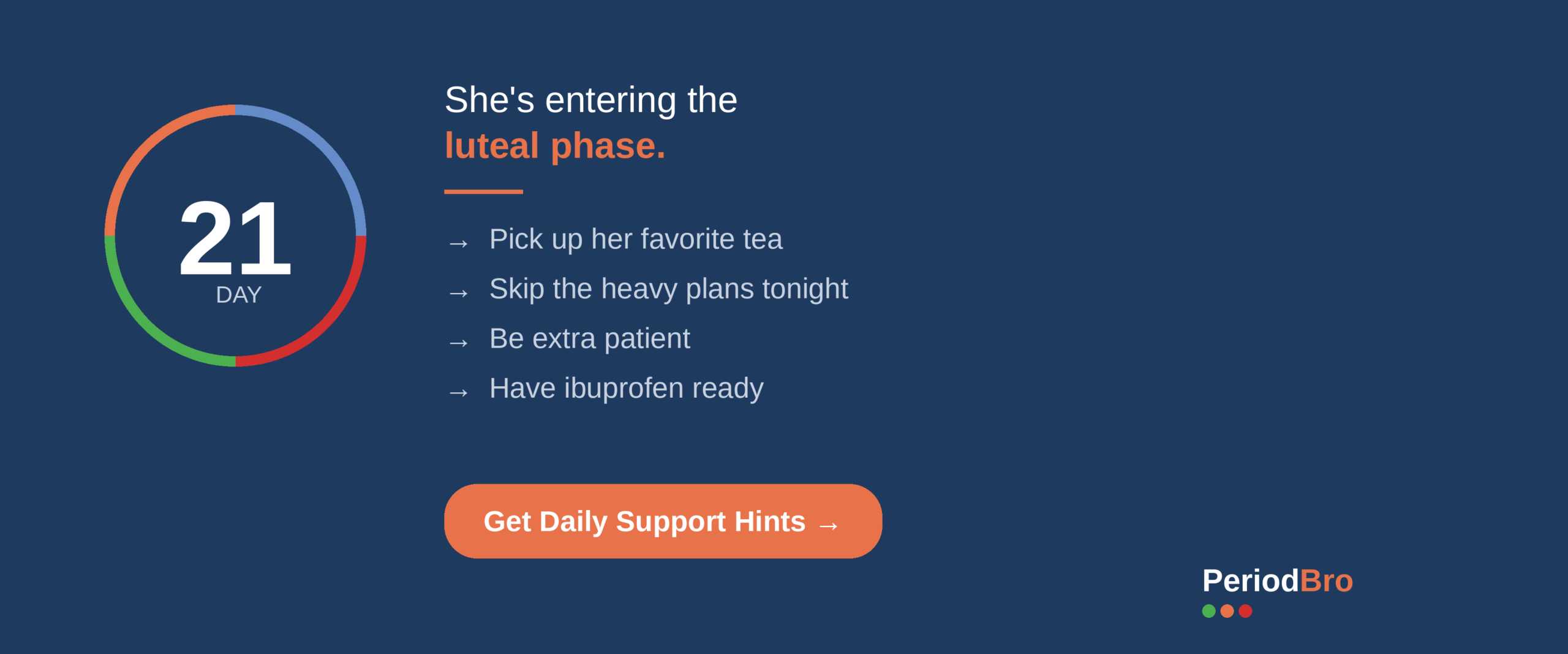
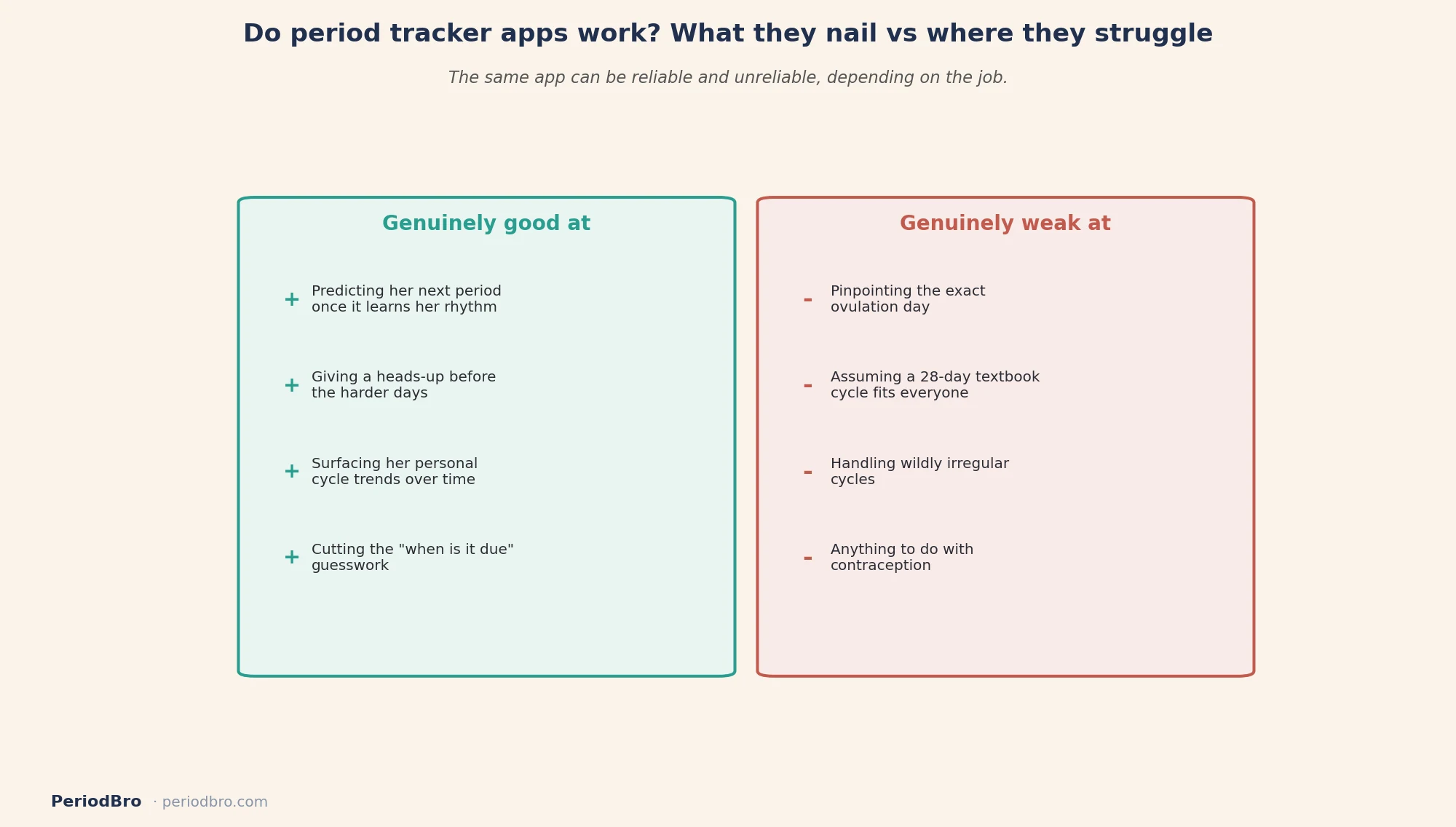
Start with what they are genuinely good at. A calendar-based app is a pattern-matcher. Feed it a few of her real cycles and it gets reasonably good at predicting when the next period will start, because period timing, once an app has learned her personal rhythm, is the more stable thing to forecast. That is the everyday value for a partner: a quiet heads-up that the harder week is coming, so you are not caught flat-footed. If you are choosing between apps for exactly this, we compared the options in the best period tracker apps for partners.
Where apps get shaky is ovulation. Predicting the exact day she ovulates is a much harder problem, and most calendar apps are quietly bad at it. A 2021 study that put ten popular period apps to the test found that only 3 of 36 ovulation predictions were exactly right, and the apps gave conflicting answers on period dates, ovulation day, and the fertile window, with cycle-length estimates landing anywhere from 0 to 8 days off (Worsfold et al., 2021). That is not a knock on any one app. It is the nature of predicting a moving target from a calendar alone.
Why the textbook cycle breaks the prediction
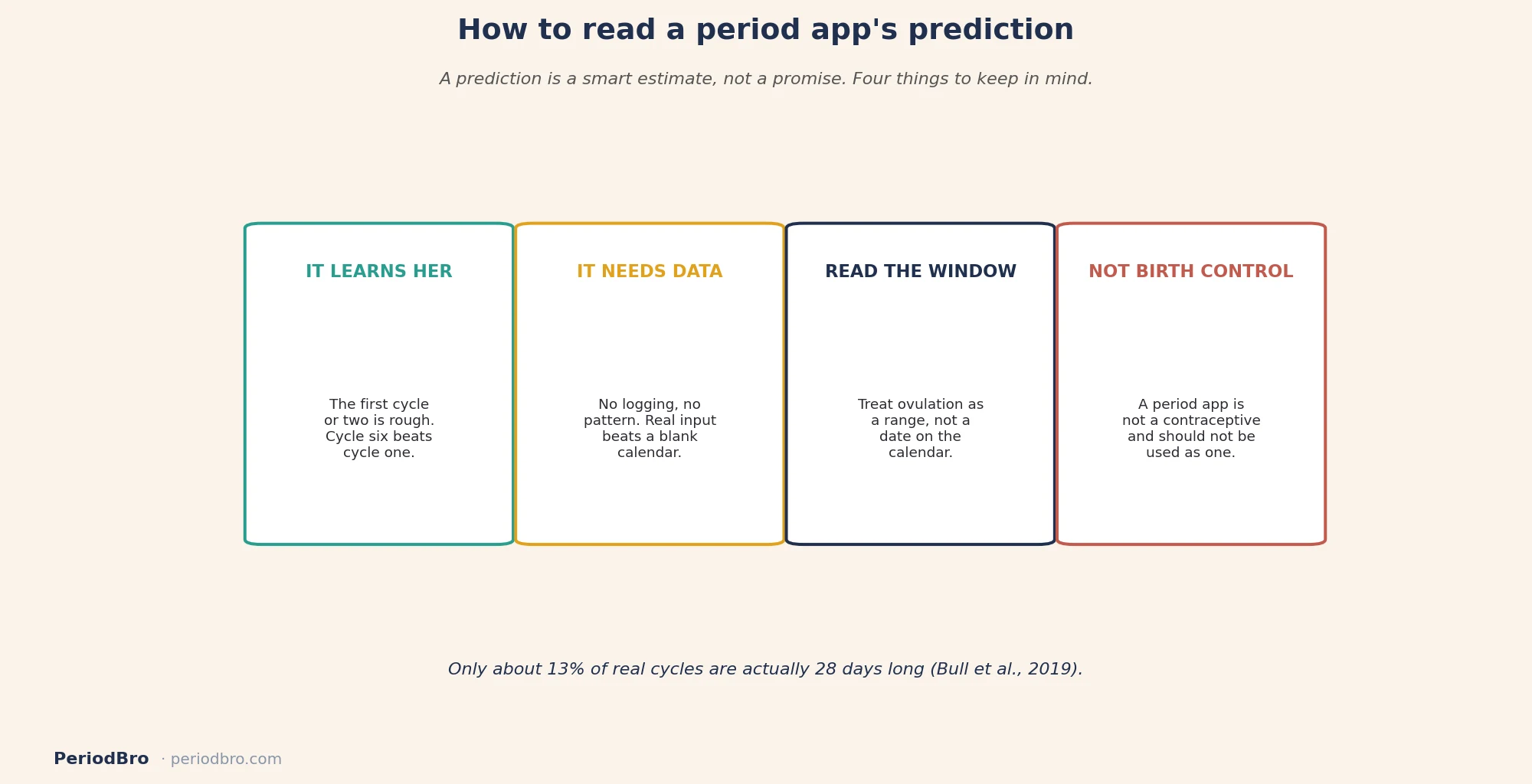
Here is the root of it. Most simple apps are built on the same assumption you probably learned in school: a 28-day cycle with ovulation on day 14. Real cycles do not read that memo. When researchers looked at more than 600,000 real cycles, the mean length was 29.3 days and only 13 percent of cycles were actually 28 days long, with the vast majority spread anywhere from 23 to 35 days (Bull et al., 2019). Even among the women who did have a clean 28-day cycle, ovulation was spread across about ten different days rather than reliably landing on day 14.
So an app that assumes day 14 is starting from a number most people do not have. The good apps get around this by learning her actual data instead of leaning on the textbook, which is exactly why the app feels dumb for the first cycle or two and smarter later. If you want the biology under all this without the myth, it is in our plain-English guide to her cycle.
What actually makes a prediction more accurate
The accuracy is not fixed, it is something the app earns. A few things move the needle, and it helps to know them so you both have realistic expectations.
First, consistent logging. An app can only pattern-match what it is given, so a few cycles of real data beat a year of blank calendar. Second, time. The prediction for cycle six is a lot better than the one for cycle one, because the app has more of her rhythm to work with. Third, how regular her cycles are: a woman with steady 30-day cycles will get tighter predictions than someone whose cycles swing widely, and that is the app being honest about uncertainty, not failing. Fourth, extra signals. Apps or devices that use body-temperature or hormone data, not just dates, do measurably better at catching the fertile window than calendar math alone. A 2025 review of wearable cycle-tracking technology found pooled accuracy around 0.88 for identifying the fertile window, well above what a plain calendar guess manages (npj Digital Medicine, 2025).
A quick word on irregular cycles, because this is where expectations go sideways. If her cycles swing widely from month to month, no app is going to give you tight predictions, and one that claims to is bluffing. What a tracker can still do in that case is surface her personal range, so instead of a false to-the-day date you get an honest window and a record of how much things move. That is genuinely useful information, both for the two of you and for a doctor if the irregularity is worth looking into. The worst thing an app can do with an irregular cycle is pretend it is regular.

The one thing an app is not: birth control
This matters enough to say on its own. Because ovulation prediction is the weakest part of the whole exercise, a standard period app is not a contraceptive and should never be used as one. The fertile-window estimate is a guide for people trying to understand or plan, not a green light for unprotected sex. There are separately regulated fertility-awareness apps built and cleared for that purpose, and a general cycle tracker is not one of them. If contraception is part of the picture for you two, that is a different conversation, and we covered how the methods actually change her cycle in birth control and her cycle.
So what is the app actually for, as a partner
Once you stop expecting a crystal ball, the value gets clear and modest and genuinely useful. The app gives you context. It tells you roughly where she is in her cycle, which turns a confusing week into an understandable one, and it gives you a soft heads-up before the days that tend to be harder. That is not fortune-telling, and it does not need to be. It just saves you from reacting to something you could have seen coming. The point was never to predict her to the day, only to stop you being blindsided by something that runs on a rhythm.
Used that way, a tracker earns its place. It is a small daily nudge toward paying attention, and paying attention is most of the job. The full version of what that looks like is in our guide to being a better partner through her cycle, and if you are still weighing which app to trust with her data, the honest privacy rundown is in whether period tracker apps are safe.
Where I land (founder note)
Disclosure: I build PeriodBro, so this is the interested party talking. I would rather you go in clear-eyed than oversold. My app predicts her next period well and treats the fertile window as an estimate, because that is what the science supports and pretending otherwise would just erode your trust the first time it was wrong. If an app ever promises you certainty about ovulation from a calendar alone, that is the tell that it is overselling. A good tracker is honest about what it does not know.
The short version
- Apps predict her next period well once they have learned a few of her real cycles.
- They are much weaker at pinpointing ovulation, because real cycles vary far more than the 28-day textbook.
- Accuracy improves with consistent logging, more cycles of data, regular cycles, and temperature or hormone signals.
- A standard period app is not birth control and should never be used as one.
- For a partner, the real value is context and a heads-up, not a to-the-day forecast.
This article is general information, not medical advice, and period tracker apps are not a substitute for contraception or clinical care. For questions about fertility, contraception, or an unusual cycle, talk to a qualified clinician.