The Best Period Tracker Apps for Partners in 2026 (Honest Comparison)
For about a year, I had my girlfriend’s Flo login. Not because she hid anything – she offered it early on so I’d stop asking “wait, are you due soon?” every few days. And it worked, sort of. But every time I opened it, I felt like I was reading her diary. The app wasn’t built for me. It was built for her, and I was a guest poking around in her data.
That’s the quiet problem with almost every period tracker: it assumes the person tracking is the person bleeding. If you’re the partner – the boyfriend, the husband, the dad who wants to be ready – you’re an afterthought at best. So I went looking for the best period tracker app for partners – something built for my side of the relationship. This is what’s out there in 2026, where each one actually helps, and how to pick. Full disclosure up front: one of these is the app I built, and I’ll tell you exactly where it fits and where it doesn’t.
What actually matters when you’re the partner
Most “best app” lists rank features you’ll never touch. When you’re the one supporting, not tracking your own body, only a few things really decide whether an app earns space on your phone.
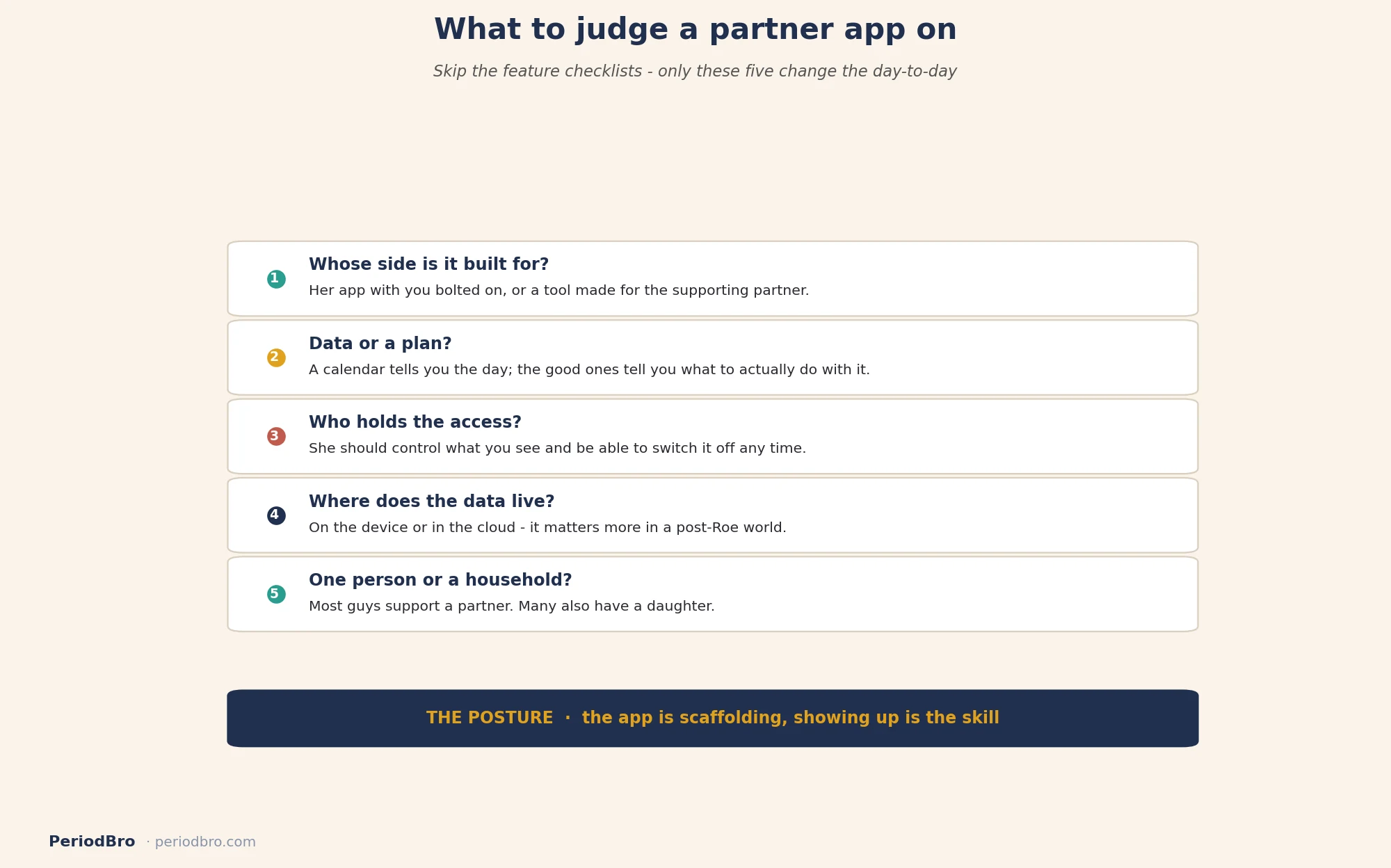
Can you track independently, or do you need her to install and share? Some apps only work if she runs the main app and invites you in. Others let you keep your own quiet record on your side. Both are fine – but they’re very different relationships with the data, and you should know which one you’re signing up for.
Does it tell you what to do, or just show you a calendar? Knowing she’s on day 23 is useless if you don’t know what day 23 means. The better tools translate the cycle into something actionable: her energy’s likely low today, this is a good week to plan something social, go easy tonight.
Who controls the access? This is the one nobody asks about. The healthiest setups put her in charge of what you see and let her switch it off any time. If an app lets you quietly surveil someone, that’s not a feature, that’s a red flag. I’ve written more about tracking her cycle without it getting weird if you want the longer version.
Privacy. Cycle data is sensitive, and in a post-Roe United States it’s a real concern. Where the data lives and who can be forced to hand it over matters now in a way it didn’t a few years ago.
Can you follow more than one person? Most guys reading this have a partner. A lot of you also have a daughter. Almost no app lets you support both from one place without pretending your kid is a second girlfriend, which is exactly as awkward as it sounds.
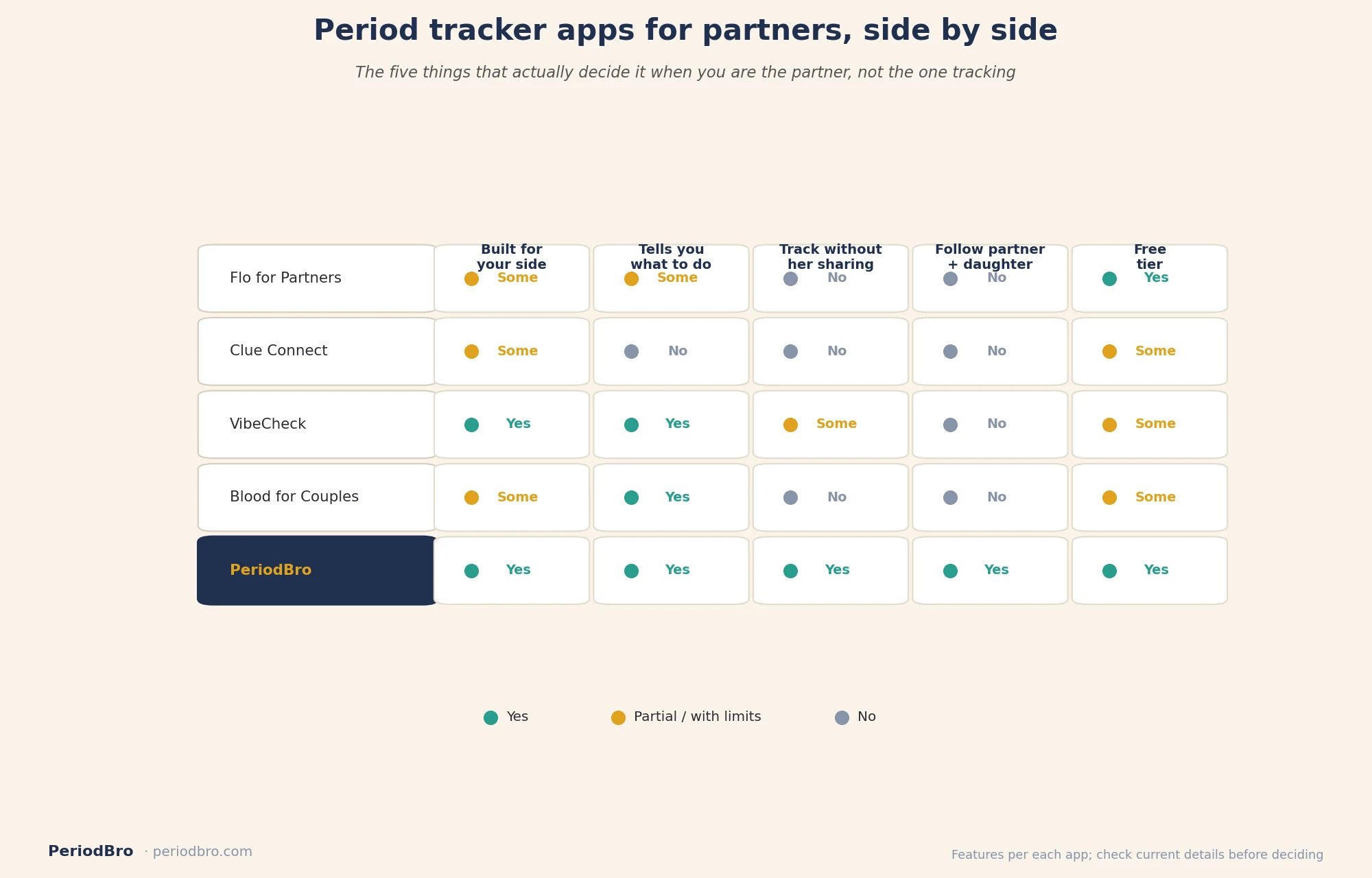
The best period tracker app for partners in 2026, compared
Here’s how the main options stack up against those criteria. So here’s how the main options for the best period tracker app for partners stack up. I’m not here to trash anyone – a couple of these are solid, and the right pick depends on what you need.
Flo for Partners
Flo is the giant, and Flo for Partners is a mode built into the app she probably already uses. She generates a pairing code, you download Flo, enter the code, and you’re linked in under two minutes. You get medical insights and proactive tips to support her, plus shared couples quizzes (Flo Help Center).
The privacy design is actually thoughtful: your partner can’t see or edit her calendar, personal notes, logged symptoms, or her community chats – visibility is deliberately limited, mostly to cycle logging and the quizzes (Flo Help Center). Where it hits a ceiling: it’s her app with you bolted on, not a tool for your side, and it only tracks one person. Great if she’s a committed Flo user and you just want to be looped in.
Clue Connect
Clue is the science-first tracker, and Clue Connect lets her share her cycle with one trusted person. You’ll see her basic phases – period days, fertile window, ovulation, PMS – in a clean calendar view. You won’t see her mood, energy, or pain logs (Clue Support).
She’s in full control and can remove you any time, which is exactly right. Two limits worth knowing: she can only share with one person at a time and can’t share and view at once, and sharing sits behind a Clue Plus subscription (viewing someone else’s cycle is free). It’s a calm, no-drama option if you want the map without the coaching.
VibeCheck
VibeCheck is the one built explicitly for men, and it leans hard into the “what do I actually do” gap. Instead of raw data it sends a daily mission tied to where she is in her cycle: “her energy is low today, handle dinner and give her quiet time,” or a heads-up that it’s a good week to suggest plans. It personalizes around her love language and claims to learn what works over time. It’s freemium, with the deeper coaching behind a small monthly fee (VibeCheck).
It’s the most partner-native product on this list, and the daily-nudge format is actually useful for guys who freeze up. The trade-off is that it’s an advice engine, so you’re trusting its read of your relationship, and like the others it’s built around a single partner, not a household.
Blood for Couples
Blood takes the maximum-transparency route. Both of you get a shared, real-time dashboard where her symptoms, moods, and predictions show up on your side as she logs them, and its Care Messages feature nudges you toward the right support instead of just posting a calendar. It requires mutual consent and gives her granular control over what you can see (App Store).
If you’re the couple that shares everything, this is the deep-end option. If either of you wants a little more separation between her private log and your view, it can feel like a lot.
PeriodBro
This is the one I built, so read the rest with that in mind. I made it because none of the above solved my two actual problems: I wanted to keep my own quiet record without living inside her app, and I wanted to support more than one person. PeriodBro is built for the partner’s side – it turns the cycle into daily support hints rather than making you interpret a chart – and it’s designed around multiple profiles, so you can be there for a partner and a daughter from one place. It’s the tool I wanted the year I was awkwardly refreshing her Flo. If you want the fuller picture of the thinking, it’s here: an app built for the partner.
Where it’s not the answer: if she’s a devoted Flo or Clue user and just wants to loop you in, use their partner mode – no reason to add an app. PeriodBro earns its place when you want your own side of the tracking, or when you’re supporting more than one person.
If you also have a daughter, the math changes
This is the criterion that quietly reshuffles the whole list. Every app above is built around one woman – your partner. The moment you’re also a dad trying to be ready for a daughter’s cycle, the single-profile design falls apart. You can’t reasonably run two “couple” links, and you shouldn’t have to frame supporting your kid the same way you frame supporting a girlfriend.
Multi-profile isn’t a nice-to-have here, it’s the whole reason to choose one tool over another. Supporting a daughter is also a different job – more about being prepared and unembarrassed than about relationship coaching. If that’s you, start with how to talk to her about it and the broader understand her cycle guide.

Privacy in a post-Roe world
A few years ago I’d have skipped this section. Not anymore. Cycle data can indicate pregnancy and its absence, and in parts of the United States that’s information people would rather not have sitting on a server that can be subpoenaed. This isn’t paranoia, it’s just the world tracking apps operate in now.
When you compare apps, look past the marketing and ask three plain questions. Where does the data live – on the device, or in the cloud? Who can access it, and can it be handed over under legal pressure? And does the company sell or share data with third parties? A privacy policy that’s vague on any of these is telling you something. The best answer for the most sensitive data is simple: the less that leaves her phone, the better.
The common questions
Are these apps free? Mostly freemium. The base tracking is usually free; the partner coaching, sharing, and advanced features tend to sit behind a subscription (Clue Connect needs Clue Plus to share; VibeCheck’s coaching is paid). Read what’s actually free before you commit.
Does she have to install anything? Depends on the model. Shared apps like Flo for Partners, Clue Connect, and Blood need her running the main app and inviting you in. If you want to track your own side without asking her to do anything, you want an independent option.
Is it even ethical to track her cycle? Yes, when it’s consensual and in the open. Tracking to show up better is care. Tracking to monitor or “catch” someone is control, and no app makes that okay. The line is simple: she knows, she’s fine with it, and she can switch it off. If you’re not sure how to even raise it, that’s a conversation worth having before you download anything.
So which one should you pick?
If she lives in Flo or Clue and just wants you in the loop, turn on their partner mode and you’re done. If you want to be told what to do each day, VibeCheck is the most direct. If you’re the share-everything couple, Blood goes deepest. And if you want your own quiet record, or you’re supporting a partner and a daughter both, that’s exactly the gap PeriodBro was built for.
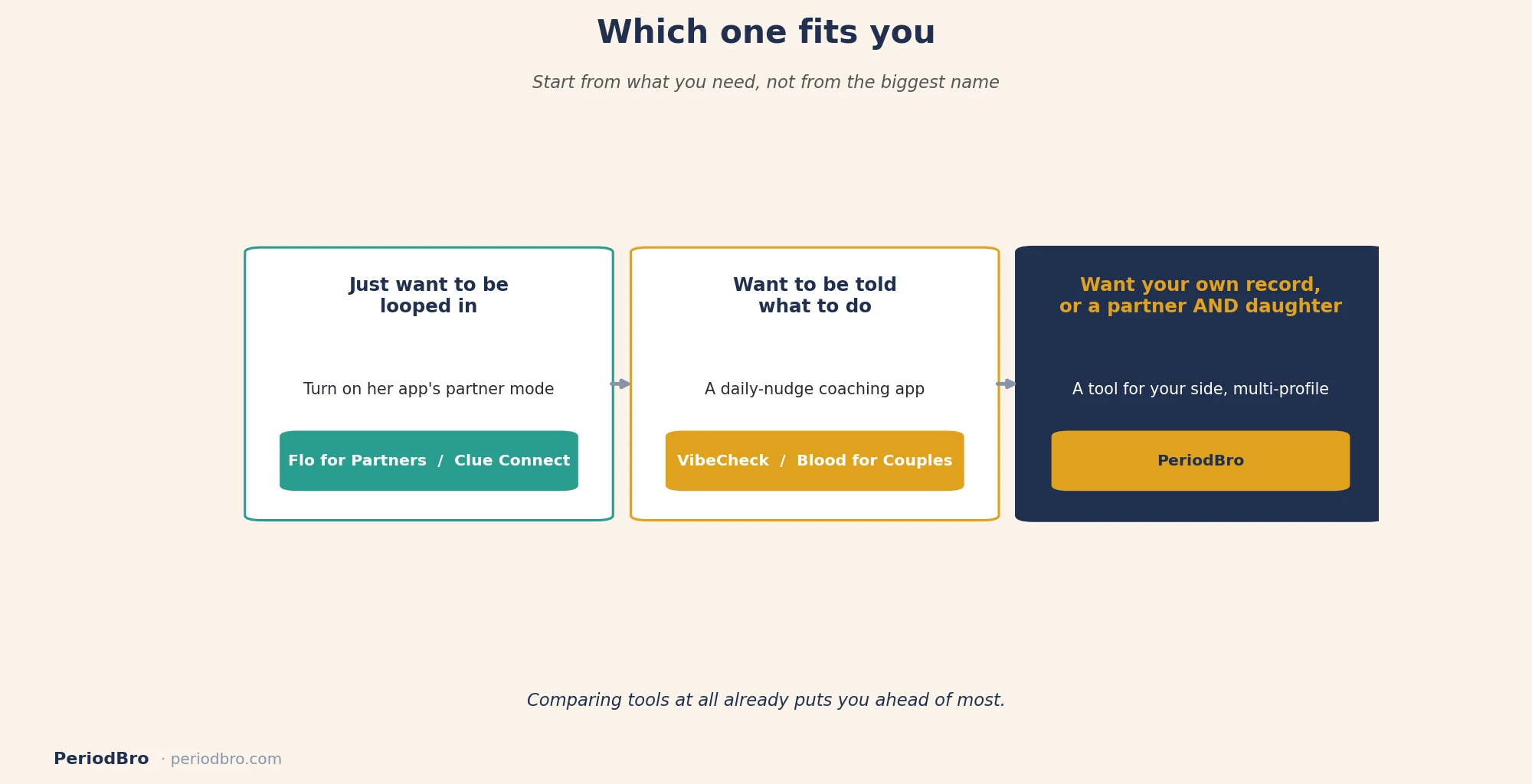
Whatever you choose, the fact that you’re comparing tools at all already puts you ahead of most. The app is just scaffolding. Showing up is the actual skill. If you want the one built for partners who track more than one person, you can try PeriodBro free.
This is a product comparison, not medical or legal advice, and app features and pricing change – check each app’s current details before deciding. For anything about your partner’s or daughter’s health, talk to a clinician.