Does a TENS Unit Help Period Cramps?
If you have seen those little electrode pads people stick on their lower belly for period pain and wondered whether a TENS unit is worth buying for her, here is the honest version. It is a real, drug-free option with decent evidence behind it, it is cheap, and it is very safe. It is also not magic, and it works better as one tool in the kit than as the whole answer.
I bought one for my partner after a run of months where ibuprofen alone was not cutting it and she hated the idea of taking more of it. It has become a quiet fixture in the bedside drawer. Some cycles it takes the edge right off, some cycles she barely reaches for it. That is roughly what the research would predict, and it is worth knowing why before you spend the money.
What a TENS unit actually is
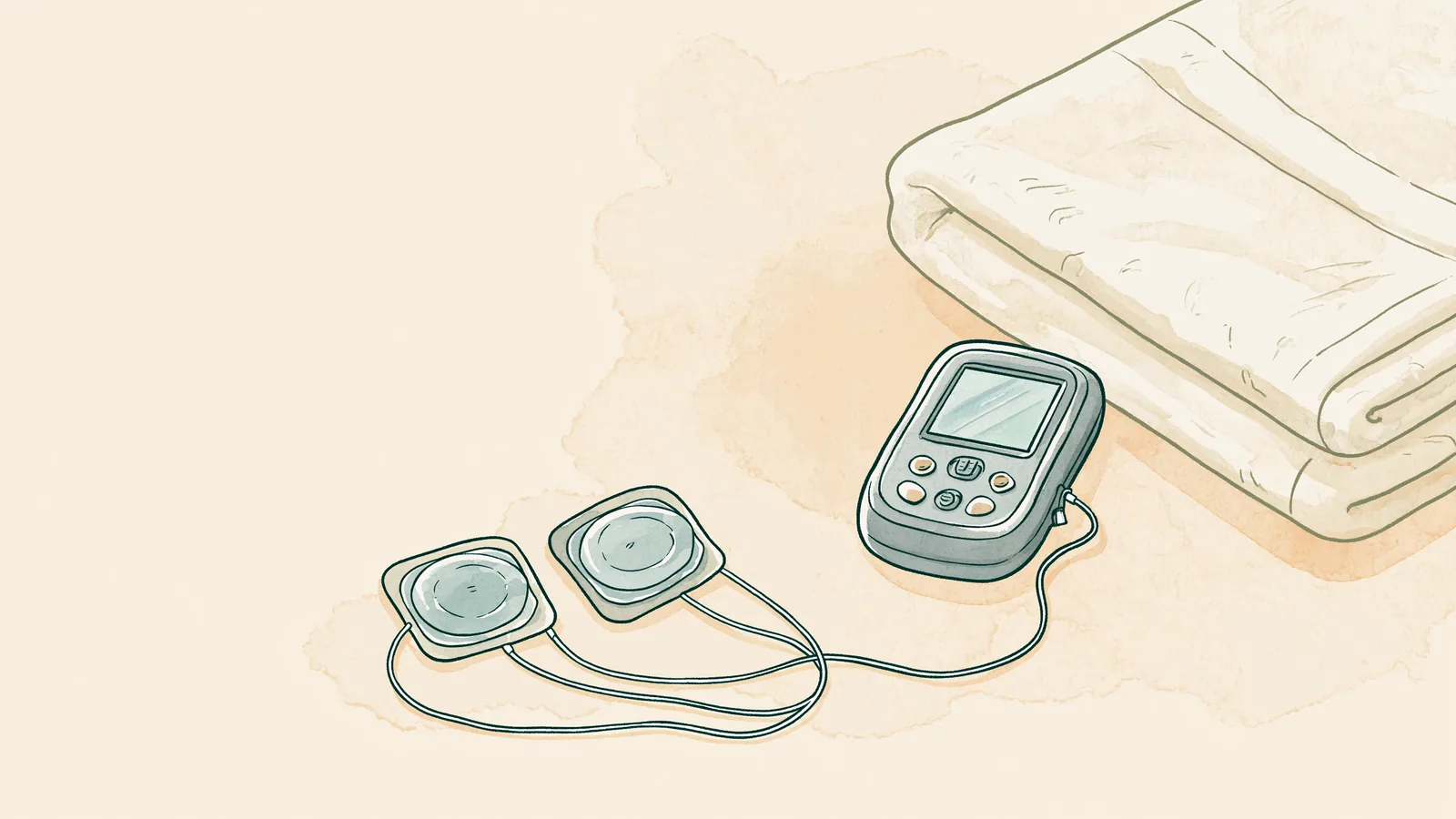
TENS stands for transcutaneous electrical nerve stimulation, which is a long way of saying a small battery-powered box that sends mild electrical pulses through sticky pads on the skin. You place the pads on her lower abdomen or lower back, turn it up until it feels like a strong buzzing or tingling, and that is it. No pills, no heat, no mess. The units made for period pain are the same technology physios have used for years, just shrunk down and sometimes shaped to sit discreetly under clothes.
The reason a buzzing sensation would touch period pain comes down to how pain signals travel. The leading explanation is gate control theory: the nerves that carry that harmless tingling reach the spinal cord and effectively crowd out the slower nerves carrying the pain, so fewer pain signals make it up to the brain (gate control theory of pain, Physiopedia). On top of that, the stimulation is thought to nudge the body into releasing endorphins, its own built-in painkillers (TENS for primary dysmenorrhea overview, PMC). So it is not masking anything or numbing her skin. It is quietly turning down the volume on the signal.
Does a TENS unit help period cramps, or is it a gimmick?
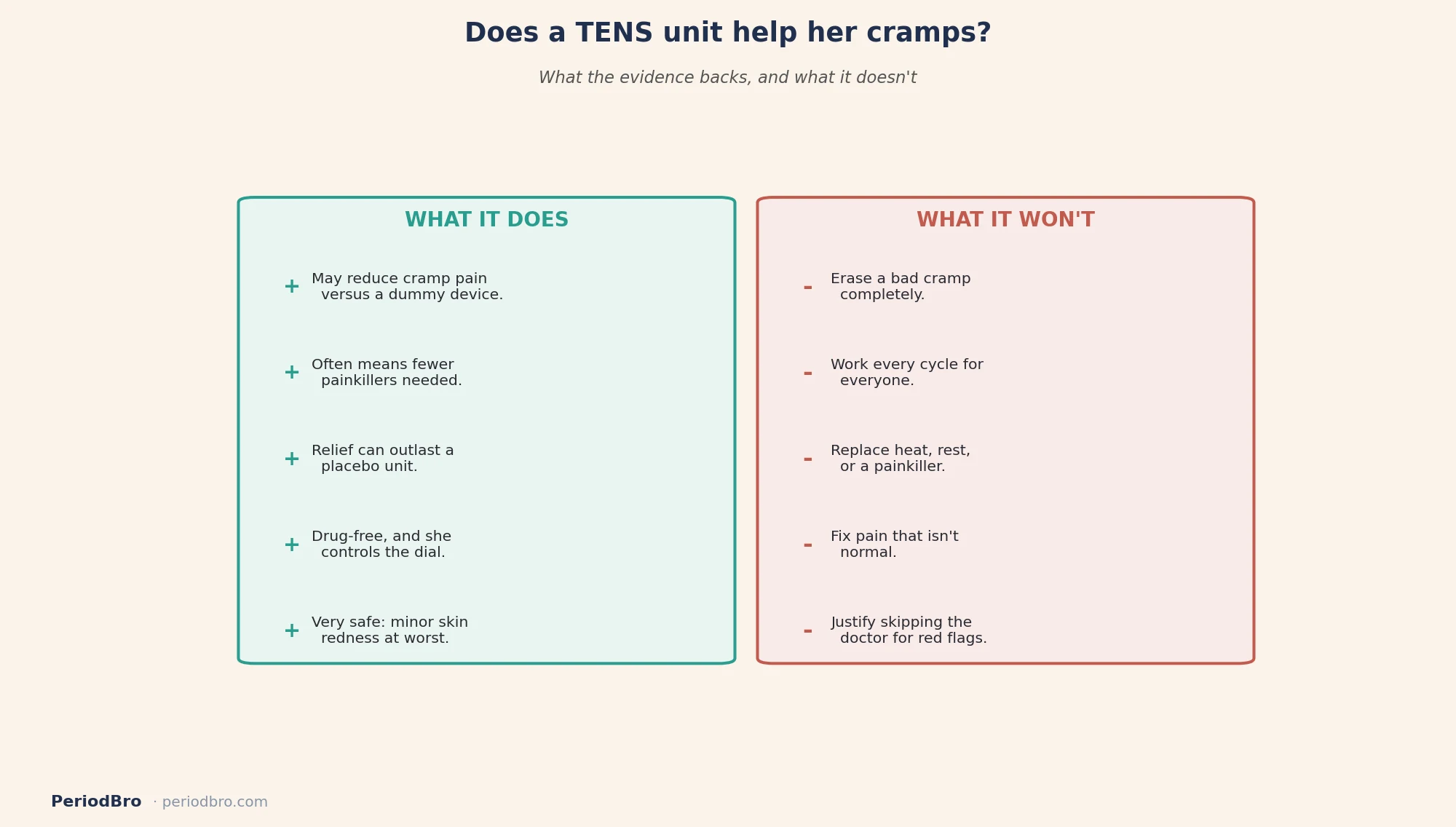
This is the part where the honesty matters, because the marketing around these devices oversells them and a straight answer is more useful. The best summary we have is a 2024 Cochrane review, and it found that both high-frequency and low-frequency TENS may reduce period pain compared with a dummy device or no treatment, while noting the overall evidence is still limited and low-certainty (Cochrane review, TENS for primary dysmenorrhoea, 2024). A separate meta-analysis added a practical detail worth knowing: women using TENS were less likely to need to reach for pain medicine, and the relief tended to last longer than with a placebo device (TENS for primary dysmenorrhea meta-analysis, PubMed).
Read that plainly and it says: promising, genuinely helpful for a lot of people, not guaranteed, and not a miracle. High-frequency settings have the stronger track record. It is the kind of thing where she should go in expecting “this might take the edge off and mean fewer pills,” not “this will erase the pain.” Set that expectation and a TENS unit tends to earn its place. Oversell it and it ends up in a drawer, resented.
How to actually use one
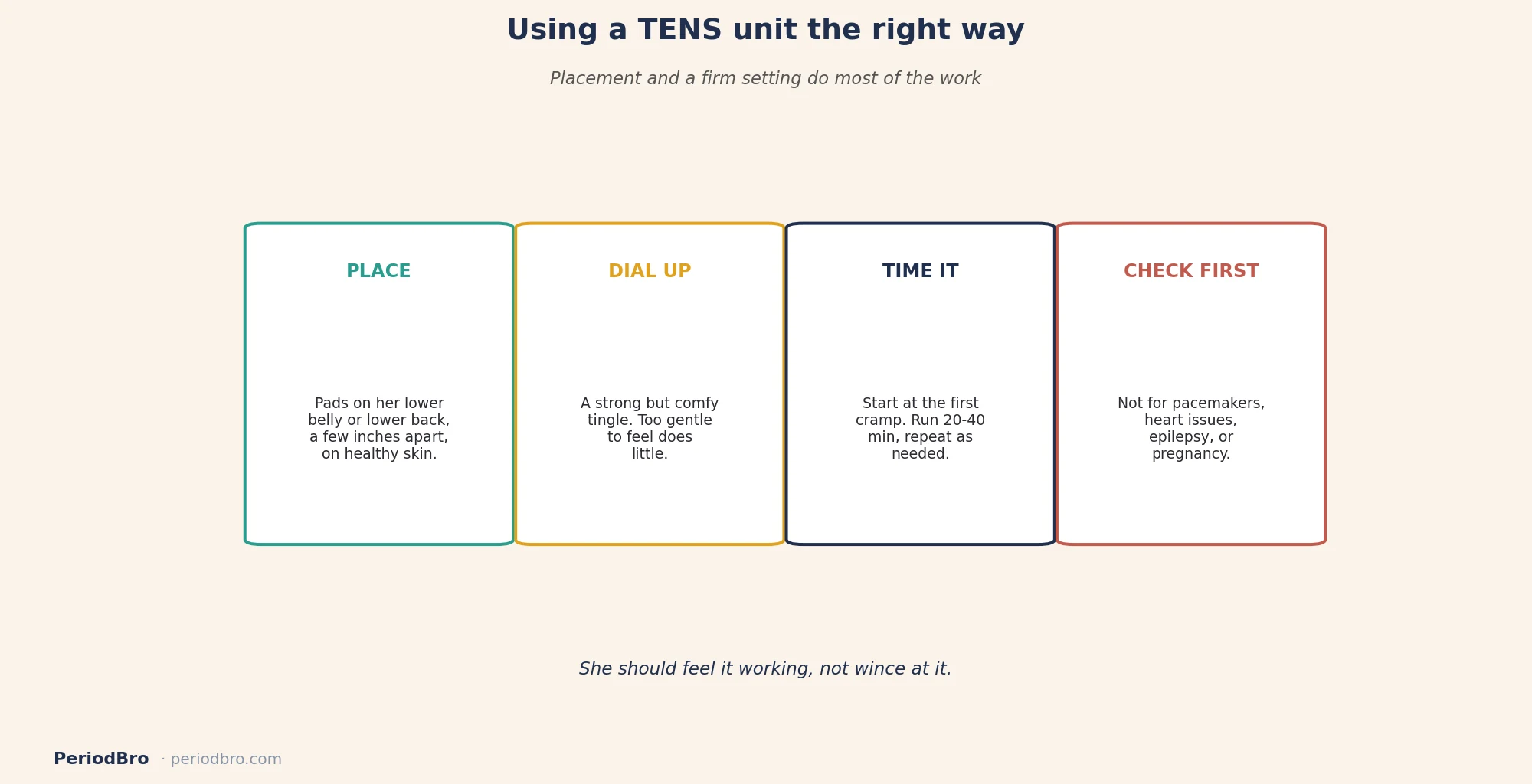
Getting results is mostly about placement and not being timid with the dial. Stick the pads on her lower belly, roughly between the belly button and the pubic bone, or on her lower back if that is where the ache sits. Keep the two pads a few inches apart rather than touching. Then turn the intensity up until the tingling feels strong but comfortable, because a setting so gentle she can barely feel it will not do much. She should be able to feel it working, just not wince at it.
Timing helps too. It works best used at the first sign of cramping rather than hours in once the pain is already bad, and she can leave it running for a session of twenty to forty minutes and repeat as needed. A couple of safety basics: pads go on healthy, unbroken skin only, not over the front of the neck, and anyone with a pacemaker, a heart condition, epilepsy, or who is pregnant should clear it with a doctor first (Cochrane plain-language summary on TENS safety). Beyond that the reported side effects are minor, usually just a bit of skin redness under the pads.

Where a TENS unit fits in the toolkit
The mistake is treating a TENS unit as a replacement for everything else. It is better thought of as another lever, and it stacks well with the ones that already work. Heat is the obvious partner: in trials, continuous low-level heat on the lower belly eased period pain about as well as ibuprofen (topical heat for dysmenorrhea, PubMed), and there is no reason she cannot use a heat patch and a TENS unit in the same evening. Gentle movement and the usual painkiller taken early all pull in the same direction.
What a TENS unit buys her specifically is a drug-free option she controls herself, dial in hand, that she can use at her desk or on the sofa without swallowing anything. For someone who is already near her sensible limit on ibuprofen, or who just prefers fewer pills, that is genuinely valuable. If you want the wider picture of what pulls its weight, we went deep on it in the best ways to ease her period cramps, and a TENS unit slots in as one of the drug-free entries there.
What to look for if you are buying one
You do not need to overthink the purchase. The menstrual-specific units are convenient because they are small, wireless, and designed to hide under a waistband, which matters if she wants to wear it out of the house. A standard physio-style TENS machine with wired pads does the same job for less money if discretion is not the point. The features actually worth having are simple: enough intensity levels that she can find a strong-but-comfortable setting, a decent battery or easy recharging, and replaceable pads, since the sticky gel wears out after a few dozen uses.
Skip the gimmicks. Bluetooth apps and dozens of “massage modes” add cost without adding relief. What matters is that it delivers a firm, adjustable buzz to the right spot. If this is a gift, pairing it with a pack of spare pads and a good heat patch makes it land as a thought-through kit rather than a random gadget.
When a TENS unit is not the answer
A TENS unit is for ordinary period cramps. It is not a diagnosis, and it should not become a way to keep quietly coping with pain that is not normal. If her cramps are severe enough to knock her out of work or plans, if they are getting worse over time, if the pain shows up outside her period, or if ordinary measures never touch it, that is worth a doctor’s visit rather than a stronger gadget, since pain like that can point to something like endometriosis (Mayo Clinic on menstrual cramps). We wrote a fuller guide to telling ordinary cramps from a red flag if you are not sure where the line is.
Common questions
Does it hurt? No. At the right setting it feels like a strong tingling or a light drumming on the skin, not a shock. If it stings or makes her muscles jump, it is turned up too high or the pads are badly placed. She should be able to hold a conversation through it.
Can she use it with a heating pad? Yes, and a lot of people do. Just do not stack the TENS pads directly under a hot pad on the same patch of skin. Put the heat on her back and the pads on her front, or alternate them. The two work through different mechanisms, so using both is fair game.
How fast does it work? Usually within the session. Many people feel the edge come off within ten to fifteen minutes of turning it on at a good intensity. If half an hour at a strong setting does nothing across a couple of cycles, it may just not be her thing, and that is fine.
The honest takeaway is that a TENS unit is a low-risk, low-cost, drug-free option that helps a good share of people take the sharpness out of their cramps, especially paired with heat. Go in with realistic expectations and it is a solid addition to her corner. If keeping half an eye on when the bad days are coming is new to you, that is the whole point of what we build: knowing the rough week ahead means the heat patch and the TENS unit are charged and in the drawer before she needs them, not dug out mid-cramp. For the hands-on side, a simple massage pairs with all of this, and the bigger picture lives in being a better partner through her whole cycle.
This article is general information, not medical advice. TENS is not suitable for everyone, and anyone with a pacemaker, heart condition, epilepsy, or who is pregnant should check with a healthcare professional first. Severe or worsening period pain is worth getting properly checked.