Cycle Tracking for Partners: The Complete Guide to Apps, Consent, and the Data That Actually Helps
Somewhere on your phone there is probably a calendar app, a weather app, and a banking app you check without thinking. What most of us never got handed is the one for the person we live with: a way to know that this week is going to be rough before it is rough, without turning into someone who monitors his girlfriend. That gap is what cycle tracking for partners is trying to fill, and it is also where most people get it wrong on the first try.
This is the hub for everything we have written about tracking, apps, sharing, and privacy. Read the map here, then jump into whichever deep dive you need tonight. Every claim is sourced, every section links out to a longer piece, and the parts that are uncomfortable are in here too.
One note before we start. We say “she” and “her” throughout, because that is who most of our readers are supporting. None of it depends on that. If you are supporting a wife, a girlfriend, a partner, a daughter, or a friend who menstruates, the mechanics are identical.
What is in this guide
- The 60-second version
- What cycle tracking for partners actually means
- Start with consent, not the app store
- How to bring it up without making it weird
- What the app is actually doing when it predicts
- How accurate the prediction really is
- What no app and no wearable can see
- The four movements the app is drawing
- The four routes to sharing a cycle
- Route 1: apps with a partner mode
- Route 2a: Apple Health
- Route 2b: Android and Health Connect
- Routes 3 and 4: the shared calendar, and just asking
- Choosing an app: what actually matters
- What free actually costs
- Where the data actually goes
- How to vet any app in five minutes
- The legal part, stated straight
- What is worth logging, and what is not
- What to do with the data on an ordinary Tuesday
- Does any of this actually help
- The line between support and surveillance
- When she is on birth control
- When you are trying to conceive
- When the cycle starts changing for good
- The one thing an app is not
- If you are a dad, not a partner
- When the hard week is more than a hard week
- When the data says book an appointment
- What changed in the last year
- Seven things you will read that are not true
- Setting it up this week, in seven days
- Where we fit, disclosed
- Common questions
- The short version
The 60-second version
If you read nothing else, this is the whole thing compressed.
Ask her first, out loud, before you install anything. Tracking she knows about is support, and tracking she does not know about is surveillance, and there is no clever middle position. Let her decide what you see: most people land on the period dates and a rough sense of the week, not the symptom-by-symptom log.
Expect the app to be good at periods and shaky at ovulation. A calendar-only prediction sits at roughly 0.72 accuracy for the fertile window in the pooled research, while wearables that measure temperature and heart rate get to about 0.88 (npj Digital Medicine, January 2026). Neither number is good enough to plan contraception around.
Check where the data goes before you check the feature list. In August 2025 a San Francisco jury found Meta liable under California’s wiretapping law for collecting menstrual and pregnancy data through the Flo app’s analytics, which tells you what these files are worth to somebody (TechCrunch, August 2025).
Then use it for something small. One hot water bottle on the right night beats a year of impressive charts. If you want the practical version of that, our complete playbook for being a better partner through her cycle is the sister piece to this one.
What cycle tracking for partners actually means
The phrase covers three different things that people constantly mix up, and most of the arguments about whether this is creepy come from arguing about different ones.
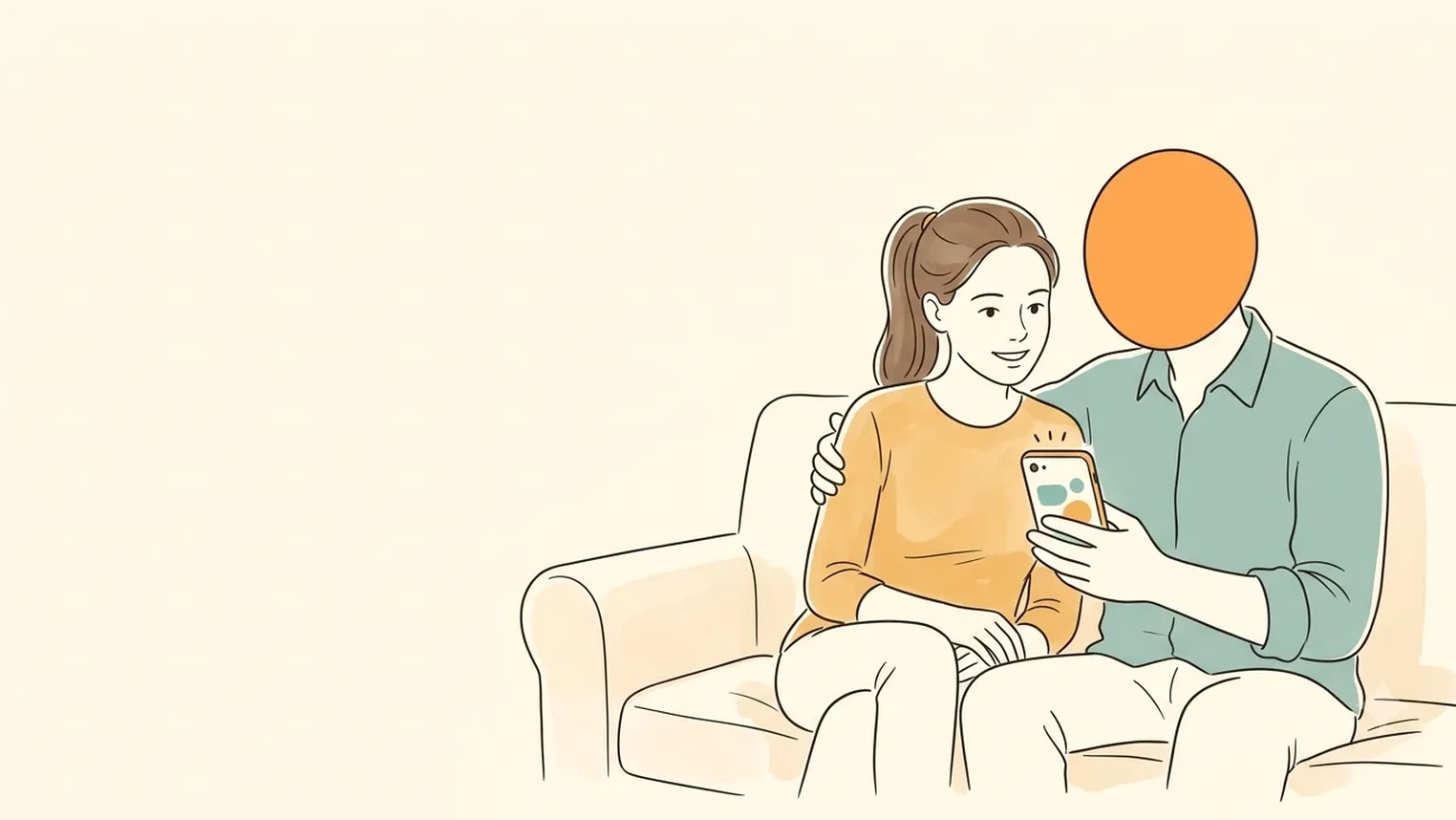
She tracks, you see a summary. She logs in her own app, and you get a read-only view: where she is in the cycle, when the next period is due, maybe a heads-up the day before. This is what a partner mode is, and it is what most couples mean.
She tracks, you ask. No app on your end at all. She tells you when it is coming, or you ask on a Sunday, and you keep it in your head. Plenty of couples run on this and never need anything else.
You keep your own note. A date in your calendar, a reminder, a private log. Harmless when she knows. Something else entirely when she does not, which is the whole subject of tracking her cycle without being creepy.
Cycle tracking for partners, done properly, is the first version with the third one as a backup for your own memory. It is a small amount of shared information that stops you being surprised by something that happens every month, not a dashboard about her.
Worth knowing how common the underlying habit is: in a mixed-methods study of 700 people, 62.3% used a period tracker app, mostly to predict the next period rather than for anything clinical (JMIR, 2024). A 2025 systematic review across 14 studies put pooled use at around 61%. The odds are she is already tracking. You are usually not introducing a habit, you are asking to join one.
Start with consent, not the app store
Here is the part people skip, and it is the only part that cannot be fixed later.
The information in a cycle log is not neutral. It contains sex, contraception, pregnancy attempts, miscarriage, mood, medication, and in some cases abortion. The Cambridge Minderoo Centre report on cycle tracking apps, published in June 2025, described this data as a “gold mine” for consumer profiling and pointed out that pregnancy data is valued at more than 200 times age, gender, or location data for targeted advertising (University of Cambridge, 2025). If advertisers pay that much for it, it is not a small thing to hand to a boyfriend without being asked.
The rule is boring and absolute. She knows. She agreed. She can switch it off tomorrow without a negotiation.
That last clause is the one that gets dropped. Access she cannot revoke without a fight is not consent, it is a hostage situation with a nicer interface. If she turns off sharing and your first instinct is to ask what she is hiding, the tracking was never the point and you have a different conversation to have.
Two situations where the answer is no, and staying no is the right call. If the relationship is new enough that you would not ask to see her bank balance, it is too new for her health log. And if there is any pattern of jealousy, checking, or monitoring in the relationship already, an app makes that worse rather than better. We wrote the honest version of that in should you track your partner’s cycle, including the cases where the answer is a clean no.
How to bring it up without making it weird
The ask lands badly when it sounds like a request for access. It lands fine when it sounds like a request for a warning.
What works, roughly: “I keep getting caught out by your bad week and then being useless. Would it help if I knew it was coming? You pick what I see.” Then stop talking. The offer is a heads-up for you, and less explaining for her, and it costs her one setting.
What does not work: framing it as an explanation for her moods. Nobody wants to be told their partner is installing software to decode them. That is the single fastest way to make a reasonable idea sound like an accusation, and we go through better and worse phrasings in how to talk to your partner about her period.
If she says no, take it cleanly and stay useful without the data. Ask on a Sunday. Notice the second night of bad sleep. Keep the heat pad where she can find it. Half of what this guide describes works with no app at all, which is worth saying out loud before we spend 8,000 words on apps.
And if she says yes, ask the follow-up that most people forget: what do you actually want me to see. Some partners share the whole log. Plenty share dates only. Both are correct answers, and the second one is more common than app marketing suggests.
What the app is actually doing when it predicts
A prediction looks like knowledge. It is arithmetic.
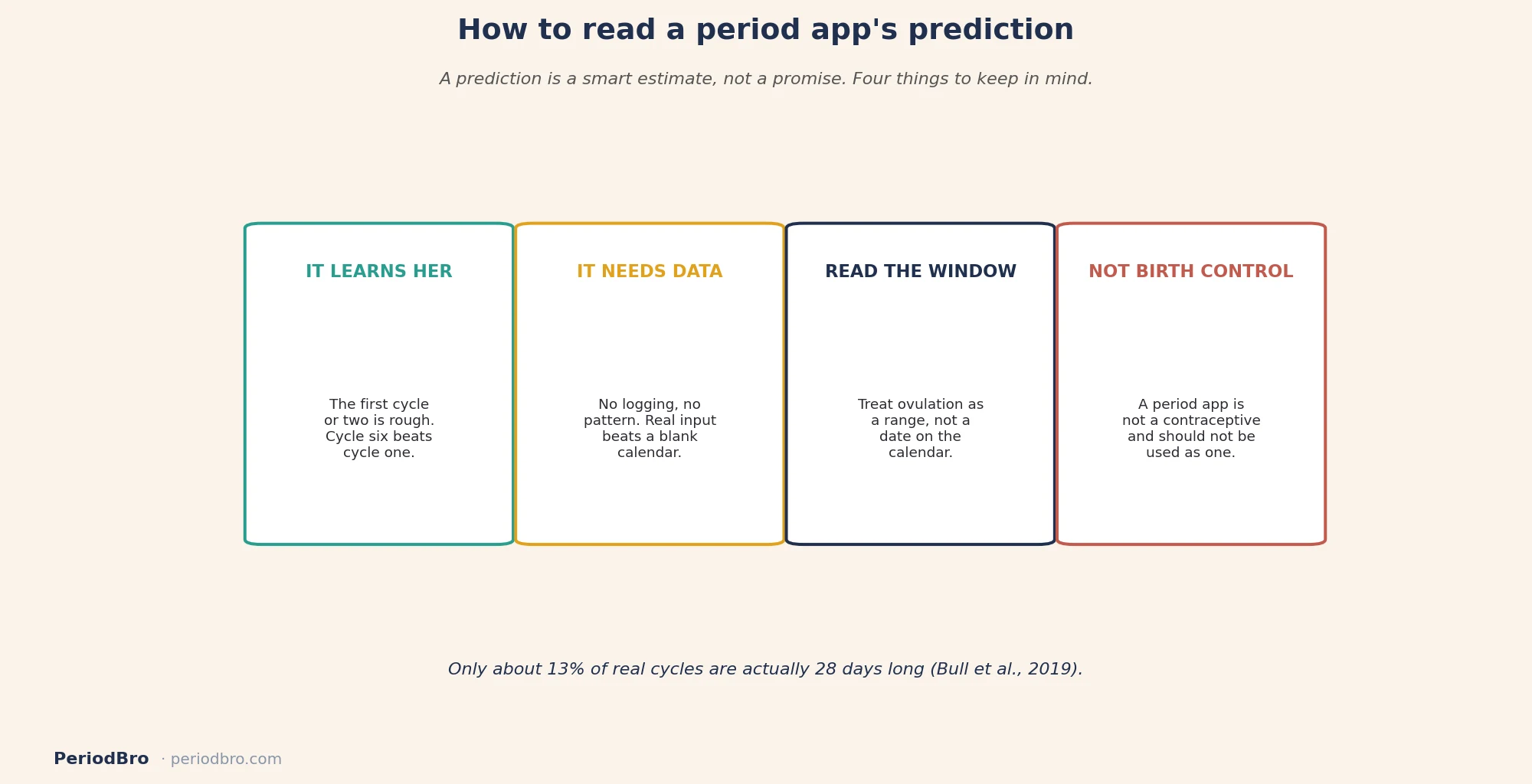
Most cycle apps take her last few period start dates, work out an average cycle length, add that number to the last start date, and draw the next period there. Ovulation gets placed by subtracting roughly 14 days from the predicted next period, and the fertile window is drawn as a band around it. Some apps adjust with machine learning across a bigger user base. The core is still a projection of her past onto her future.
That is fine for periods, because the thing being predicted is the same thing being measured. It gets shaky for ovulation, because the app is predicting an event it has never observed. The luteal phase, the stretch between ovulation and the next period, is the relatively stable part. The follicular phase before ovulation is what moves with stress, illness, travel, and sleep, so a late period usually means ovulation happened late, not that the calendar broke.
This matters for you in one practical way. When the app says her period is due Thursday and it turns up on Sunday, nothing went wrong. The prediction was an average and the body was not obliged to match it. Treating the app as a schedule she is failing to keep is the fastest way to make tracking feel like pressure. We go through how to read a prediction properly in do period tracker apps work.
How accurate the prediction really is
This is the section where real numbers exist, so here they are.
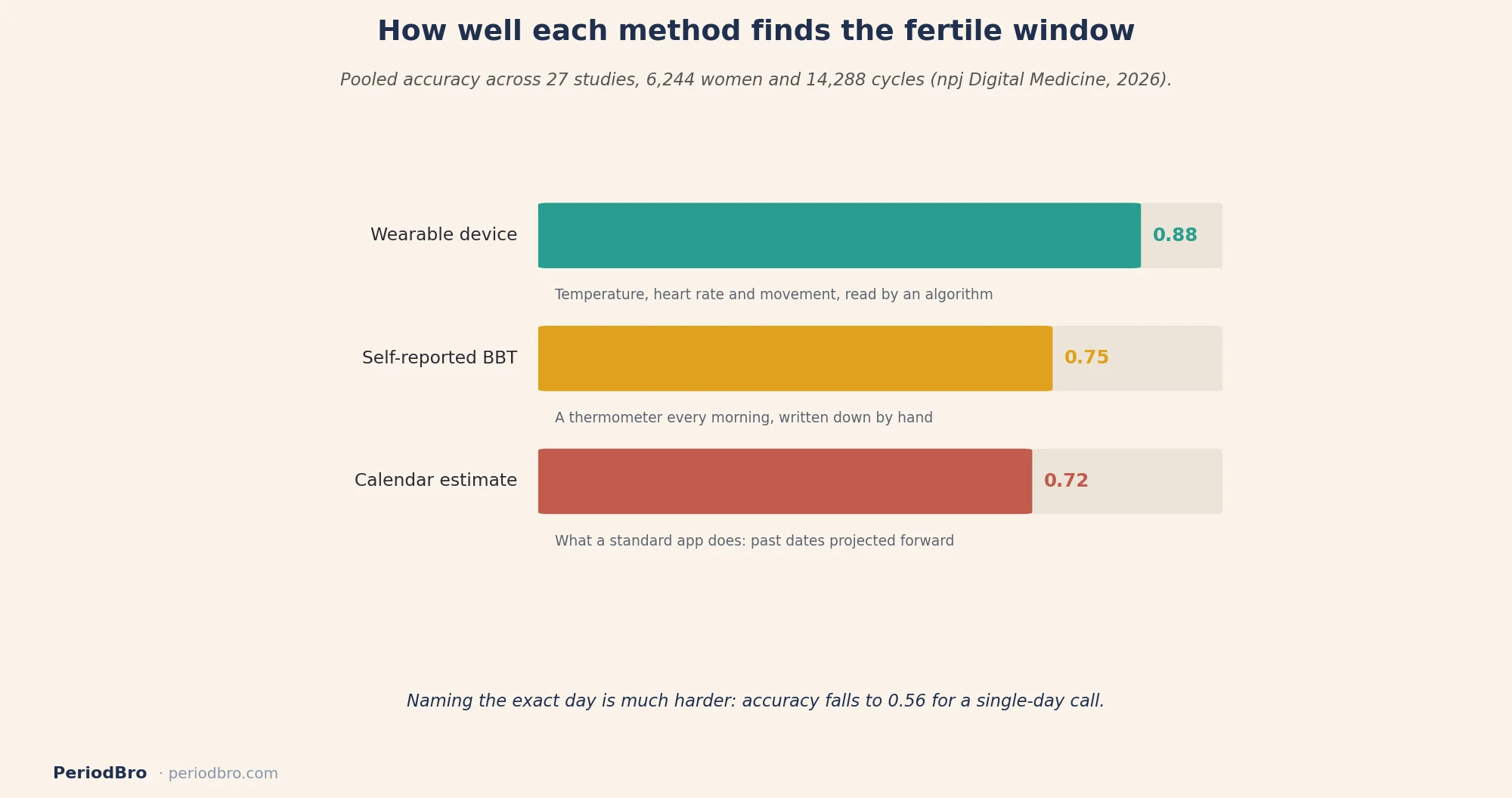
The best current summary is a Bayesian network meta-analysis published in npj Digital Medicine in January 2026, pooling 27 studies covering 6,244 women and 14,288 menstrual cycles. Wearable digital technology reached a pooled accuracy of 0.88 (95% CI 0.86 to 0.90) for detecting the fertile window and cycle events. Self-reported basal body temperature came in at 0.75. Calendar estimation, which is what a standard app is doing, came in at 0.72 (npj Digital Medicine, 2026).
The same analysis found something worth holding onto: devices did well at placing ovulation within a two or three day window, at 0.90 and 0.88 accuracy, and fell to 0.56 when asked to name the exact day. Ring-format devices edged out wrist bands, and multi-parameter monitoring beat temperature alone.
A validation study of one specific device gives the sharper picture. Across 1,155 ovulatory cycles from 964 participants, with ovulation prediction kits as the benchmark, the physiology-based method detected 96.4% of ovulations with an average error of 1.26 days, against 3.44 days for the calendar method. Roughly a threefold improvement, and the calendar method got notably worse in people with irregular cycles while the physiology method did not (JMIR, 2025). A separate January 2025 analysis of wrist temperature plus heart rate reported 85.47% accuracy for the fertile window in regular cycles, with sensitivity at 70.07%.
Translate all that into partner language. The app is reliable enough to tell you a hard week is approaching and to stop you being ambushed. It is not reliable enough to tell you which specific day anything happens, and it gets less reliable exactly when her cycles are irregular, which is when people most want it to work.
What no app and no wearable can see
Nothing on her wrist or finger measures a hormone. That sounds obvious written down, and it is the single most misunderstood point in this whole category.
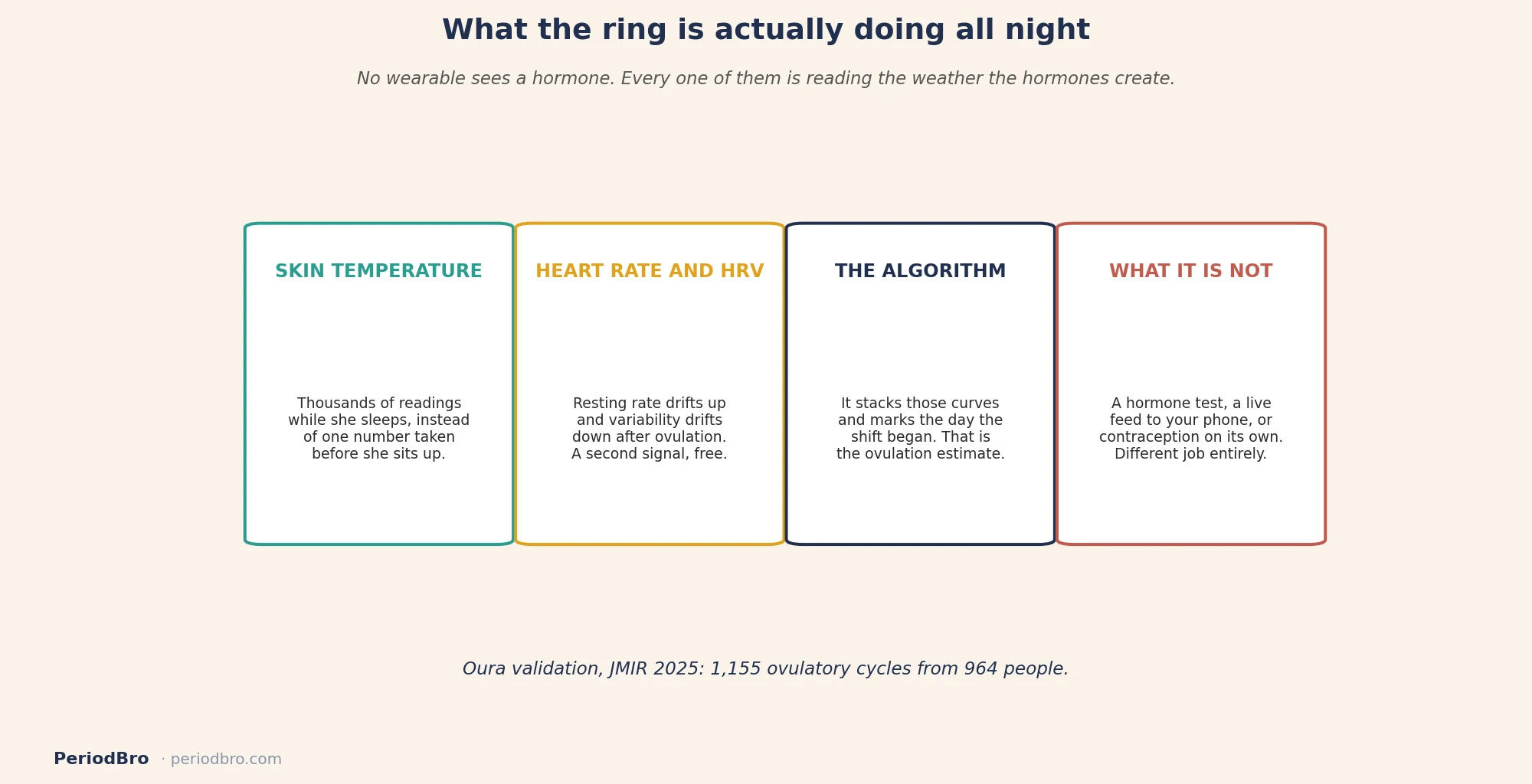
A smart ring measures skin temperature, heart rate, heart rate variability, and movement. Progesterone rising after ovulation nudges body temperature up by a few tenths of a degree, so the device is watching a downstream shadow of the hormone and inferring the event backwards. That inference is good, as the numbers above show, and it is still an inference. A fever, a late drink, a hot bedroom, or a bad night can all move the same signal, which is why the honest version of what a smart ring actually measures is less magical than the marketing.
The same goes for mood. No app knows how she feels. It knows what she typed. If she stops logging symptoms in a rough week, and people often do, the app quietly reports a calm month. The gap between the log and the life will not be closed by a better app, and it is a good reason not to argue with your partner using her own data as evidence.
If you want the biology under the graph rather than the graph, we have how hormones, mood and energy actually connect and the luteal phase explained, which is the stretch most of this is really about.
The four movements the app is drawing
You do not need the biology to be useful, and about twenty minutes of it makes every screen in every one of these apps readable.
Menstruation. Day one is the first day of proper bleeding, and every prediction in every app counts from there. Hormones are at their floor. Energy is often low on the first two days and then climbs, which is why the worst day of the month is frequently the day before the period rather than the period itself.
The follicular phase. Oestrogen rises. This is the stretch that stretches, so stress, illness, travel, and bad sleep push it longer and drag everything after it along. Most people feel steadier and more social here, and it is the part of the month that looks like nothing is happening.
Ovulation. An egg is released, usually around the midpoint, and the fertile window is the five days before it plus the day itself. This is the event apps are guessing at, and the one they get wrong most often. Our plain-language version is ovulation explained.
The luteal phase. Progesterone rises, then falls if there is no pregnancy, and that fall is what triggers the bleed. This phase is the relatively fixed one, usually somewhere around two weeks, and it is where premenstrual symptoms live. If there is one section of the cycle worth understanding as a partner, it is this one.
Two consequences follow, and they explain most of the confusion people have with these apps. First, a late period usually means a late ovulation, since the second half is more stable than the first. Second, the rough week is a hormonal withdrawal, not a personality event, which is the single most useful reframe in this whole subject.
If you want the fuller tour, we have the four phases explained, the seasons framing for people who think in metaphors, and cycle syncing for couples for what to do with the energy curve once you can see it.
The four routes to sharing a cycle
Every setup that works is one of four things. Picking the route first saves you an evening of comparing feature tables that do not matter.
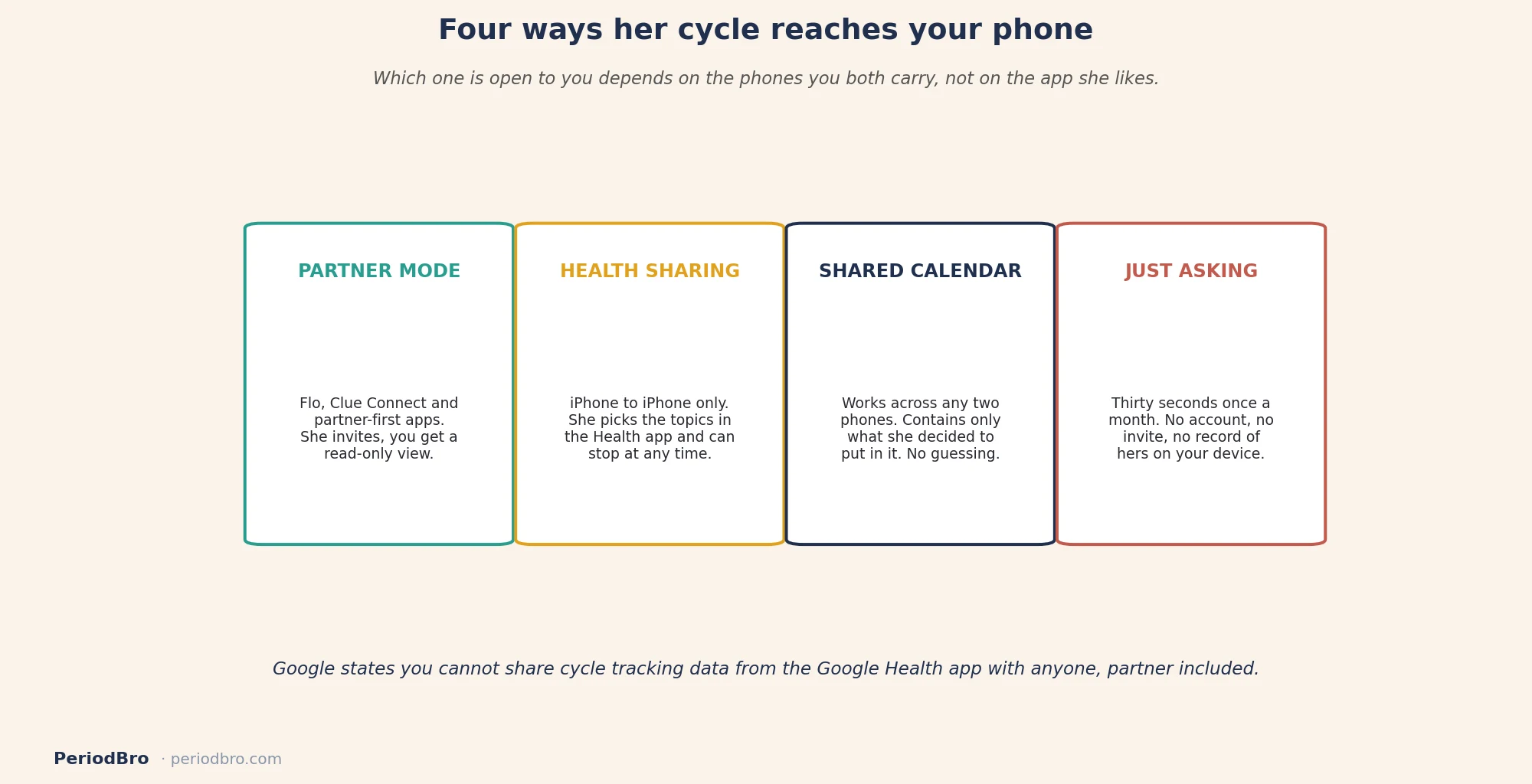
Route 1, an app with a partner mode. She logs, you get an invited view. Best fit, most control for her, and the only route that gives you anything like daily context.
Route 2, sharing at the phone level. Apple Health or an Android health platform, where cycle data lives alongside steps and sleep. Fewer moving parts, and much blunter.
Route 3, a shared calendar. She puts the period start in a calendar you both see. Ugly, free, unbreakable, and enough for a lot of couples.
Route 4, ask for the summary instead of the data. “Where are you this week” once a week. No technology at all, and the one route that improves the relationship even when it fails.
Most people should start at Route 4, and move up only if there is a reason. We walk through all four with setup steps in how to share a period tracker with your partner. The choice comes down to how much she wants you to see, which is the axis nobody puts on the comparison table.
Route 1: apps with a partner mode
Partner modes come in three shapes, and knowing which shape you are looking at explains most of the frustration people report.
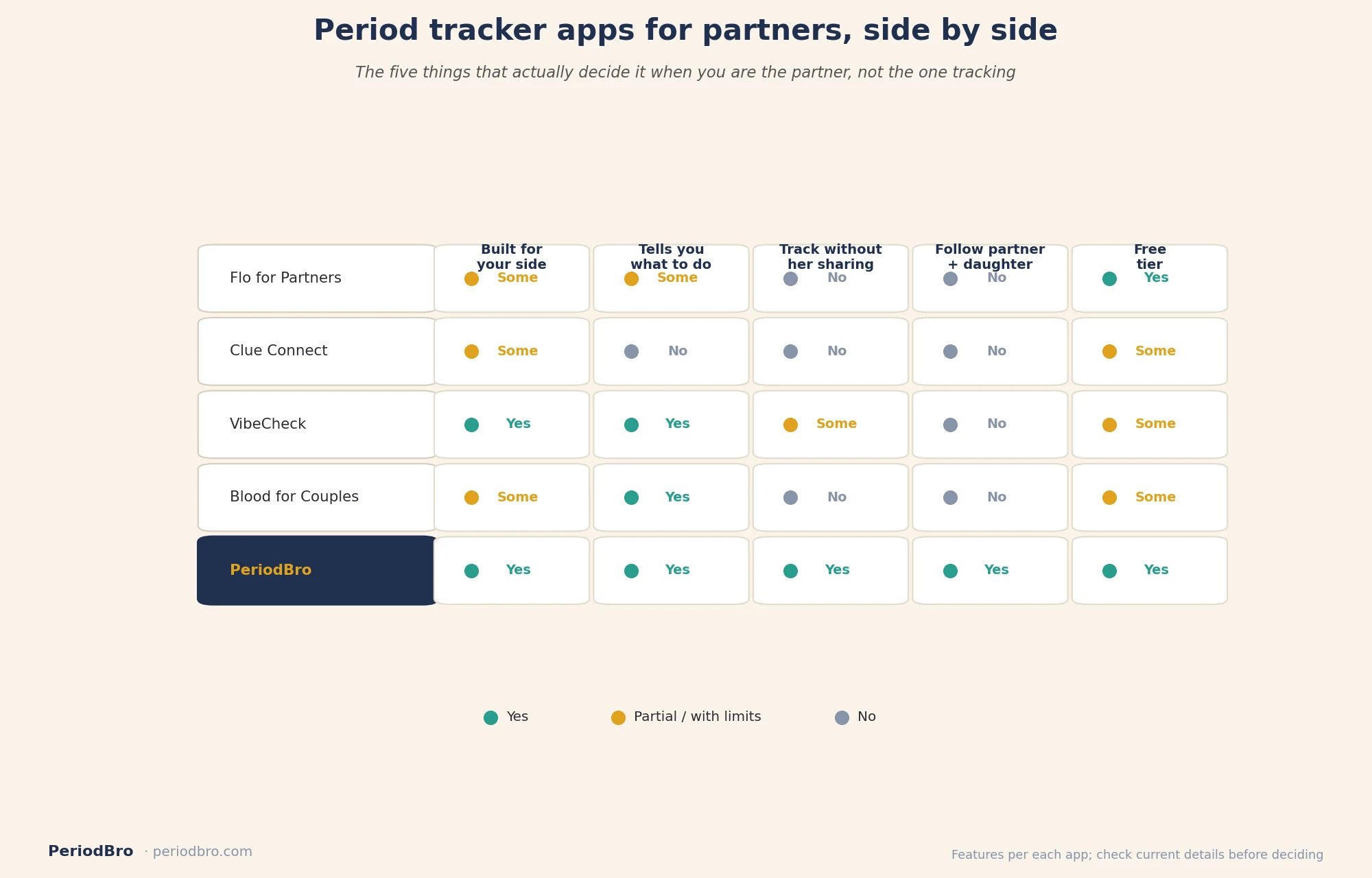
Read-only mirror. She shares a slice, you see it, you cannot log anything. Clue Connect works like this, and it is deliberately narrow: cycle day, period dates, a few high-level bits. Setup is on her side and she can revoke it. The practical limits of Clue Connect are worth reading before you ask her to switch apps, because the ceiling is lower than people expect.
Companion app. The partner gets their own install with its own content, fed by her shared data. Flo has moved this direction, and the strength is polish and reach, since it is the app she is most likely to already have. The weakness is that the partner experience is a side feature of a product built for her, and it shows. Our honest Flo for Partners review goes through where it stops.
Partner-first app. Built for the person supporting, taking her shared data as input. That is what we built, and the disclosure sits further down this page.
What decides between them is who controls the connection. Ask before you install: can she turn this off alone, in under a minute, without asking you. If yes, the rest is preference. If no, walk away regardless of how good the interface is.
If you want the head to head comparisons rather than the categories, we keep the best period tracker apps for partners updated, plus a list of alternatives for when the obvious one does not fit.
Route 2a: Apple Health
If you are both on iPhone, the cycle data may already be sitting in an app she has not opened in a year. Apple Health has logged periods since 2019, predicts the next one, and flags irregular patterns.
The sharing mechanism is Health Sharing, which she sets up from her phone and can revoke from her phone. Two things surprise people. First, cycle data is not always included by default in what gets shared, so she has to pick the category. Second, what you see is a fairly clinical set of tiles rather than anything that tells you what to do on a Tuesday night. It is data without translation, which is why plenty of couples set it up and then quietly stop looking. The full walkthrough is in can you see her cycle in Apple Health.
Apple has also kept extending this. At its June 2026 developer conference the company announced perimenopause and menopause support inside the same cycle tracking feature, which matters for couples in their forties where predictions stop making sense (TechCrunch, June 2026).
The privacy story here is better than the app-store average, since the data stays on device and in her iCloud rather than passing through an ad-funded startup. The tradeoff is that it tells you numbers and leaves the interpretation entirely to you.
Route 2b: Android and Health Connect
Android’s equivalent is Health Connect, and the most common misunderstanding is worth stating plainly: it is a local data hub, not a sharing service. It lets apps on her phone read and write to one shared store, so a tracker and a fitness app can see the same numbers. It does not send anything to you.
Which means on Android there is no phone-level route to a partner in the way iPhone users expect. Cross-platform makes it worse: the two ecosystems do not exchange health data on their own, and the partial bridges that have appeared are one-directional and narrow. If she is on Android and you are on iPhone, Routes 1, 3 and 4 are your actual options, and we go through each of them in cycle tracking on Android.
None of this is a reason to push her onto a different phone. It is a reason to stop looking for a setting that does not exist and pick a route that does.
Routes 3 and 4: the shared calendar, and just asking
The shared calendar is the setup nobody writes about because there is nothing to sell. She adds one all-day event on day one, or you both use a discreet emoji, and it lands in a calendar you already check. No account, no third party, no privacy policy, no subscription. It is the most private option available and the only one that survives an app shutting down.
It also has a real advantage over every app on this page: it contains exactly what she chose to put in it and nothing else. Ninety percent of what you need as a partner is one date and a rough sense of where she is. A calendar entry carries both.
Then there is asking, which is not a fallback. The point of any of this is a conversation that happens earlier and with less friction, and a Sunday check-in gets you there without a download. “How is this week looking” is a question that also works during the months where the app is wrong, and it is the whole basis of what healthy cycle tracking looks like in a relationship.
A reasonable target: use the calendar or an app for the dates, and use the conversation for everything else. The data tells you when. Only she can tell you what she wants this time.
Choosing an app: what actually matters
Feature lists are mostly noise. Four things decide whether a setup survives past month two.
Who controls the connection. Covered above, and it stays first. Her switch, her phone, no negotiation.
Whether it translates. A number is not help. “Day 24” means nothing on a Wednesday night unless something turns it into “she is likely to be running low, do not schedule anything loud.” Most apps built for her do not translate for you, because they were never supposed to.
Whether it survives a boring month. The app you keep is the one that asks nothing of you on the days nothing is happening. If it needs daily input from you, it is dead by March.
What it does with the data. Which is section fifteen, and it belongs in the top four rather than the footnotes.
Notice what is not on that list: cute graphics, horoscope-style daily insights, phase-based workout plans, and anything that promises to explain her personality. That stuff sells and it does not help, and it is the reason a lot of partners quietly delete these apps. If you want the comparisons written out, how to actually choose a tracker as a boyfriend covers the same ground for a newer relationship, and how sharing a cycle actually works for couples covers it for a settled one.
Match the tool to where the relationship is. Six months in, dates only, probably a calendar. Living together with kids and a mortgage, a partner mode earns its keep. Trying to conceive, the requirements change completely, and that is its own section further down.
What free actually costs
Most trackers are free to install. That is a pricing decision, not a gift, and the money comes from somewhere.
Three models. Subscription, where you pay and the incentive to sell data is weaker. Advertising, where attention and profile data are the product. And data licensing, where aggregate or individual-level information is sold onward to research or commercial buyers. Plenty of apps run two of the three at once.
The free tiers that matter to a partner usually cut exactly the feature you wanted. Sharing is a common paywall, since it is the thing a couple will pay for. So is history beyond a few months, and so are exports. We went through which ones are genuinely free for a partner and where the wall sits in free period tracker apps for partners.
A rough rule that has held up. If an app is free, ad-supported, and asks for a lot of intimate detail up front, the detail is the business model. That is not automatically disqualifying, and it is a thing to know before she fills in six months of history.

Where the data actually goes
This is the section to read even if you skip everything else, because it is the part that changed most in the last eighteen months.
Start with the legal frame. In the United States, a period app is generally not a covered entity under HIPAA. It is a consumer app, and the health information in it does not get the protection a clinic file gets. That gap is the whole story, and it is why the Cambridge report argued menstrual data should be classified as medical data rather than lifestyle data (Minderoo Centre, June 2025).
Then the enforcement picture. On 1 August 2025 a federal jury in San Francisco found Meta liable under the California Invasion of Privacy Act for intercepting sensitive reproductive health information collected through the Flo app between 2016 and 2019, in a class action that also named Google and an analytics firm. The events logged through the software development kit had names like the last period date and the cycle length (National Law Review, 2025). It was one of the first wiretapping claims of its kind to reach a jury against a large technology company, and it went against the technology company.
Meanwhile the federal protection that was supposed to help got removed. The HIPAA Privacy Rule to Support Reproductive Health Care Privacy, finalised in 2024, was vacated nationwide by a federal court in Texas on 18 June 2025 (Holland & Knight, 2025). So the specific rule limiting disclosure of reproductive health information is gone, while the general gap for consumer apps was never closed in the first place.
And the apps themselves vary enormously. Mozilla’s 2026 privacy review of period and ovulation trackers scored Euki at 10 out of 10, Clue at 8, Flo at 7, Period Calendar at 6, Spot On at 5, and Stardust at 2, with Stardust found sending detailed reproductive health data to a customer data platform (Mozilla Foundation, 2026). Same category, same app store, and a five-fold spread in how carefully your partner’s most sensitive information gets handled.
The scale is not small either. The Cambridge report put downloads of the three most popular cycle apps at around 250 million, in a femtech market projected past 60 billion dollars by 2027, with cycle tracking making up roughly half of it. Our standalone piece on this is are period tracker apps safe, and it is the one to send her if she asks.
How to vet any app in five minutes
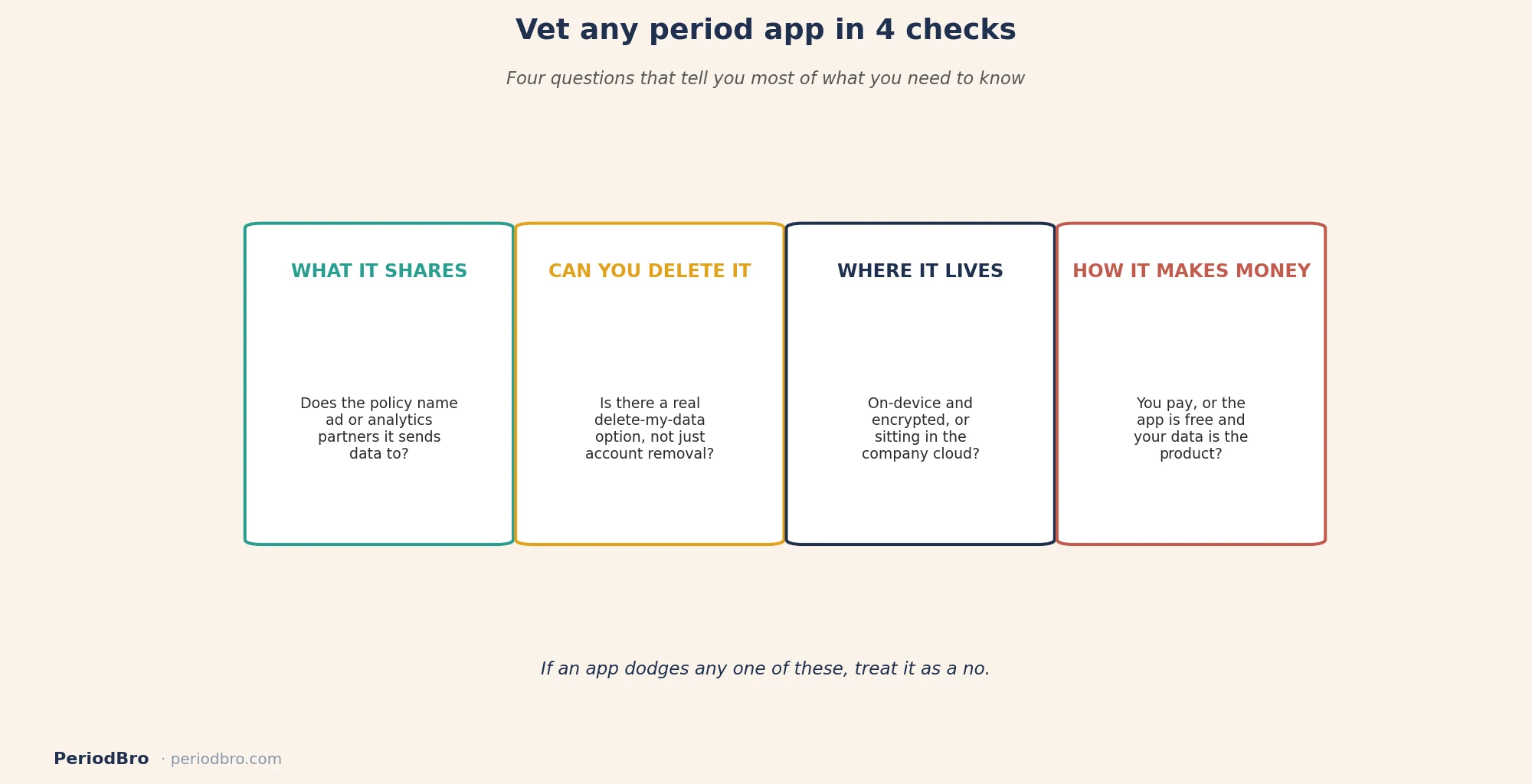
You do not need to read a privacy policy end to end. Five checks catch most of it.
One, find the deletion path before you sign up. Can she delete the account and the data, not just uninstall. If the answer takes more than two minutes to find, that is the answer.
Two, look for the third-party sharing line. Search the policy for “share”, “partners”, “advertising”, and “affiliates”. You are looking for whether health data is carved out from general data, or quietly lumped in with it.
Three, check whether it works logged out or offline. Apps that store locally and need no account, like the one that topped Mozilla’s ranking, cannot leak a server they do not have.
Four, check who owns the company now. Acquisitions rewrite privacy policies, and a promise from a startup is worth what the acquirer decides it is worth.
Five, check what it wants beyond the cycle. Location, contacts, and social login on a period app all deserve a raised eyebrow.
Run those and you have done more diligence than almost anyone. The longer version, with the traps, is in our app safety guide.
The legal part, stated straight
In parts of the United States, reproductive health data now sits inside a legal environment where it can matter in ways it did not use to. That is not a reason for panic and it is a reason for a real conversation rather than a shrug.
What is documented: menstrual and pregnancy data has commercial value, it is bought and sold, and the Cambridge researchers listed police investigations, insurance discrimination, workplace monitoring, and cyberstalking among the plausible downstream harms. What is not documented is a wave of prosecutions built on app logs, and you should be suspicious of anyone claiming certainty in either direction.
What that means in practice for a couple. The decision about how much to log and where belongs to her, not to you, even when you are the one who read the privacy research. Your job is to make sure she is choosing with the information, not to choose for her. If she wants to log everything in a mainstream app because the convenience is worth it, that is a legitimate call. If she wants everything local and nothing shared, also legitimate.
We wrote the version of this that is about the two of you rather than the law in tracking her cycle with consent, including how to run the conversation without turning a Tuesday into a threat briefing.
What is worth logging, and what is not
Assume for a moment she has said yes and you are looking at a screen with forty toggles. Most of them are noise for your purposes.
Worth having. Period start and end. Cycle length over time. A one-word energy or mood marker if she wants to add one. Anything she has explicitly told you she wants you to notice, like migraines or a bad sleep stretch.
Not yours to collect. Sex and libido logs. Discharge and cervical mucus detail. Anything to do with a pregnancy attempt she has not opened as a topic. These are hers, they are the reason the whole category is sensitive, and a partner having them adds nothing you can act on.
The one to actively skip. A personal tally of arguments cross-referenced to cycle day. People do build these. It reliably ends with a man showing his partner a chart to win a fight, and it is the single worst outcome of tracking. We describe the wreckage in the creepiness playbook, and the rule that prevents it is simple: never quote the app back at her during a disagreement.
Less is more here. Two data points and a habit of asking will outperform a complete symptom database every time.
What to do with the data on an ordinary Tuesday
Tracking that never converts into behaviour is just a hobby. Here is the conversion, and it is smaller than people expect.
Move the friction. If the app says the rough stretch starts Thursday, do not book the dinner with your loud friends for Friday. That is one calendar decision a month and it does more than any conversation about feelings.
Front-load the boring stuff. Groceries, laundry, the thing she has been putting off. Doing it two days early is invisible help, and invisible help is the kind that does not feel like being managed.
Have the supplies in the house. Painkillers she actually takes, the heat pad, the food she wants. Our field guide to helping with period cramps is the deep dive on that side, and it is the most-used article we have.
Change one sentence. Instead of “what is wrong”, try “rough week, what do you want from me”. The app told you which week. It did not tell you the answer, and asking is still required.
Do not announce your knowledge. “The app says you are on day 25” is the worst sentence in this entire field. Use the information, do not perform it. That distinction is what separates cycle awareness that improves a relationship from the version that irritates everyone.
Does any of this actually help, or does it just feel productive
Fair question, and the honest answer is that the evidence for tracking specifically is thin, while the evidence for partner involvement is better.
What is reasonably established: how a partner responds shapes how the experience lands. Experimental work has found that pain sensitivity across the cycle varies with relationship context and with whether a supportive person is present, which is a strange finding until you remember that pain is processed rather than just transmitted (PLOS One). A 2025 qualitative study of male partners of women with endometriosis found the same theme from the other direction: what these men consistently valued, and consistently lacked, was communication rather than information (Sexual and Relationship Therapy, 2025). We summarised the wider literature in what the research actually says about partner support.
What is not established: that having an app makes anyone a better partner. Nobody has run that trial, and be suspicious of any product page implying otherwise, including ours. The plausible mechanism is modest and mechanical. Knowing which week it is removes the surprise, removing the surprise removes a chunk of the friction, and less friction means the two of you spend the hard week on the actual problem rather than on the argument about the mood.
The claim we will stand behind is narrow. Tracking does not fix anything on its own. It shortens the distance between noticing and acting, and in a busy household that distance is where most support gets lost.
Which also tells you when to stop. If the app is generating conversations about the app, it is costing more than it returns. Delete it and go back to asking.
The line between support and surveillance
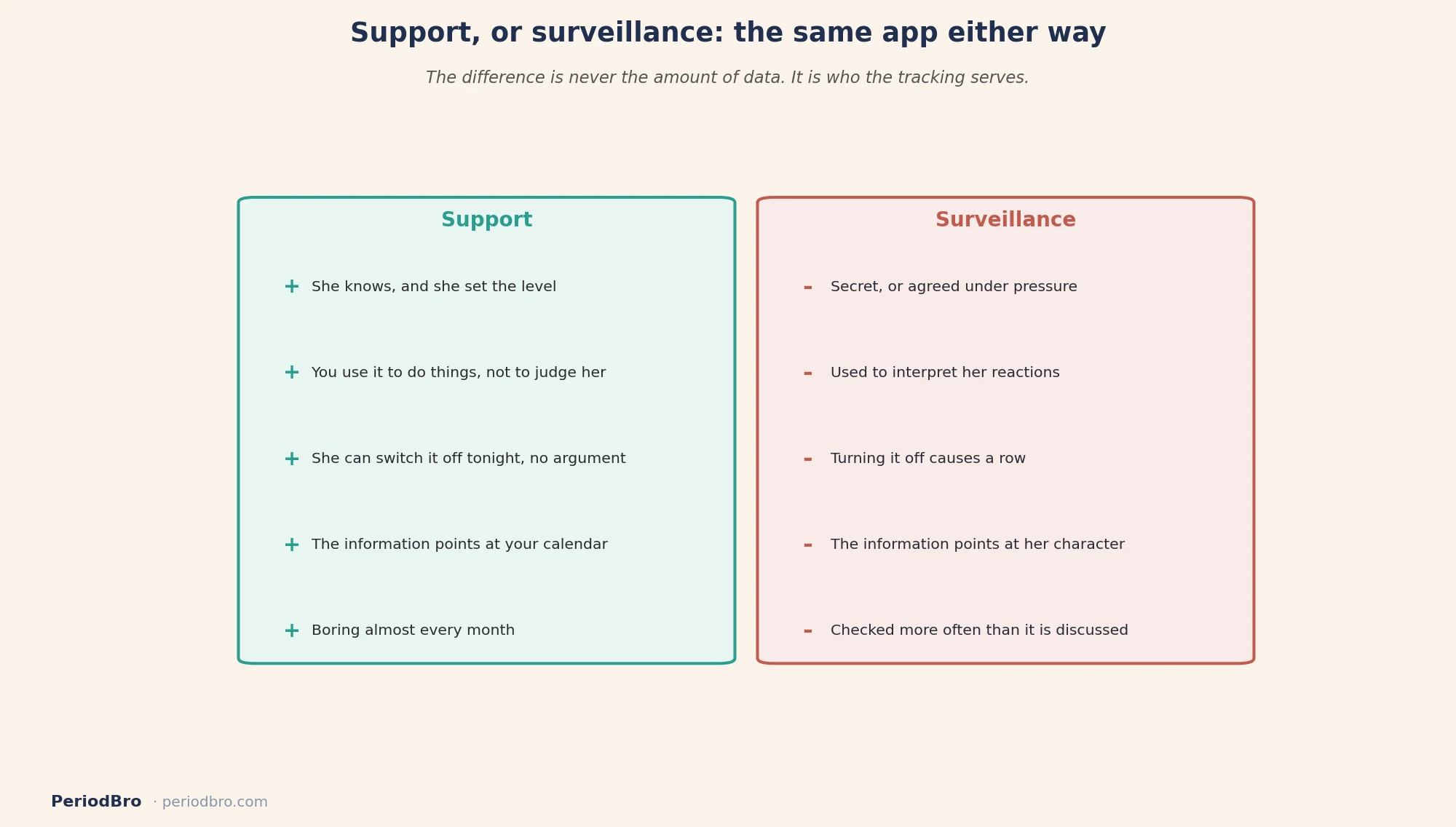
One thing separates them, and it has nothing to do with how much data you have: who the tracking serves.
Support looks like this. She knows. She set the level. You use it to do things and not to draw conclusions about her character. The information flows toward action, and it is boring almost all of the time.
Surveillance looks like this. She does not know, or she knows and did not really have a choice. You use it to interpret her, to predict arguments, or to decide whether her reaction is legitimate. The information flows toward judgement.
The tell is what you do with a bad day. A supportive setup has you thinking “rough week, order the food, keep the evening quiet”. A surveillance setup has you thinking “day 26, that explains it, so I do not have to take what she said seriously”. The second one uses biology to dismiss a person, and it is corrosive whether or not there is an app involved. We spelled out the failure modes in what healthy cycle tracking looks like.
Two more warning signs worth naming. Checking the app more often than you talk to her about it. And feeling something when she turns sharing off. Both mean the tool has drifted from helping you show up to helping you monitor, and the fix is to close it for a month and see whether anything gets worse.
When she is on birth control
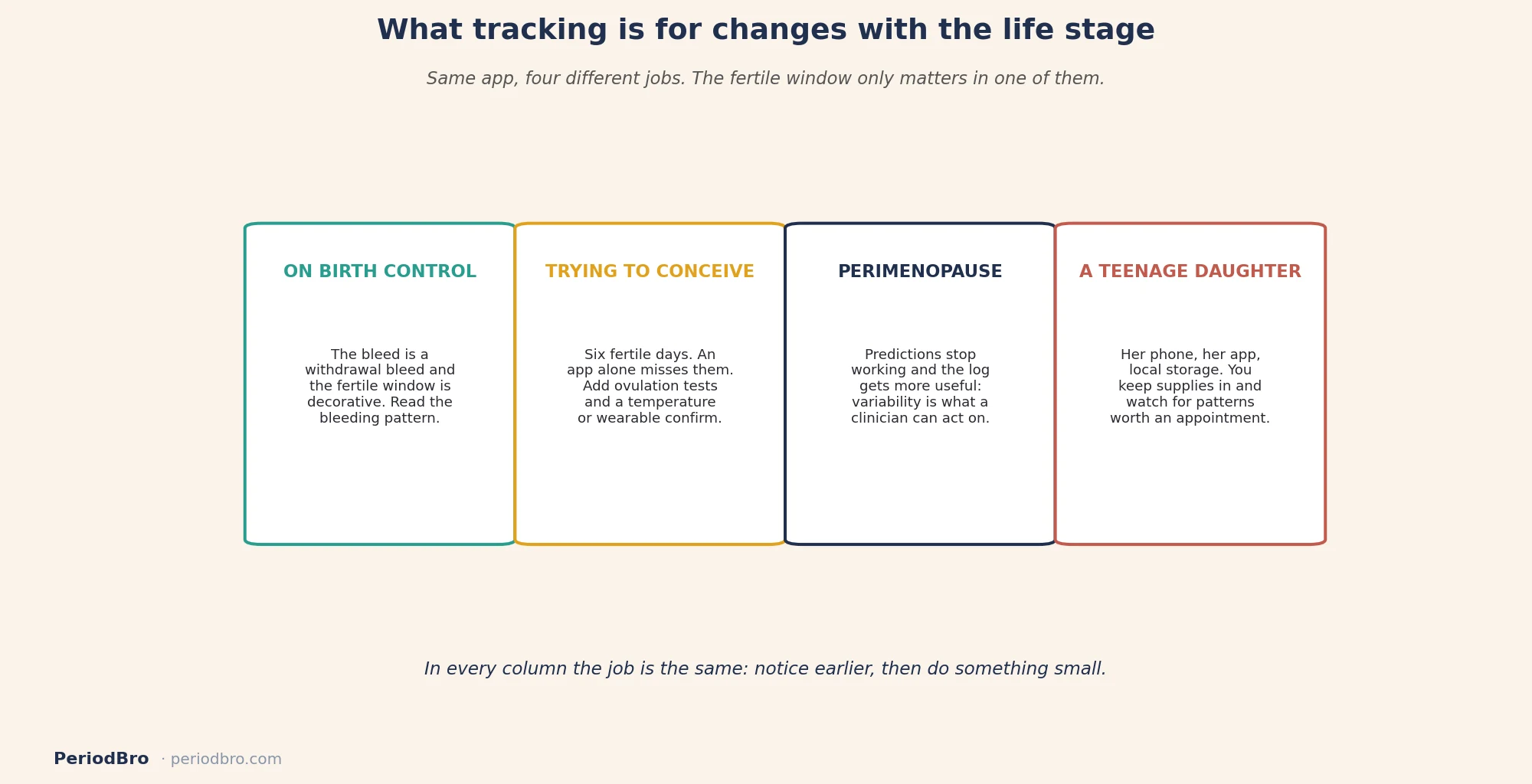
If she is on a hormonal method, most of what the app shows is decorative, and this trips up more couples than anything else on this page.
The bleed in the placebo week of a combined pill is a withdrawal bleed, not a period. It happens because hormone levels drop when the active pills stop, not because a cycle completed. There is no ovulation preceding it when the method is working. So the fertile window drawn on screen is the app applying its standard model to a body that is not running that model.
What changes by method. On a combined pill the pattern is regular by design, which makes the app look impressively accurate and tells you very little. On progestogen-only methods, an implant, an injection, or a hormonal IUD, bleeding often becomes irregular, light, or absent, and the app will keep predicting periods that are not coming. That is the app being confused, not her body.
What tracking is still good for here. Symptom patterns, since premenstrual-type symptoms can persist. Breakthrough bleeding, which is worth having a record of before a clinic appointment. And side effects in the first few months of a new method. The full breakdown is in period tracking on birth control.
The practical instruction for you: stop reading the fertile window entirely, and read the bleeding pattern instead.
When you are trying to conceive
Trying for a baby is the one situation where the accuracy numbers stop being trivia and start deciding your month.
The biology: the fertile window is about six days long, ending on the day of ovulation, because sperm survive several days and the egg does not. Which means the useful information is a window that is closing, not a single day. Given that a calendar-based app places ovulation with an average error of over three days, and a physiology-based method gets to around 1.26 days (JMIR, 2025), an app alone will regularly point at the wrong days.
What adds real signal: ovulation prediction kits, which detect the luteinising hormone surge a day or two before ovulation, and basal body temperature or a wearable that confirms afterwards that it happened. One looks forward, one looks back, and together they beat any prediction drawn from past cycle lengths.
What to stop doing: scheduling sex to a calendar alert, since regular sex across the window outperforms precision timing and costs the relationship far less. Also worth dropping is treating a negative month as a failure of effort, which is where cycle tracking starts damaging the thing it was supposed to help. We wrote about that part specifically in what to do with her cycle data when you are trying for a baby.
And the timing rule for when to ask for help: under 35, a year of trying without a pregnancy is the usual threshold for a workup, and over 35 it drops to six months. Bring the tracking history to that appointment, because it is the one place the data is unambiguously useful.
When the cycle starts changing for good
Somewhere in the forties, often earlier than people expect, the predictions start being wrong in a way that is not the app’s fault. Cycles get shorter, then longer, then skip. The average the app is projecting forward is an average of a past that no longer applies.
This is the moment a lot of couples conclude the app is broken and delete it. That is backwards. Tracking gets more useful in perimenopause, not less, because the two things a clinician can work with are the pattern over time and the change from her own baseline. A log showing cycles that went from 28 days to a range of 21 to 45 over two years is a useful document. A memory of “they have been weird lately” is not.
What to log shifts too. Cycle length variability, heavy bleeding, sleep, and vasomotor symptoms matter more than any fertile window. Apple’s decision in June 2026 to add perimenopause and menopause support to its cycle feature is a sign of where the whole category is heading, and it is overdue.
Two things not to assume. Irregular does not mean infertile, so contraception still applies until a clinician says otherwise. And not every change belongs to the transition, since heavy bleeding, bleeding between periods, or bleeding after sex deserve a look regardless of age. The longer version is tracking a cycle in perimenopause.
The one thing an app is not
A standard period tracker is not birth control. Not the free one, not the beautiful one, not the one with the machine learning claims on the App Store page. Nothing in the calendar-prediction category is designed or cleared for pregnancy prevention.
There is one narrow exception worth naming precisely, because it gets misquoted in both directions. Natural Cycles is a regulated fertility-awareness product rather than a generic tracker, cleared by the FDA, and it works from daily basal body temperature or a compatible wearable rather than from calendar arithmetic. It received its sixth FDA clearance in July 2026 for an updated algorithm that combines statistical modelling with machine learning (PR Newswire, July 2026). The published effectiveness figures are around 98% with perfect use and 93% with typical use.
Read that typical-use number honestly. It means roughly 7 in 100 users experience a pregnancy over a year, which sits well below an IUD or an implant and requires daily measurement and abstinence or barriers on flagged days. It is a real option for some couples and a poor one for couples who cannot absorb an unplanned pregnancy. Our honest read is in Natural Cycles for partners.
The rule that keeps you out of trouble: the moment contraception is the goal, the conversation belongs with a clinician, and a general tracker has no role in it at all.
If you are a dad, not a partner
Everything above changes shape when the person cycling is your teenage daughter, and the changes matter.
The consent bar goes up, not down. A teenager has a stronger claim to privacy over this than almost anything else in her life, and a father with a live feed of her symptoms is a fast route to her logging nothing at all. What works is her app on her phone, a heads-up she chooses to give, and you knowing enough to keep supplies in the bathroom and not schedule the big trip on the wrong week.
What is worth knowing as a dad. That cycles in the first couple of years after menarche are often irregular, and that this is usually normal development rather than a problem. That the menstrual cycle is treated by ACOG and the American Academy of Pediatrics as a vital sign in adolescents, which means a pattern that is badly off is a reason to see someone (ACOG committee opinion). And that the practical stuff, supplies and painkillers and a lift home, is most of the job.
On app choice for a teenager, the privacy questions get sharper, since a data profile built at fourteen follows her. Local storage and no account is a much stronger default here than it is for an adult. We wrote the dad-specific version in a period tracking app for dads, and the appointment thresholds in when should a girl see a gynecologist.
When the hard week is more than a hard week
Tracking surfaces something that used to be invisible, and occasionally what it surfaces is not ordinary premenstrual symptoms. This is the most valuable thing a log ever does for a couple, so it gets its own section.
Ordinary premenstrual symptoms are common, annoying, and compatible with a normal week. Sore breasts, bloating, irritability, low mood, worse sleep, appetite changes. They arrive in the second half, ease once bleeding starts, and do not take the month apart.
Premenstrual dysphoric disorder is a different animal. Same timing, different magnitude: severe mood symptoms that damage work, friendships, or the relationship, followed by a genuinely clear stretch after the period. That clear week is the diagnostic signature, and it is the thing a tracking log is uniquely good at showing, because the diagnosis formally requires prospective daily ratings across two cycles rather than anyone’s memory. If the same collapse lands in the same week every month, read PMS vs PMDD and then our complete PMDD guide for partners.
What you do with a suspicion: bring the pattern, not the label. “I noticed this lands the same week each month, and it looks brutal” is useful. “I think you have PMDD” is a diagnosis you are not qualified to make, and it usually gets heard as an accusation.
One line that is not optional. If a hard week ever includes talk of self-harm or of not wanting to be here, that is urgent every time, regardless of what the calendar says. In the US and Canada, call or text 988. In the UK and Ireland, call Samaritans on 116 123. Do not wait for the next cycle to see whether it repeats.
When the data says book an appointment
The most valuable thing a tracking log ever does has nothing to do with you. It gives a clinician a real record instead of a guess, and it catches patterns that are easy to normalise when you live inside them.
Patterns that are worth a medical conversation. Cycles consistently shorter than 21 days or longer than 35 to 38 days once cycles are established. Any gap of 90 days or more without a period, when pregnancy is not the explanation. Bleeding that soaks through a pad or tampon every hour for several hours in a row, or bleeding that lasts more than seven days. Bleeding between periods or after sex. Pain that stops her doing normal things despite over-the-counter painkillers (ACOG, Cleveland Clinic).
Pain deserves its own line, because it is the one most often dismissed on both sides of the consulting room. Period pain that repeatedly overrides painkillers and clears the calendar is not something to tough out, and it is the main way endometriosis and adenomyosis stay undiagnosed for years. We cover the thresholds in is her period pain normal.
What you do with all this is narrow and useful. Offer the log, offer the lift, and offer to be in the waiting room. Do not diagnose from a graph, and do not book the appointment over her head. The record is hers to bring.
What changed in the last year
If you last looked at this category in 2024, four things moved.
The privacy question stopped being theoretical. The August 2025 jury finding against Meta over data collected through Flo turned a long-running argument into a legal fact, with a statutory penalty attached per violation. Whatever the appeals do, the discovery record is public and it describes exactly which cycle events were logged and shipped.
The federal protection went the other way. The HIPAA reproductive health rule was vacated nationwide in June 2025, so the direction of travel in the courts and the direction of travel in regulation are currently opposite. In practice that puts more weight on the app’s own design, and on state law, than on anything federal.
The evidence on wearables firmed up. The January 2026 network meta-analysis gave the category its first solid pooled numbers, and they support a specific claim rather than a vague one: wearables beat calendars, they place ovulation well within a few days, and they still cannot name the day.
The platforms kept absorbing the feature. Apple added perimenopause and menopause support in June 2026, and Natural Cycles cleared an updated algorithm with the FDA in July 2026. The standalone tracker is slowly becoming a layer inside the phone, which is good for privacy and bad for the apps whose entire product was a calendar.
What did not change: none of it tells you what she needs on a given evening. That part has been the same since before there were apps.
Seven things you will read that are not true
“The cycle is 28 days.” That is an average, not a rule. Normal covers a wide range, and variation between cycles is expected rather than alarming. An app drawing a clean 28-day loop is showing you a default, not her.
“Ovulation is day 14.” Day 14 comes from subtracting a textbook luteal phase from a textbook cycle. In real data ovulation moves around a lot, which is why prediction accuracy drops to 0.56 when an app is asked for the exact day.
“The app knows when she is fertile.” It estimates. There is a real difference between an estimate built from past dates and a measurement, and the entire contraception question sits in that gap.
“Tracking apps are all the same on privacy.” Mozilla’s 2026 scoring ran from 10 out of 10 down to 2 out of 10 inside the same category. The spread is enormous and it is knowable before you install.
“Health data in an app is protected like medical records.” Not in the United States, for consumer apps, in most cases. This is the assumption that does the most damage.
“A wearable measures her hormones.” It measures temperature, heart rate, and movement, and infers. Useful, and not the same thing.
“If she is on the pill, the app still shows her cycle.” It shows a withdrawal bleed and a fertile window that does not apply. The screen looks the same, and the meaning is completely different.
Setting it up this week, in seven days
Everything above collapses into a week of small moves. If you do nothing else with this page, do this.
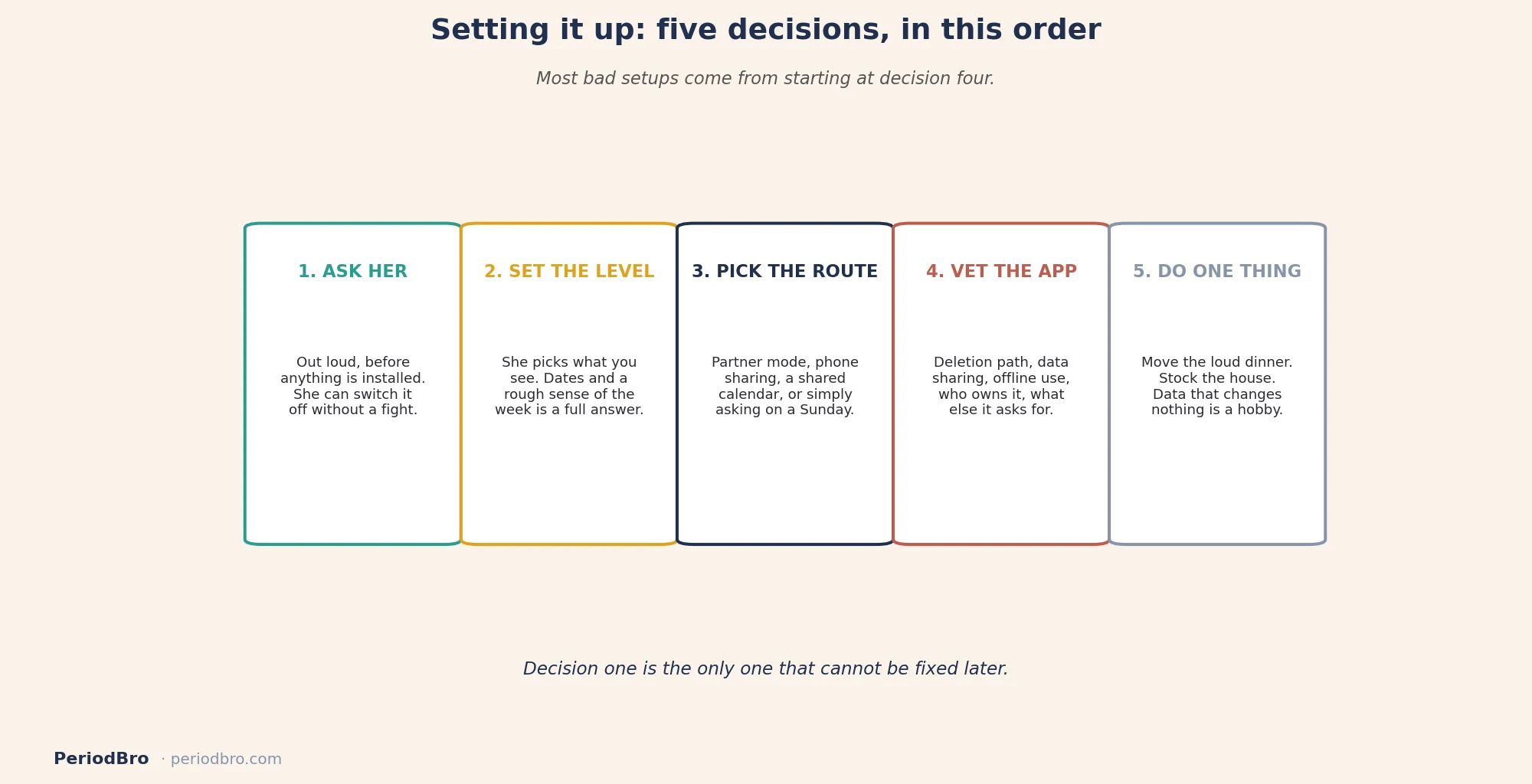
Day one, ask. One sentence, offered as a heads-up for you rather than access to her. “I keep getting caught out, would it help if I knew it was coming, you pick what I see.” Then stop talking and let her answer properly.
Day two, pick the route, not the app. Shared calendar, phone-level sharing, a partner mode, or just asking. Start at the lightest one that solves the problem in front of you. Almost nobody needs to start at the heaviest.
Day three, run the five-minute vet. Deletion path, third-party sharing, offline capability, who owns the company, what it wants beyond the cycle. Do this before she fills in six months of history, not after.
Day four, agree what you see. Say it out loud so nobody has to guess. Dates and a rough sense of the week is a complete and normal answer, and it is where most couples land.
Day five, put one thing in the calendar. Not a symptom log. A single decision, like not booking anything loud in the back half of next week. This is the step everyone skips, and it is the one that converts data into support.
Day six, stock the house. The painkillers that work for her, the heat pad, the food she wants when nothing sounds good. Doing it before it is needed is the whole trick.
Day seven, close the app. Ask her how the week is going instead. The tracking is a prompt, not a replacement, and a month from now the only thing she will remember is whether you showed up.
Review it after two cycles. If the setup is generating conversations about the setup, simplify it. If neither of you has thought about it and things are running smoother, it is working exactly as intended.
Where we fit, disclosed
We build a cycle app for partners, so read this section knowing that.
The reason it exists is the gap described at the top of this page. The good trackers are built for the person cycling, and their partner features are an afterthought bolted onto a product with a different job. What we wanted was the opposite: an app whose main user is the person trying to show up well, taking her shared data as input, translating a cycle day into something to do, and asking almost nothing of her.
What we are not: a medical device, a fertility product, or a contraceptive. We do not predict ovulation for family planning, and we would rather send someone to a clinician than compete with one.
Where an honest comparison lands: if she is deep into her own tracking and wants a polished ecosystem, one of the mainstream apps will suit her better, and we say so in our head to head with Flo. If she wants to share almost nothing and you want to be useful anyway, that is the case we were built for. And if you two are fine with a shared calendar and a Sunday conversation, you do not need us, which is an odd thing for a founder to write and it is true.
The design constraints we set for ourselves are in what a period tracking app for partners should actually do. The short version: her switch, minimal data, no dashboard about her, and nothing that tells you what she is thinking.
Common questions
Is it wrong to track my partner’s cycle? Not if she knows and agreed and can revoke it. It is wrong when it is secret, and it is a bad idea when it is being used to interpret her rather than to help her. That distinction, not the technology, is the whole ethical question.
What if she says no? Then no, and it is not a negotiation. Ask on a Sunday instead, notice the pattern yourself, and keep the practical support running. Plenty of couples never use an app and do this well.
Can she see that I am looking? Depends on the app. Some show the partner’s activity, most do not. If it matters to either of you, check before you set it up, and the safer assumption is that she can.
Do I need my own app? Usually not. A shared calendar entry or a note covers the dates. A partner app earns its place when you want the translation from cycle day into something to do, which is the part a calendar cannot give you.
Which app is the most private? On Mozilla’s 2026 testing, the ones that store data locally and require no account scored highest, with Euki at 10 out of 10. Apple Health is a strong option for an iPhone couple for the same structural reason. Neither is the most useful for a partner, which is the tradeoff.
Is a smart ring worth it for this? For ovulation timing while trying to conceive, the evidence says a wearable beats a calendar. For general partner awareness, it is an expensive way to learn something a shared date already told you.
Her period is four days late and the app is panicking. Should I be? Late periods are common and usually mean ovulation happened later than the average, often after stress, illness, travel, or disrupted sleep. If pregnancy is possible, a test answers it. If cycles are regularly missing without an explanation, that is a clinic conversation, not an app one.
Can I use the app to know when not to start an argument? You can use it to pick your moment, which is fine and adult. You cannot use it to decide her point is invalid because of the date, which is not. If you catch yourself doing the second one, close the app.
She is on the pill and the app still shows a fertile window. Is that a bug? No, and it is not meaningful either. Most trackers apply the same model regardless of contraception. Ignore the window and read the bleeding pattern.
Should we log anything for the doctor? Yes, and keep it simple: period start dates, length, how heavy, pain and what helped, and anything unusual. That is what turns “they have been a bit off” into something a clinician can work with.
What about my daughter, not my partner? Higher privacy bar, her phone, her app, local storage strongly preferred. Your job is supplies, timing, and knowing which patterns are worth an appointment.
The short version
Cycle tracking for partners works when it is small, agreed, and pointed at behaviour. Ask her first, let her set the level, and accept that dates and a rough sense of the week are usually the whole useful payload.
Expect good period prediction and unreliable ovulation prediction, because the app is projecting an average and the body is not obliged to comply. Wearables do measurably better than calendars, at roughly 0.88 against 0.72 in the pooled evidence, and neither is precise enough to serve as contraception.
Take the privacy question seriously, because the last eighteen months made it concrete. A jury found against a large technology company over reproductive data collected through a period app, the federal rule meant to protect that data was struck down, and independent testing found a five-fold spread in how carefully apps in this category behave. Vet the app in five minutes, prefer local storage where you can, and leave the final call to her.
Then do the unglamorous part. Move the loud dinner, buy the supplies before you need them, ask instead of assuming, and never quote the app back at her. The tracking is only the thing that tells you when to show up, and showing up is still done by hand.
This article is general information for partners, not medical advice, and it does not diagnose anyone. Cycle tracking apps are not contraception and are not a substitute for care from a qualified clinician. Decisions about contraception, fertility treatment, and any symptom that worries you belong with her and her clinician.