Cycle Tracking on Android: What a Partner Can Actually See
If you both carry iPhones, there is a built-in answer: she turns on Health Sharing and her cycle shows up on your phone. On Android there is no equivalent switch, and looking for one is how people waste an evening in settings menus. Cycle tracking on Android is genuinely good, right up to the moment you want a second person to see any of it.
That gap is what this piece is about: what Android gives you in 2026, what it will not do however you configure it, and what a couple on Android can do instead.
What changed this year
The Fitbit app is gone as a brand. Google folded it into the Google Health app on 19 May 2026, and Fitbit Premium became Google Health Premium on the same day. If you last looked at this a year ago, the thing you remember as Fitbit cycle tracking now lives somewhere else.
Cycle logging in Google Health works on the phone with no wearable at all. Period logging on the wrist is supported on Sense 2, Versa 2, and Pixel Watch 3 and 4. Google’s own documentation says the app predicts periods, estimates a fertile window and ovulation from logged data, and starts from a 28-day cycle with a 5-day period until it has enough history to do better.
That last detail is worth holding onto, because we spent a whole piece on it in do period tracker apps actually work. Early numbers in any app are a textbook average wearing her name, not a read on her cycle.
The three routes for cycle tracking on Android
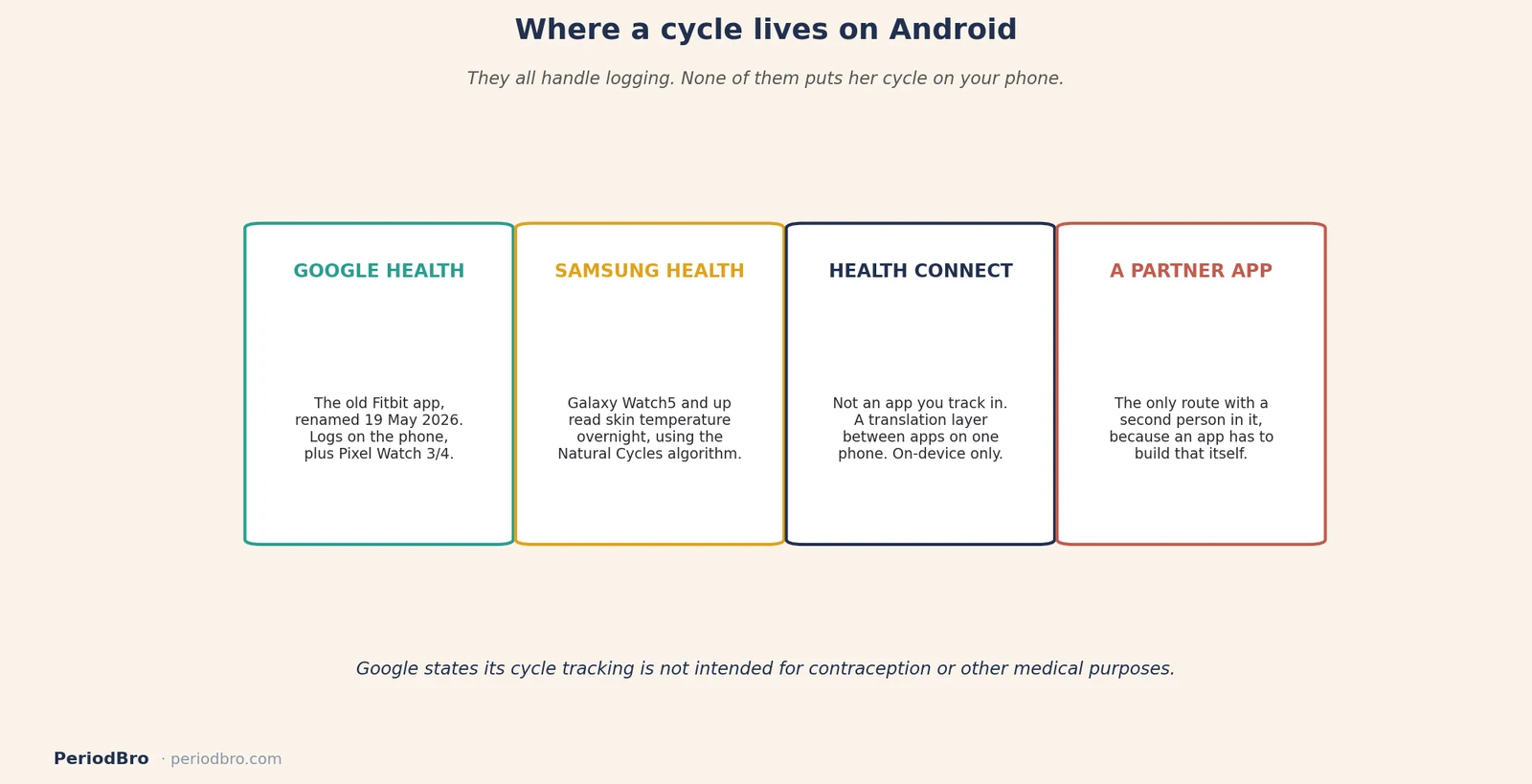
There are three, and they do different jobs.
Google Health is the default for anyone on a Pixel or any Android phone who wants logging without picking a specialist app. It is competent, it is free, and it is tied to the Google account she already has.
Samsung Health is the one with the interesting hardware story. Samsung partnered with Natural Cycles to bring temperature-based cycle tracking to the Galaxy Watch5 series, using the watch’s skin temperature sensor overnight and Natural Cycles’ algorithm to sharpen predictions. Samsung’s own announcement put availability at 32 countries across Europe, North America and Asia. It is the same algorithm behind the app we looked at in our honest look at Natural Cycles, with the important difference that the watch feature is cycle tracking, not the contraceptive product.
A third-party app is the route people actually take when they want a partner involved, because that is where partner features exist at all.
Health Connect is not what you think it is
This is where most people get their hopes up. Health Connect looks like Android’s answer to Apple Health, and in a narrow sense it is.
Google’s documentation describes it as a way to share health and fitness info between multiple apps, with Cycle Tracking as one of six categories alongside Activity, Body Measurement, Nutrition, Sleep and Vitals. The developer documentation lists what sits inside that category: menstruation, cervical mucus, ovulation tests, skin temperature, and sexual activity.
The sharing in Health Connect is app-to-app, on one phone. It works as a translation layer that lets the tracker she uses talk to the watch app she uses. It has no concept of another person. There is no partner, no invitation, no second phone.
The privacy side of that is a real upside. Health Connect data is stored on the device rather than in Google’s cloud, and she can delete everything, or one data type, or one app’s contributions, whenever she wants. If the thing that makes her uneasy about tracking apps is where the data ends up, and that concern is well founded as we covered in are period tracker apps safe, Health Connect is the reassuring part of this story.

The sharing wall, stated plainly
Google is refreshingly blunt about it. Its support page for cycle health says you cannot directly share your cycle tracking data from the Google Health app with anyone, and suggests reviewing it together with a partner or a clinician outside the app instead.
So if you are on Android and you were hoping for the Apple arrangement we described in the Apple Health guide, where she picks the topics and they appear on your phone one-directionally until she revokes it, that does not exist here. Not in Google Health, not in Samsung Health, not in Health Connect.
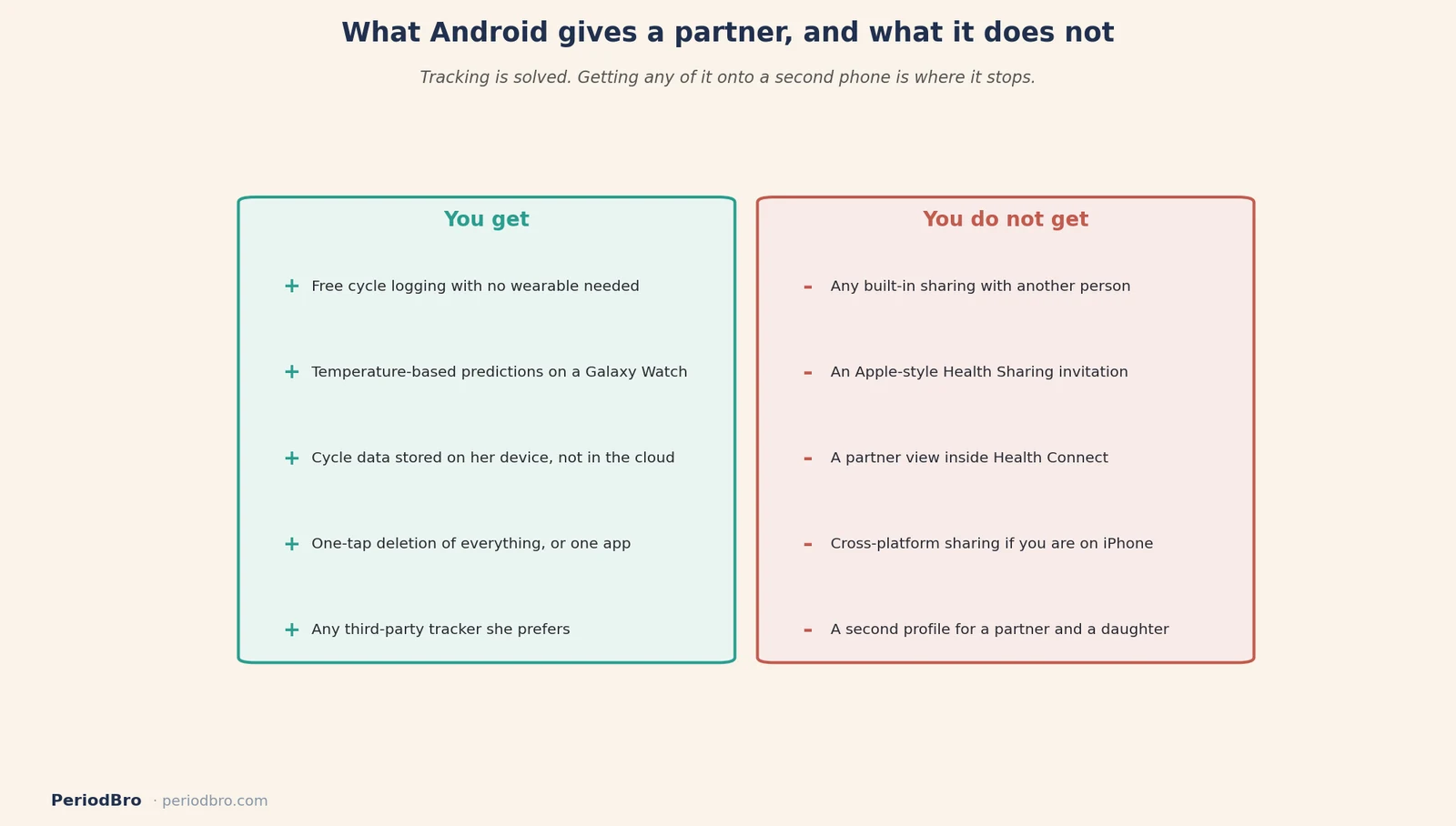
What is left is app-level partner features, which is exactly why apps like Clue built them. We walked through the mechanics of one in how Clue Connect works, and the shortlist of everything else in the best period tracker apps for partners.
The disclosure
We make one of those apps, so read this with that in mind. PeriodBro is built for the person supporting rather than the person cycling, it runs on Android, and it holds more than one profile, which matters for anyone tracking both a partner and a daughter.
Discount that as much as you like. The part that survives the bias is structural: on Android, partner visibility has to be built by an app, because the operating system does not offer it. That holds whether you pick ours, Clue’s, or nothing at all.
What actually works for an Android couple
Pick one place to log. Two apps holding two half-histories predict worse than either would alone. If she is happy in Samsung Health, that is the place, and you get information by asking rather than by syncing.
If she wears a Galaxy Watch, wear it to sleep. Overnight skin temperature is what the Natural Cycles algorithm needs, and a watch charging on the nightstand contributes nothing.
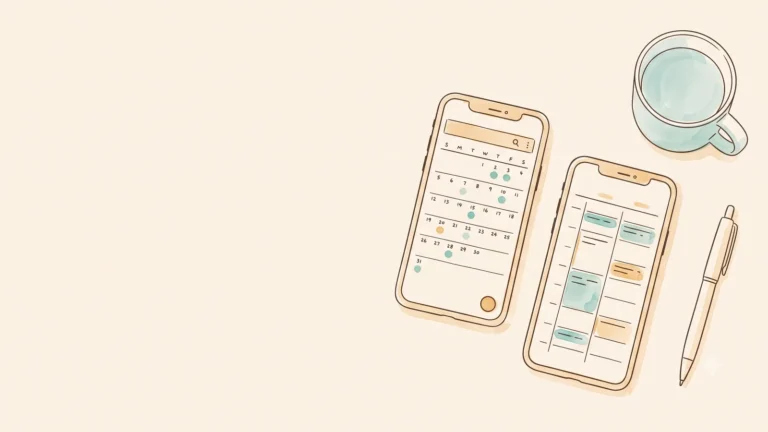
Use a shared calendar rather than a shared health record. This is the underrated Android workaround. Two recurring entries she controls, one for the expected start and one for the week before, gives you the heads-up you actually needed without handing anyone a symptom log.
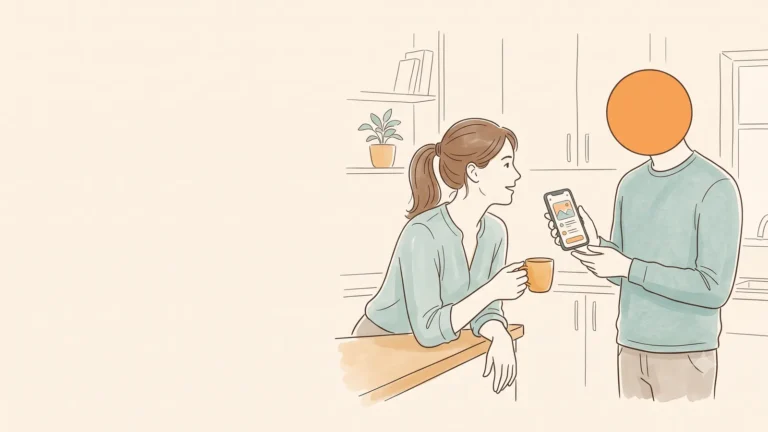
Ask for the summary, not the data. “Where are you in your cycle this week” is a better question than a dashboard, and it does not require a settings menu.
Get consent explicitly, because the tech will not ask for you. On Apple, the sharing prompt is the consent conversation. On Android there is no prompt, which means the conversation has to happen out loud. Ours on tracking her cycle with consent covers what that sounds like when it goes well.
Common questions
Can I see my partner’s cycle on Android?
Not through the operating system or Google’s own apps. Google states plainly that cycle tracking data cannot be shared directly from the Google Health app with anyone. A third-party app with a partner feature is the only route.
Is Health Connect the Android version of Apple Health?
For app-to-app data on one phone, roughly yes. For sharing with another person, no. That second half is where the comparison breaks.
Does Samsung Health track ovulation?
Galaxy Watch5 and later use overnight skin temperature with Natural Cycles’ algorithm to sharpen cycle predictions. Like every algorithm of this type, it works on patterns after the fact rather than announcing ovulation in advance.
Is any of this reliable as contraception?
No. Google states its cycle tracking is not intended for contraception or other medical purposes. The FDA-cleared contraceptive product is the standalone Natural Cycles app, which is a different thing from a watch feature, and it has its own effectiveness numbers that we covered separately.
What if she has an iPhone and I have an Android?
Then neither ecosystem helps you, because Apple’s Health Sharing needs an iPhone on both ends. A cross-platform app or a shared calendar entry are the realistic options.
Which Android app should she use?
The one she will actually open. Consistency beats features by a distance, and a beautifully designed app logged twice a month predicts worse than a plain one logged daily. Our roundup of alternatives goes through the trade-offs.
Is period data on Android private?
Health Connect data stays on the device and she can delete it. Individual apps are a separate question with separate privacy policies, and that is the part worth reading before installing anything.
Android has the tracking side handled, and leaves the sharing side to the two of you. As defaults go that one is defensible. It does mean the work is yours rather than the phone’s.
This article is general information, not medical advice, and cycle tracking apps are not contraception. Cycle predictions are estimates, and questions about fertility or contraception belong with a clinician.