
Are Period Tracker Apps Safe? What Partners Should Know About the Data
A friend texts you a link to a period app, or your partner asks which one to put on her phone, and the honest first question is: are period tracker apps safe? It is a fair thing to ask before you put your name behind something that will hold some of the most personal data a person generates. The short version is that the app itself is rarely the risk. What happens to the data behind it is where the real answer lives.
I went down this rabbit hole because I build a cycle app, so people assume I have an opinion and I would rather have a researched one. Here is what I found, kept calm and factual, so you can pass an app along with your eyes open instead of either panicking or shrugging.
Two different questions hide inside the word “safe”
When someone asks if a period app is safe, they usually mean one of two things, and it helps to separate them. The first is whether the app is medically trustworthy: does it predict cycles sensibly, does it avoid handing out sketchy health advice. The second is whether the data is safe: who sees what she logs, where it is stored, and whether it can be sold, shared, or handed to someone else later. Most of the noise online is about the second question, and that is the one this piece is about. Cycle predictions are only ever estimates anyway, which is a separate conversation about picking a tracker that actually works for partners.
The reason the data question carries more weight is what gets logged. A period app is not just dates. Depending on the app, it can hold sex drive, contraception, moods, symptoms, pregnancy details, and more. That is a richer profile of a person’s private life than most of us keep anywhere else, which is exactly why advertisers and brokers find it valuable and why it deserves a harder look than a weather app.
Are period tracker apps safe? It depends on where the data goes
The clearest cautionary tale comes from the regulator, not a blog. In 2021 the US Federal Trade Commission finalized an order against Flo Health, maker of a popular period and ovulation tracker. The FTC alleged that despite promising to keep users’ health data private, Flo shared sensitive information from millions of users with marketing and analytics firms, including Facebook and Google. Worth saying plainly: this was a settlement, and Flo did not admit wrongdoing. As part of it, Flo agreed to get affirmative consent before sharing health data, to submit to an independent privacy review, and to tell any third party that received the data to destroy it.
That was one company. The broader picture is not much cheerier. When Mozilla ran its *Privacy Not Included review of period and pregnancy trackers in 2022, it slapped a warning label on 18 of the 25 apps and devices it looked at. At least eight failed its basic security bar, some allowing passwords as weak as “1”. Mozilla described a lot of these apps as collecting a buffet of personal data, using it to target ads, and in some cases selling it on. Only one app in the whole roundup earned its “Best Of” badge.
Why does any of this happen? Because a lot of “free” apps are not really free. They are funded by advertising and data, which is the quiet cost behind the download button. I wrote a whole piece on what a free period tracker actually costs you, and the data economy behind it is bigger than any single app. The FTC has gone after data brokers directly: it sued the broker Kochava for selling location data that could trace people to and from reproductive health clinics, and by 2026 that case ended with Kochava barred from selling sensitive location data without a person’s clear consent. The data does not vanish once it leaves the app. It gets bought, resold, and combined.
The post-Roe dimension, stated straight
Since the US Supreme Court overturned Roe v. Wade in 2022, there has been a lot of heat around period apps and law enforcement. It is worth getting the facts right rather than the vibe. The Electronic Frontier Foundation’s take, in its guide on whether to delete your period tracking app, is measured: probably do not panic-delete, but do review what you use. Their core point is that health data held on a company’s servers can, in principle, be requested through legal process such as a subpoena. If a company holds it, it can be compelled to produce it.
That is why where the data lives matters so much. Data that stays encrypted on the phone is a very different risk profile from data sitting in a company cloud that can be queried, breached, or subpoenaed. EFF also flags the humble advertising ID on your phone, which brokers use like a nametag to stitch your activity together across apps. The politics are beside the point here. What matters is the plain mechanics of who holds the information and who can ask for it. If you and your partner are weighing this together, we covered the consent side in tracking her cycle with consent.

How to actually vet a period app in plain steps
You do not need to be a privacy lawyer to do a decent check. You need to read a couple of paragraphs and know what you are looking for. Consumer Reports, which has tested period apps for privacy, boils the good behavior down to three things: data stored locally on the device, no third-party trackers, and a clear way to delete your data. Notably, they found none of the five popular apps they tested guaranteed the data would only be used the way you intend, and they pointed to smaller apps like Drip, Euki, and Periodical as stronger on privacy.

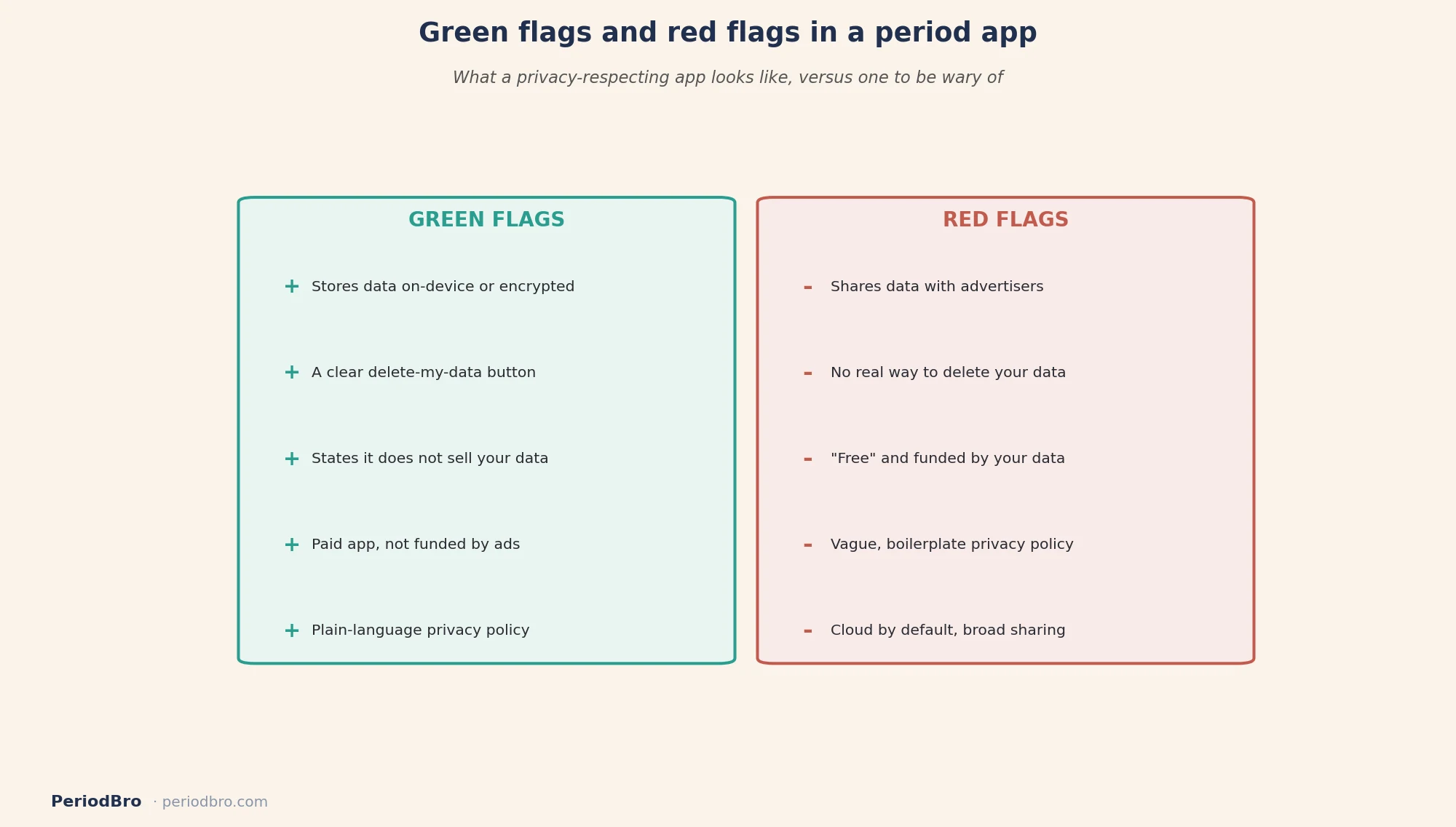
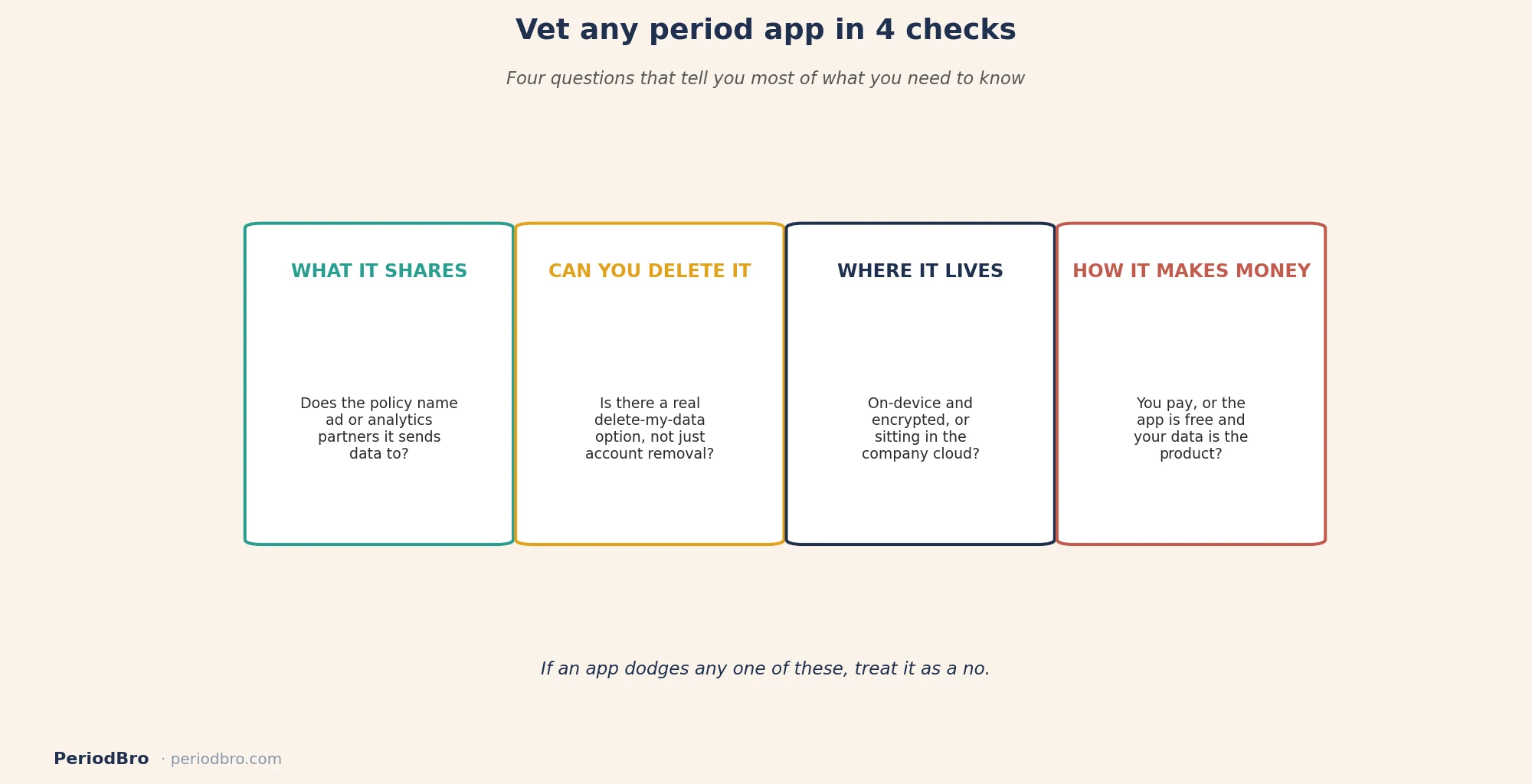
Here is the plain-steps version I use. Open the privacy policy and search it for the word “share” and the word “sell”. If it names advertisers or analytics partners it sends data to, that is a straight answer. Look for a real delete-my-data option, not just “delete your account”, which sometimes leaves the data on their servers. Check where the data lives: on-device or encrypted is the green flag, default cloud with broad sharing is the yellow one. And ask how the app makes money. If it is free and stuffed with ads, your data is a plausible part of the business model. A paid app you pay for directly has less reason to sell you.
Two more small tells are worth a glance. First, does the app even have a privacy settings page you can find. Mozilla and EFF both treat a missing one as a bad sign, because an app that will not let you turn things off usually is not built to. Second, skim the app store reviews and the privacy label, but do not stop there. The label tells you what a company says it collects, and the policy tells you what it reserves the right to do with it. When those two do not line up, believe the policy. The whole check is maybe ten minutes, and it is ten minutes better spent before you recommend an app than after.
Where PeriodBro stands (founder note, disclosed)
Disclosure: I build PeriodBro, so treat this paragraph as the interested party talking. I set it up privacy-first and partner-first on purpose: her cycle data is hers, we are not in the business of selling it to advertisers, and the whole point of the app is helping a partner show up better, not surveilling anyone. I would rather you run the checks above on my app too than take my word for it. That is the honest version, and it is the one I am comfortable putting my name on.
If you want the bigger picture on doing this well as a partner rather than as a snoop, the ethics live in whether you should track your partner’s cycle at all, and the full playbook is in our guide to being a better partner through her cycle.
The short checklist
- Read the privacy policy for “share” and “sell”. If it names ad or analytics partners, believe it.
- Confirm there is a real delete-my-data button, not just account deletion.
- Prefer on-device or encrypted storage over default cloud with broad sharing.
- Be wary of “free” apps funded by ads. A paid app has less reason to monetize you.
- If an app dodges any one of these, treat it as a no.
One last thing that matters more than any setting: sharing a cycle is her call, not yours. The safest app in the world does not change the fact that this is her data and her decision about who tracks it. Ask, do not assume, and let her pick the tool she trusts.
This article is general information about data privacy, not legal or medical advice. Privacy policies, laws, and app practices change, so verify an app’s current terms yourself before relying on them.