
PeriodBro vs Flo for Partners: An Honest Head-to-Head
Before we go any further: I built PeriodBro. So read this the way you’d read a review of a restaurant written by the guy who owns it – with your guard up. I’m going to try to be useful anyway, because there’s a version of this comparison that’s actually honest, and there’s a version that’s a sales page pretending to be a comparison. I’d rather write the first one.
Here’s the short version. Flo is the biggest cycle app in the world, and it has a partner feature. PeriodBro is a small app built for the partner from the ground up. Those are not the same product with different logos. They start from opposite ends, and which one fits you depends almost entirely on one question: does she want to be the one running this, or do you?
PeriodBro vs Flo for partners: what each one actually is
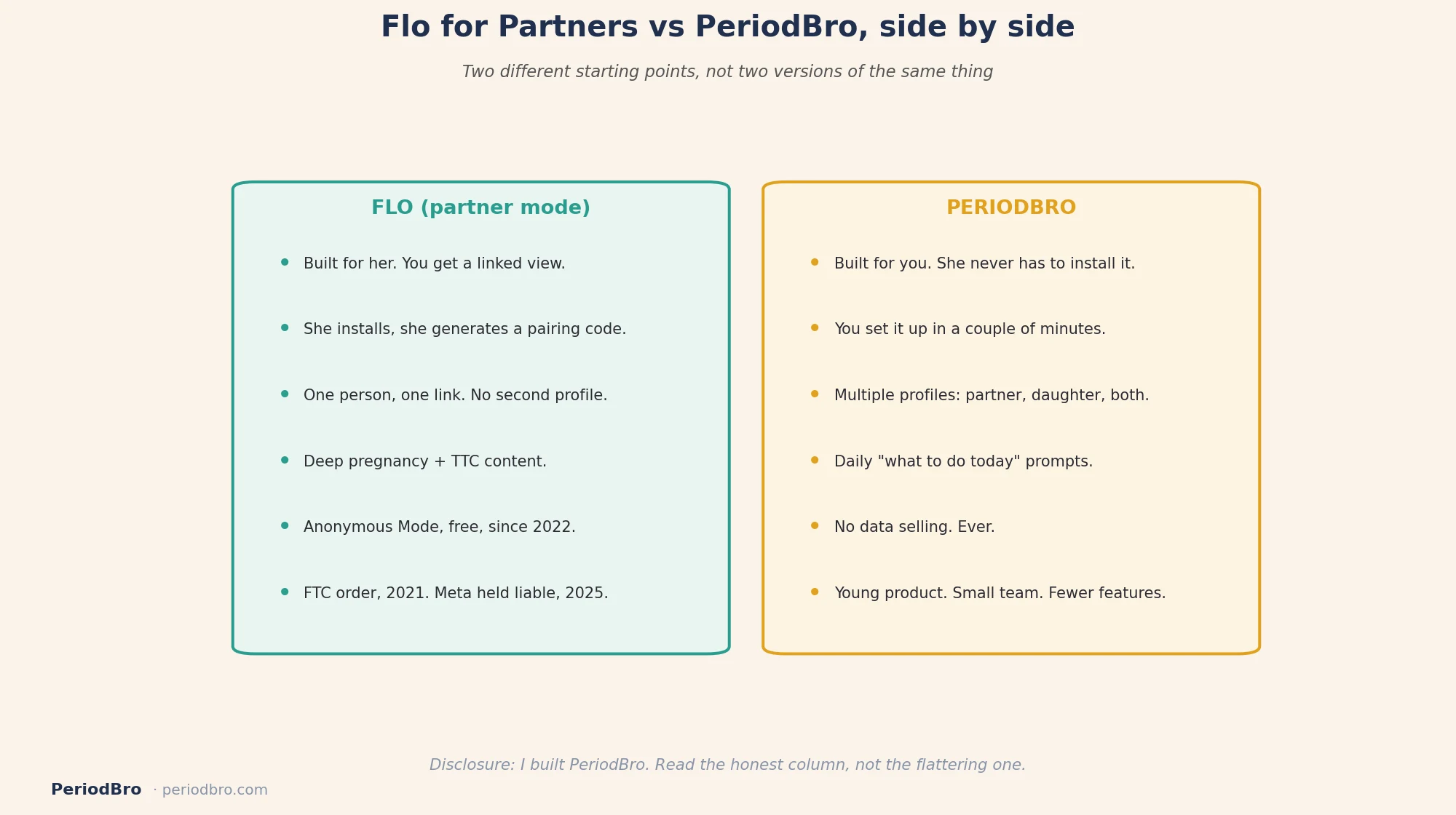
Flo for Partners is a mode inside Flo. She installs Flo, tracks her cycle in it, and then – if she wants to – she opens the Partner tab, generates a pairing code, and sends it to you. You install Flo, tap “I am a partner,” enter the code, and your accounts link. From then on you get notifications, explanations of what she’s experiencing, and tips on how to support her. Flo’s own help docs walk through the pairing flow, and both of you have to be 18 or older.
The structural thing to notice: her account is the source of truth. She decides whether to link, what to log, and she can unlink. That’s a genuinely good design if she’s already a Flo user. It’s a non-starter if she isn’t, because the whole thing depends on her downloading an app, maintaining it, and inviting you in. For a lot of guys – especially early in a relationship – asking your girlfriend to install a period tracker so you can see it is a conversation you’d rather not have in month three.
PeriodBro flips it. You install it. You enter what you know, which at the start is usually just the date her last period started. She never has to touch it. There’s no pairing code, because there’s nothing to pair. It’s a tool for the person doing the learning, not a window into someone else’s account. That’s the design decision the whole product hangs on, and it’s the one people either immediately get or immediately dislike.
Where Flo is straightforwardly better
Flo has hundreds of millions of users and a content library to match. If she’s pregnant or you’re trying to conceive, Flo has depth PeriodBro doesn’t come close to. If she’s already logging symptoms in Flo every day, her data is richer than anything you’d type into a second app from memory. And if she wants tight control over exactly what you can and can’t see, Flo gives her that switch. She flips it, you see what she’s chosen to share. That’s the cleanest consent model of the two, and I’m not going to pretend otherwise.
Flo is also, bluntly, a real company with a real engineering team. We’re a small operation. There are features in Flo I’d love to ship and haven’t. That gap is real and it’s not closing this year.
Where PeriodBro is different, and why I built it that way
Two things, mainly. The first is that PeriodBro assumes you know almost nothing, and that this isn’t a character flaw. Most cycle apps are written for the person who has the cycle, so they use language she already understands. Ours is written for a guy who last heard the word “luteal” in a biology class he wasn’t paying attention to. If you want the same ground covered slowly, our menstrual cycle guide for men is the long-form version of what the app tells you a day at a time.
The second is multiple profiles. Every man I know has more than one woman in his life whose cycle matters to him – a partner, a daughter, sometimes a sister or a mother he’s caring for. Every mainstream app assumes exactly one cycle, because it assumes you’re tracking your own. PeriodBro lets you hold a partner and a teenage daughter in the same app without either of them ending up in the other’s data. That’s the thing nobody else does, and it’s why the app exists at all rather than being a feature request I sent to Flo.
What that means in practice: you get a daily line telling you roughly where she is in her cycle and one concrete thing worth doing about it today, in a sentence rather than a chart you have to interpret. Whether that’s what you want depends on whether you want to become a hobbyist about this or just stop being caught off guard.

The privacy question you should be asking either of us
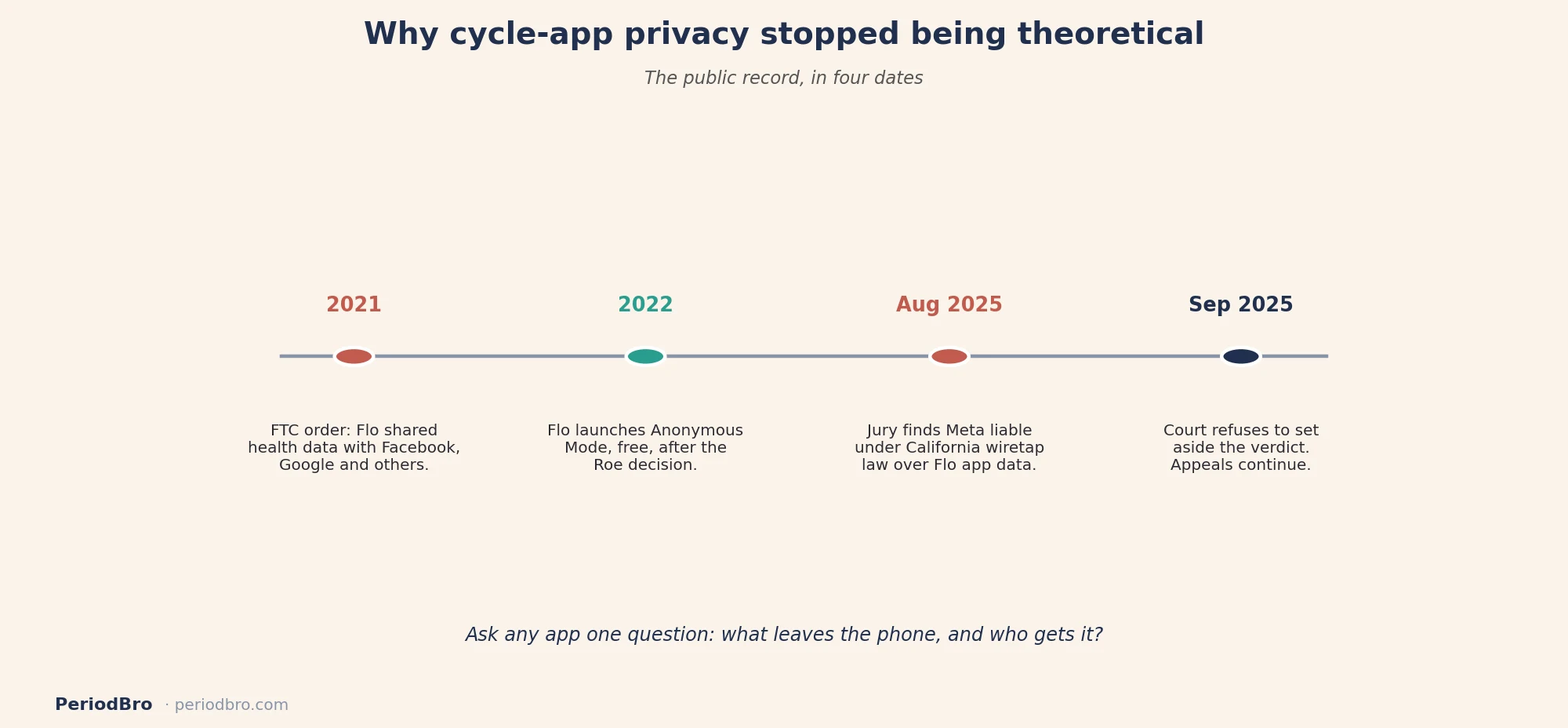
Reproductive health data is not ordinary data, and the last few years have made that concrete rather than theoretical. In 2021 the FTC finalized an order against Flo Health over allegations that, despite promising privacy, it had shared users’ health data with marketing and analytics firms including Facebook and Google. Flo settled without admitting wrongdoing and has since launched Anonymous Mode, free for all users since 2022, which lets someone use the app without a name or email attached. They also open-sourced parts of it, which is more than most companies bother to do.
The story didn’t end there. In August 2025 a San Francisco jury found Meta liable under California’s wiretap statute for capturing reproductive health answers through a software kit embedded in the Flo app, without users’ consent. Flo and the other co-defendants settled before or during the trial, leaving Meta alone in front of the jury. Meta’s attempts to undo the verdict were rejected the following month, and appeals are ongoing.
I’m not telling you that to score a point. I’m telling you because the honest reading of that case isn’t “Flo bad, PeriodBro good.” It’s that the third-party SDKs almost every app ships with are the actual risk surface, and a small app can be careless with them just as easily as a big one. PeriodBro doesn’t sell data and doesn’t intend to. But “trust me” is not a privacy policy. Ask any app you’re considering – including mine – the same blunt question: what leaves the phone, and who receives it? If the answer takes four paragraphs, that’s an answer.


The thing neither app can do
Neither of us can make this okay if you’re doing it behind her back. An app that tells you she’s on day 24 is a support tool if she knows you’re using it and a surveillance tool if she doesn’t. Same data, completely different act. We’ve written the long version of this in should you track your partner’s cycle, and the practical script is in tracking her cycle with consent. It takes one sentence: “I downloaded a thing that tells me where you are in your cycle so I stop being clueless. Weird or fine?”
In my experience she says “that’s fine” and looks at you slightly differently for a second. That’s the whole hurdle, and everything after it is just software.
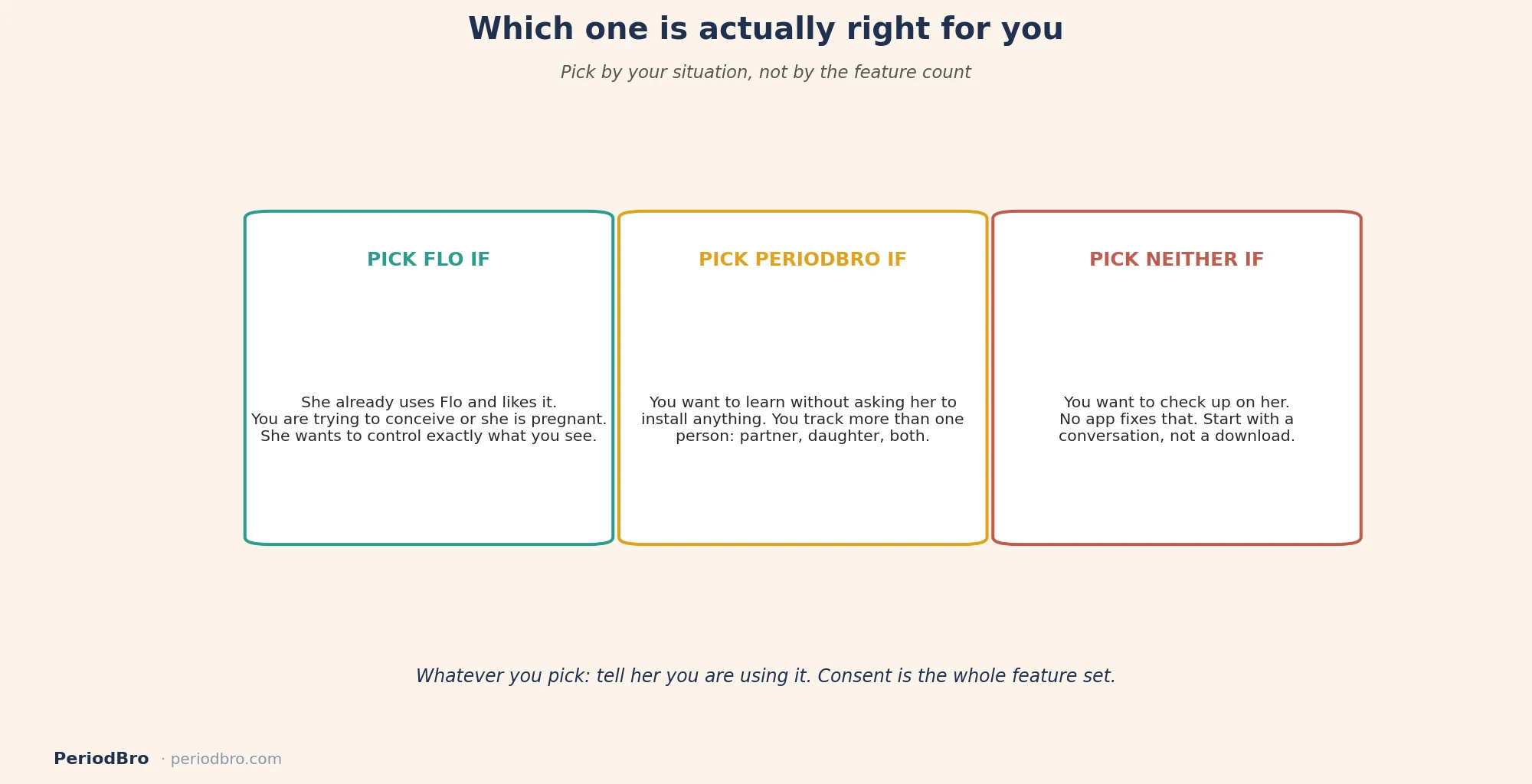
So which one
If she already uses Flo and likes it, use Flo for Partners. It’s free, it’s her data, and there’s no reason to add a second app to the pile. If you’re trying to conceive or she’s pregnant, use Flo. It isn’t close.
If she doesn’t use a tracker, or you’d rather not make your learning curve into her admin task, or you’re a father who needs to hold a partner’s cycle and a daughter’s in the same place – that’s the gap PeriodBro was built for. There’s a free tier, and you’ll know within a week whether the daily prompt is useful to you or just another notification you swipe away. If you want the wider field first, we keep an honest rundown of the period tracking app for partners category, and a standalone Flo for Partners review that isn’t about us at all.
And if you’re picking an app because you want to catch her out, or check up on her, or win an argument by pointing at a calendar – please don’t. No app makes that fine. That one’s on you, not the software.
This article is for general information and isn’t medical advice. Cycle apps predict, they don’t diagnose. For anything that worries either of you – severe pain, cycles that vanish, symptoms that wreck her month – talk to a doctor.