
A Period Tracking App for Dads: Her Cycle and Your Daughter’s, in One Place
When I started tracking cycles, it was about my relationship. Then it hit me that my daughter was a couple of years away from her first period, and I’d be just as unprepared for hers as I’d been for everyone else’s. That’s when I went looking for a period tracking app for dads and found out the category didn’t exist. There were apps built for the person menstruating, and there were parental-control tools built for watching your kid. Nothing built for a father who wants to be ready and useful for the women in his life, plural.
Because that’s the actual situation, right? Any man has more than one woman in his life. A partner, a daughter, sometimes both, sometimes a mom or a sister he looks out for. This article is about what a tool for that job should look like, and where the line sits between supporting your daughter and surveilling her.
Why there was no period tracking app for dads
Open the app store and search “period tracker.” Everything on the first screen is designed for the person having the period: her symptoms logged in her words, her fertility windows, her pink-and-lavender interface. Fair enough, that’s who those apps serve. But it means a dad who installs one is either roleplaying as his own daughter or squinting at a tool that keeps asking him about his cervical mucus.
The other shelf is worse. Search “period app for my daughter” and you land in parental-control territory, where guides rank teen period apps alongside screen-time locks and location monitoring. The frame is safety-through-oversight. Some of that writing is well-meaning, and resources like Luna’s guide to choosing a teen tracker do take teen privacy seriously. But the underlying posture is a parent looking over a shoulder. That posture poisons exactly the thing you’re trying to build with a teenager: trust.
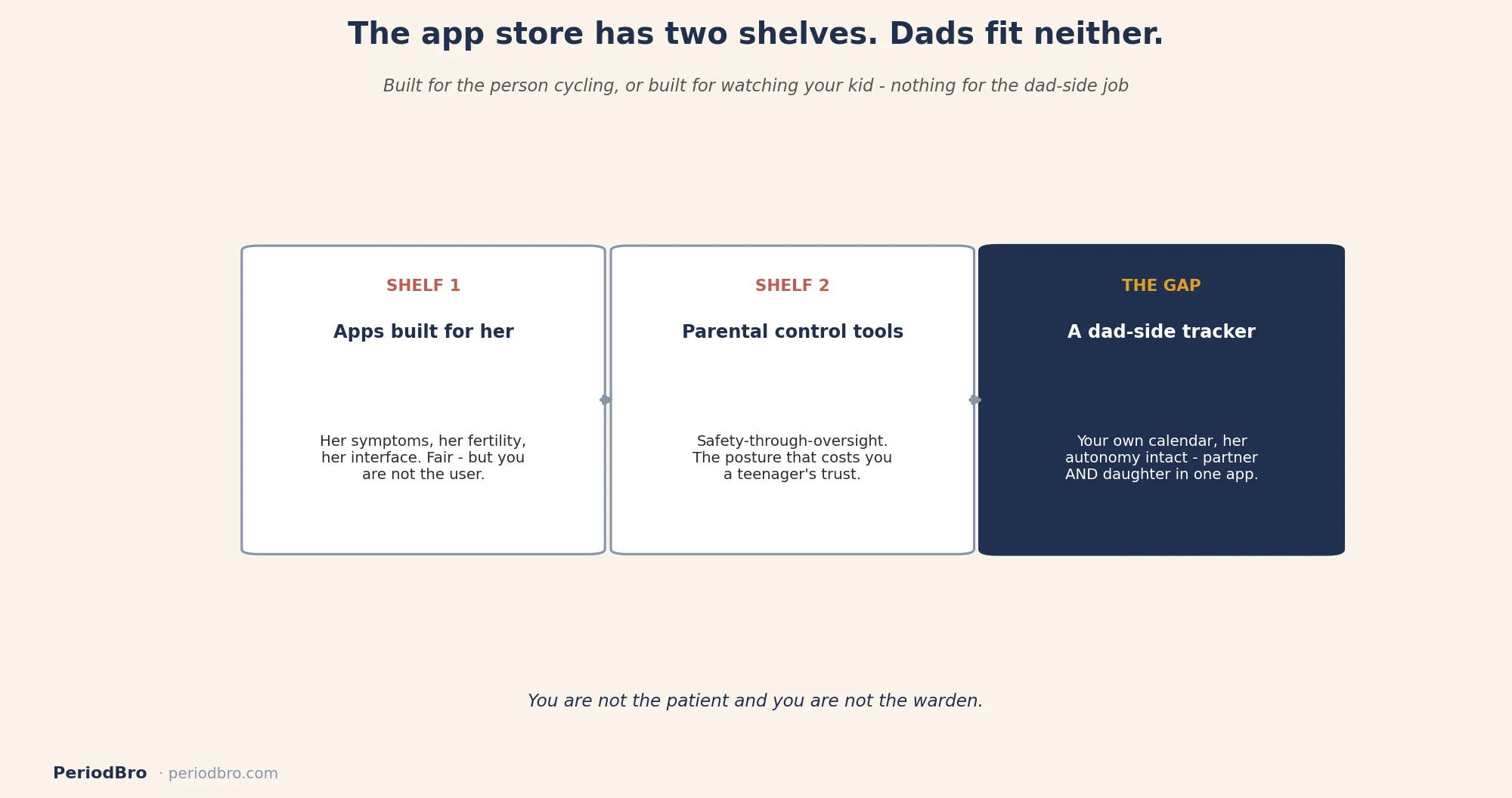
So dads fall through the gap. You’re not the patient and you’re not the warden. You’re the guy who wants to have pads in the house before they’re needed, know when to expect a rough week, and be someone she can actually talk to. We’ve written before about why dads are the missing link in menstrual education; the missing tool is the same story.

Support, not surveillance: where the line is
Let’s draw the line clearly, because everything else follows from it.
Support means you keep your own notes so you can show up prepared: roughly when her cycle lands, what supplies to stock, when to quietly plan the easy dinner. It means she knows you track it, the same way she knows you track dentist appointments. It’s care logistics on your side of the fence.
Surveillance means reading her private logs, demanding she report symptoms, tracking her body without her knowledge, or using an app to interrogate her mood. Even with good intentions, that teaches her that her body generates data other people are entitled to. It’s corrosive at any age, and with a teenager it guarantees the information dries up entirely.
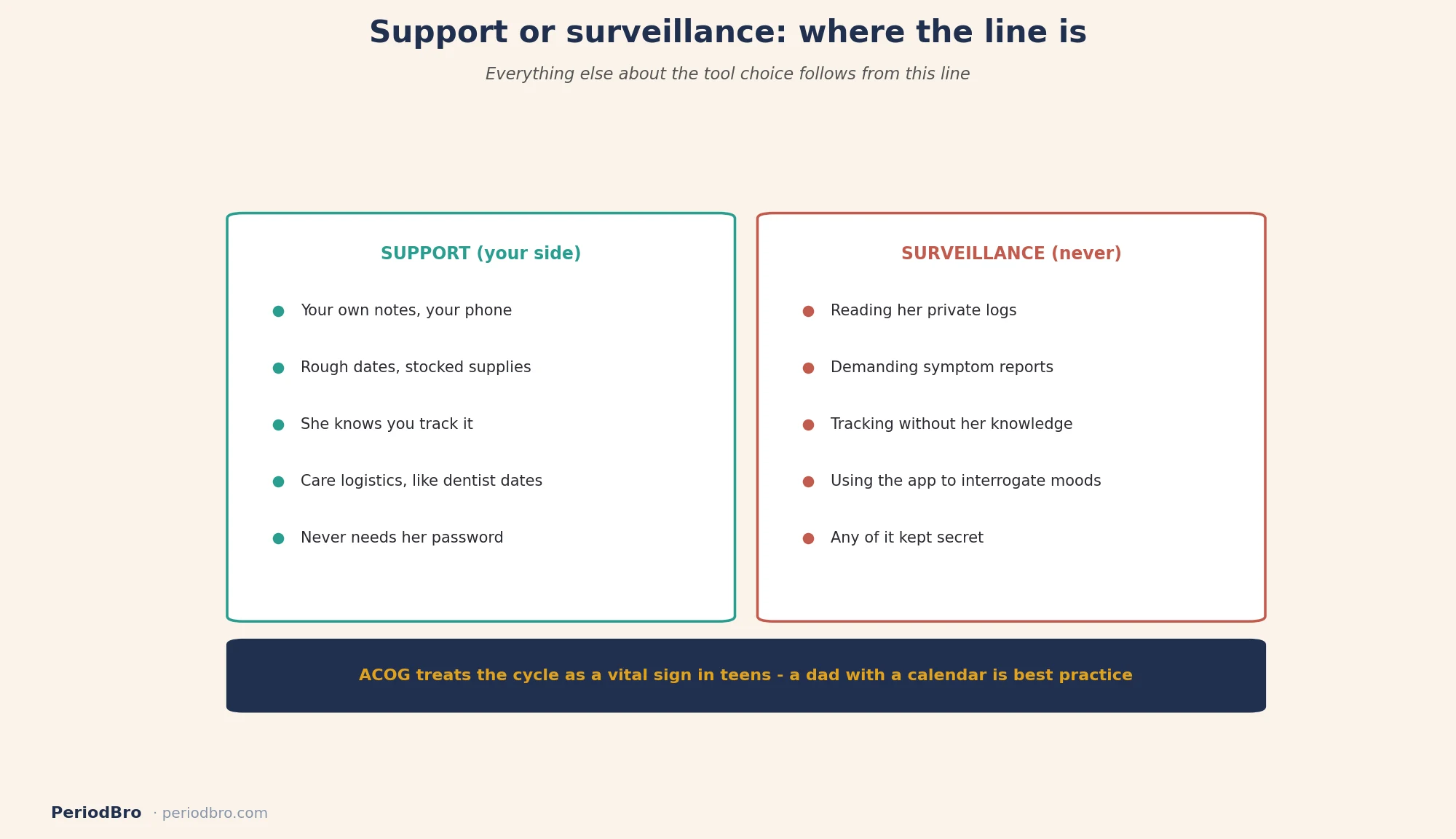
The medical establishment lands on the support side, by the way. The American College of Obstetricians and Gynecologists treats the menstrual cycle as a vital sign in adolescents: worth knowing, worth a calendar, because irregularities can flag real health issues. And they recommend talking about periods well before the first one arrives, which in the US averages around age 12. A dad with a rough calendar and stocked supplies is executing medical best practice. A dad reading his kid’s diary entries in an app is not.
Tracking two people at once
Here’s the practical wall you hit even after you’ve sorted the ethics: almost no app lets you follow more than one person. Partner apps pair you with exactly one account, hers. Teen-safety apps handle exactly one kid profile, framed as monitoring. If you’re a dad with a partner and a daughter, the market’s answer is two apps with two philosophies, neither of them yours.
This is the single biggest reason I built multi-profile into PeriodBro. One app, separate profiles: your partner’s cycle on one card, your daughter’s on another, each with its own boundaries. What you track for a partner (phase, mood context, how to show up well) is different from what you track for a 13-year-old (roughly when her period lands, whether the house is stocked, when to be extra patient about homework). Different relationships, different depth, one calendar in your pocket.
If you’re earlier in the journey, start with our guides on handling her first period as a single dad and what to stock at home before your daughter’s period. The app makes those playbooks ambient; the playbooks still matter.

What to look for in a teen-friendly tracker
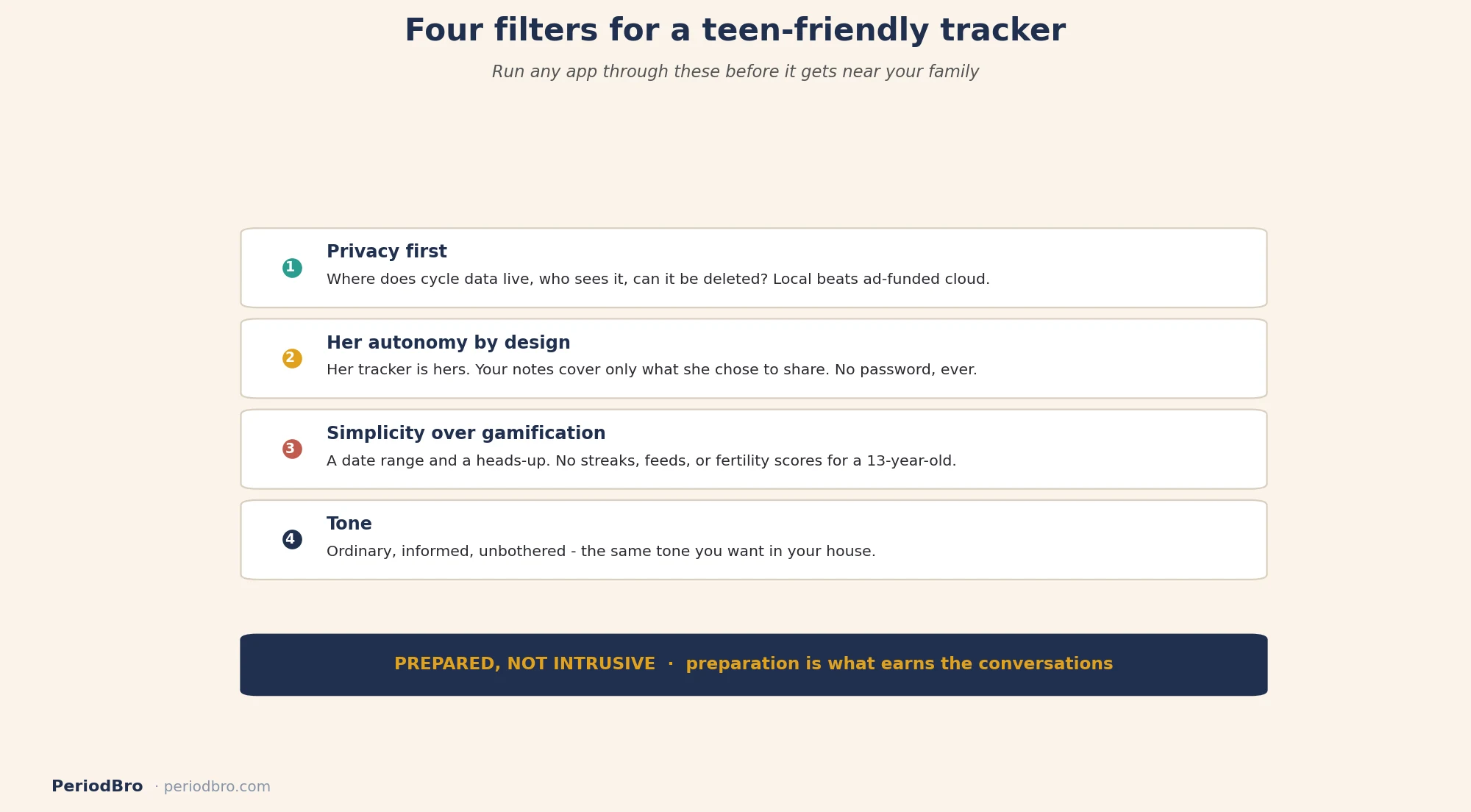
Whichever tool you pick, run it through four filters:
- Privacy first. Where does the data live, who can see it, and can it be deleted? Cycle data is sensitive health data, and in a post-Roe world that’s not paranoia, it’s diligence. Local storage beats cloud syncing to an ad-funded server, every time.
- Her autonomy by design. If your daughter uses her own tracker someday, that’s hers. Your notes stay yours, covering what she’s chosen to share with you. A good dad-side app never requires her participation, her installation, or her password.
- Simplicity over gamification. You need a date range and a heads-up, not streaks, social feeds, or fertility scores that make no sense for a 13-year-old.
- Tone. If the app talks about periods like a disease, a secret, or a marketing opportunity, keep scrolling. The tone you want in an app is the tone you want in your house: ordinary, informed, unbothered.
How PeriodBro handles it
Transparency first: PeriodBro is my product, so read this section knowing that. It’s also the only app in the category built from the dad-plus-partner premise instead of retrofitted to it.
Multi-profile is the core: partner, daughter, anyone you care for, as separate profiles with separate depth. For daughters we designed Teen Mode, which keeps the dad’s view deliberately simple (where she likely is in her cycle, what a rough week looks like, a checklist of what to have at home) and pairs it with plain-language education pulled from our dad guides, including the signs her first period is coming and red flags that are worth a doctor’s visit rather than a shrug. Nothing in it reads her mind, tracks her phone, or asks her to report. It makes you prepared, and preparation is what earns the conversations, as we wrote in our guide to talking to your daughter about periods.
FAQ
Does my daughter need to know I’m tracking her cycle?
Yes. Not as a confession, as a normal sentence: “I keep rough track of dates so I can have stuff ready and not be clueless. Tell me if anything’s off.” Secrecy converts care into surveillance the moment it’s discovered, and it’s always discovered.
Isn’t it weird for a dad to track this at all?
It’s exactly as weird as knowing her shoe size, her allergies, and the date of her math final. Which is to say: this is what involved parenting looks like from the inside, even when the culture hasn’t caught up. The weird version is the one where dad is a stranger to half of his kid’s health.
What age is this relevant from?
First periods in the US arrive around 12 on average, and ACOG suggests the conversations start years earlier. A reasonable rule: once you’d stock a first-period kit, you’d benefit from the calendar. Our field guide covers the moody-teenager years that follow.
The short version
Dads have been left out of this category by design: the apps serve her, or they serve fear. You need neither. You need your own quiet calendar, a stocked cabinet, and a kid who knows you’re informed and unbothered. PeriodBro lets you support your daughter and your partner from one app, without ever taking control away from them. That last part isn’t a feature footnote. It’s the whole point.
This article is for information only and isn’t medical advice. For concerns about your daughter’s cycle (very heavy bleeding, severe pain, or periods that stop) talk to her pediatrician or an adolescent gynecologist.