Teenage Migraines and Periods: What Dads Should Know
She came in from school, said almost nothing, and went upstairs with the blinds down. Third time this term. You looked back and the last two both landed in the same few days as her period, and that’s either a coincidence or the single most useful thing anyone has noticed about her headaches so far.
It’s usually not a coincidence. And the two things a dad can actually do here are smaller and more concrete than they sound.
Why teenage migraines and periods start showing up together
Migraine is not evenly distributed across childhood. Boys and girls get it at roughly similar rates before puberty, and then it separates. After menarche, girls carry it two to three times more often.
The timing is specific enough to be worth knowing: onset frequently sits close to menarche itself, and recurrent migraine in adolescent girls runs at something approaching 15 percent. So a daughter who never had headaches and now gets them, a year or two after her periods started, is following an extremely well-trodden path rather than developing something exotic.
The usual explanation is estrogen withdrawal. Estrogen climbs through the cycle and falls sharply in the days before bleeding, and that fall is treated as the trigger. Worth being honest about how solid that is: a 2023 review in the Journal of Headache and Pain looked at the evidence for the withdrawal hypothesis and concluded that despite wide acceptance, the supporting evidence remains limited. The pattern is real and well documented. The mechanism is the part still being argued about.
Which matters for one practical reason. If someone tells her the fix is simply to stabilise her hormones, that’s running ahead of what’s actually known.
The five day window, and the three cycle rule
Teenage migraines and periods have an actual definition attached to them, and it’s the thing that turns “she gets bad headaches” into a diagnosis someone can treat.
The international headache classification defines menstrually related migraine as attacks that occur in the window from two days before bleeding starts to three days after, in at least two out of three menstrual cycles. A five day window, hit twice in three months, and that’s the entire diagnostic test.
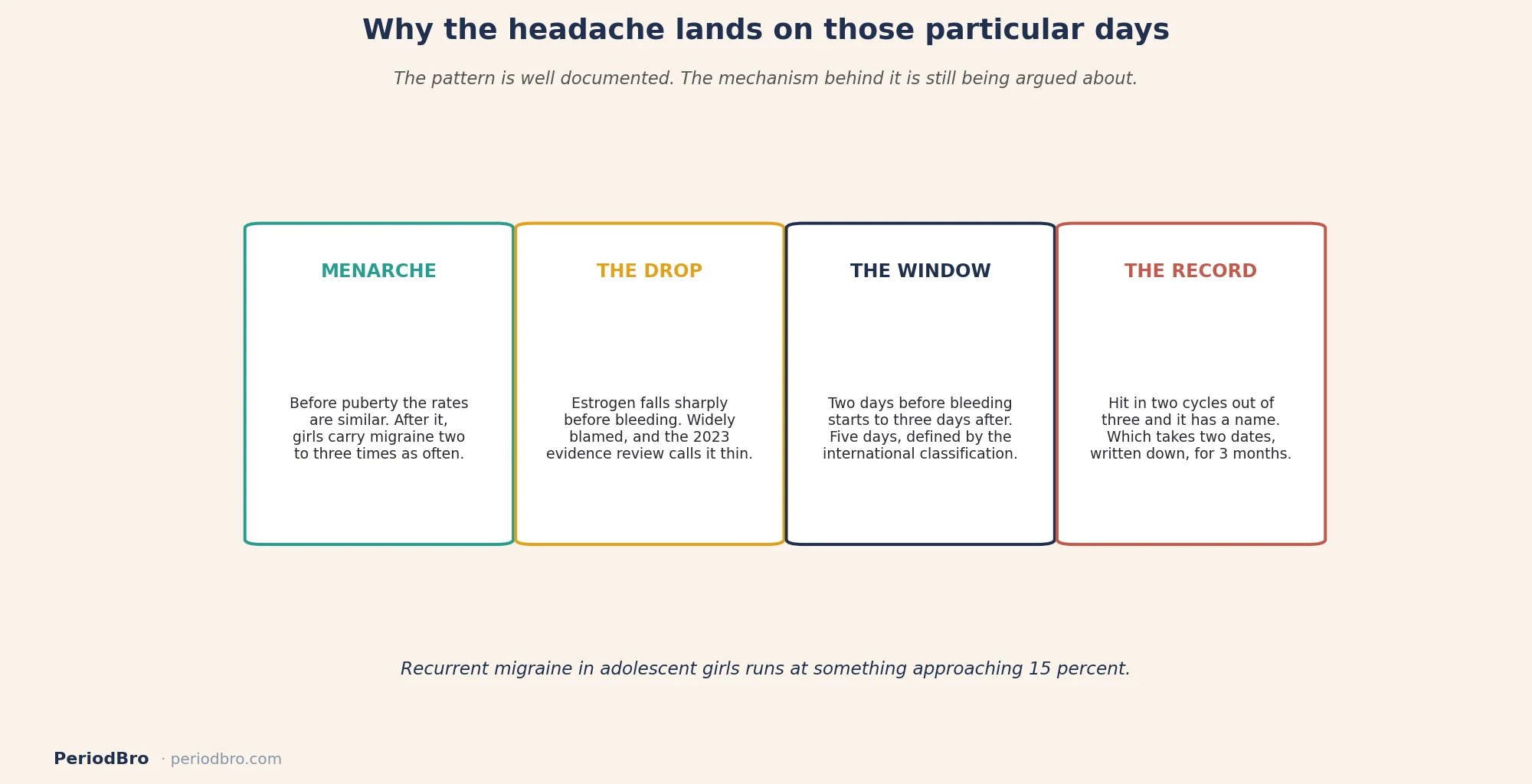
What it requires is two dates recorded across three months: when the headache hit, and when her period started. No scan, no blood test, no specialist.
The person who usually can’t produce that is a fifteen-year-old in a seven-minute appointment. Asked “how often do you get these and when,” she’ll say “quite a lot” and “I don’t know,” and that answer gets her sent home with advice about screen time. The same girl arriving with a phone note listing six dates gets a different conversation entirely. The format is irrelevant. Its existence is the whole point.
This is where you’re genuinely useful, and it’s also where it goes wrong. She keeps the record. You ask once whether she’s got it before the appointment. If you build it for her by asking every month whether her period has started, you’ve turned a medical tool into surveillance, which is covered properly in the guide to her irregular cycle.
Aura, and why the word matters more than it sounds
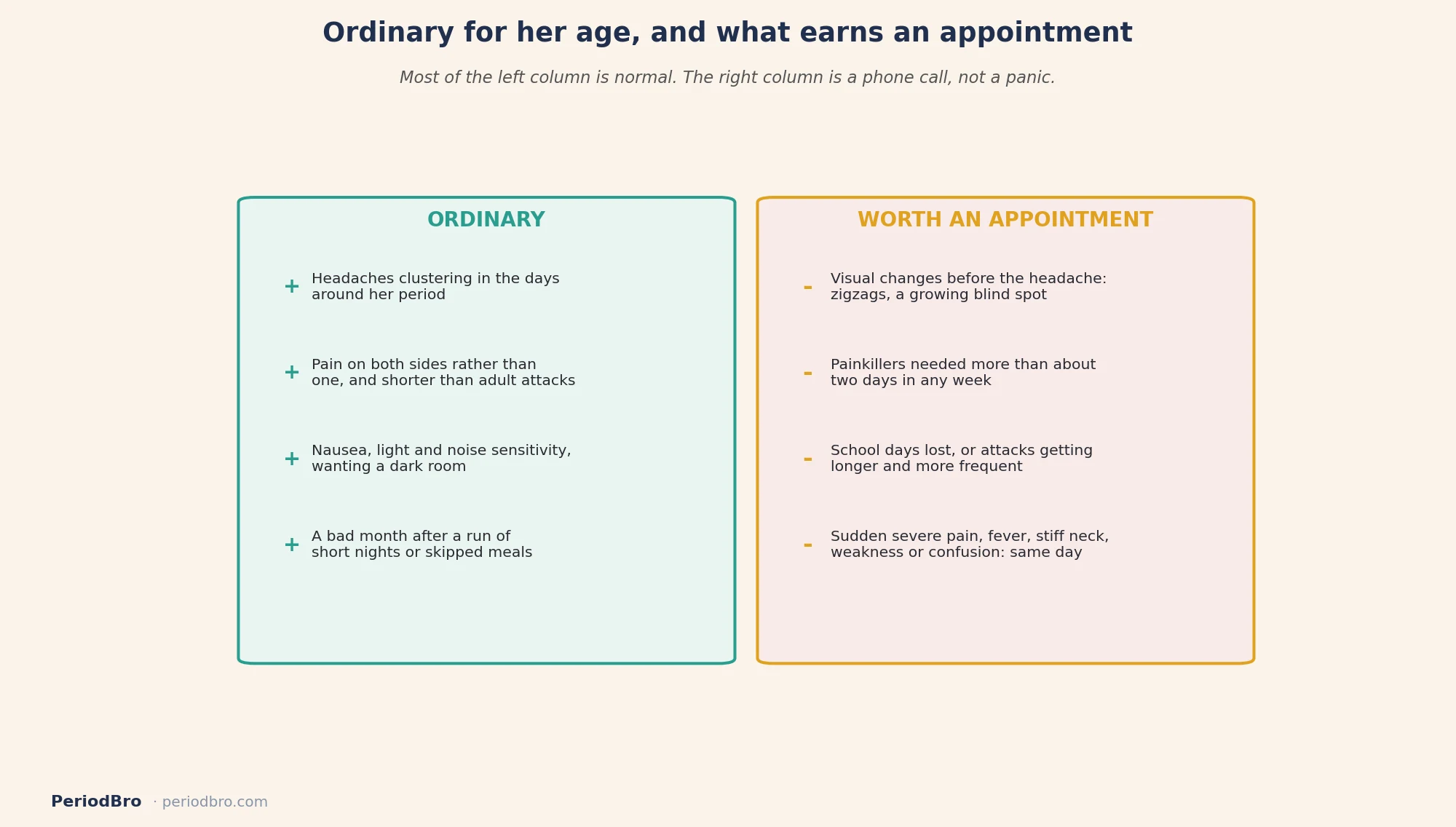
About a quarter to a third of people with migraine get aura, which is a set of neurological symptoms arriving before or with the headache. Typically visual: zigzag lines, a blind spot that grows, flickering shapes at the edge of vision. Sometimes tingling in one hand or the face, sometimes trouble finding words. It builds over five to twenty minutes and passes within an hour.
Teenagers usually don’t report this, because it doesn’t feel like a medical symptom. It feels like their eyes went funny. They mention the headache and leave out the twenty minutes beforehand.
The reason to care about that omission is a specific safety interaction. Migraine with aura is independently associated with a raised risk of ischemic stroke, and so are combined hormonal contraceptives. Put together, the European Headache Federation and the European Society of Contraception’s joint statement reports an odds ratio of 6.1 for ischemic stroke in women with migraine with aura using combined hormonal contraception, with a confidence interval from 3.1 to 12.1. Guidance from CDC and from headache societies is consistent: women with migraine with aura should avoid combined hormonal contraceptives. Progestin-only methods aren’t implicated in the same way.
Now connect the dots to a normal teenage timeline. The combined pill is a common and reasonable answer to severe period pain, and it comes up constantly at this age, which is why the pill for teenage period pain exists as a topic at all. If she has aura and nobody has said so out loud, the safety question doesn’t get asked.
So the one question worth carrying into any appointment where contraception might come up: has anyone asked her whether she gets visual changes before the headache. Not a question for you to interrogate her about. A question to make sure a doctor asks.
What treatment actually looks like at her age
Lower drama than expected, and the evidence base is genuinely mixed, which is worth knowing before anyone gets sold a miracle.
For attacks, the American Academy of Neurology’s 2019 guideline supports ibuprofen and acetaminophen in children and adolescents, and triptans mainly in adolescents. It reports high confidence that oral sumatriptan with naproxen, and zolmitriptan nasal spray, get adolescents headache-free at two hours more often than placebo. The guideline’s headline recommendation is about timing rather than drug choice: treat early. A migraine caught in the first half hour responds far better than one treated three hours in, which is a scheduling problem more than a pharmacological one, and it means she needs access to the medication at school rather than in the kitchen cupboard at home.

For prevention, the same group’s companion guideline is more sobering. Most randomised trials of preventive drugs in children fail to beat placebo. The one combination that stood out was amitriptyline plus cognitive behavioural therapy, which outperformed amitriptyline plus headache education. The behavioural half carried a measurable share of the effect.
Which lines up with the unglamorous stuff. Sleep, food, hydration, and not skipping meals on a school day are the levers with the most consistent support in this age group. Sleep in particular shifts across the month anyway, covered in how sleep changes through the cycle, and a teenager going into her premenstrual week on five hours is stacking two triggers.
School, and the loop that makes it worse
Migraine at this age costs school days, and the way schools handle it often makes the next attack more likely rather than less.
The common pattern: she gets an attack, waits it out in a lit classroom because asking to leave feels dramatic, treats it four hours late when she gets home, sleeps badly, and comes in wrecked the next day. Nothing about that sequence is her fault and all of it is fixable with a piece of paper. A note from her doctor that lets her take medication at school and go somewhere dark for twenty minutes turns a lost day into a lost lesson.
The other loop worth naming is medication overuse. Painkillers taken too many days a month can start generating headaches by themselves, and it creeps up quietly. If she’s reaching for something more than about two days a week, that’s a fact for a doctor, not a reason to start rationing her tablets on your own authority.
The rest of the practical school layer, the kit and the permission to leave a room, sits in handling her period at school.
What not to say
Not “it’s just hormones.” It’s accurate in the loosest sense and it lands as a dismissal, and she’ll hear enough of that version from other people.
Not “you’re on your phone too much.” Screens are a modest trigger for some people and a favourite explanation for adults who want a simple lever. Leading with it tells her you’ve decided this is a behaviour problem.
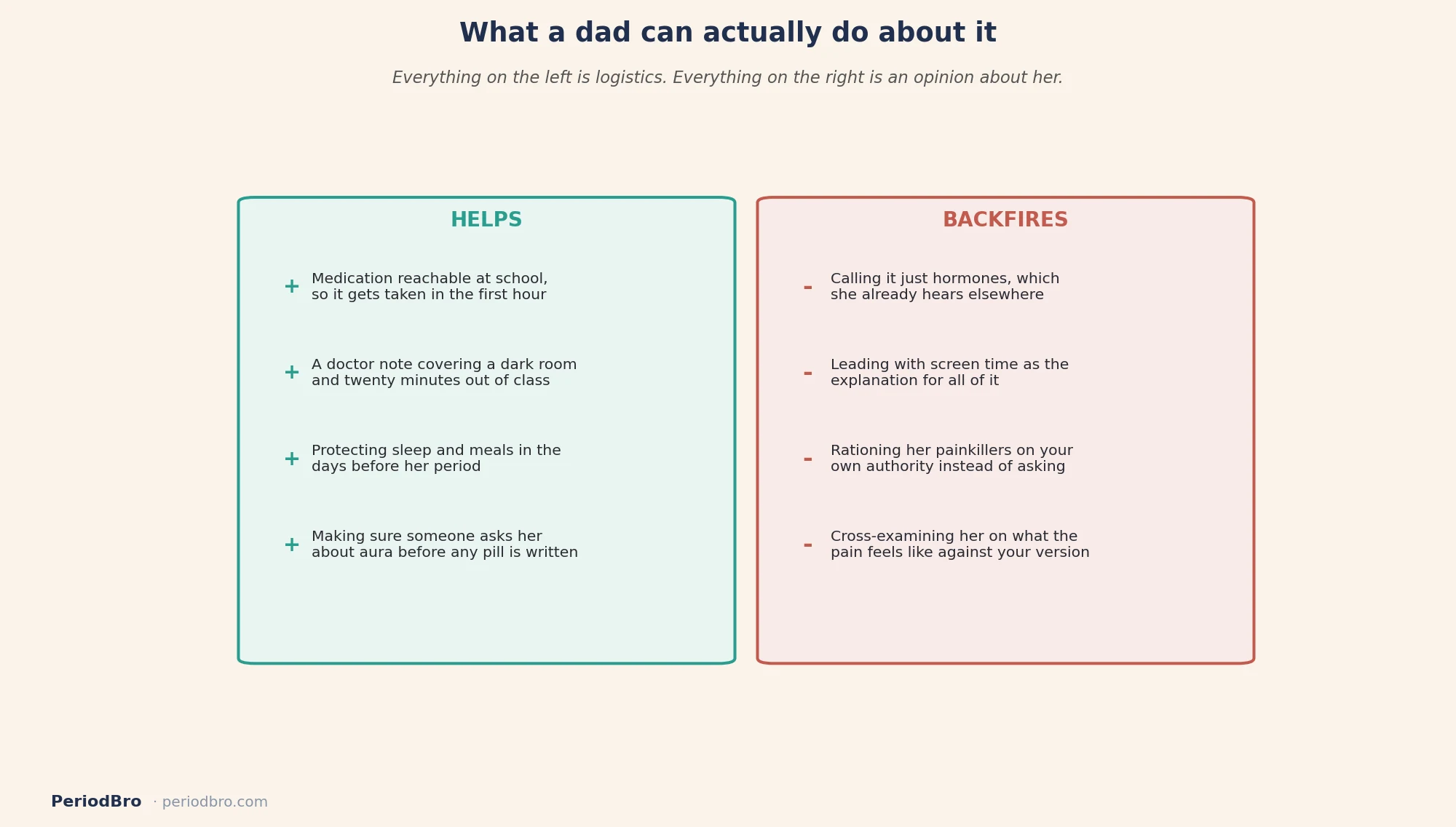
And skip the interrogation about what the pain is like. Migraine at her age is often bilateral rather than one-sided and shorter than the adult textbook version, so an interrogation that starts from what you remember about adult migraine mostly teaches her that she’s describing it wrong. The adult version of menstrual migraine is a useful background read for you, not a script for her.
What does work is short and boring. Dark room, no negotiation about whether it’s bad enough. Medication early rather than as a last resort. The dates written down somewhere. A lift to the appointment, and staying in the waiting room if that’s what she wants. If the appointment goes badly and she gets waved off, when a teenage girl should see a gynecologist and what to do when a doctor dismisses period pain both cover the next step.
The short version
Teenage migraines and periods showing up together, starting in the year or two after menarche, are a recognised pattern with a definition attached: attacks in the window from two days before bleeding to three days after, in two cycles out of three. Getting that written down is what converts it into something a doctor can treat.
Treat early rather than heroically late. Protect sleep and meals in the premenstrual week. And make sure the word aura gets said out loud before anyone writes a prescription for the combined pill, because that’s the one place where a missed detail carries real risk. The wider map of your role in all of this is in a father’s role in her menstrual education.

PeriodBro keeps dates and symptoms in one private log, which is exactly the three-cycle record a doctor asks for and nobody can reconstruct from memory. Try it free.
This article is general information, not medical advice. A headache that is sudden and severe, comes with fever or a stiff neck, follows a head injury, wakes her from sleep, or arrives with weakness or confusion needs urgent medical assessment rather than a scheduled appointment.