How to Talk to Your Son About Periods
Nobody ever sat me down and explained any of this. Not my father, not a teacher, nobody. I was a grown man with a marriage behind me before I could have told you what the luteal phase was, and I don’t think that was unusual. It was just how it worked for boys of my generation. You learned about periods the way you learned about tax: badly, late, and from people who also didn’t know.
So when I think about my daughter’s classmates, the boys sitting next to her, I’m not angry at them. Nobody told them either. Somebody’s father decided it wasn’t his conversation.
Here’s the thing most fathers get wrong before they start: you imagine you’ll talk to your son about periods once, in a formal, sweaty, sit-down way. You won’t. You’ll do it in about forty ten-second bursts, starting earlier than you expect. The only real question is whether you’re the father who answers, or the father who defers.
Why this is a father’s job specifically
If his mother handles it, he learns that periods are a women’s topic that men politely stand outside of. That lesson lands harder than any of the facts. He’ll carry it into his twenties, into a shared bathroom with a girlfriend, into whatever awkwardness follows.
When you handle it, he learns something else: this is ordinary, and men are allowed to know about it. That’s the entire curriculum. The biology takes ten minutes. Giving him permission to know it is the part only you can do.
The numbers on what happens when nobody does this are not subtle. Plan International surveyed over 4,000 boys and young men aged 16 to 25 across Brazil, Indonesia, the Netherlands and Uganda. More than one in three thought periods should be kept secret. They associated menstruation with words like “dirty” (55%), “disgusting” (38%) and “embarrassing” (31%) (Plan International, 2022). Separate Australian research found nearly half of boys said their school education on periods was poor or non-existent (Plan International Australia).
Nobody teaches boys to think periods are disgusting. They arrive at it because of the silence, and the silence is usually ours.

When to start
Earlier than feels natural, and then continuously. ACOG’s guidance to clinicians is that conversations about menstruation should begin at the seven or eight year visit, before menarche, which typically arrives between ages 12 and 13 (ACOG Committee Opinion 651). That’s the timeline for girls. For boys there’s no reason to run a different clock, and one good reason not to: if his sister learns at 8 and he learns at 14, he’s spent six years being told, by omission, that it’s none of his business.
Rough ladder:
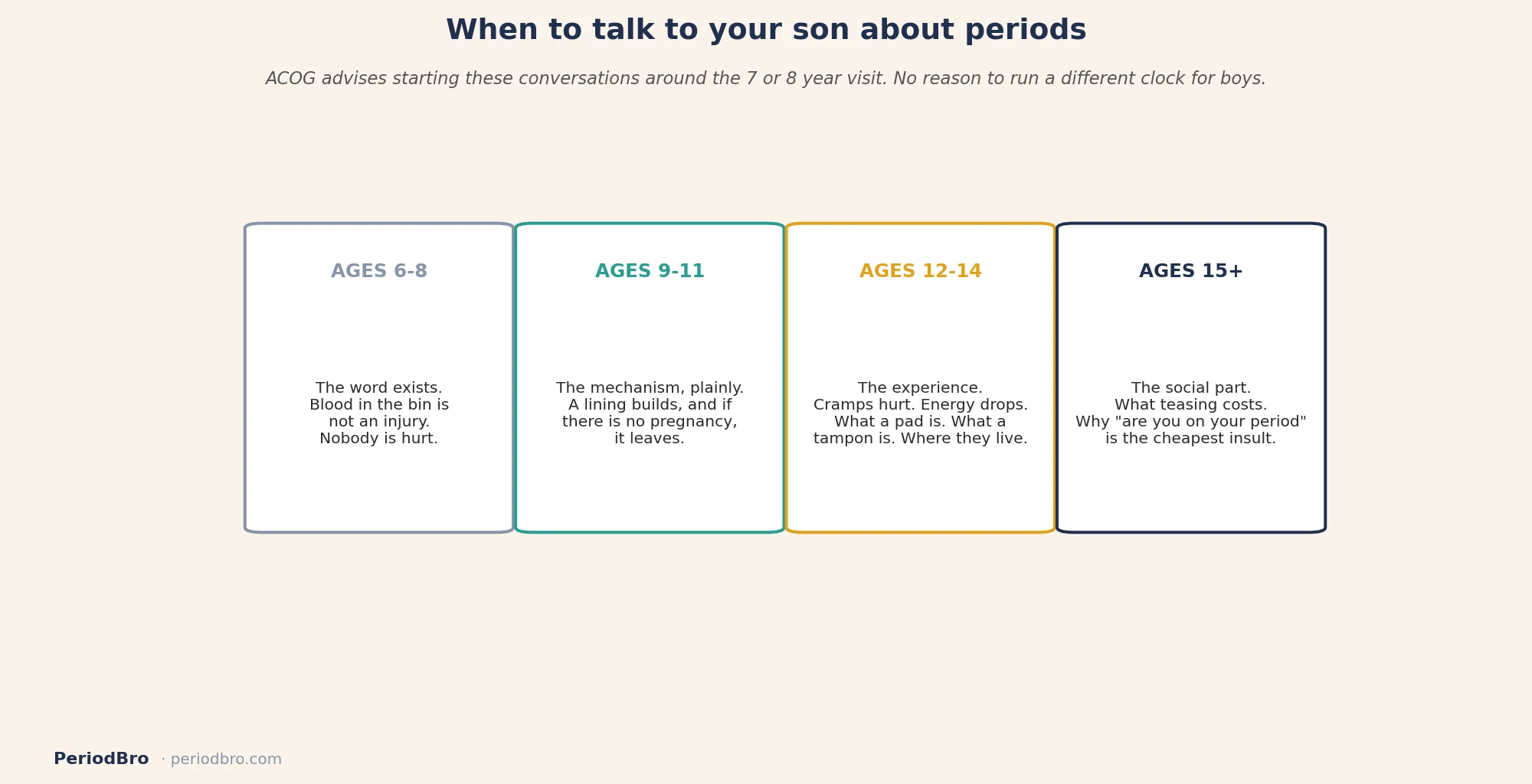
- Ages 6 to 8. The word exists. Blood in the bathroom bin isn’t an injury. Nobody is hurt. One sentence, no anatomy.
- Ages 9 to 11. The mechanism, plainly. A uterus builds a lining every month, and if there’s no pregnancy, it leaves. That’s the period. It lasts a few days and happens roughly monthly.
- Ages 12 to 14. The experience. Cramps hurt. Energy drops. Moods shift, and that’s hormones doing hormone things, not a character flaw. Also: what a pad is, what a tampon is, where they live in your house.
- Ages 15 and up. The social part. What teasing costs. What to do if a classmate bleeds through. Why “are you on your period” is the cheapest insult in the language and what it says about the guy who reaches for it.
The five things he actually needs to know
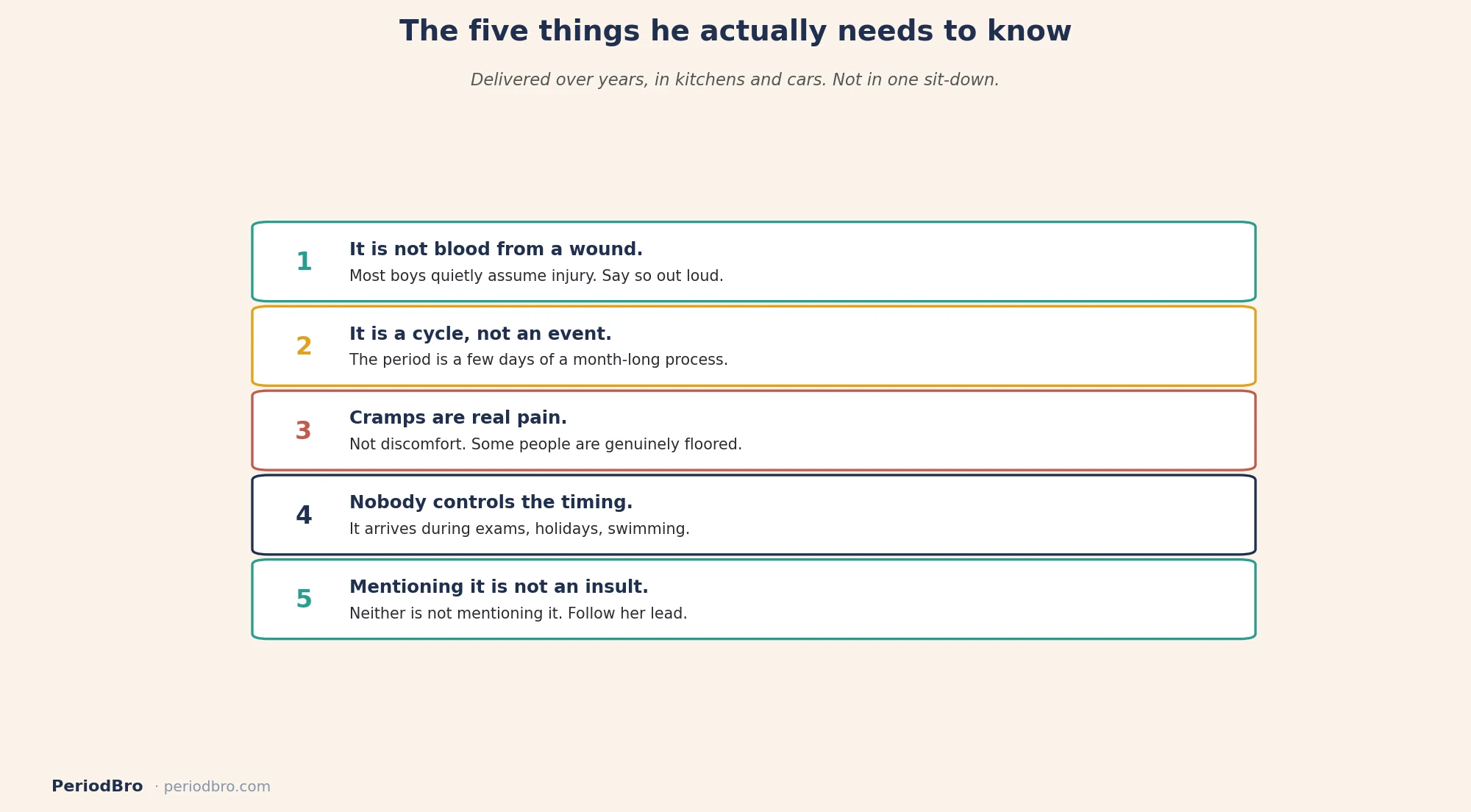
- It isn’t blood from a wound. Most boys quietly assume injury. Say the words “it doesn’t mean she’s hurt” out loud.
- It’s a cycle, not an event. The period is a few days of a month-long process. Energy and mood move across the whole thing.
- Cramps are real pain. Not “discomfort.” Some people are genuinely floored by it.
- It isn’t optional or controllable. Nobody chooses the timing. It arrives during exams, holidays, swimming lessons.
- Mentioning it is not an insult. Neither is not mentioning it. Follow her lead.
That’s it. Five things, delivered over years, in kitchens and cars. If you want the vocabulary side of it laid out, I put together a plain-English glossary of period terms for dads that you can read once and stop feeling underqualified.

How to talk to your son about periods, out loud
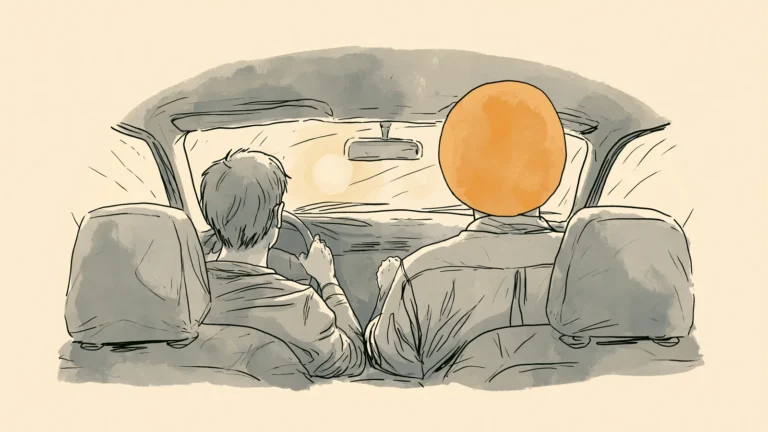
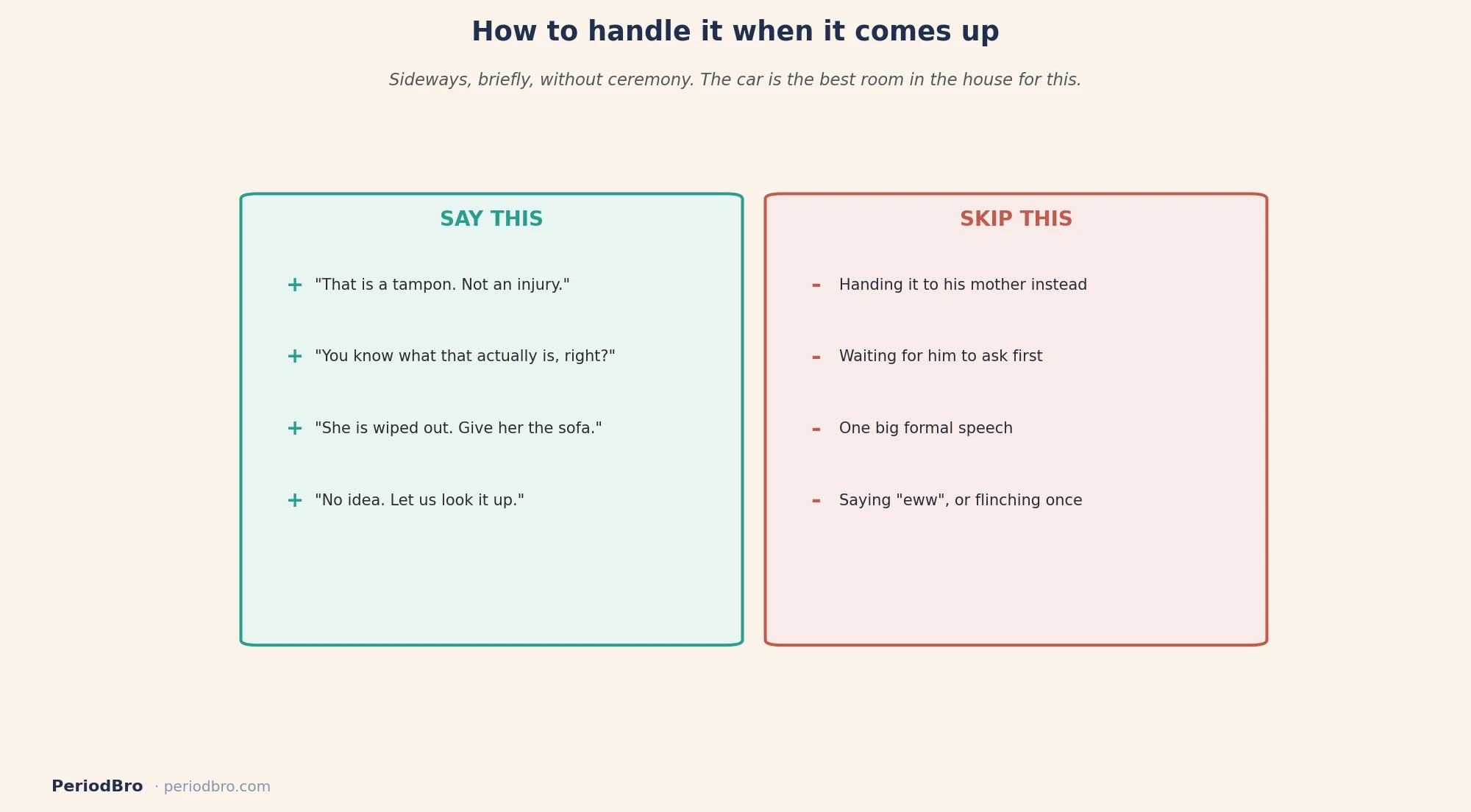
Sideways, briefly, and without ceremony. The car is the best room in the house for this. No eye contact, a clear exit, and a natural end when you arrive.
He finds a tampon. “That’s a tampon. Women bleed a bit for a few days each month, it’s normal, that soaks it up. Not an injury.” Then stop. Let him ask the next question or not.
He repeats a joke he heard at school. Don’t do outrage. “You know what that actually is, right?” Explain it in thirty seconds. The joke stops being funny the moment it’s understood, which is more effective than a lecture on respect.
His sister is having a rough day. “She’s got her period, she’s wiped out, give her the good spot on the sofa.” Model the behaviour and narrate it once. He’ll copy the behaviour long before he understands the reason.
He asks something you can’t answer. “No idea. Let’s look it up.” This is the single most valuable move available to you, and it costs nothing but the admission.
The four ways fathers get this wrong
Deferring to her mother. Understandable, and it teaches exactly the wrong lesson. Do it alongside her, not instead.
Waiting for him to ask. He has already worked out that this is a topic adults get strange about. He won’t ask. You open it.
Making it a one-time speech. One big talk is memorable for the wrong reasons. Forty small ones make it boring, and boring is the goal.
Being squeamish on camera. If you say “eww” once, or hand him the box like it’s radioactive, he’ll believe the flinch over anything you said afterwards.
If he’s already fifteen and you never started
Start anyway, and don’t apologise your way in. A retrospective apology makes it a bigger deal than it is and puts him in the position of reassuring you.
Just answer the next thing that comes up like it was always allowed. If nothing comes up, make something come up: hand him the shopping list with pads on it and let it be unremarkable. Fifteen-year-olds are ruthless detectors of performance and quite forgiving of ordinariness.
Common questions
Isn’t this his mother’s territory?
She has the lived experience, which matters. You have something she can’t provide: proof that a man can discuss this without flinching. He needs both.
Won’t it embarrass him?
Briefly, at some ages. Embarrassment passes. The alternative is a twenty-five-year-old who can’t buy tampons for his partner without narrating it as heroism.
What if I don’t know enough myself?
Then learn the basics first. Most of us weren’t taught either, and there’s no shame in reading up before you talk. Start with the cycle explained from scratch.
Should I talk to my son and my daughter together?
Sometimes, and it works well when it’s incidental rather than staged. A joint sit-down usually humiliates the daughter. Answering his question in front of her, normally, does the job.
What if he laughs?
Let him, then carry on in the same tone. Laughing is how eleven-year-olds handle being slightly uncomfortable, and it passes on its own if you don’t make it a thing.
What you’re really teaching
None of this is about menstruation. You’re teaching him that half of human bodies do a thing his doesn’t, that this is not gross, and that a man who understands it is more useful than a man who doesn’t.
He will be a partner one day, or a father to a daughter, or both. What he learns from you at nine is what he brings to that. I’ve written about why fathers are the missing link in menstrual education, and about the parallel job of talking to a daughter and what to stock before she needs it. The son version is easier. It’s also the one almost nobody does.
Answer the question when it comes. Don’t flinch. That’s the job.
This article is general information for parents, not medical advice. Questions about your child’s development belong with your pediatrician.