Heavy Periods in Teens: When a Dad Should Push for Answers
The tell in our house was the laundry. Two months in a row, sheets in the machine at six in the morning, and my daughter saying it was fine before I had asked anything. She was thirteen, she had had maybe five periods in her life, and she had already decided that whatever was happening to her was what happened to everybody.
That is the whole problem with heavy periods in teens. She has no baseline. Nobody hands a fourteen year old a chart of what normal blood loss looks like, so she measures her month against a sample size of one and concludes she is just dramatic. And the adult most likely to spot the pattern is often the one who feels least entitled to ask.
What the usual range actually is
You cannot judge heavy without knowing ordinary, so here is ordinary.
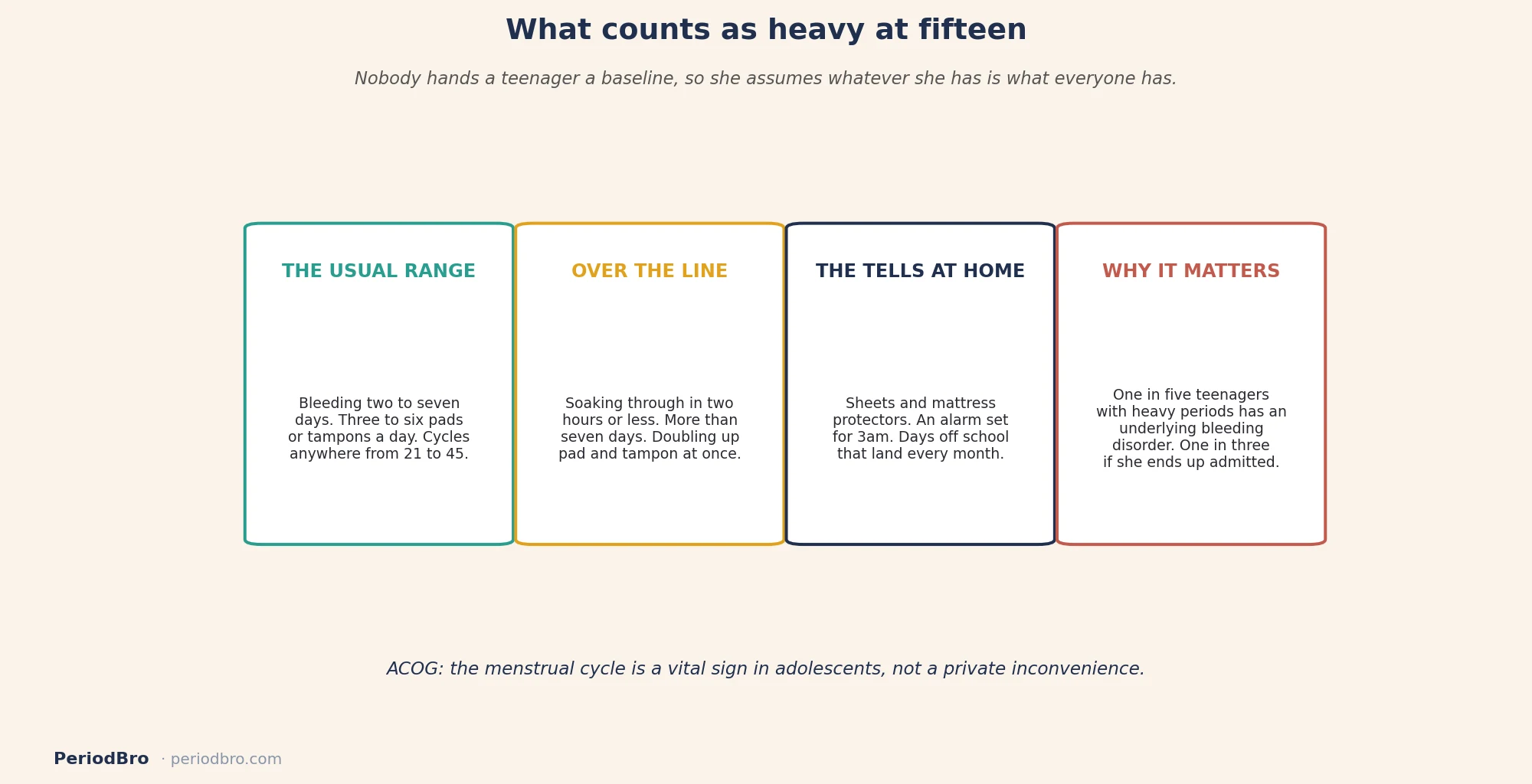
ACOG treats the menstrual cycle in adolescents as a vital sign, on the same footing as blood pressure, and sets out the numbers plainly. Around 90% of cycles fall between 21 and 45 days in the years right after her first period, which is a much wider spread than the adult 28 day story. Bleeding usually lasts two to seven days. And a normal flow is one that needs a pad or tampon changed three to six times a day.
That last number is the one worth carrying around, because it is countable. Everything else in this subject is vague and this one is not.

What counts as heavy periods in teens
Heavy menstrual bleeding has a clinical definition that is deliberately about life rather than millilitres: blood loss that interferes with physical, social, emotional or material quality of life. Underneath that, the markers ACOG uses are concrete.
Soaking through a pad or tampon in two hours or less. Bleeding longer than seven days. Needing more than six products a day. Doubling up, a tampon and a pad at the same time, because one alone does not hold. Flooding or gushing. Bleeding through onto clothes or through the sheets at night.
At home, the version you actually see looks different. Sheets in the wash. A new mattress protector. An alarm set for three in the morning so she can change before it fails. A carrier bag of spare clothes in her school bag. Days off school that land in the same week every month, which is easy to read as avoidance if you do not know what week it is. She will not present any of this as a problem. She will present it as her being organised.
Why this is not just a comfort issue
About one in five adolescents with heavy menstrual bleeding turns out to have an underlying bleeding disorder, and among those who end up admitted to hospital for it, closer to one in three, per the ACOG guidance summarised for family physicians. That number is why I stopped filing this under comfort.
The usual culprit is von Willebrand disease, along with platelet function disorders, low platelet counts and clotting factor deficiencies. These are not exotic. Von Willebrand disease is the most common inherited bleeding disorder there is, and of the people who have one, 75 to 80% name heavy periods as the main way it shows up in their life. Heavy bleeding that starts right at her very first period is the pattern most associated with one.
None of which means your daughter has a bleeding disorder. Four out of five do not. It means that “she just has heavy ones” is a conclusion, not a starting position, and that somebody should rule the other thing out rather than assume it away.
The second issue is iron. Heavy monthly loss drains it, and iron runs out before the blood count drops, so a normal full blood count can sit there looking reassuring while she is exhausted, foggy and cold all the time. ACOG specifically wants ferritin checked, not just haemoglobin. If she has been flat for a year and everyone has settled on teenagers being tired, that is worth a second look, and iron deficiency from heavy periods covers what the pattern looks like.

What it costs her that nobody adds up
The clinical case is one thing. The reason to move on it sooner is the part that never gets written into a chart.
A heavy period at fifteen eats the month in pieces. It is the swimming she stops signing up for, and the trip she talks herself out of, and the seat she picks at the back of the class so she can leave without anyone watching. It is the three in the morning alarm, which means the sleep is going too, on top of the iron. It is a PE kit that stays in the bag with a reason invented on the spot. Sport is usually the first thing to go and the hardest to get back, which is why it is worth naming early rather than after she has quietly quit, and daughter period and sports goes through how that unravels.
Every one of those decisions looks, from the outside, like a personality change. Less keen than she used to be. Withdrawn. Dropping things. At an age where adults are primed to read exactly that into a teenager, a physical problem gets filed as a phase, and she has no vocabulary to argue with the diagnosis.
What to bring to the appointment
Doctors get about eleven minutes and a teenager who says everything is fine. What you bring changes the visit.
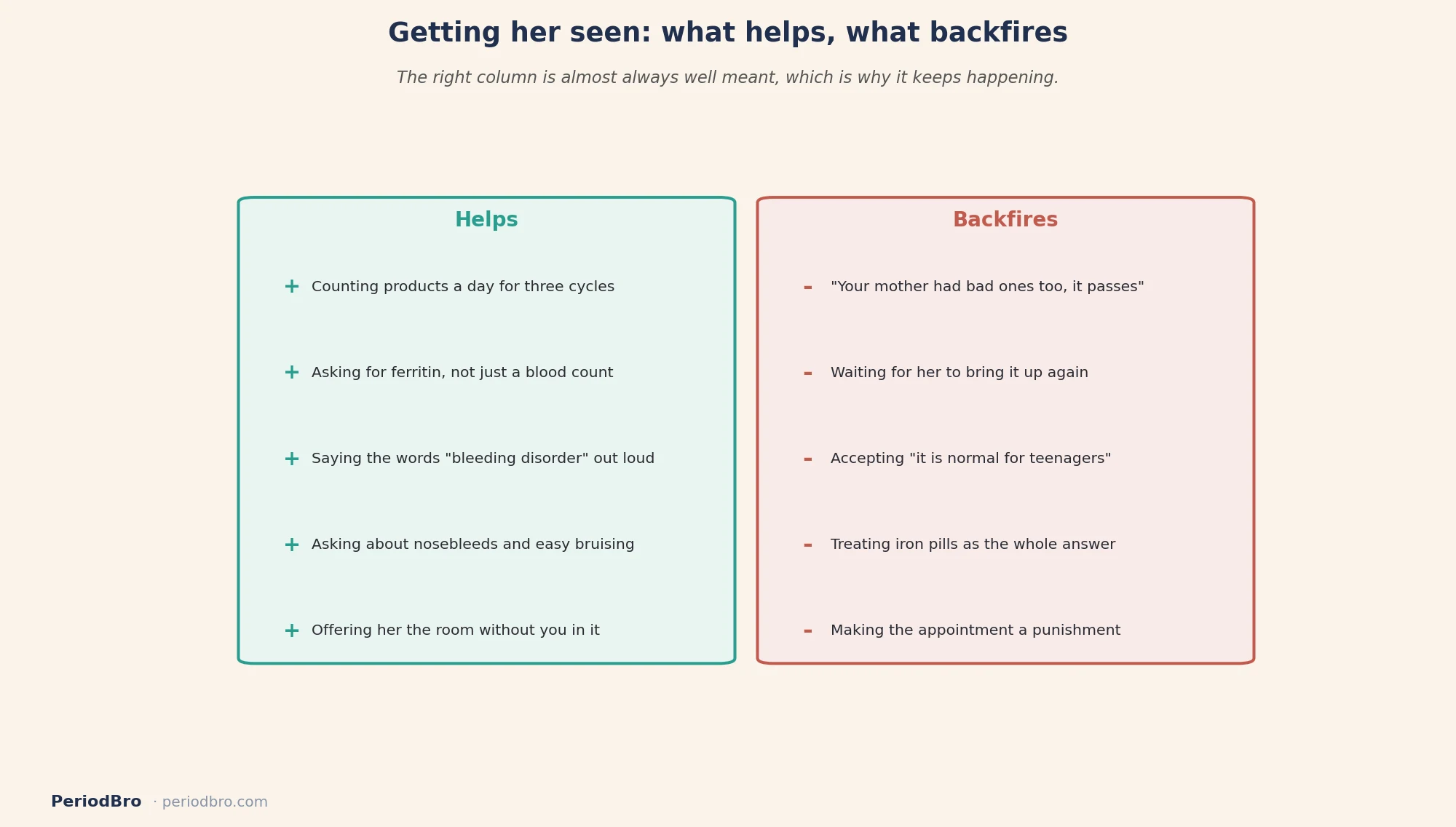
Count for three cycles before you go. Products used per day, days of bleeding, any night changes, any days missed. Written down. A number beats an adjective every single time, and it also means she does not have to describe it out loud in front of you.
Ask about the rest of the family bleeding history. Nosebleeds that take ages to stop, bruising easily, heavy bleeding after dental work or surgery, anyone who needed a transfusion after childbirth. Bleeding disorders are inherited and the family often has a trail of small clues nobody connected.
Ask for ferritin by name. Not just a full blood count. If it comes back low, that is treatable and it explains a lot.
Say the words. “Has a bleeding disorder been ruled out?” is a fair question and it is not rude. Screening for von Willebrand disease in adolescents with heavy periods is recommended and still under done in practice.
Give her the room. Offer to step out for part of the appointment. She may say things to a doctor alone that she would not say with you sitting there, especially about pain, school and how she is actually coping. It is not a rejection of you. Getting the timing of that first appointment right is its own subject, and when a girl should see a gynecologist covers it.
What gets offered, and what it is for
If a bleeding disorder is ruled out and this is just heavy, treatment usually starts with reducing the bleeding rather than investigating further.
The options are hormonal, usually the combined pill, or an antifibrinolytic like tranexamic acid taken only on the bleeding days, or a hormonal coil for the longer term. The pill will probably come up first, and if the word lands badly in your house, it is worth knowing it is being offered to thin the lining and cut the volume, not as a comment on her social life. That conversation has its own traps and I wrote them out in birth control for teen period pain.
Iron replacement usually runs alongside, and it is not optional if ferritin is low. Iron pills alone, though, treat the consequence and leave the cause running, which is the most common way this stalls for another two years.
The bit that is actually on you
Notice out loud, once, without a diagnosis attached. “I’ve seen the sheets a couple of times. Is it always like that, or was that a bad month?” leaves her somewhere to go. “That’s not normal, we’re going to the doctor” gets you a closed door and a girl who does the laundry more quietly.
Do not accept the first shrug. From her or from a clinician. “It’s normal for teenagers” is true often enough to be dangerous, and it is the sentence that keeps bleeding disorders undiagnosed into adulthood.
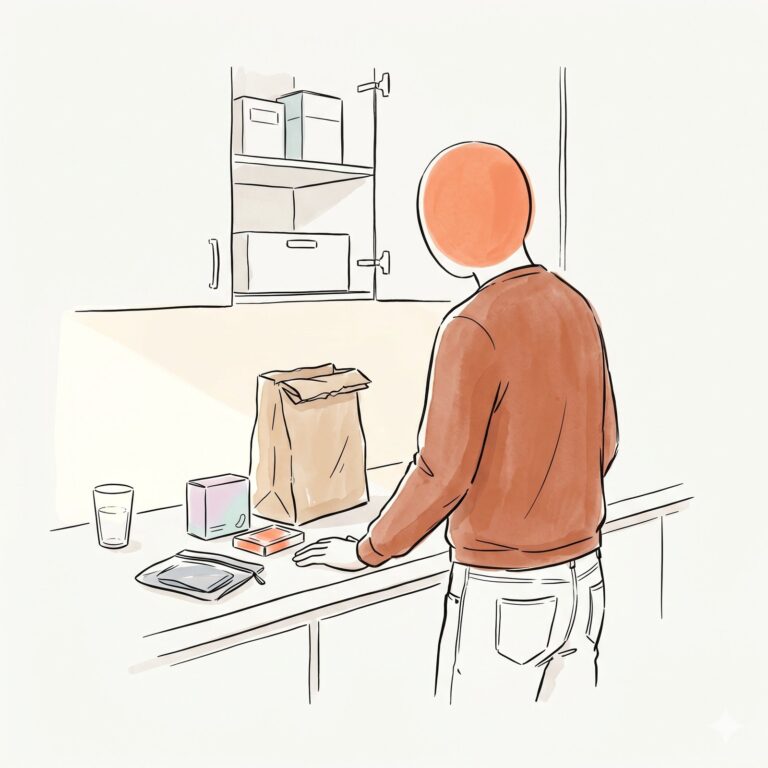
Handle the supply chain without commentary. Overnight products, spare underwear in the bag, a second mattress protector, and never a word about cost or laundry. The practical side of the school day is covered in daughter period at school.
Keep asking after the appointment. The single most common failure is not the visit going badly. It is the visit happening, a plan being made, and nobody checking three months later whether the plan worked.
My daughter’s turned out to be nothing more sinister than genuinely heavy periods and a ferritin level in the basement. Two months of iron and a treatment plan and she got a chunk of her energy back that we had all quietly written off as being fifteen. The part I still think about is that she would not have said a word for another two years if the washing machine had not given her away.
If you want the wider frame on your job in all this, a father’s role in menstrual education is the place to start. I built PeriodBro so a dad has the pattern in front of him before the laundry is the only evidence.

This is general information, not medical advice. Heavy bleeding in a teenager deserves an actual clinician, and anything involving dizziness, breathlessness or bleeding that will not stop is urgent rather than a topic for a search engine.