Daughter Period and Sports: How to Keep Her in the Game
She had swum four times a week since she was seven. Then there were two Tuesdays she didn’t feel like it, then a month where the bag stayed by the door, and by the spring she had a story about how she had gone off swimming anyway. I took the story at face value, because it was a reasonable story and because the alternative meant asking a question I did not want to ask.
The month it started was the month her periods started. I worked that out roughly a year too late, from a calendar, sitting in a car park. Daughter period and sports turns out to be one of the better measured problems in teenage sport, and almost none of that research reaches the dads doing the driving to practice.
Daughter period and sports: the drop-off has a size
The drop-off is not a feeling, it is measured. Women in Sport surveyed 4,000 teenagers in 2022 for a report called Reframing Sport for Teenage Girls (summary here). Among girls who had thought of themselves as sporty at primary school, 43% disengaged from sport afterwards. For boys of the same age it was 24%.
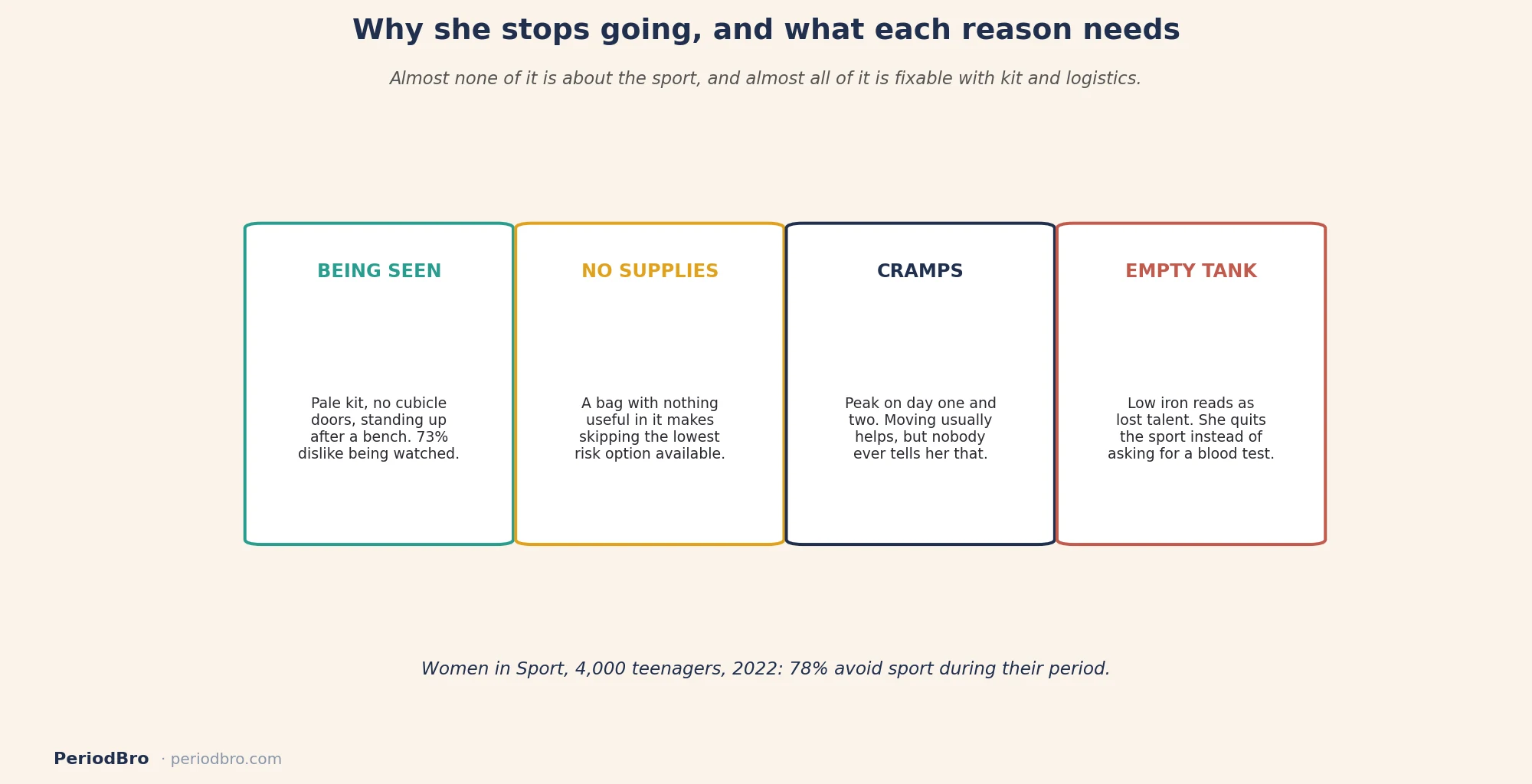
The number underneath that one does most of the explaining: 78% of teenage girls say they avoid sport when they have their period.
Two more from the same work. 68% named fear of being judged as a barrier, and 73% said they disliked being watched while taking part. Then the finding that should stop anyone from calling this a loss of interest: 59% of the girls who had dropped out still said they liked competitive sport. The appetite survived. The conditions did not.
What she is actually calculating
When a fourteen year old skips practice, the internal maths is rarely about the sport. It is about exposure, and it is very specific.
Pale kit. A white PE skirt, or leggings that show everything, or the school’s swim requirement. Standing up after sitting on a bench for twenty minutes. A changing room with no doors on the cubicles. A bin in the wrong place or no bin at all. A teacher who asks in front of everyone why she is sitting out, so that opting out costs more socially than turning up in pain. Whether she can get to a bathroom between the warm-up and the game, and whether anyone will notice her going.
Add cramps that peak on day one and two, plus a bag with nothing useful in it, and skipping becomes the lowest-risk option on the board. She is picking the choice with the fewest ways to go badly wrong in public, which is what most of us would have done at fourteen.
Most of what a dad can fix sits in that list, and very little of it requires a conversation about feelings. There is more on the school-day version of this in what to do when her period starts at school, and on the supplies side in what to stock before her first period.

Exercise on her period is not just allowed, it helps
This is worth knowing accurately, because it is the one piece of the puzzle where the evidence points clearly in one direction and most households assume the opposite.
A Cochrane review of exercise for period pain, summarised for clinicians in American Family Physician, pooled 12 trials with 854 participants. Exercise produced a clinically meaningful drop in menstrual pain intensity, on the order of a 25mm reduction on a 100mm pain scale. The programmes ran 8 to 12 weeks and included both the gentle end, yoga and stretching and core work, and the hard end, aerobic training and Zumba.
That is a bigger effect than most people expect from something that is free. The catch worth being honest about is that it is a training effect, not a rescue remedy. It comes from exercising across the month, not from being told to run it off on day one. And the evidence was rated as limited quality, so treat it as a good reason to keep her in sport rather than a prescription.
The practical translation for a parent is short. Keeping her in the sport is itself part of the pain plan. Every term she stays in is a term the cramps have a better chance of being manageable, and a term she does not have to rebuild a habit from nothing.
Swimming, and the conversation you do not have to run
Swimming is where most of these decisions get made, because it is the one sport where a pad is genuinely not an option and the alternatives require a conversation that a lot of dads freeze on.
You do not have to be the one who runs it. What you can do is make sure the information and the options both exist in the house, so she is not deciding based on a rumour from the changing room. Period swimwear is now sold in ordinary shops and needs no explanation from anyone. Tampons and menstrual cups work in water. Pads do not, because they absorb pool water instead.
If tampons come up, the safety guidance is simple and worth having accurately. Cleveland Clinic advises changing a tampon every four to eight hours, never leaving one in beyond eight, and using the lowest absorbency that does the job. Toxic shock syndrome is rare, and the rules that keep it rare are those three.
The move that works better than any speech is stocking the options and saying nothing about which one she picks. Two or three types in the bathroom, period swimwear in the drawer, and one sentence: it is all there, take what you want, I will not ask. Period products explained for dads covers what is what if you have never had to buy any of it.

The thing that quietly ends girls’ seasons: iron
This is the piece that rarely gets connected, and it has more effect on whether she can compete than anything else on this page.
A 2025 study screened 394 girls at two high schools in southern Sweden, median age 16 (full text). 52.8% screened positive for heavy menstrual bleeding. 39.8% were iron deficient at the World Health Organization threshold of ferritin under 15, and at the under-30 threshold recommended for this age group, 73.6% were.
Now put that next to endurance sport. Iron carries oxygen. A teenage girl who is training hard, growing, bleeding heavily every month and eating like a teenager can arrive at a season where she is slower than last year and cannot work out why, and the conclusion she reaches on her own is that she has stopped being good at it. An empty tank looks exactly like a talent ceiling from the inside.
The same study found that girls who both bled heavily and restricted meat had 70.9% iron deficiency, against 45.1% of the omnivores who bled heavily. Given how common vegetarianism is at that age, that combination is worth knowing about in advance rather than in hindsight.
The ask at a GP appointment is one word: ferritin. A standard blood count can look normal while stores are near empty. If her performance has fallen off a cliff and she is tired in a way that sleep does not fix, that is the test to name. The adult version of the same mechanism is in iron deficiency from heavy periods, and the bleeding side of it in teenage daughter irregular periods.
What a dad can actually do
None of this requires a big talk. It requires supplies and logistics, which is the part dads are usually good at anyway.
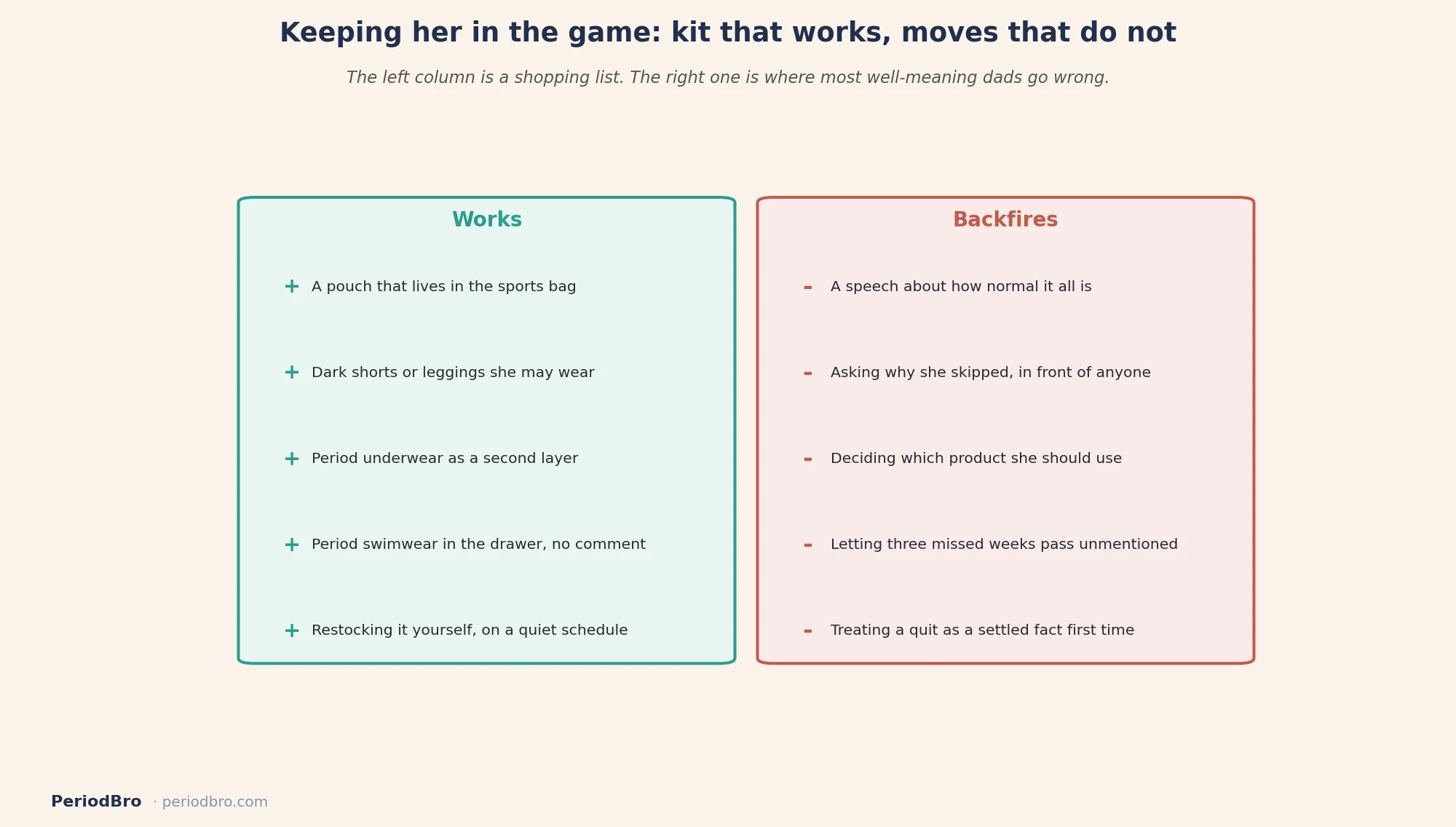
Build the sports bag. A zip pouch that lives in it permanently: two product types, spare underwear, a dark towel, painkillers if she is old enough for them, a snack. Restocked by you, quietly, on a schedule she never has to think about. The travel version of this is when her period starts away from home.
Fix the kit problem with money, not advice. Dark shorts or leggings she is allowed to wear, period underwear as a second layer under the kit, a spare set in the bag. Most of the fear is about a visible stain, and most of that is solvable with fabric.
Know the dates. Not to comment on them. So that you do not schedule the long drive or the tournament weekend blind, and so that when she says she is not going on Tuesday you already have the context and do not need to ask for it.
Take the excuse at face value, once. Push on it the second time. “You have skipped three weeks, is there something making it harder to go” is a different question from “why are you being like this”, and it gives her a door rather than a defence.
Say the boring true thing out loud. Periods are not a reason to stop playing, most athletes train through them, and moving usually helps the cramps rather than making them worse. There is a decent chance she has not heard that from anyone, and hearing it from you carries further than it should. If you have never had the first version of that conversation, how to talk to your daughter about periods is the place to start, and the timeline itself is in what age girls get their period.
I got about a year of this wrong by accepting a plausible story from a fourteen year old who did not want to have the conversation either. If you want the calendar half handled without turning it into a subject, that is what I ended up building PeriodBro for. Knowing it is day one, and having already put a dark towel in the bag on Sunday, does more than any speech.
She might still quit swimming. Plenty of kids do, for ordinary reasons. Just make sure that when she does, it is because she went off swimming, not because nobody put a pouch in her bag.

Medical disclaimer: general information, not medical advice. Periods that soak through a pad or tampon every hour, last longer than seven days, or come with pain that stops her going to school are worth a doctor’s appointment. So is exhaustion that does not lift, and so is a period that has not arrived by 15.