When Your Daughter Gets Her Period at School: A Dad’s Playbook
Here is the moment a lot of dads quietly dread: your phone buzzes in the middle of a workday, it is your daughter, her voice is tight, and she is dealing with her first period, or a leak, in a bathroom stall at school with no one from home in reach. A daughter period at school feels like an emergency the first time it happens, but it is really just a logistics problem, and logistics problems have answers you can put in place well before the call ever comes.
None of this needs to be complicated. Get her equipped and get a plan agreed in advance, and most of the panic never shows up, because she has what she needs and knows what to do, so she mostly handles it herself. Your job is to make sure she is never caught empty-handed and never feels alone with it. Everything below is how you do that.
Get this in place before you think you need it
The single biggest mistake is waiting until it is relevant. First periods land earlier than most dads expect and across a wide window. Cleveland Clinic puts the average in the US at around 12 to 12 and a half, but says a period can arrive as early as 9 or as late as 15, usually about two to two and a half years after her breasts start to develop. So the honest planning rule is simple: if she has started developing, the kit and the plan should already exist.
The conversation should start even earlier than the prep. The American College of Obstetricians and Gynecologists recommends that discussions of periods begin around the 7 or 8 year well-child visit, years before anyone expects a first period, so that when it shows up it is a known thing rather than a shock. If you have not had that talk yet, our guide on how to talk to your daughter about periods is the place to start, and the signs her period is about to start will tell you roughly how close you are.

The go-bag she keeps at school
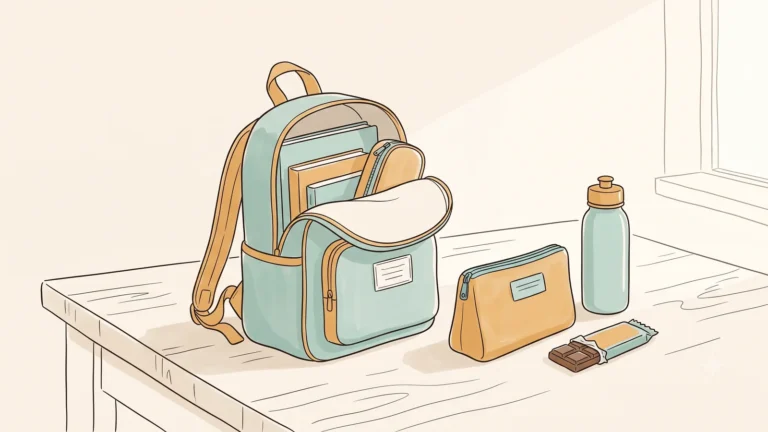
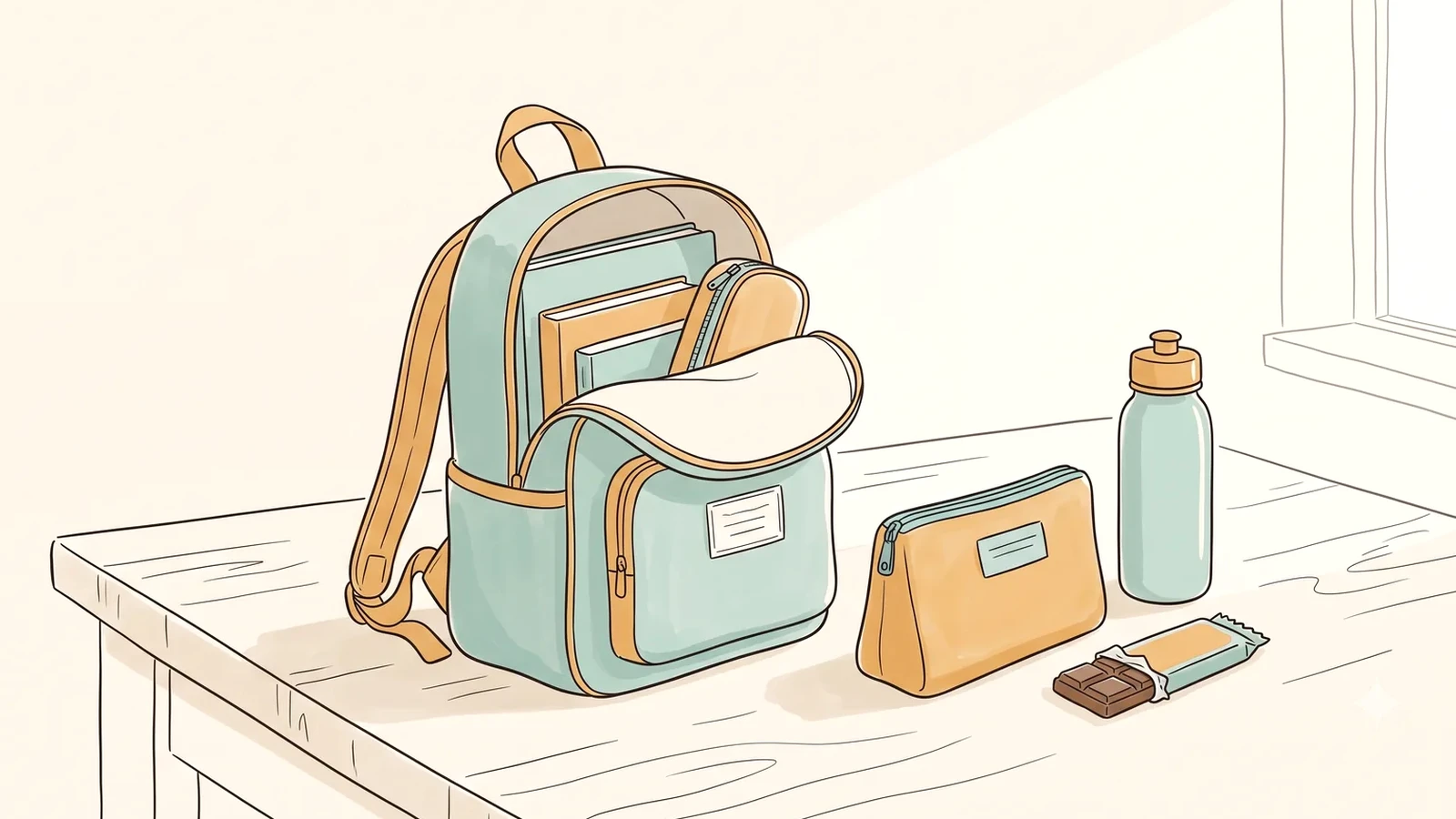
The kit is the thing that turns a bad moment into a two-minute fix. Pack it once, zip it shut, and it lives in her school bag or her locker so it is there whether or not today is the day. Keep it small and boring so it is easy to carry and nothing about it announces itself.
Put in a few pads or liners, one clean spare pair of underwear, a small pack of wipes, and a little zip pouch to hold it all so nothing rattles around loose. Add one dark spare layer she can tie around her waist or change into, a hoodie or dark tights. This is standard advice, not overkill: the NHS tells girls directly to start carrying pads or tampons in advance and to keep a spare pair of pants and tights at school or in a bag in case of leaks. If you want the full at-home version of this list, we broke it down in what to stock before her first period.
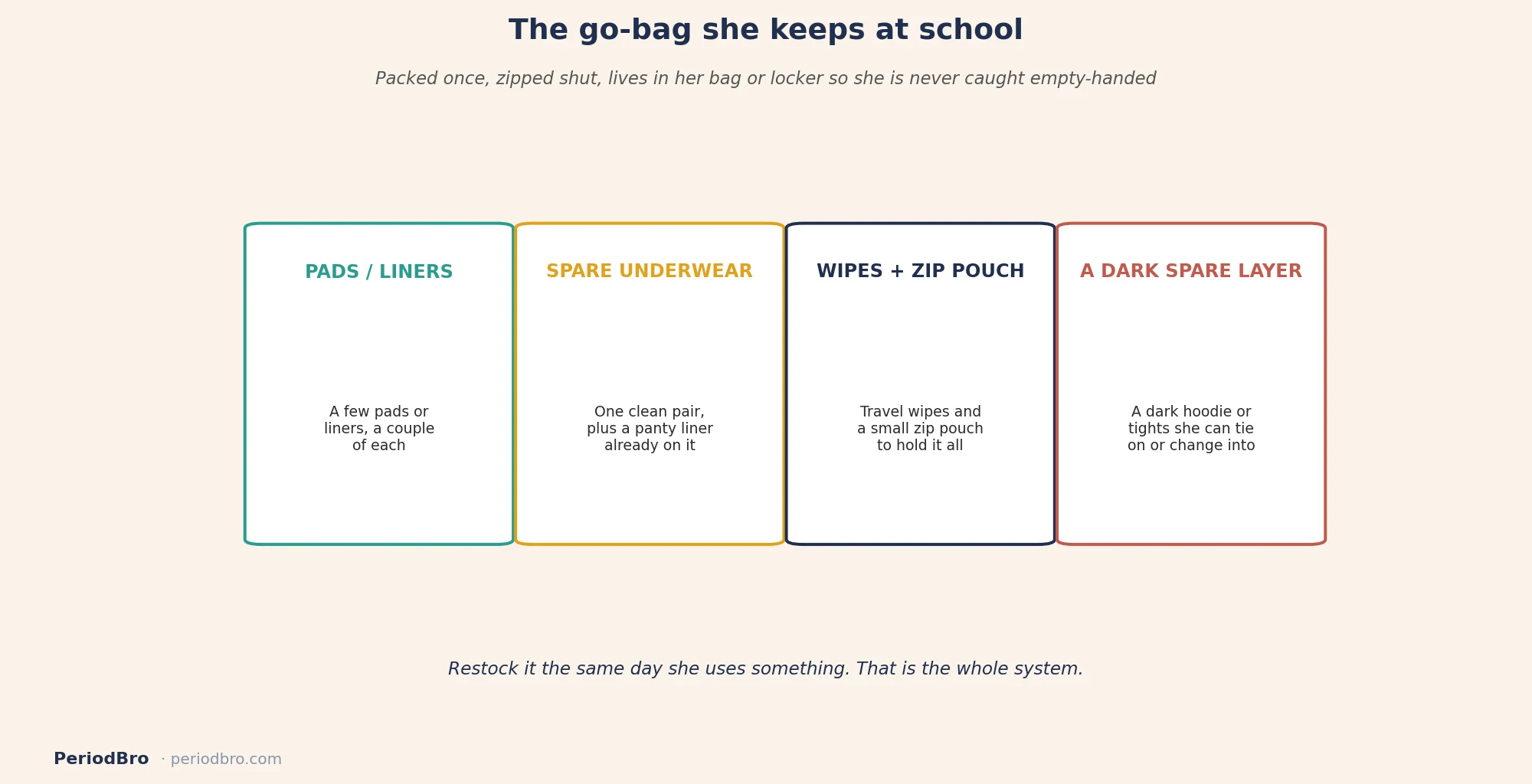
The one habit that keeps the kit useful is restocking it the day she uses something, not a week later when you both forget. Make that the deal: she tells you when she is low, you top it up, no discussion needed. A kit that is empty when she reaches for it is worse than no kit, because she was counting on it.
Map the help at school before she needs it
She is not actually on her own at school, but she will feel like she is if nobody has told her where to go. Most schools have more help than kids realise. The nurse or health office almost always keeps period products on hand, and increasingly so do the bathrooms themselves. A study of high school students in St. Louis found that two-thirds had used at least one school resource to get period products, which tells you the supply is usually there once a student knows to ask.
So walk her through the map in advance: where the nurse or health office is, which teacher she trusts enough to quietly ask, and that the front office is a fallback. The point is that she should not be solving this from a standing start in a stressful moment. The same study is worth knowing for another reason: one in three students said they had missed school at some point because they did not have period products. Being equipped is not a small thing here; it can be the difference between her staying in class and going home.
The phone plan you agree in advance
Decide together, while it is calm, how she reaches you and what happens next. A simple version works best: agree on a low-key signal, a single word she can text you that means “call me, it is that,” so she does not have to explain anything in a crowded classroom. Then agree on what you will actually do, and make clear that any of the options is fine.
The options are usually one of three. You talk her through it on the phone and she handles it with her kit. You drop supplies at the front office if hers ran out. Or you pick her up if she wants to be home. Tell her plainly that asking to come home is allowed and so is toughing it out, and that neither one disappoints you. What she needs to hear is that reaching you always works and never costs her anything.

Handling a leak in the moment
If she has leaked, the physical fix is short and she can do most of it herself once she knows the moves. Tie the dark layer around her waist and knot it at the front, which covers everything and reads as completely normal. Get to the nearest bathroom or the nurse, no need to rush. Change the pad, put on the spare underwear, and go back to her day.
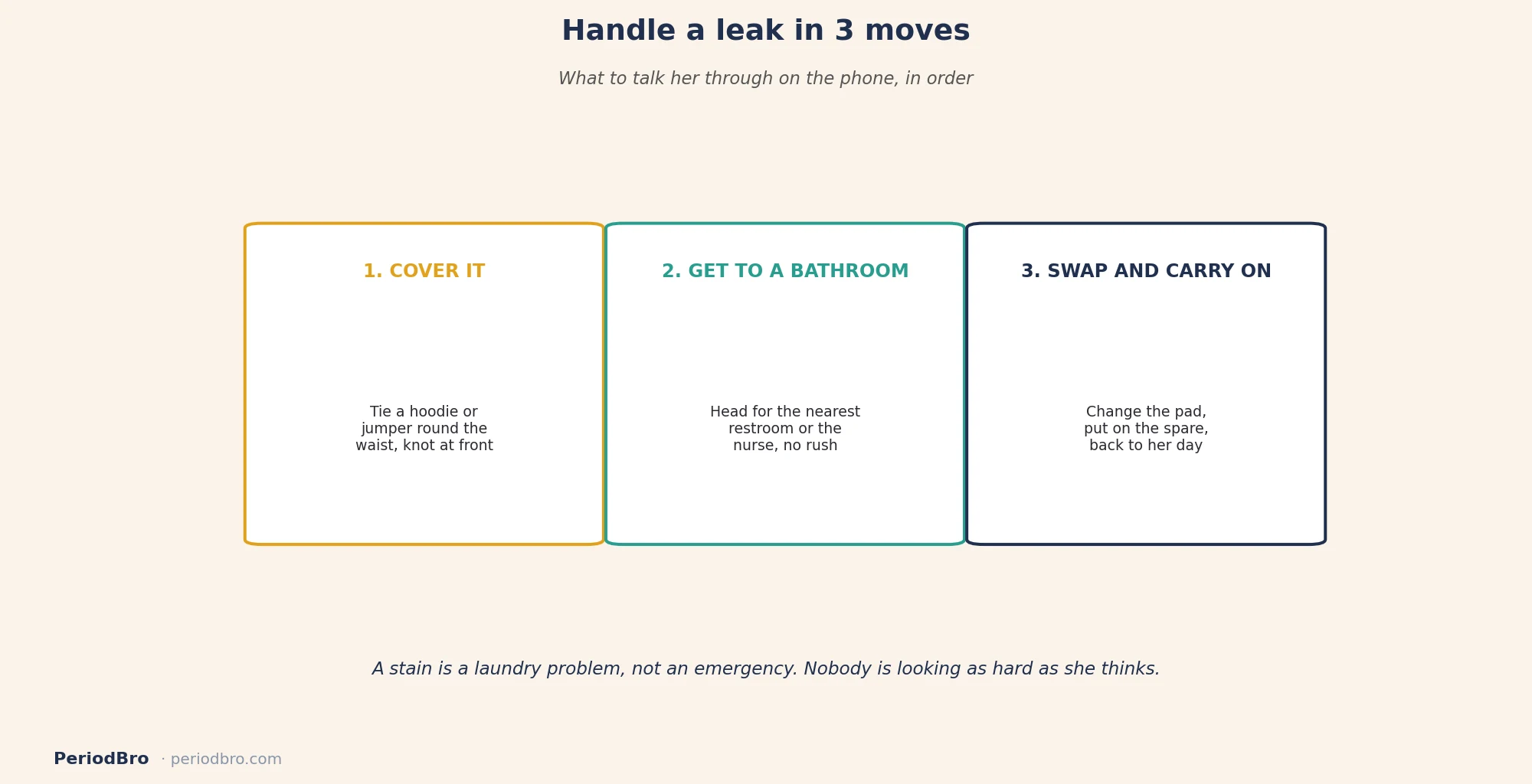
The line that matters most here is the one about the stain. A mark on her jeans is a laundry problem, not an emergency, and almost nobody is looking as hard as she is convinced they are. Say that out loud. When you treat the stain as trivial, she gets to treat it as trivial too, and the panic drains out of the moment fast.
What to say during a daughter period at school
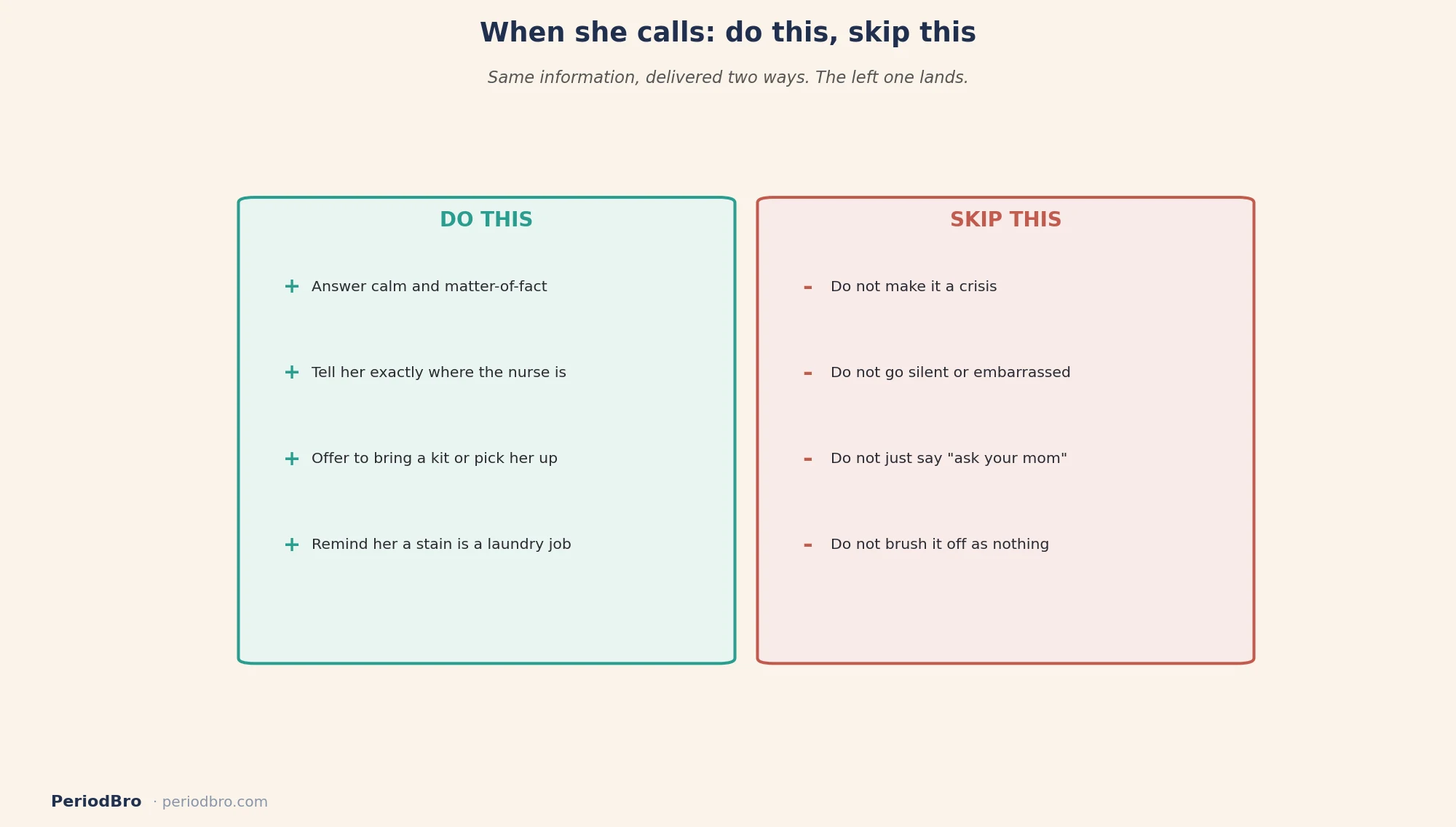
How you sound on that call does more than anything else you do. Keep it short, calm, and matter-of-fact, the same voice you would use if she called about a flat bike tyre. Something like: “Okay, no problem, this is normal and you have got this. Have you got your kit? Good. The nurse is by the front office if you need more. Do you want me to bring anything or come get you, or are you good?” That is the whole script, and it takes about fifteen seconds.
There are four ways dads accidentally make it worse, and they are all easy to skip once you can name them. Do not make it a big deal, because your alarm becomes her alarm. Do not go silent or visibly embarrassed, because that teaches her the topic is shameful. Do not deflect the whole thing with “ask your mom” or “go find a female teacher,” because in that moment she called you, and handing her off says you would rather not deal with it. And do not brush it off so hard that she feels unheard. Somewhere between panic and dismissal is the calm middle, and that is the target.
The emotional read, which is your real job
Strip away the logistics and here is what is actually going on. A period at school is mostly a practical problem she can own once she is equipped and knows the plan. The kit handles the supplies, the map handles the help, the phone plan handles the reach-back. What is left is the part only you can do, which is making sure she never feels alone with it and never picks up the idea that there is anything to be ashamed of.
You do not need to be an expert on cycles to pull this off, and you do not need to have every biological answer ready. You need to be the calm, unembarrassed adult who prepared her in advance and picks up the phone. That posture is the whole of what a father brings here, and it is more than enough. If you want the bigger picture of where this fits, our pillar on a father’s role in menstrual education and our no-panic walkthrough of her first period both go deeper.
This article is general parenting information, not medical advice. If she has very heavy bleeding that soaks through a pad every hour, severe pain, or feels faint, treat that as a reason to see a doctor rather than a school-day logistics problem.