Period Terms for Dads: A No-Awkwardness Vocabulary List
The first time my daughter mentioned her period to me, I said “okay” three times in a row and then changed the subject to whether she wanted pizza. Not because I didn’t care. Because I didn’t have the words, and the silence where the words should’ve been felt louder than anything I could’ve said.
That’s the thing nobody tells you. You don’t avoid the conversation because you’re squeamish. You avoid it because you’re scared of using the wrong term and making it weird. So here’s a plain-English list of period terms for dads – the actual vocabulary, defined like a friend would explain it, so you can say the real words without flinching.
I’m not a doctor. I’m a guy who had to learn all of this late, mostly by getting it wrong first. Every definition below is checked against the medical sources, but the goal isn’t to make you sound clinical. It’s to make you sound calm.
Why these period terms for dads matter more than you think
When a girl gets her first period, the single biggest thing she’s reading off your face is: is this a normal thing, or a problem? If you can name what’s happening in a steady voice, you’ve answered that question before she even asks it.
Doctors take this seriously enough that ACOG – the main body of OB-GYNs in the US – now treats the menstrual cycle as a vital sign in teenagers, right alongside heart rate and temperature. If a pediatrician thinks the cycle is worth tracking and discussing plainly, so can the man in the house. You don’t need to lead the conversation. You just need to not fumble it. Knowing the period terms for dads below is how you stop fumbling.
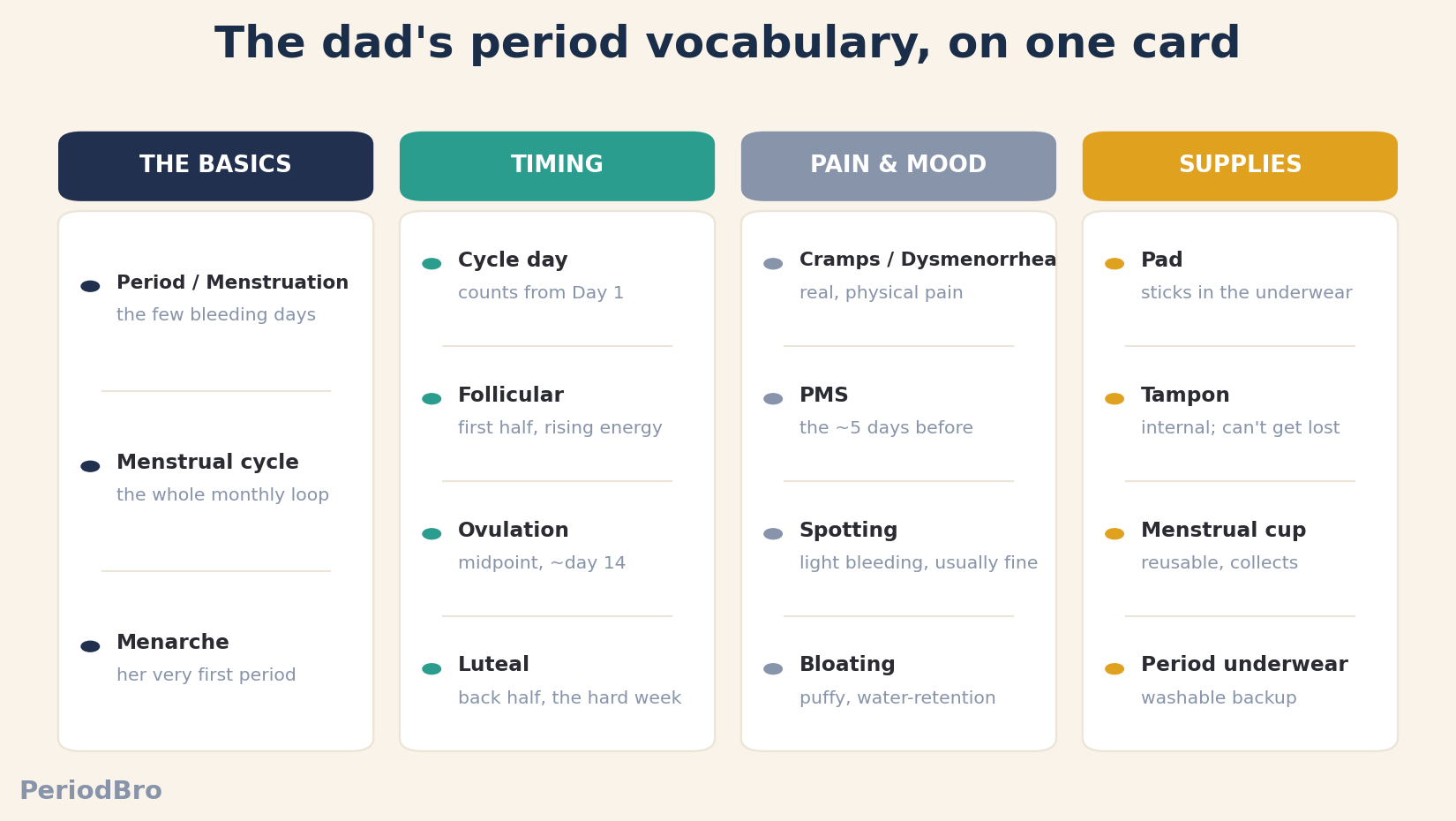
A quick map of how I’ll group these: the basics, the timing words, the pain-and-mood words, and the supply words. Then the short list of terms to quietly retire.

The basics: period, menstruation, cycle, menarche
Period / Menstruation. Same thing. “Menstruation” is the medical word; “period” is what everyone actually says. It’s the few days each month when the lining of the uterus sheds and leaves the body as blood. Per the Cleveland Clinic, bleeding usually lasts somewhere between three and seven days. Both words are fine to say out loud. Pick “period” if you want to sound human.
Menstrual cycle. This is the bigger thing the period is just one part of. The cycle is the whole monthly loop – from the first day of one period to the first day of the next. The Cleveland Clinic puts the average length at 28 days, but anywhere from 21 to 35 days is normal. This matters for a dad because “her cycle” and “her period” aren’t the same word. The period is a few days; the cycle is the whole month.
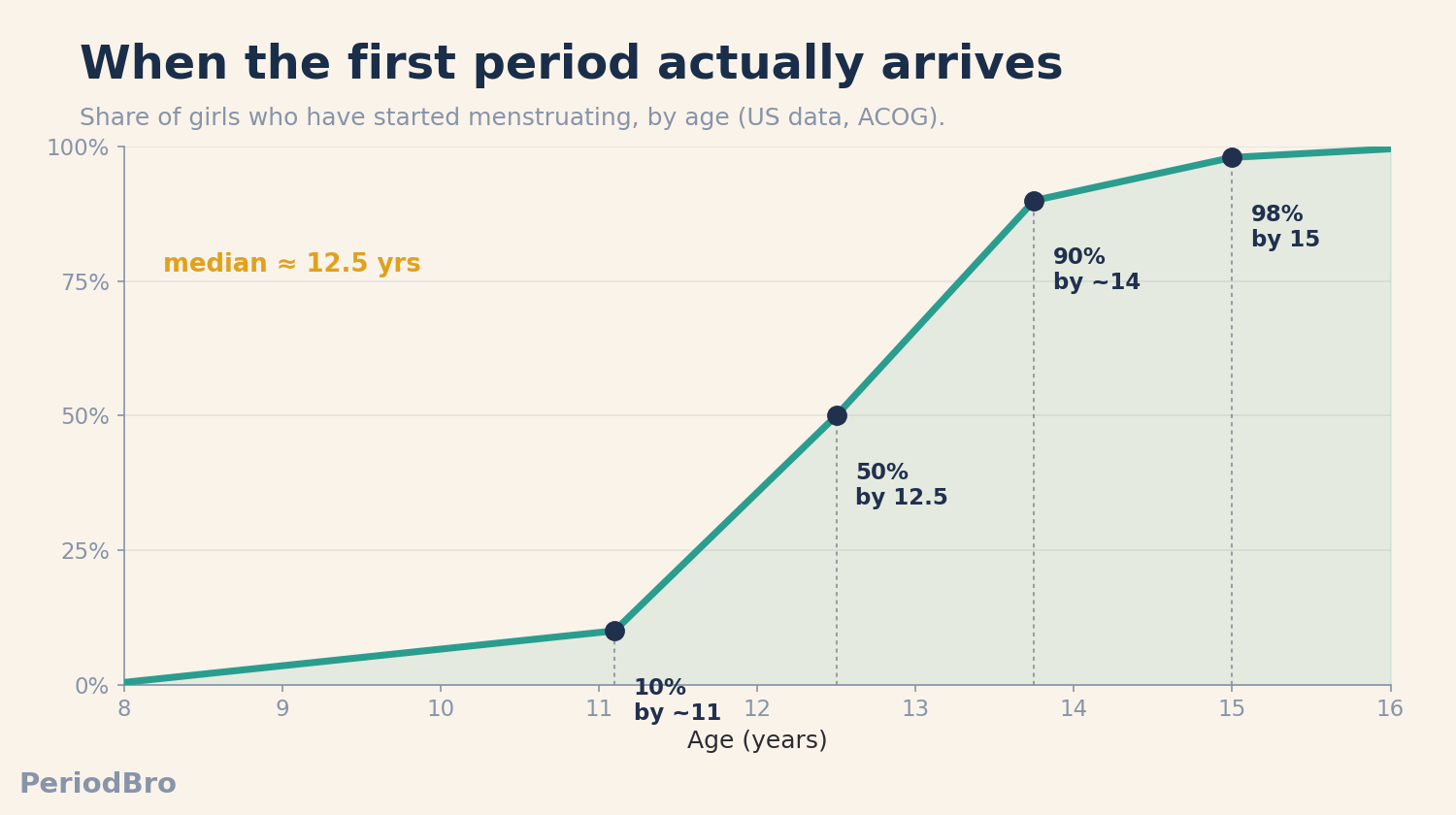
Menarche. The one term that sounds intimidating and almost never gets said. It just means a girl’s first period. You’ll probably never use it in conversation, but you’ll see it on every doctor’s form and pamphlet, so it’s worth recognizing. According to ACOG, the average age is around 12 and a half, and it usually arrives about two years after breast development – the first visible sign of puberty – begins. If you want the full picture of what comes before it, I wrote a separate piece on the signs a daughter’s period is about to start.
The timing words: cycle day, follicular, ovulation, luteal
You don’t need these four to get through a hallway conversation. But if you ever want to understand why the mood and energy shift across the month – instead of taking it personally – this is the vocabulary that unlocks it.
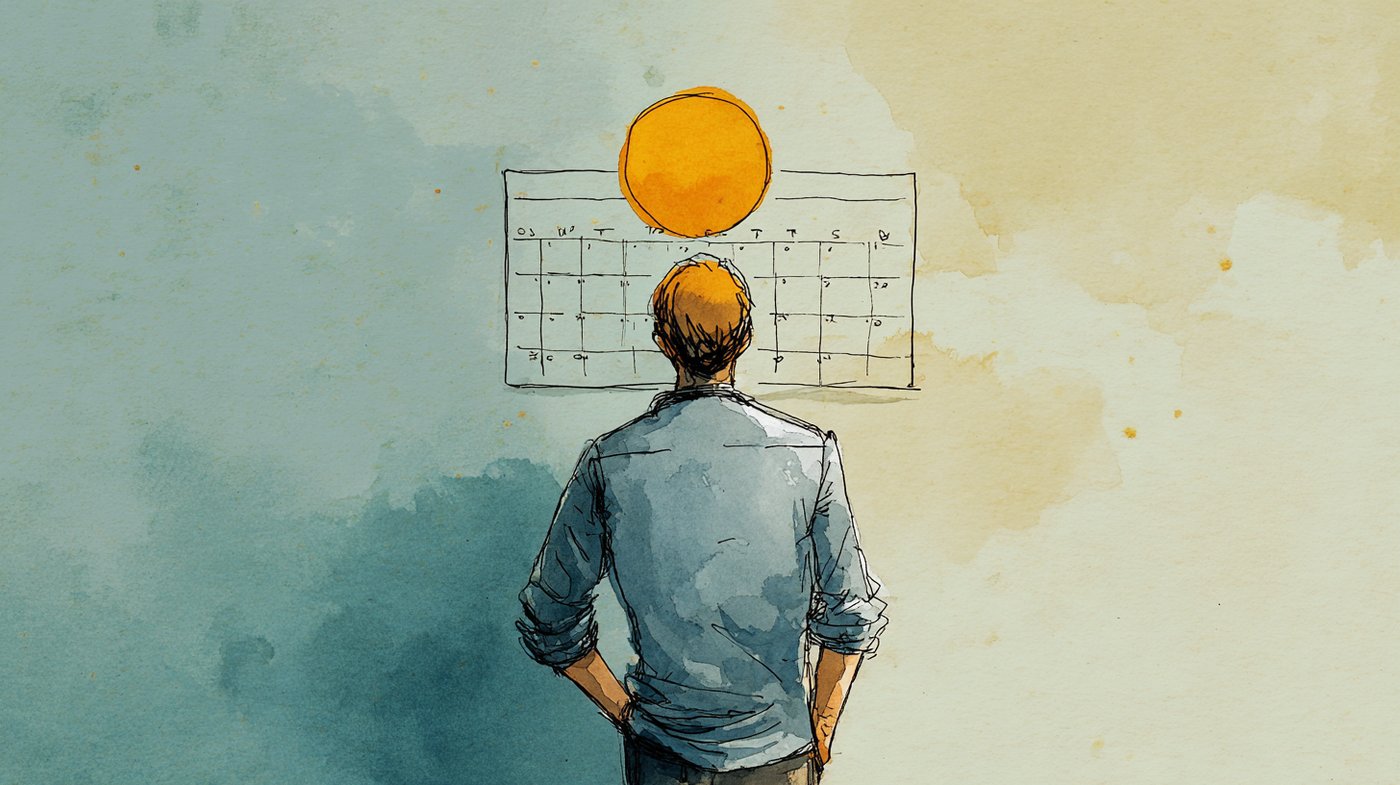
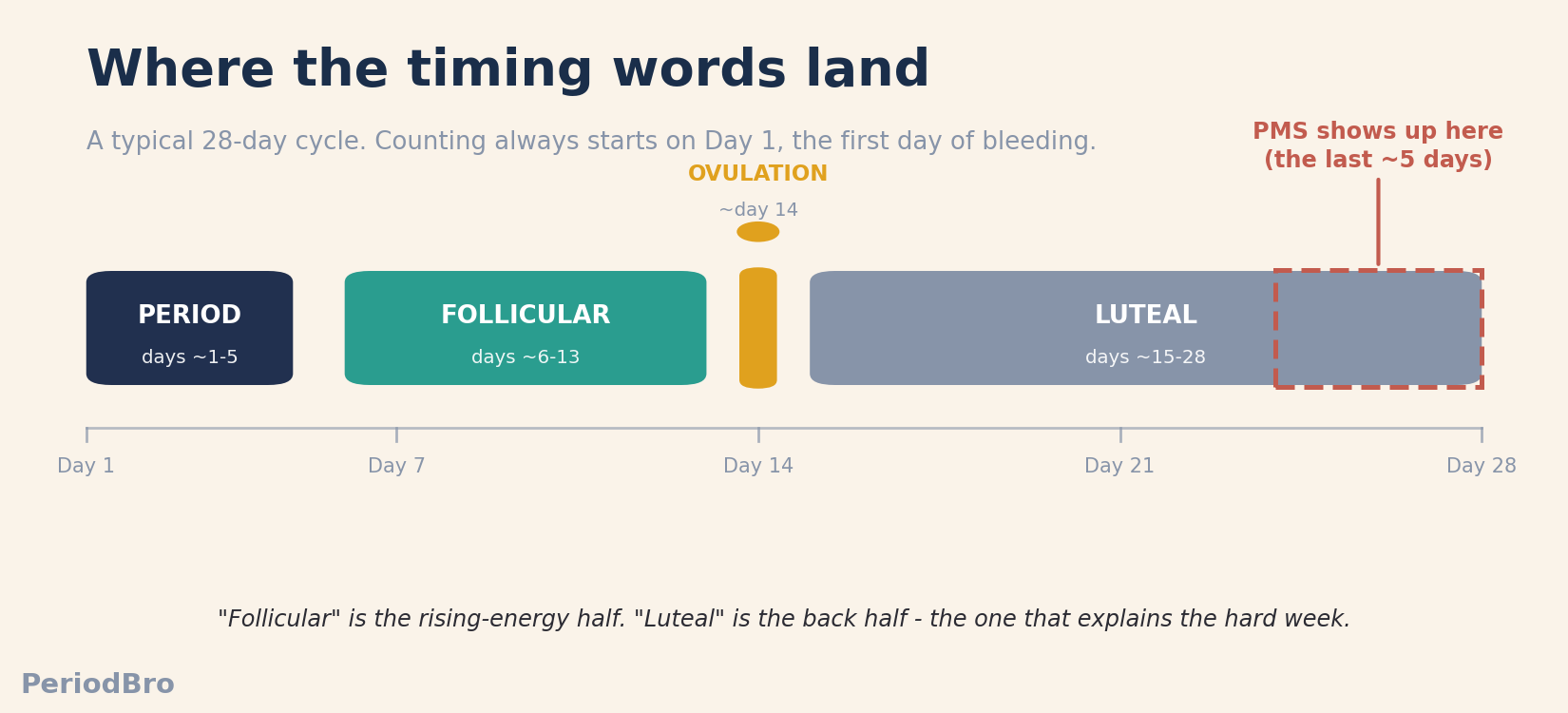
Cycle day. Day 1 is the first day of bleeding. Everything else counts forward from there. When an app or a doctor says “day 21,” they mean 21 days after her period started. That’s it. No mystery.
Follicular phase. The first half of the cycle, from the period until ovulation. The Cleveland Clinic notes estrogen is rising through this stretch, which for a lot of people lines up with steadier energy and a brighter mood.
Ovulation. The midpoint – roughly day 14 in a 28-day cycle – when an egg is released. It’s the one day the whole cycle is built around.
Luteal phase. The back half, from ovulation until the next period – usually about 12 to 14 days. This is the stretch where PMS shows up, which is the next word on the list. If you only learn one phase, learn this one, because it’s the one that explains the hard week.
I broke down all four phases in plain language in Menstrual Cycle Phases Explained for Men if you want to go a level deeper.

The pain and mood words: cramps, PMS, spotting, bloating
Cramps / Dysmenorrhea. “Dysmenorrhea” is just the medical name for painful periods. The pain comes from chemicals called prostaglandins that make the uterus contract. The Cleveland Clinic says about 60% of people who menstruate get at least mild cramps, and somewhere between 5% and 15% have pain bad enough to disrupt daily life. So when she says “I have cramps,” that’s a real, physical thing – not a mood, not an exaggeration.
PMS. Premenstrual syndrome. Per ACOG, it’s the cluster of physical and emotional changes – irritability, low mood, tender breasts, bloating – that show up in the roughly five days before the period and usually ease once it starts. The keyword for a dad is before. PMS lives in that luteal phase we just covered. It’s predictable, which means it’s something you can prepare for instead of be ambushed by.
Spotting. Light bleeding that happens outside the normal period – a few drops, not a flow. Common and usually nothing. Worth knowing the word so it doesn’t sound alarming when you hear it.
Bloating. Exactly what it sounds like – that puffy, heavy, water-retention feeling that often rides along with PMS. Not weight. Not something to comment on. Just a word to recognize.
The supply words: pad, tampon, cup, period underwear
This is the section most dads skip, and it’s the one that actually comes up at a pharmacy at 9 p.m. on a Tuesday.
Pad. Adhesive strip that sticks inside the underwear and absorbs the flow from the outside. The simplest option, and usually the first one a girl uses. Comes in different lengths and thicknesses – “overnight” is the bigger one.
Tampon. A small absorbent insert worn internally. Quick reassurance, because dads worry about this one: it can’t get lost inside the body. There’s nowhere for it to go.
Menstrual cup. A small reusable silicone cup worn internally that collects rather than absorbs. Reusable, so you’ll see it once and then not buy it again for ages.
Period underwear. Washable underwear with a built-in absorbent layer. Increasingly common and genuinely useful as a backup, especially overnight or for a first period.
You don’t have to know which one she prefers. You just have to be able to stand in the aisle, read the box, and not treat it like defusing a bomb. If you want a head start, I put together a what-to-stock-at-home checklist so the supplies are in the house before the day, not bought in a panic on the day.
The short list of words to quietly retire
A few terms aren’t wrong, exactly, but they teach a small lesson you don’t want to teach: that this is something to talk around instead of about.
“That time of the month.” “On the rag.” “Shark week.” Any joke that turns the period into a punchline. None of these are crimes. But every time a girl hears the real thing referred to in code, she learns it’s a little shameful – and she files you under people I can’t be straight with about this. The fix is small. Just say “period.” Say “cramps.” Say the real word in a normal voice, and the awkwardness has nowhere to live.
This isn’t about you becoming an expert. The whole reason dads matter here is covered in why dads are the missing link in menstrual education – and it comes down to this: a girl who grows up with a father who can say “period” without tensing up grows up believing her own body isn’t a problem to be managed around the men in her life.
One thing to do with this
Pick the three words you flinched at while reading – probably “menarche,” “dysmenorrhea,” and whichever supply word you’ve never bought – and just say them out loud once, alone, in the car. That’s the whole exercise. The first time the real conversation happens, you want those words to already feel ordinary in your mouth. The calm doesn’t come from knowing everything. It comes from the words not being strangers.
That’s why I built PeriodBro – so a dad can quietly learn where his daughter is in her cycle and what the words mean, without having to ask her to explain it or install anything herself. If you’d rather walk in already knowing than figure it out mid-conversation, that’s exactly who it’s for.