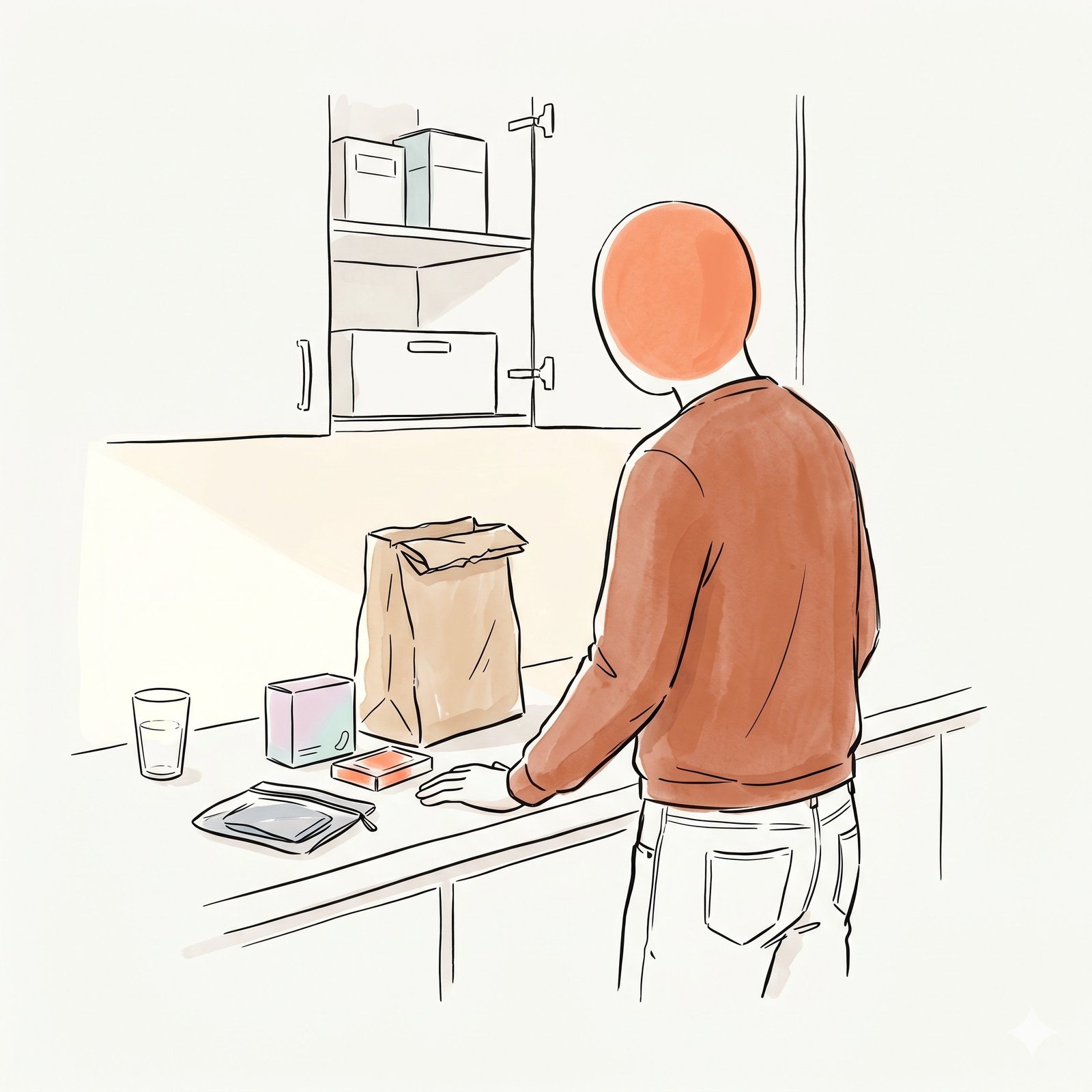
What to Stock at Home Before Your Daughter’s Period: A Dad’s Quiet Checklist
What to stock before daughter period is the question most dads only ask in a CVS aisle at 9pm after the call from school. This is the list I wish someone had handed me before my daughter’s window opened. It’s not a long list. It fits in one bag.
Most dads I know figured out what to keep at home by being late. They got the call from the school nurse, or saw the door close a little harder than usual, or found themselves standing in a CVS aisle at 9 p.m. trying to read three pad packages at once. There’s a better order. You stock the shelf before the day, not on the day.
This is the list I wish someone had handed me before my daughter’s window opened. It’s not a long list. It fits in one bag.
What to Stock Before Daughter Period: You’re Earlier Than You Think
In the United States, the average age at first period is about 12 and a half, and roughly 90% of girls have started by age 13 and 9 months (ACOG, Your First Period). The range that’s still considered normal stretches from about 10 to 15. Translation: if your daughter is in fifth grade and she’s been through the early changes of puberty — breast buds, a growth spurt, sometimes light vaginal discharge a few months ahead — you’re in the window. ACOG notes that menarche typically arrives about two years after breast development begins.
So if you’re reading this thinking “she’s only ten, I’ve got time,” I’d flip it: she’s ten, this is the time. The whole point of stocking ahead is to make the actual day boring. Not eventful. Boring. Boring is the goal.

The visible stack: what goes in the bathroom drawer
You need her to be able to open one drawer and find what she needs without thinking. Don’t make her hunt. Don’t make her ask. Don’t make this a quest.
Here’s what I keep in there:
Pads — two absorbencies. Get one pack of “regular” or “thin” and one pack of “overnight” or “long.” Most teen-targeted brands (Always, Kotex, Stayfree, the store-brand equivalents) come in teen sizes with wings. KidsHealth recommends picking a pad that’s big enough to feel secure but small enough to be comfortable, and most beginners do best with wings (KidsHealth, Tampons, Pads, and Other Period Supplies). She’ll figure out her preference. Your job is to give her options without making her ask for them.
Period underwear — two or three pairs. This was the single biggest upgrade I didn’t know existed. Brands like Thinx, Knix, Saalt, and the generic versions at Target are designed to absorb a full pad’s worth of flow on their own. KidsHealth lists them as a standard option alongside pads. For a kid just starting out — especially overnight, or for a school day she’s nervous about — period underwear takes a lot of the leak-anxiety off the table. Two or three pairs is enough to start.
Tampons — small box, “regular” absorbency. Don’t push these. Some girls want them right away because of swim team or dance. Others want nothing to do with them for a year or two. Have a small box in the drawer so she can try when she’s ready and not have to bring it up. KidsHealth notes that tampons aren’t required and many people start with pads — your move is availability, not advocacy.
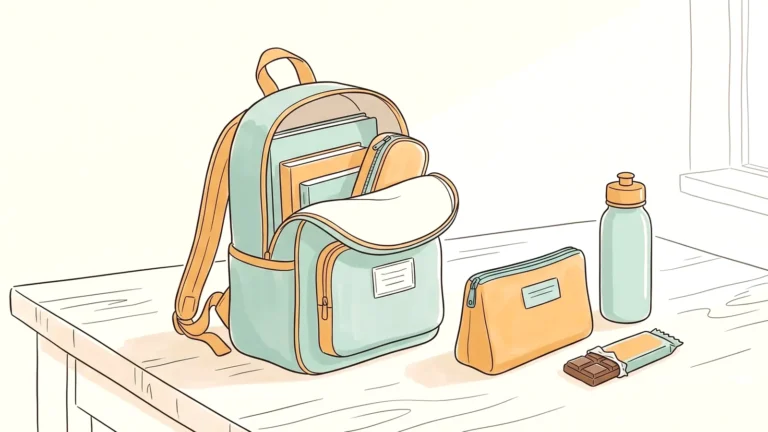
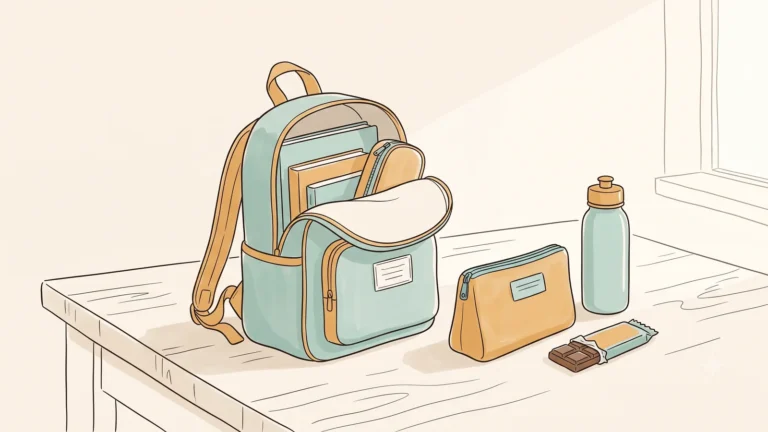
A small zip pouch. Whatever goes in her backpack. One pad, one pair of period underwear or a spare, a couple of wet wipes. The pouch is so she can carry it without the contents being the carry. A pencil case works.
If you want a more detailed breakdown of what an early-period kit looks like — and the order to introduce things — our single dad’s no-panic first-period playbook goes deeper.
The quiet stack: pain relief and comfort
Cramps are not guaranteed in the first year — a lot of early cycles are anovulatory and relatively painless — but they show up for most teenagers eventually. Cleveland Clinic describes primary dysmenorrhea as one of the most common gynecological complaints in adolescents, driven by prostaglandins released as the uterine lining sheds (Cleveland Clinic, Dysmenorrhea).
What helps, in order:
Ibuprofen, in the right place at the right time. NSAIDs are the first-line treatment for menstrual cramps because they reduce prostaglandin production rather than just masking pain. The guidance for adolescents, per the literature on painful periods, is to start dosing at the first sign of pain or bleeding (or one to two days ahead if she can predict the day), take it with food, and continue on a regular schedule for the first two to three days rather than waiting for pain to spike (Painful Periods in Adolescents, PMC8084563). Keep a small bottle of ibuprofen in the bathroom drawer, not in a high cabinet she has to ask you for. For the right dose for her age and weight, talk to her pediatrician — but the principle is “early and on schedule,” not “wait and see.”

A heating pad or a stick-on heat patch. A small electric heating pad lives next to her bed. A box of stick-on heat patches (the iron-chip kind) lives in the drawer. Cleveland Clinic lists heat as a non-medication option for cramp relief, and at least one randomized trial found heat patches comparable to ibuprofen for primary dysmenorrhea. Heat is also the thing she can use during school, in a car, at a friend’s house — anywhere ibuprofen isn’t an option in the moment.
Comfort foods she actually likes. I keep a small stash of the snacks she always wants when she’s not feeling well. Mine prefers salty over sweet, which surprised me. Yours may be different. The point isn’t a “period menu” — the point is that on a hard day, the thing she likes is in the house.
A change of clothes in her backpack. One spare pair of leggings or sweatpants and clean underwear. Doesn’t have to be discussed. Just there.
The invisible stack: how you talk about it
This is the part most dads skip, and it’s the part that does the most work.
You want her to know three things, in this order: that you know it’s coming, that she doesn’t have to manage it alone, and that you’ve already done the boring shopping so she doesn’t have to. That’s it. You don’t need to give the puberty lecture. You don’t need to explain the cycle. You don’t need to make it a sit-down conversation.
Mine looked like this: I walked her into the bathroom one Saturday morning, opened the drawer, and said “this is where everything is, this is what each thing does, you don’t have to ask me to restock anything, I check it every month.” Then I closed the drawer and we went and got breakfast. Total run time: ninety seconds. Lower stakes than explaining the dishwasher.
If you want a framework for the bigger conversation — the one about what’s actually happening in her body, when she’s ready for it — our breakdown of why dads are the missing link in menstrual education is the longer read on why your presence in this conversation matters more than your fluency.
A note on cycle irregularity (so you don’t worry the first year)
The first year or two of periods are routinely irregular. ACOG, in their Menstruation as a Vital Sign guidance, defines normal adolescent cycles as anywhere from 21 to 45 days, and notes that it can take up to six years from menarche for cycles to settle into a fully regular pattern (ACOG Committee Opinion 651). Cleveland Clinic adds that it’s not uncommon to go several months between periods in the first year (Cleveland Clinic, Menarche).
This is the trap I fell into. I thought “irregular” meant “something is wrong.” It usually doesn’t. What ACOG actually flags as worth a pediatrician conversation is the opposite end: cycles consistently shorter than 21 days, longer than 45, bleeding heavy enough to soak through a pad or tampon every hour for several hours in a row, or no period at all by age 15. Those are the patterns to know. Everything else, for the first year or two, is mostly the system finding its rhythm.
If you want to track quietly — for her, without making her the subject of a spreadsheet — that’s a longer conversation about consent and tracking that I won’t shortcut here. The principle is the same as everything else on this list: the goal is making the system boring for her, not making her the topic.
What I got wrong
The first time I tried to prepare for this, I did the thing the internet tells you to do. I bought one of every kind of pad, watched a video about menstrual cups, made a little kit in a clear plastic box, and put a calendar app on my phone. I had a whole speech ready.
Then nothing happened for nine months. By the time it did happen, the plastic box was in a closet I’d forgotten about, the speech had gone stale in my head, and what she actually needed was for me to drive to the store and not act weird about it.
The version I’m describing here is what I built after that. Smaller. Quieter. Replenished without ceremony. The boring drawer in the boring bathroom. That’s the whole thing.
One move this week
Buy two things you don’t have: a pack of pads in her teen size with wings, and a box of stick-on heat patches. Put them in the bathroom drawer she already uses. Don’t announce it. The next time she opens that drawer for floss or a hair tie, she’ll see them. That’s the entire opening move.
The rest of the list can fill in over the next couple of weeks. The point is starting before you need to start.