
Her First Tampon: The Part a Dad Can Actually Help With
She asks for tampons, or you find a box in the trolley she did not mention, and you hit the wall immediately: this is one thing you cannot demonstrate and should not try to. A daughter first tampon is not a lesson you get to give, so the useful question is which parts of it you own, and there are more of them than you would guess.
I watched a friend stand in an aisle for eleven minutes taking photos of boxes to send to his sister, because the labels made no sense to him and he was too embarrassed to ask anyone standing there. He is an engineer. The information he needed took about ninety seconds to find later, and none of it was on the front of the box.
The label is a size, not a skill level
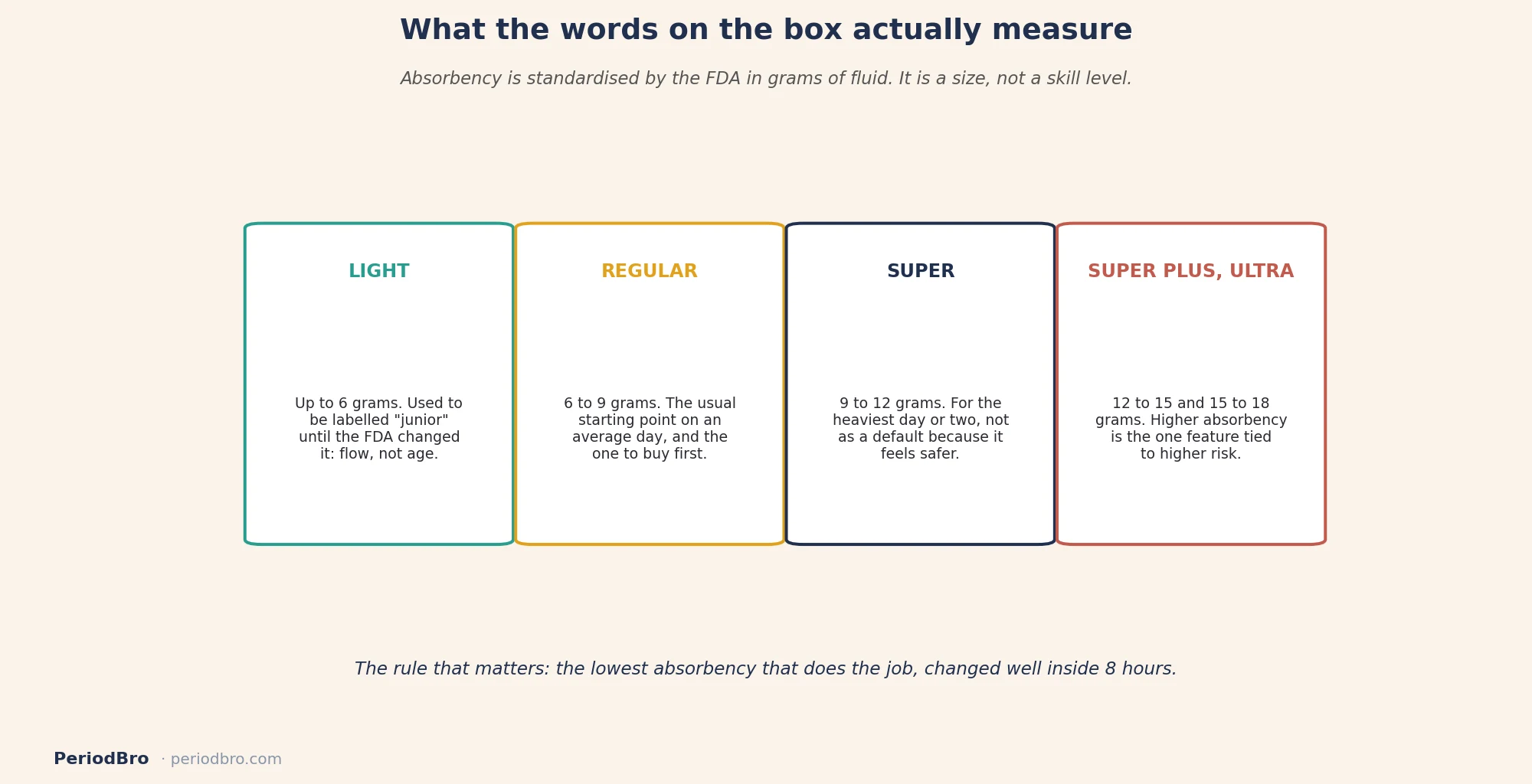
Most of the aisle confusion comes apart with one fact. Tampon absorbency in the US is standardised by the FDA and measured in grams of fluid: light absorbs up to 6 grams, regular is 6 to 9, super is 9 to 12, super plus is 12 to 15, and ultra is 15 to 18. The words describe how much liquid the thing holds, and nothing else. They are not a rating of quality, comfort, or how experienced you are supposed to be.
There is a detail buried in the FDA’s own labelling history that makes the point better than anything. The lowest absorbency used to be labelled “junior,” and the FDA changed it to “light” because the old word implied the product was for younger or teenage users when it is really just for lighter flow. The regulator had to rename a box because the name was teaching people the wrong thing. Nobody rewrote the aisle in anybody’s head, though, which is why half the adults reading this still think the sizes are a ladder you climb.
The guidance that actually matters when you pick one up: use the lowest absorbency that does the job. Higher absorbency is the one tampon characteristic linked to higher risk, so buying big to be safe is precisely backwards.

What a daughter first tampon actually needs from you
Four things, and you can do all of them without a single awkward sentence.
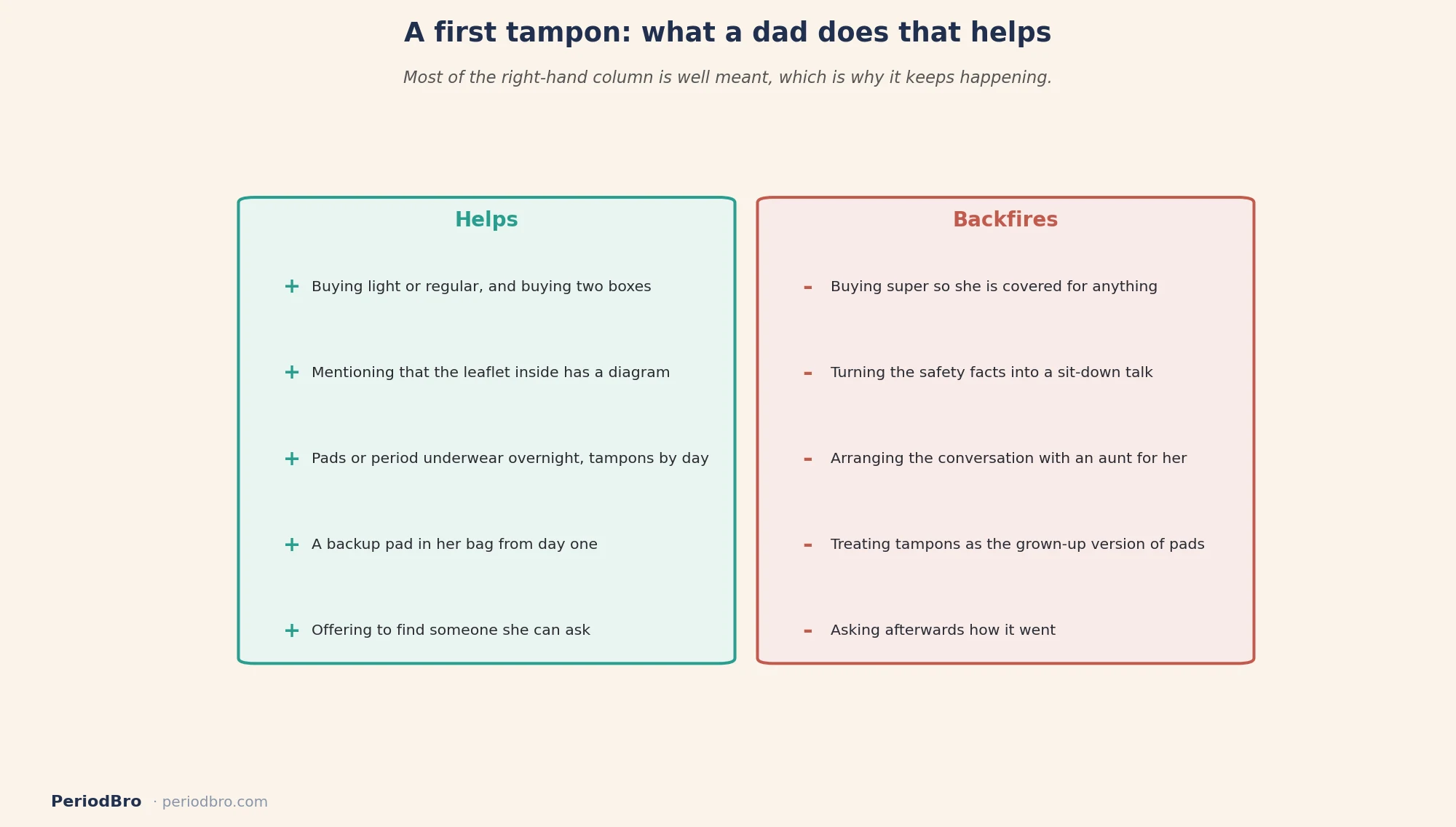
Buy the right box, and buy two. Light or regular absorbency, with an applicator for a first try, plus whatever pads she already uses. The second box is because the first attempt often does not work, and a girl who has used up her only supply learning something new is a girl who quietly gives up on it. If you are still building out the bathroom cupboard generally, what to stock before her period covers the rest of it.
Say the leaflet exists. Every box has instructions with a diagram inside, and roughly nobody reads them because opening the box in front of a parent feels like an announcement. Mentioning once that the paper in there is worth five minutes alone is a genuinely useful thing a father can say out loud.
Make sure she has a backup in her bag, alongside the tampons rather than instead of them. The failure mode on day one is rarely medical. It is being at school with something half-done and no plan B, which we went through in her period at school.
Say the hours out loud once. More on this next, because it is the one piece of safety information that genuinely belongs to whoever is doing the shopping.
The eight hour rule, and the number that is quietly stricter
The FDA line is straightforward: never wear one tampon for more than 8 hours, and use the lowest absorbency you need. If a tampon lasts the full eight hours comfortably, that is a signal the absorbency is too high, not that she has found a good one.
There is newer evidence that tightens this. A French case-control study of menstrual toxic shock syndrome, published in EClinicalMedicine, compared how people with the condition had actually used tampons against controls. Risk was roughly two-fold higher with wear beyond 6 consecutive hours, and roughly three-fold higher when a tampon was worn during sleep for more than 8 hours. The authors went as far as suggesting the advice should be a maximum of 6 hours rather than 8.
The sleep finding is the one to act on, because it is the one that turns into a habit without anyone deciding anything. A tampon at bedtime is convenient exactly once and then becomes the default. Pads or period underwear overnight, tampons for the day, is a simple rule that costs her nothing.
For scale, before anyone loses an evening to search results: the same paper puts menstrual toxic shock syndrome at roughly 1 to 3 cases per 100,000 menstruating people, down from around 10 before the highest-absorbency products left the market. It is rare, and it moves fast when it does happen, which is the only reason it is worth knowing at all.

The symptoms worth knowing, without turning it into a briefing
You do not need to sit her down for this. You need it in your own head, so that if she is unwell on a day she is wearing one, you connect two things instead of reaching for the flu.
Cleveland Clinic’s list is a sudden high fever, vomiting or diarrhoea, a rash that looks like sunburn, dizziness or fainting, muscle aches, and red eyes or throat. What makes it different from a bug is the speed: it escalates over hours, not days.
The response is one sentence long. Take the tampon out, and get seen the same day rather than waiting to see how it goes. Removing it and turning out to be wrong costs her nothing at all.
The three questions she will not ask you
She will ask a friend, or nobody. You can answer them ahead of time by mentioning them once and then leaving the room, which is a real technique and works better than a conversation.
It cannot get lost. There is nowhere for it to go, because the cervix closes off the far end. One can end up higher and harder to reach than expected, which is uncomfortable and occasionally needs help, but the underlying fear of something disappearing into her body is anatomically impossible.
Yes, she can still pee. Different opening. A lot of people work this out by accident weeks in, having spent the first fortnight doing something inconvenient for no reason.
A first attempt that fails is normal, and it is usually angle and tension. Muscles tense when you are nervous, and a tensed pelvic floor makes it hard. That is why the second and third attempts on a calm evening at home go better than the first one in a rush before school. It is also worth knowing that using a tampon does not change anything about virginity, whatever anyone at school says, and that is a sentence a father is allowed to say plainly if it comes up.
Where you hand it off, and how to say so
There is a limit here, and pretending otherwise helps nobody. The physical part of this is best explained by someone who has done it.
If there is an aunt, an older cousin, a family friend or a school nurse she likes, the move is to offer, not to arrange: “if you want to ask someone who has actually used them, I can ask X, or I can just leave you the box.” Offering keeps her in charge. Arranging behind her back means she now has two problems.
If you are on your own with this, that is workable too. Single dads handle this every day, and the thing that carries it is not expertise but the fact that you did not flinch. Being visibly unbothered while buying the box is worth more than any explanation. That whole posture, and why it matters more than the information, is the subject of talking to your daughter about periods.
Pads stay on the table permanently
There is no progression here that she owes anyone. Plenty of adults use pads exclusively and always have. Period underwear has made the overnight and just-in-case category much better than it was, and the full product landscape is worth a read if the language on the shelf is still fuzzy for you.
The reason tampons come up at all is usually specific and practical: swimming, sport, a school trip. That is a real problem worth solving, and we covered the sport version in her period and sport. But if she tries once and goes back to pads, nothing has failed. She ran an experiment and got an answer.
A daughter first tampon comes down to a short list on your side. Buy the light box, mention the leaflet, say the six hours and not overnight, and put a spare pad in her bag. Then get out of the way, which is the hardest part and, as usual, most of the job.

PeriodBro gives dads a plain read on where their daughter is in her cycle, so the supplies and the timing stop being a guess. Try it free.
This article is general information, not medical advice. Anything unusual or worrying belongs with her doctor or a school nurse rather than a search bar.