Birth Control for Teen Period Pain: A Dad’s Guide to the Conversation
The doctor said “we could look at the pill” and I watched my daughter’s face close like a door. She was fourteen. She had been off school twice that term with cramps that folded her in half, and the one sentence she took out of that appointment was that a man in a room had suggested she go on the pill, with nothing said about the pain or the reasoning.
I handled the next twenty minutes badly, so consider this the version I wish someone had handed me in the car park. Birth control for teen period pain is a normal, mainstream, well-evidenced treatment. It is also a phrase that lands on a teenager with a load of meaning nobody in the room intended, and how you talk about it decides whether she gets treated at all.
Why the pill comes up when nobody mentioned sex
Because hormonal medication is treating the mechanism, not the sex life. Period pain, the ordinary kind, comes from prostaglandins driving hard uterine contractions as the lining sheds. Hormonal methods thin that lining, so there is less to shed and less to cramp about. Contraception is a side effect of the mechanism, not the reason it was offered.
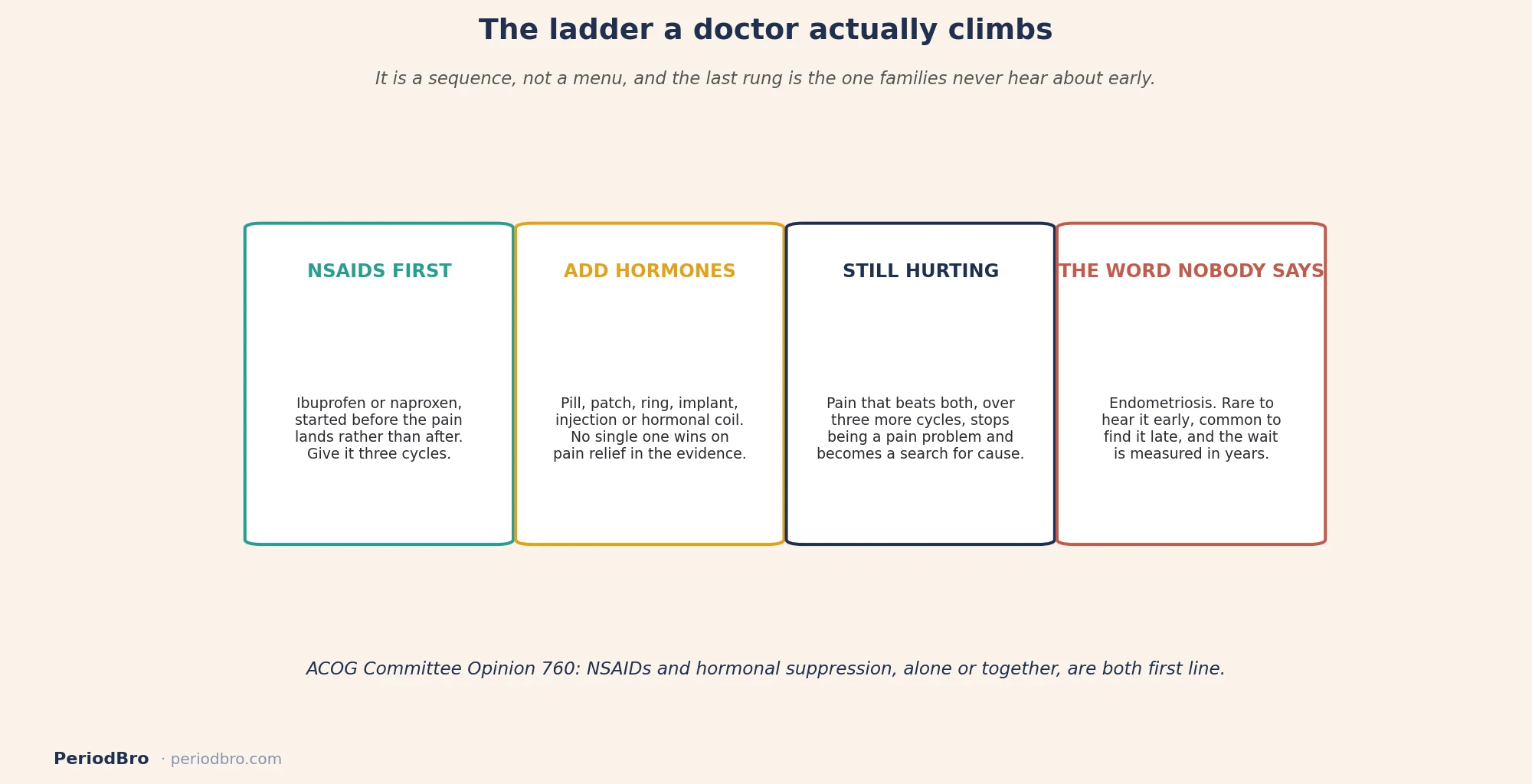
Doctors reach for it early because the guidance tells them to. ACOG Committee Opinion 760 is explicit that most adolescents with painful periods have primary dysmenorrhea, meaning nothing structural is wrong, and that they respond well to empiric treatment with NSAIDs, hormonal suppression, or both. Hormonal agents are named as an appropriate first-line option, not a last resort.
She does not know any of that. What she hears is a room full of adults deciding something about her body, using a word she associates with something else entirely. Saying that part out loud, in plain language, is most of the job.
The ladder, so you know where you are standing
Rung one: NSAIDs, taken properly. Ibuprofen or naproxen, started before the pain arrives rather than after it has taken hold, because these drugs block prostaglandin production rather than chasing it. Most teenagers take them too late and at too low a dose, decide they do not work, and stop. Guidance is to give a proper trial across about three cycles before calling it a failure.
Rung two: add hormones. If NSAIDs alone do not do it, ACOG lists combined pills, the patch, the vaginal ring, the progestin implant, the injection and the hormonal IUD as all being reasonable. No single one is established as the most effective for pain, so the choice comes down to her preference, her other health issues, and what she can actually keep up with. NSAIDs can carry on alongside.
Rung three: the search for a cause. Pain that survives NSAIDs and then survives hormonal treatment is telling you something, and the guidance is to evaluate for secondary causes at that point rather than cycling through more of the same.
The word nobody says early. Endometriosis. In adolescents with chronic pelvic pain or period pain that has not responded to both NSAIDs and hormonal therapy, at least two thirds are found to have endometriosis when they are finally looked at surgically. The reason the average diagnosis takes years is that families and doctors keep restarting rung one. If you know the ladder has a top, you stop accepting “just bad periods” as a final answer. There is more on what that condition does day to day in endometriosis explained for partners.
What each option actually does to her month
The guidance says no method clearly wins on pain relief. What they do to the rest of the month differs a lot, and that is usually what decides it for a fifteen-year-old.
Combined pill, patch or ring. A predictable, usually lighter bleed on a schedule she can see coming. The pill is the one most teenagers are offered first because it is easy to stop. The catch is that it only works if she takes it, and remembering something daily at that age is a genuine ask rather than a character test.
Hormonal IUD. Often the biggest drop in bleeding and pain, and nothing to remember for years. Insertion is a real procedure and the discomfort of it in someone who has never been pregnant is a fair thing for her to weigh, so it needs an honest conversation rather than a sales pitch.
Implant and injection. Both remove the daily step. Both can make bleeding unpredictable for months, spotting for weeks then nothing then spotting again. For a teenager whose main complaint is that her body feels unreliable, that trade sometimes reads as worse rather than better.
Whatever she picks, the first three months are the settling-in period and the reviews are the point. A method that has not helped by then gets changed, not endured. What each of these does to the underlying cycle is laid out in birth control and her cycle.
The one safety question you should carry in your head
Ask whether she gets migraines with aura.
Aura means visual disturbance before the headache: zigzags, flashing lights, blind spots, sometimes tingling or trouble speaking. Combined hormonal contraception, meaning anything containing estrogen, carries an increased stroke risk in people who get migraine with aura, and it is generally avoided for them. Progestin-only options and the hormonal IUD are usually still on the table.
Any decent clinician will ask. Plenty of appointments are short and rushed, and a teenager who has never connected her “weird headaches” to the word migraine will not volunteer it. You knowing to raise it costs nothing and occasionally matters a great deal.

How bad does it have to be before this is worth raising
Lower than most dads think, and the threshold is function rather than drama.
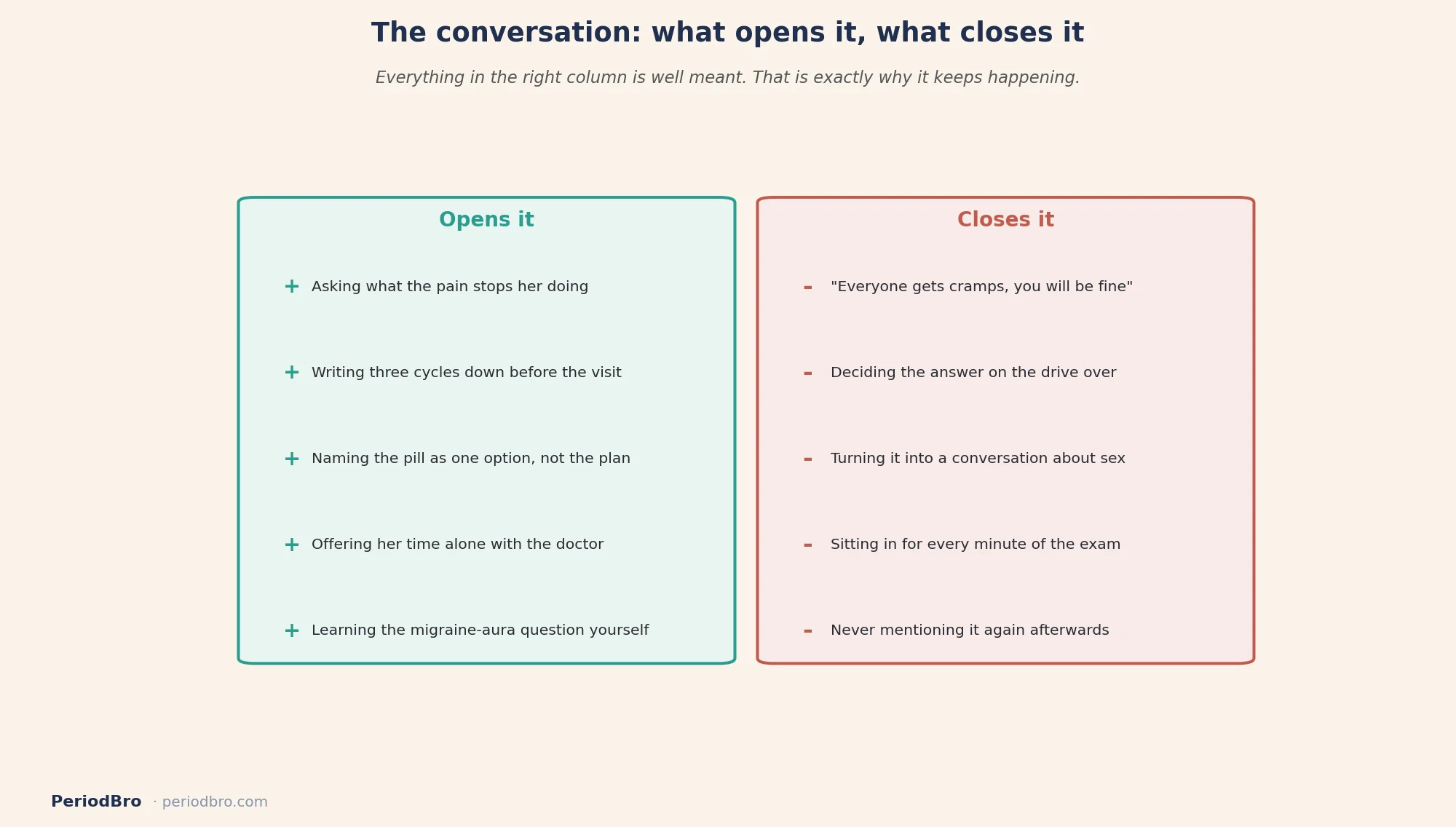
Painful periods affect somewhere between 50% and 90% of adolescents, and roughly a third to a half of them miss school or work at least once per cycle. That it is common is not an argument for putting up with it. Ask what the pain stops her doing rather than how much it hurts out of ten, because no teenager answers the second question usefully. Missed school, dropped training, or a weekend written off every month, repeating, is enough.
Before the appointment, write down three cycles. Dates, days she was in real pain, what she took and when, what she missed. That single sheet of paper changes the appointment more than anything you will say in it, because it turns “she gets bad cramps” into a pattern a doctor can act on. If you are not sure whether it is time to see anyone at all, when should a girl see a gynecologist covers the thresholds.
Having the conversation without closing the door
What I got wrong in that car park was talking. What worked, a week later, was asking what the pain stopped her doing, and then shutting up long enough for her to answer.
A few things that hold up.
Name the confusion first. “I know the pill sounds like it is about something else. It is being offered for the pain, and it is your call whether we look at it.” Thirty seconds, and it takes the loaded meaning off the table.
Do not arrive with the answer decided. If you have already concluded she should take it, or already concluded she should not, she will hear that in the first sentence and the conversation is over.
Offer her the room. Some of the appointment without you in it, if she wants that. It is a normal part of adolescent care, it makes honest answers more likely, and offering it says you trust her more clearly than any speech.
Then bring it up again. The failure I see most in other dads is not saying the wrong thing. It is saying the awkward thing once and never returning to it, so she concludes the subject is closed. Two weeks later, in the car, is a good time. Cars are excellent for this, because nobody has to make eye contact.
Meanwhile the ordinary comfort stuff still works and still counts. Heat, timing, food, a lift instead of the bus. I put the practical version in how to help your daughter with period cramps, and if her cycles are still all over the place, that is often normal in the first couple of years, which I covered in is my daughter’s period irregular.
She is on rung two now and back at training. It took eleven months longer than it needed to, and most of that delay was me not knowing there was a ladder. That is why I built PeriodBro with a profile for a daughter as well as a partner, so the pattern is written down before anyone has to remember it in a waiting room.
This is general information, not medical advice. Every one of these options has trade-offs that depend on her own health history, and the decision belongs to her and her clinician.