
Toxic Shock Syndrome in Teens: What Dads Should Watch For
You’re doing laundry and a box of tampons falls out of her gym bag. Nothing dramatic happens. She grabs it, mutters something, and disappears into her room. But for about four seconds, your brain runs through every half-heard horror story about toxic shock syndrome in teens, and you realize you don’t actually know what you’d be watching for if something ever did go wrong.
That gap is what this piece is for. Toxic shock syndrome in teens is rare. It’s also fast when it happens, and most of what circulates about it online is either outdated 1980s panic or nothing at all. Neither one helps you if you’re standing in a hallway trying to decide whether a fever is a fever or something worse.
What toxic shock syndrome in teens actually is
Toxic shock syndrome is a bacterial toxin reaction, caused by a toxin released by certain strains of Staphylococcus aureus that gets into the bloodstream, and has nothing to do with a “dirty” tampon or bad hygiene. The classic setup involves a high-absorbency tampon left in longer than it should be, which gives the bacteria a place to multiply (Mayo Clinic, symptoms and causes; Cleveland Clinic). The same toxin family causes TSS after surgical wounds, nasal packing, and skin infections too, so tampons aren’t the only path, but they’re the one most teenage girls encounter first, usually not long after she’s started using them.
Here’s the part that surprises most dads: the mechanism has nothing to do with how careful she is. A responsible teenager who changes on schedule can still, in rare cases, get unlucky. That’s exactly why knowing the warning signs matters more than trying to police her habits.

Why the number is small, and why teens still carry more of it
The numbers here are genuinely reassuring, with one asterisk. In the early 1980s, before the FDA regulated tampon absorbency and required standardized labeling, menstrual TSS ran around 10 cases per 100,000 menstruating women per year. After those changes, the rate dropped by roughly a factor of ten within a decade (CDC, historical MMWR data). More recent surveillance from 2000 to 2006 put the overall rate closer to 0.5 cases per 100,000, but the same study found that women aged 13 to 24 carried a noticeably higher share of cases than older age groups (NCBI, staphylococcal TSS epidemiology 2000-2006). Nobody has a fully settled explanation for why teens run higher, though lower antibody protection against the toxin in younger bodies is one leading theory (StatPearls / NCBI).
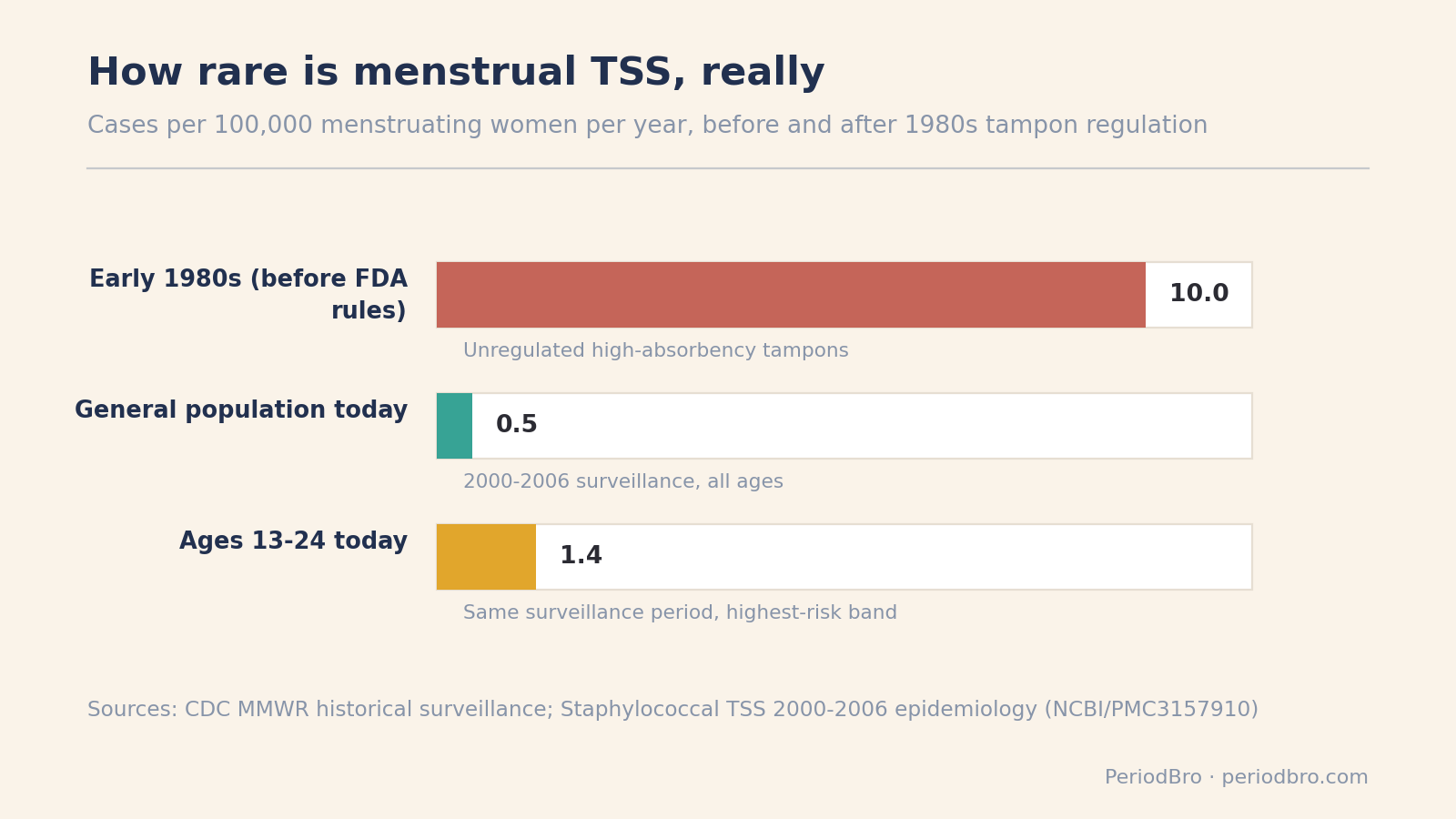
Rare, but not zero, and the age bracket that includes your daughter is the one still showing up more often than the general average.
One myth worth killing here: TSS isn’t only a first-tampon-use risk. A lot of what dads half-remember from decades ago treats it as tied to inexperience, something you only have to worry about the first few cycles. The risk is tied to how a tampon is used on any given cycle. The wrong absorbency or a longer-than-usual wear time on cycle forty can matter as much as cycle one (Cleveland Clinic).
If any of this sounds familiar from a different angle, it’s because the mechanism is identical to what shows up in toxic shock syndrome warnings written for adult partners. The biology doesn’t change with age. What changes is who’s paying attention and how early they catch it, which is exactly where a dad who knows the short list of signs has more leverage than he might think.

The warning signs that mean stop and call a doctor now
The signs here cluster and move fast, sometimes within 24 hours.
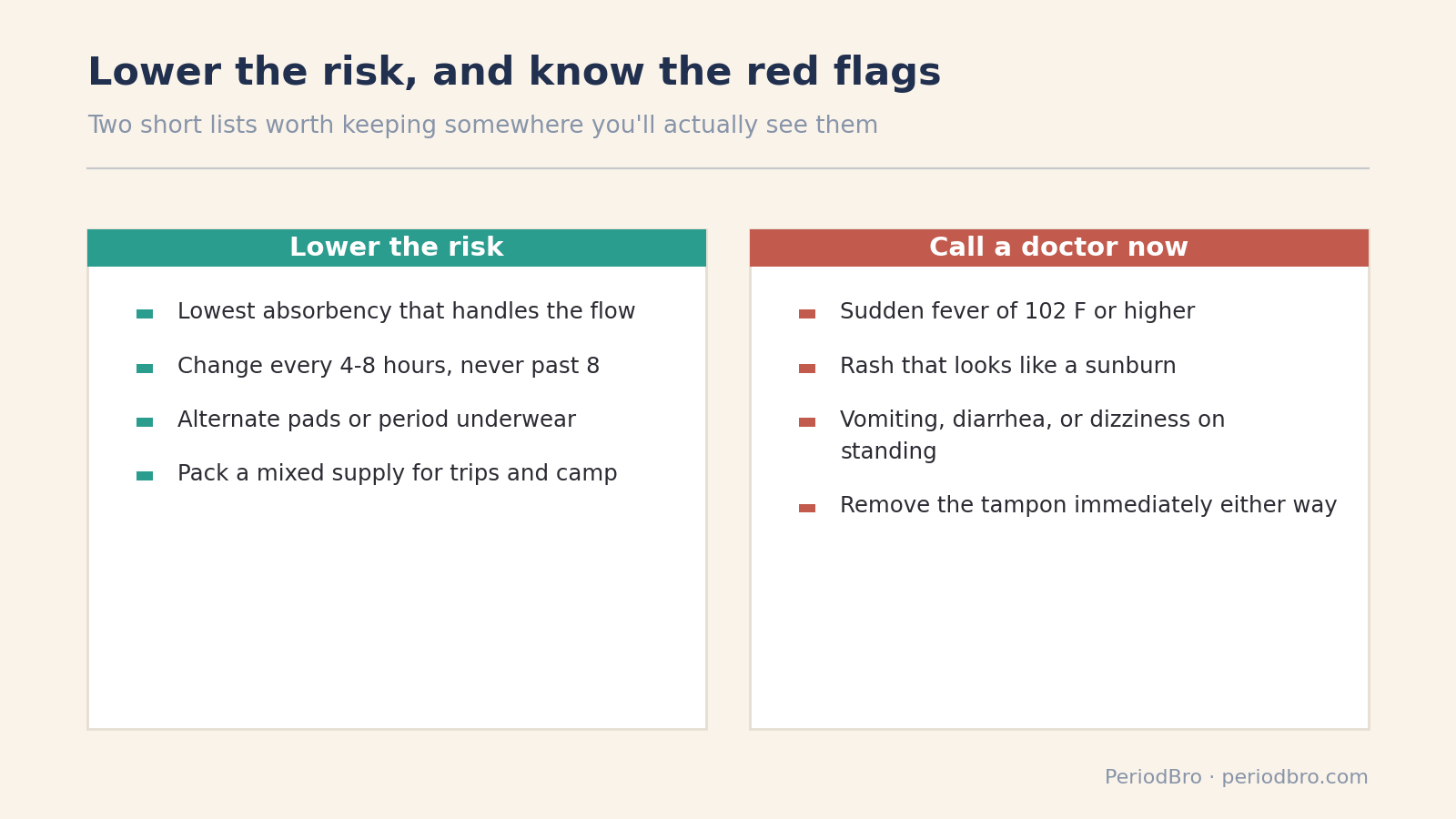
Call a doctor immediately, or go to urgent care, if she has a sudden high fever (102°F or higher) along with any of the following: a rash that looks like a sunburn, especially across the palms and soles, vomiting or diarrhea, dizziness or fainting when she stands up, or muscle aches severe enough that she’s limping or avoiding movement (Mayo Clinic). Confusion or unusual disorientation is a further red flag and, combined with the fever and rash, is a reason to go to the emergency room rather than wait for a callback.
The specific trigger to remember: if she’s currently using a tampon, or used one in the last day, take it out right away regardless of how the rest plays out. There’s no downside to removing it early, and it’s the first thing a doctor will ask.
What makes this tricky for a dad is that the early signs look almost exactly like a stomach bug or heat exhaustion. A fever on its own, without the rash and vomiting, is common and usually unrelated. The combination is what changes the calculus, especially with a tampon in the picture.
How to lower the risk without turning it into a lecture
You’re not going to supervise her tampon changes, and you shouldn’t try. What you can control is what’s around her and what’s normalized in the house.
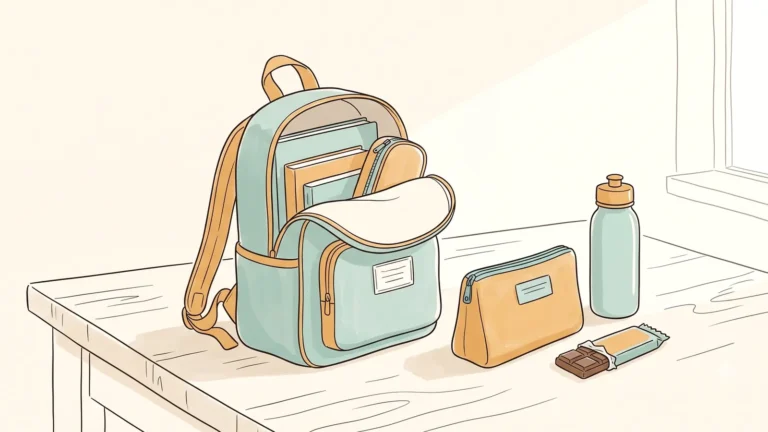
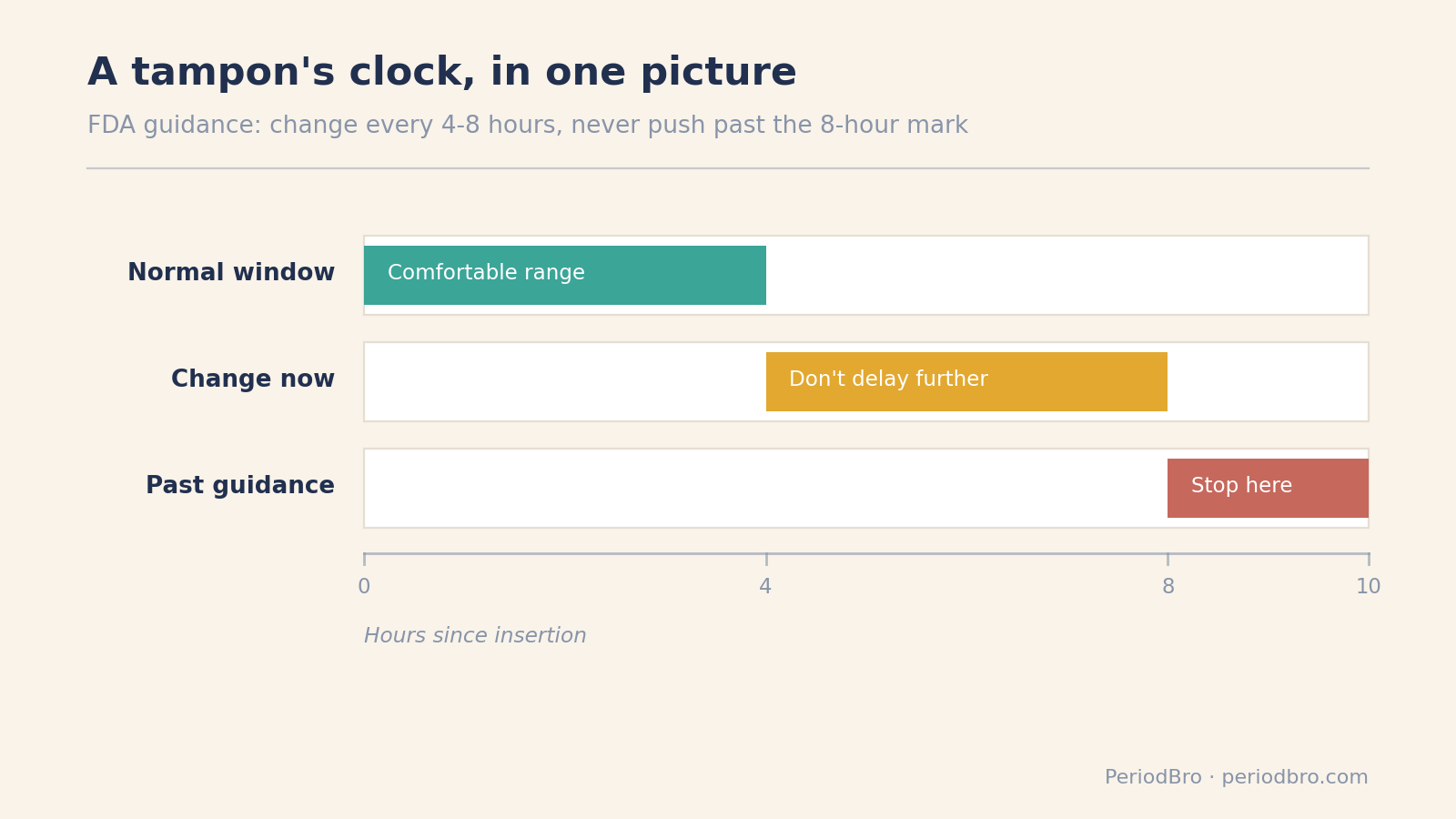
The FDA’s guidance is simple: use the lowest absorbency that handles the flow, and change it every four to eight hours, never pushing past the eight-hour mark even overnight (FDA, facts on tampons). Alternating pads or period underwear with tampons, especially overnight or on lighter days, cuts down on how long any one tampon sits in place. None of this requires a conversation about her body. It requires her having both pads and tampons stocked at home so switching isn’t a hassle, and it means her gym bag and school locker aren’t running on whatever she grabbed last during sports season or a long practice day.
If she’s still figuring out how to use a tampon for the first time, the absorbency question is worth one short, practical conversation: start with the lowest size that works, don’t reach for “super” out of convenience, and set a phone reminder if she tends to forget she has one in. It’s logistics, not a values talk.
Travel and camp weeks are where this quietly gets harder to track, since she’s out of the house and out of her normal rhythm. Before she leaves for a trip, sleepover, or camp stay during her period, it’s worth packing a small mixed supply rather than assuming she’ll manage with whatever she brought. A few pads alongside the tampons means she’s not stuck reaching for the same one all day just because it’s what’s left in the bag.


The two minutes that make the difference
A dad I know spent a week at a lake with his daughter and her friends. Late on day four, he got a call that she felt “flu-like” and dizzy after a full day of swimming with the same tampon in since morning. It turned out to be heat and dehydration, nothing more. He told me afterward that the two minutes between “something’s wrong” and “okay, it’s just heat” were worse than a real emergency would have been, because he had no checklist in his head. He was guessing.
You don’t need to become an expert. You need four or five specific things to check, so a bad afternoon doesn’t turn into a guessing game with your daughter’s health on the other side of it.
If you’re still not sure
If the symptoms overlap with something more ordinary, a stomach bug, dehydration, a hard practice, and you can’t tell, remove the tampon anyway. It costs nothing and it’s the first question any doctor or nurse will ask. Call the pediatrician’s after-hours line if the fever is moderate and isolated. Skip the phone tag entirely and go straight to urgent care or the ER if you’re seeing the fever-plus-rash combination, or if she’s dizzy enough to have trouble standing (Cleveland Clinic).
The goal is knowing which situations don’t wait, not diagnosing her from the hallway.
One more practical note: if she’s the type who forgets to change on schedule, whether that’s ADHD, a packed sports calendar, or just being fourteen, period underwear or pads as her default on lighter days removes the timing problem entirely instead of relying on her to remember every four hours. This isn’t about avoiding tampons, it’s about not relying on perfect memory as the only thing standing between her and the lowest-risk option.
Toxic shock syndrome in teens isn’t something to lie awake worrying about. It’s rare enough that most dads will go their daughter’s entire adolescence without ever needing this information. But rare isn’t the same as never, and the four or five signs above are the difference between a calm decision and a scramble. Keep them somewhere you’ll remember, and let the low odds be as reassuring as they should be.
PeriodBro provides educational information and is not a substitute for professional medical advice. Always consult a qualified healthcare provider for personal medical decisions, especially anything involving sudden fever, rash, or fainting.