How to Help With Period Cramps: A Partner’s Field Guide (Cause, Relief, and When to Worry)
If your partner curls up on the couch once a month with a heating pad and a face that says “do not talk to me,” you already know cramps are real. What most guys never get told is why they happen, what actually shortens them, and where you fit in. This is the whole map in one place, so you stop guessing and start being useful.
This is our hub for everything we have written about how to help with period cramps, so you can read the overview here and then jump straight to the deep dive on whatever you need tonight. Nothing in here is fluff. Every claim is sourced, and every section points to a longer piece if you want more.
Quick note before we start: we say “she” and “her” throughout because that is who most of our readers are supporting, but none of this depends on it. If you are supporting a wife, a girlfriend, a daughter, a friend, or anyone who menstruates, the biology and the playbook are the same.
What is in this guide
- What period cramps actually are
- How common they are, and how bad they get
- Is her pain normal, or is it something more
- Why some months are so much worse than others
- How to help with period cramps: what actually works
- Painkillers, done right
- Heat
- Movement and gentle exercise
- TENS units and massage
- Food, drinks, and supplements
- Sleep, rest, and position
- The stuff that is overrated
- Back, legs, and joints: the pain that is not in her belly
- When you cannot fix it, and that is the job
- What to say, and the four things to never say
- The mental load nobody assigns you
- Helping when you are not in the room
- When cramps come with a heavy period
- Care packages and gifts that are not useless
- If it is your daughter, not your partner
- When it is more than cramps: the doctor conversation
- Your month-by-month playbook
- Common questions
What period cramps actually are
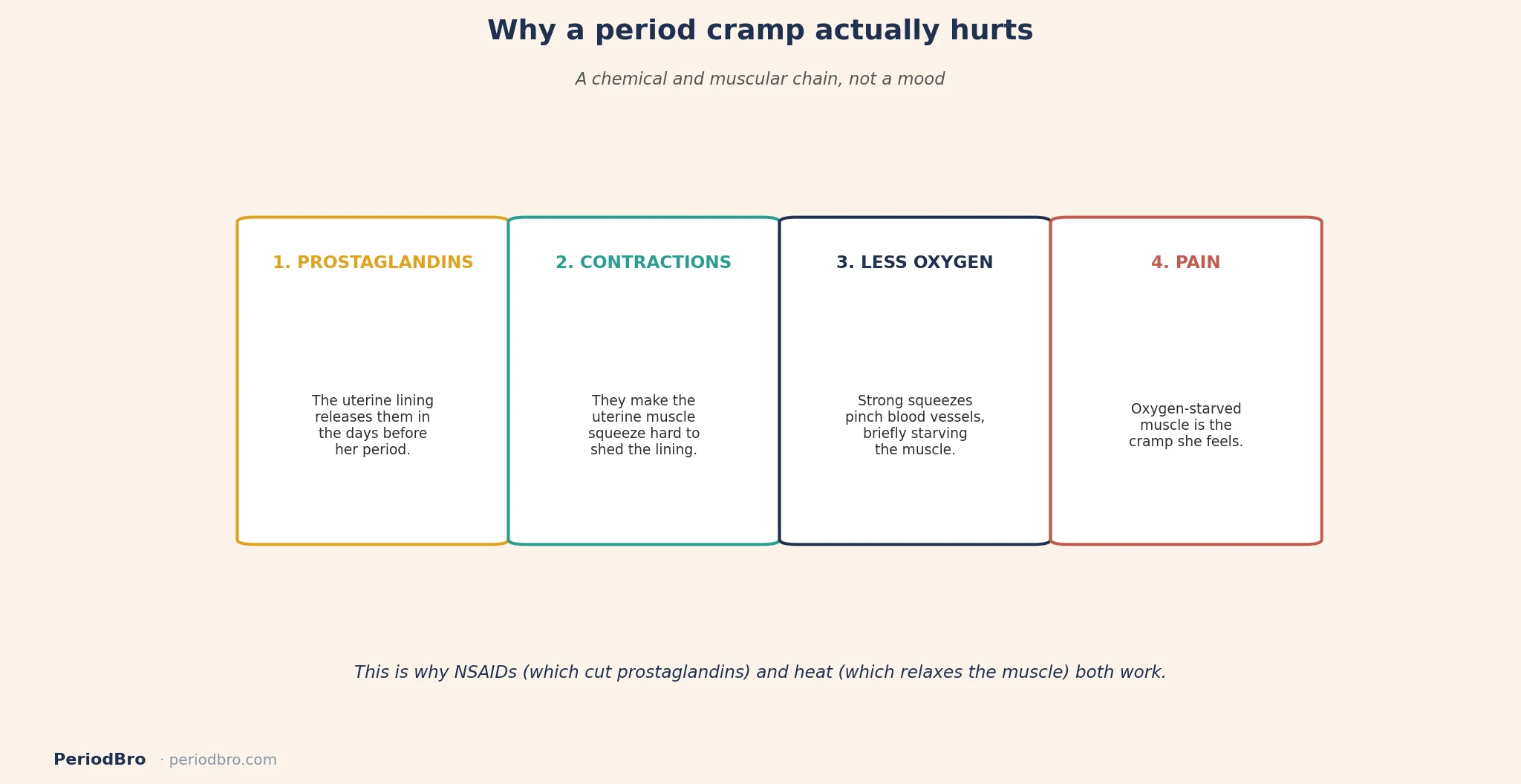
Here is the ninety-second version. In the days before her period, the lining of her uterus makes chemicals called prostaglandins. Prostaglandins make the muscle of the uterus contract so it can shed that lining. Higher levels mean stronger contractions, and strong enough contractions squeeze the blood vessels in the uterine wall, briefly cutting off oxygen to the muscle. Muscle starved of oxygen hurts. That is a cramp (Cleveland Clinic).
The clinical name for this is primary dysmenorrhea, which just means painful periods with no underlying disease driving them. It is the most common kind. The pain usually shows up right as bleeding starts, or a few hours before, and it tends to be worst in the first day or two, then fades (ACOG). It often feels like a dull, heavy ache low in the belly, sometimes with sharp waves, and it can radiate into the lower back and thighs.
The prostaglandin story matters because it explains almost everything else in this guide. The reason a painkiller like ibuprofen works is not that it numbs her. It blocks the enzyme that makes prostaglandins in the first place, so there is less of the chemical driving the contractions (StatPearls). The reason the pain sometimes comes with nausea, loose stools, or a headache is that prostaglandins do not stay politely in the uterus. They spill into the bloodstream and nudge the gut and blood vessels too. So when she says her whole body feels off, she is not exaggerating.
The two chemicals involved are worth naming, because they explain the quality of the pain. Prostaglandin F2-alpha is the one that makes the uterine muscle clamp down hard enough to briefly choke off its own blood supply, which is the deep, gripping ache. Prostaglandin E2 makes the local nerve endings more sensitive, so the same squeeze hurts more (StatPearls). Endometrial prostaglandin levels track directly with how severe the pain is, which is the scientific way of saying more of these chemicals means more pain. It is not a subjective thing she can talk herself out of.
One more useful frame. Because the uterus is a muscle doing hard, repeated contractions, a period cramp is closer to a charley horse or a labor contraction than to a stomach ache, even though it lives in roughly the same neighborhood. That comparison helps a lot of partners take it seriously. Nobody tells a guy with a seizing calf muscle to just relax and push through. The same courtesy applies here.
If you want the fuller breakdown of the biology, without needing a medical degree, we wrote a plain-language version in what actually works for period cramps. For now, hold onto one idea: cramps are a chemical and muscular event with a real, measurable cause. They are not a mood, and they are not something she can decide to stop feeling.

How common they are, and how bad they get
Cramps are close to universal. Depending on the study, somewhere between 45 and more than 90 percent of menstruating people report period pain, and reviews of adolescents and young adults put it as high as 94 percent (Reproduction and Fertility, 2025). So if she gets cramps, she is not fragile or unusual. She is in the large majority.
What varies is severity. Roughly a third of people with period pain describe it as moderate to severe, meaning it interferes with daily life: missing work or class, canceling plans, lying down because standing is too much (Reproduction and Fertility, 2025). This is the part a lot of partners underestimate. “It is just cramps” and “she physically cannot get off the bathroom floor” can both be true in the same relationship on different months.
There is a newer wrinkle on this that is worth knowing. Researchers have started treating severe period pain as a signal worth taking seriously over the long run, not just a monthly annoyance. Reporting on emerging work in the field, National Geographic noted a study finding that teenagers with severe period pain had a substantially higher risk of chronic pain conditions later in their twenties (National Geographic, 2025). That does not mean her cramps doom her. It means dismissing severe pain as normal is exactly the wrong instinct, both medically and as a partner.
And here is the uncomfortable backdrop. For a problem this common, the care is thin. A 2025 real-world study found large gaps in awareness, help-seeking, and diagnosis for period pain, with many people never raising it with a clinician at all, often because they were raised to believe suffering through it was just part of being a woman (JMIR, 2025). That is where an informed partner quietly matters. You are not her doctor, but you can be the person who does not roll his eyes, who takes it seriously, and who nudges her toward help when a pattern looks wrong.
Researchers have started calling this out plainly. A 2025 paper described a genuine gap between how widespread period pain is and how few well-studied treatments exist, arguing the whole area has been under-researched and under-funded for decades relative to its size (Reproduction and Fertility, 2025). You do not need to fix that system. But it is useful context for why she may have absorbed the message that her pain does not count, and why your simply refusing to treat it as trivial can be quietly radical.
Is her pain normal, or is it something more
This is the single most important section in the guide, so read it even if you skim the rest.
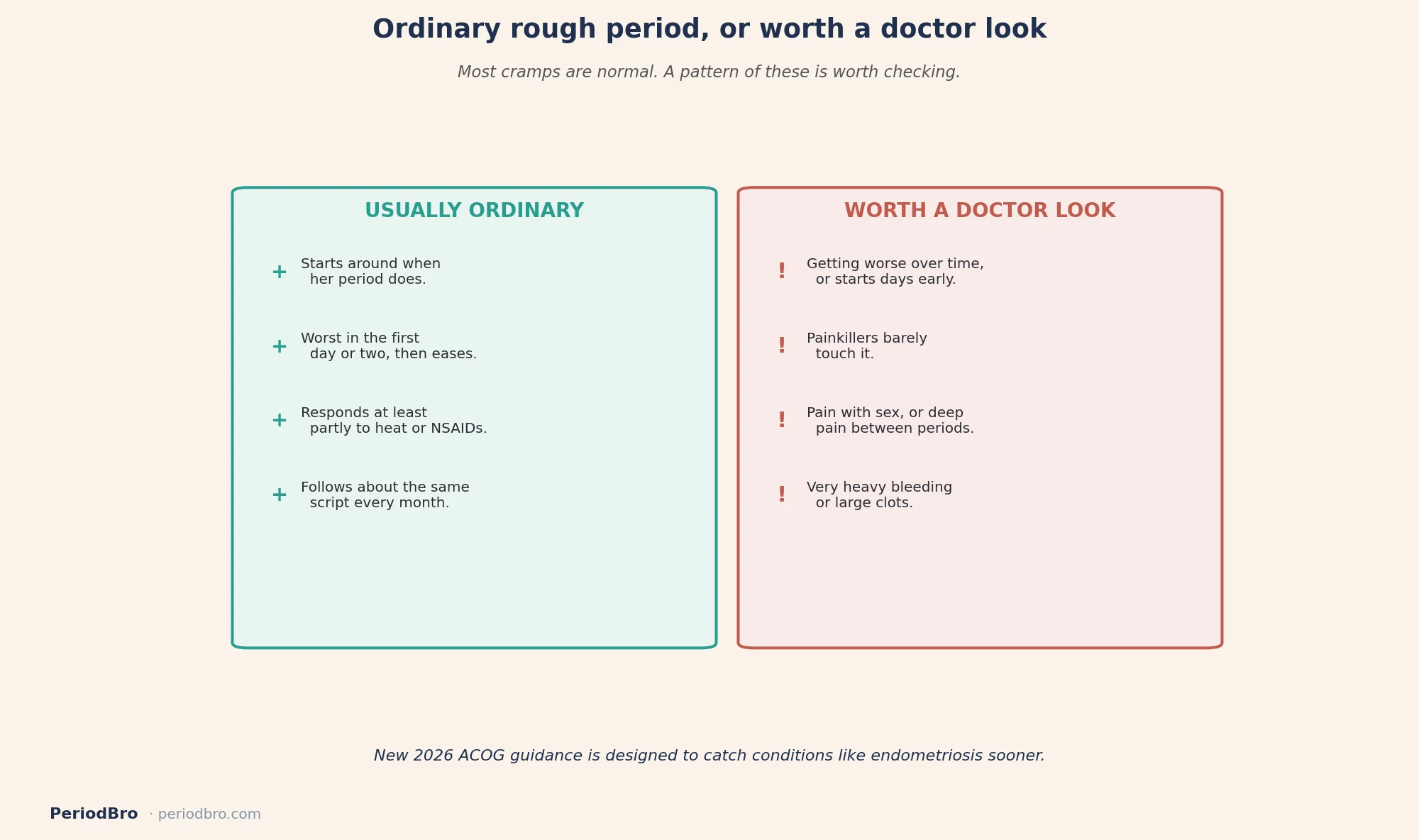
Most cramps are primary dysmenorrhea: painful, but not a sign of disease. The rough baseline for “normal” looks like this. Pain that starts around when her period does, lives mainly in the first day or two, responds at least partly to heat or an over-the-counter painkiller, and follows roughly the same script each month (ACOG). Uncomfortable, sometimes miserable, but predictable and manageable.
Then there is secondary dysmenorrhea, where the pain is a symptom of an underlying condition like endometriosis, adenomyosis, or fibroids. The signals that point that way are worth memorizing, because she may have normalized them for years:
- Pain that is getting worse over time rather than staying steady.
- Pain that lasts most of the period, or shows up well before bleeding and lingers after it ends.
- Pain that over-the-counter painkillers barely touch.
- Pain during sex, when using the bathroom during her period, or deep pelvic pain between periods.
- Cramps paired with very heavy bleeding, large clots, or periods that soak through protection in an hour or two (ACOG).
Endometriosis alone affects roughly 1 in 10 women of reproductive age, and it is badly under-diagnosed, historically taking years to catch (World Health Organization). We go deep on where the line sits in is her period pain normal, and there is good news on the diagnosis front that we will get to near the end of this guide. For right now, your job is simpler than diagnosing anything: notice the pattern, believe her, and if any of those red flags fit, gently support the idea of seeing a doctor. You are not being dramatic. You might be the reason she finally gets answers.
Why some months are so much worse than others
You have probably noticed this. One month she barely mentions it. The next she is flattened. Same person, same body, wildly different experience. There is a reason, and it is not random.
It comes back to prostaglandins. The amount her body produces is not identical every cycle, and higher prostaglandin months mean stronger contractions and more pain (Cleveland Clinic). On top of that baseline, two everyday factors turn the volume up, and they happen to be the two you can actually help with.
The first is stress. Chronic stress is associated with more severe menstrual pain, likely because stress hormones interact with the same inflammatory pathways (Mayo Clinic). A brutal week at work before her period is not a coincidence when the cramps land harder. The second is sleep. Poor sleep and pain feed each other in a loop: pain wrecks sleep, and short sleep lowers the pain threshold for the next day (PMC, 2023).
A few other things nudge a given month harder. Dehydration and a lot of salty, processed food can worsen the bloating that rides along with cramps. A month where she has been more run down, fighting off a cold, or skipping meals can hit harder. And after a break in her usual routine, coming off the pill, a stretch of travel, a big change in exercise, the pattern can shift for a cycle or two. None of this is her fault or her failure to manage. Bodies are not machines that output identical results every month, and expecting them to is where a lot of partners get quietly judgmental without realizing it.
So a “bad month” is often a high-prostaglandin cycle stacked on top of a stressful, under-slept week. You cannot change her prostaglandin levels. You can absolutely take some load off in the days before her period and protect her sleep. We break the whole thing down in why her period cramps are worse some months. The practical takeaway: the help starts before the pain does, and the months you notice her bracing for a hard week are the months your setup work matters most.
How to help with period cramps: what actually works
Now the part you came for. There is a lot of noise online about period pain remedies, so we are going to sort it by evidence, strongest first. The honest headline: a small number of things work reliably, a few more help some people, and a lot of popular advice is basically a coin flip. Knowing the difference is what makes you useful instead of just busy.
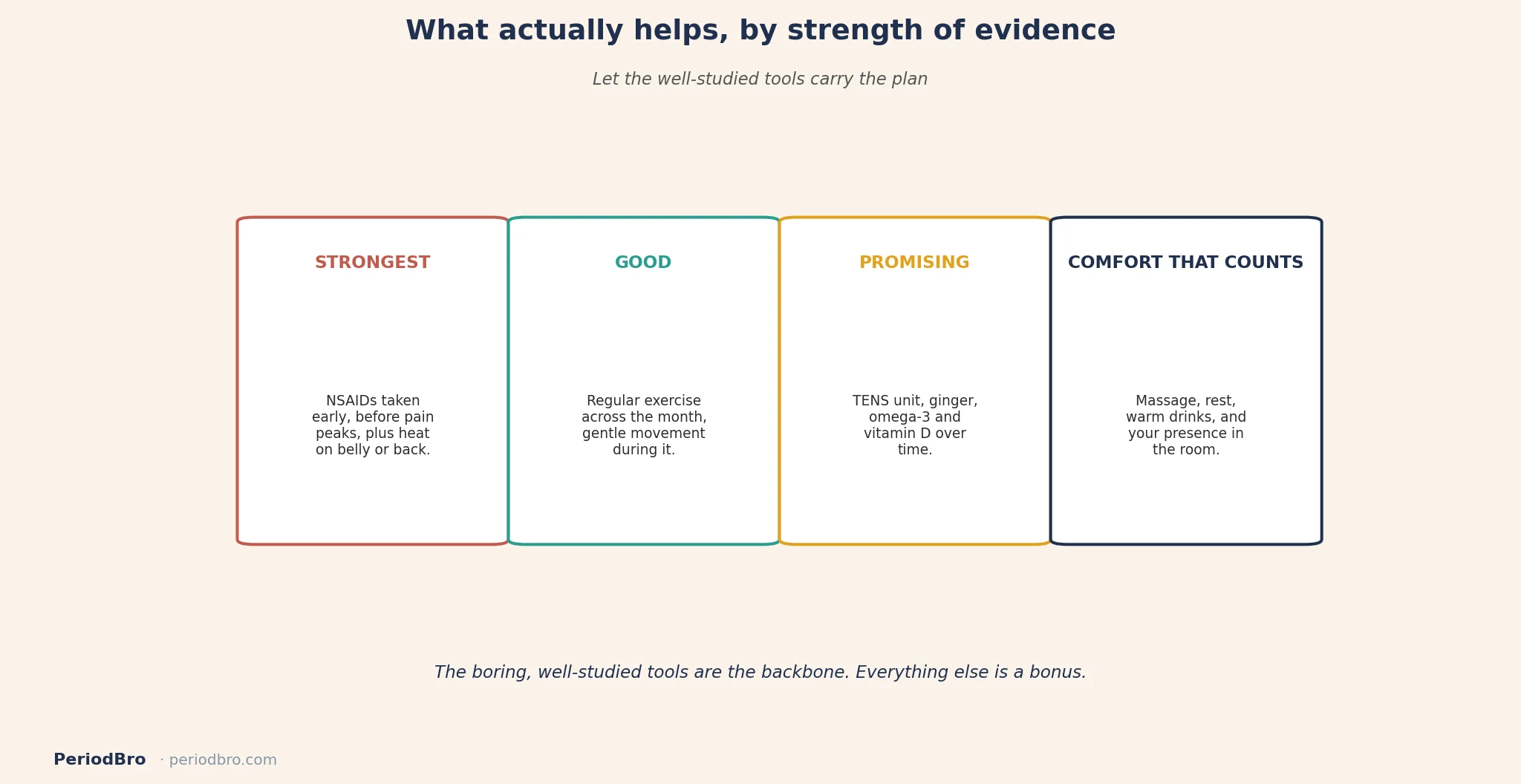
The tiers, roughly, look like this. Solid evidence: NSAID painkillers taken early, and heat. Good evidence: regular exercise across the month, and gentle movement during it. Promising but more variable: TENS units, and a few supplements like ginger, omega-3, and vitamin D. Comfort that matters even without a big evidence base: massage, rest, warm drinks, and food she can actually stomach. Let us walk through each.
Painkillers, done right
Over-the-counter NSAIDs are the most reliably effective self-care tool for cramps, and it is not close. This is the ibuprofen and naproxen family, sold as Advil, Motrin, Aleve, and store brands. A large Cochrane review found NSAIDs are significantly more effective than placebo for period pain (Cochrane). They work because, unlike a painkiller that just dampens the signal, they cut prostaglandin production at the source (StatPearls).
The catch, and the thing almost nobody does right, is timing. Because these drugs stop prostaglandins from being made, they work best taken before the flood, not after. The move is to start at the very first twinge, or even the day her period is due if her cramps are predictable, and then keep to a regular dose for the first day or two rather than chasing pain that has already peaked (Mayo Clinic). If she waits until she is doubled over, she is trying to bail out a boat that is already full.
A quick word on which one, since the pharmacy aisle is confusing. Ibuprofen (Advil, Motrin) is short-acting, so it needs re-dosing every several hours, while naproxen (Aleve) lasts longer and can mean fewer doses across the day. Both are NSAIDs and both cut prostaglandins, so it often comes down to which one her body likes and what her doctor or pharmacist suggests (Cochrane). One thing to flag: acetaminophen (Tylenol) is a different kind of drug that does not target prostaglandins the same way, so it tends to be weaker for cramps specifically, though it is an option for people who cannot take NSAIDs. She should not double up two different NSAIDs at once, and she should always follow the dose on the label.
Two honest caveats. First, NSAIDs are not for everyone. People with stomach ulcers, certain kidney issues, asthma triggered by these drugs, or who are pregnant should check with a doctor, and they are easier on the stomach taken with food. Second, they do not work for a meaningful share of people. Recent reviews estimate NSAIDs fail to provide adequate relief for roughly 18 percent of women (Heat therapy meta-analysis, 2025). That is not her being difficult. That is biology, and it is exactly why the rest of this list exists. We put the full buyer-level detail, including how NSAIDs compare and when to stop reaching for the bottle, in the best pain relief for period cramps.
Your role here is small but real. Know where the painkillers are. Know which one she prefers and roughly when in her cycle to hand it over without being asked. And never turn a dose into a debate. “Have you taken anything?” delivered gently once is help. Delivered three times, it is nagging.
Heat
If NSAIDs are the strongest tool, heat is the most underrated one, and it might be the single best thing you personally can set up. A 2025 systematic review and meta-analysis that pulled together 57 randomized trials found that heat therapy achieved pain relief comparable to NSAIDs, with a better safety profile, and reduced pain versus no treatment (PMC, 2025). A hot water bottle can hold its own against ibuprofen for a lot of people, and it does not upset anyone’s stomach.
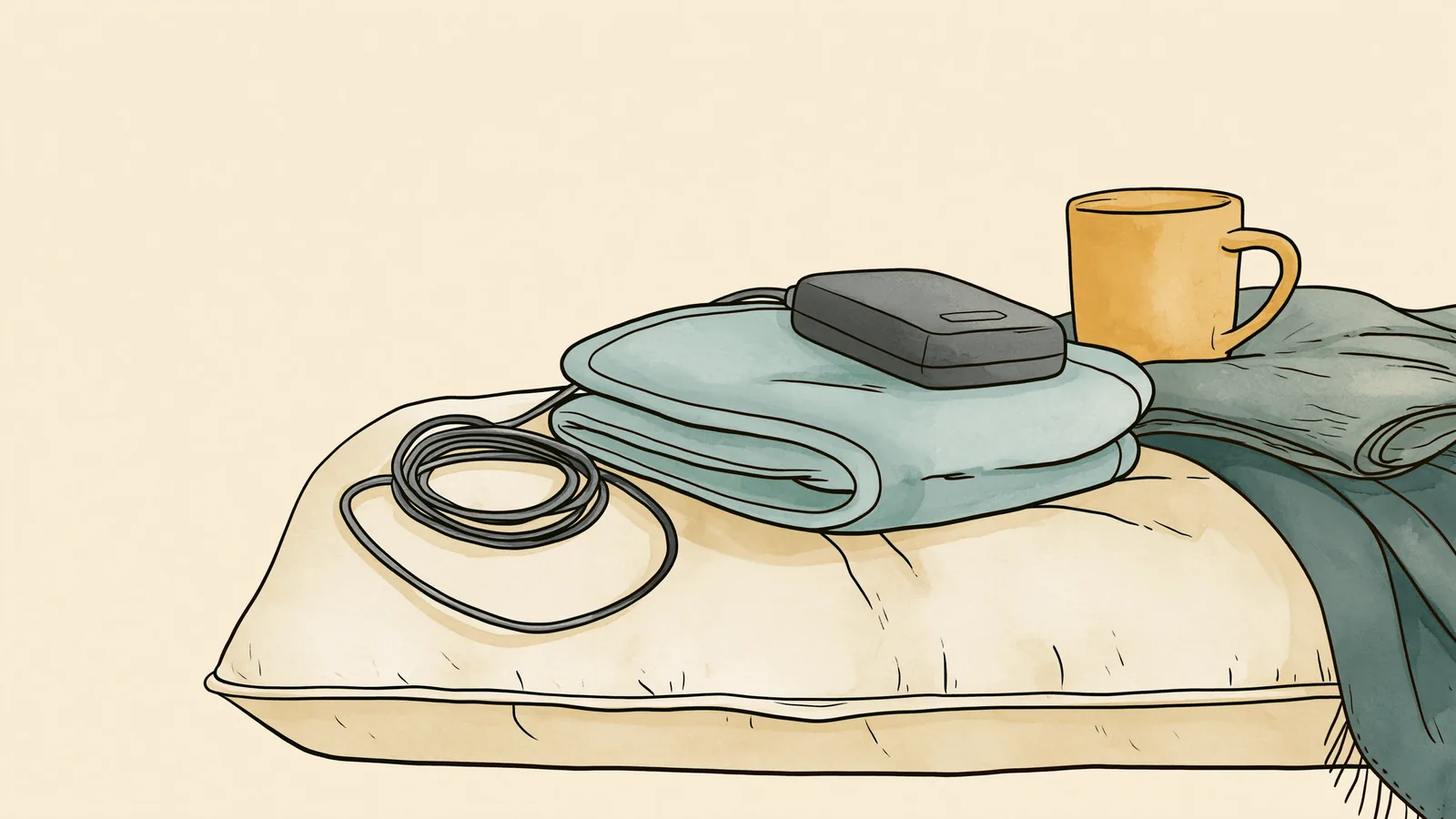
Heat works by relaxing the contracting uterine muscle and improving blood flow to the area, which directly counters the oxygen-starvation mechanism behind the pain. Warmth of around body temperature or a little above, applied to the lower belly or back, is enough. In practice, the options are a hot water bottle, an electric heating pad, or a stick-on heat patch she can wear under her clothes at work. All of them work. The wearable patches are the quiet MVP because they travel, so the relief does not end when she leaves the house, and an electric pad is the low-effort home option because it holds temperature without refilling.
A small but real bonus: heat and an NSAID are not either-or. They work through different routes, the drug on the chemistry and the heat on the muscle, so using both together is a common and sensible combination rather than doubling up on one thing. If she can only do one because she cannot take NSAIDs, the 2025 evidence says heat is a genuinely strong plan B, not a weak consolation (PMC, 2025).
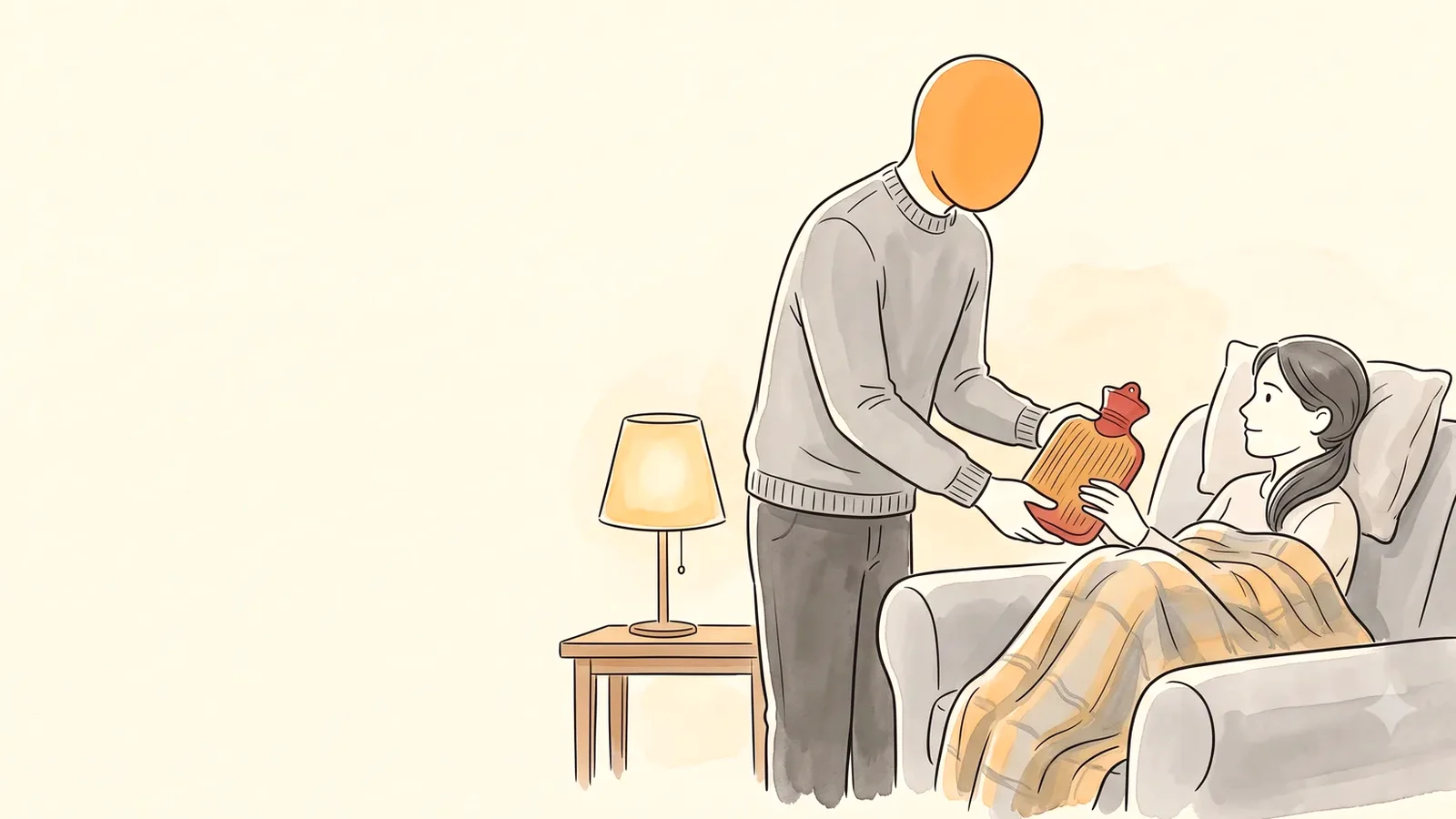
This is the easiest win for a partner in the entire guide. You do not need her permission or a conversation. You notice the day, you fill the hot water bottle or warm the pad, and you put it where she is. It is the physical version of “I see it, I am on it.” If you want help choosing hardware that does not break in a month, we compared the options in the best heating pad for period cramps.
Movement and gentle exercise
This one is counterintuitive, because when you are in pain the last thing you want is to move. But exercise has real evidence behind it, on two timescales.
Across the whole month, regular exercise is one of the better-supported ways to reduce how bad cramps get. A network meta-analysis comparing different exercise types for period pain found meaningful reductions in pain intensity, with aerobic exercise, stretching, and yoga all showing benefit (PMC network meta-analysis). This is prevention, not rescue. It is the reason “she should really exercise more” is technically true and also useless to say to someone mid-cramp.
In the moment, the evidence points toward gentle movement over total shutdown. Not a workout, but light activity: an easy walk, a few slow stretches, or restful yoga poses that open the hips and lower back. Newer reviews of movement-based approaches, including lumbopelvic and stretching interventions, continue to find they lower pain intensity in primary dysmenorrhea (Frontiers in Medicine, 2025). The key word is gentle. This is not “push through it.” It is “lying completely rigid all day can stiffen you up, so a little easy movement can help.”
How you help: do not prescribe. Offer to be the excuse. “Want to do a slow lap around the block with me?” is company. “You should really get up and move” is a lecture, even when you mean well. The same goes for the preventive side. Nagging her to exercise more will not build a habit, but making movement something you do together, a regular walk, a stretch routine you both keep, quietly does. You are not her personal trainer. You are the low-pressure reason it happens. We cover the rest-versus-movement balance, including the positions that actually help, in the best positions and rest to ease her cramps, and drug-free approaches broadly in drug-free ways to ease her period cramps.

TENS units and massage
Two hands-on options that sit in the “worth trying” tier.
A TENS unit is a small device that sends mild electrical pulses through pads placed on the skin, which can interrupt pain signals and prompt the body’s own painkillers. For period cramps the evidence is promising though less rock-solid than heat or NSAIDs, and high-frequency TENS in particular has shown benefit for some people (Cleveland Clinic). It is drug-free, reusable, and some people who get no relief from painkillers swear by it. It is also not magic and does not work for everyone. If you are curious whether it is worth the money, we dug into it in does a TENS unit help period cramps.
Massage is lower on the evidence ladder but high on the “this is what being cared for feels like” scale, and those are both worth something. Gentle massage of the lower back and abdomen can ease muscle tension and, just as importantly, delivers the reassuring physical presence that itself reduces pain, which we will get to shortly. There is a right and wrong way to do it, and pressing hard on a cramping belly is the wrong way. We wrote a partner-specific how-to in how to massage her period cramps away. The short version: ask first, start light, follow her feedback, and a warm hand resting on her lower back is sometimes the whole treatment.
Food, drinks, and supplements
You cannot cook a cramp away, but a few dietary things have real evidence, and a lot of small comforts add up.
Supplements with actual data. A few have surprised us with how much research supports them. Omega-3 fatty acids, the kind in fish oil, have a systematic review and meta-analysis behind them: daily supplementation over two to three months reduced pain and cut how many painkillers women needed (Omega-3 meta-analysis). They work by dialing down the inflammatory compounds, including prostaglandins, that drive cramps in the first place. Vitamin D has a systematic review showing regular supplementation lowered period pain, which makes sense given vitamin D’s role in inflammation (PMC vitamin D review). And ginger has repeatedly beaten placebo for cramp severity in trials, thanks to anti-inflammatory compounds called gingerols (UPMC HealthBeat, 2025). None of these is an overnight fix. They are a slow, preventive play, best started well before her period, and worth a quick word with a pharmacist or doctor if she takes other medication.
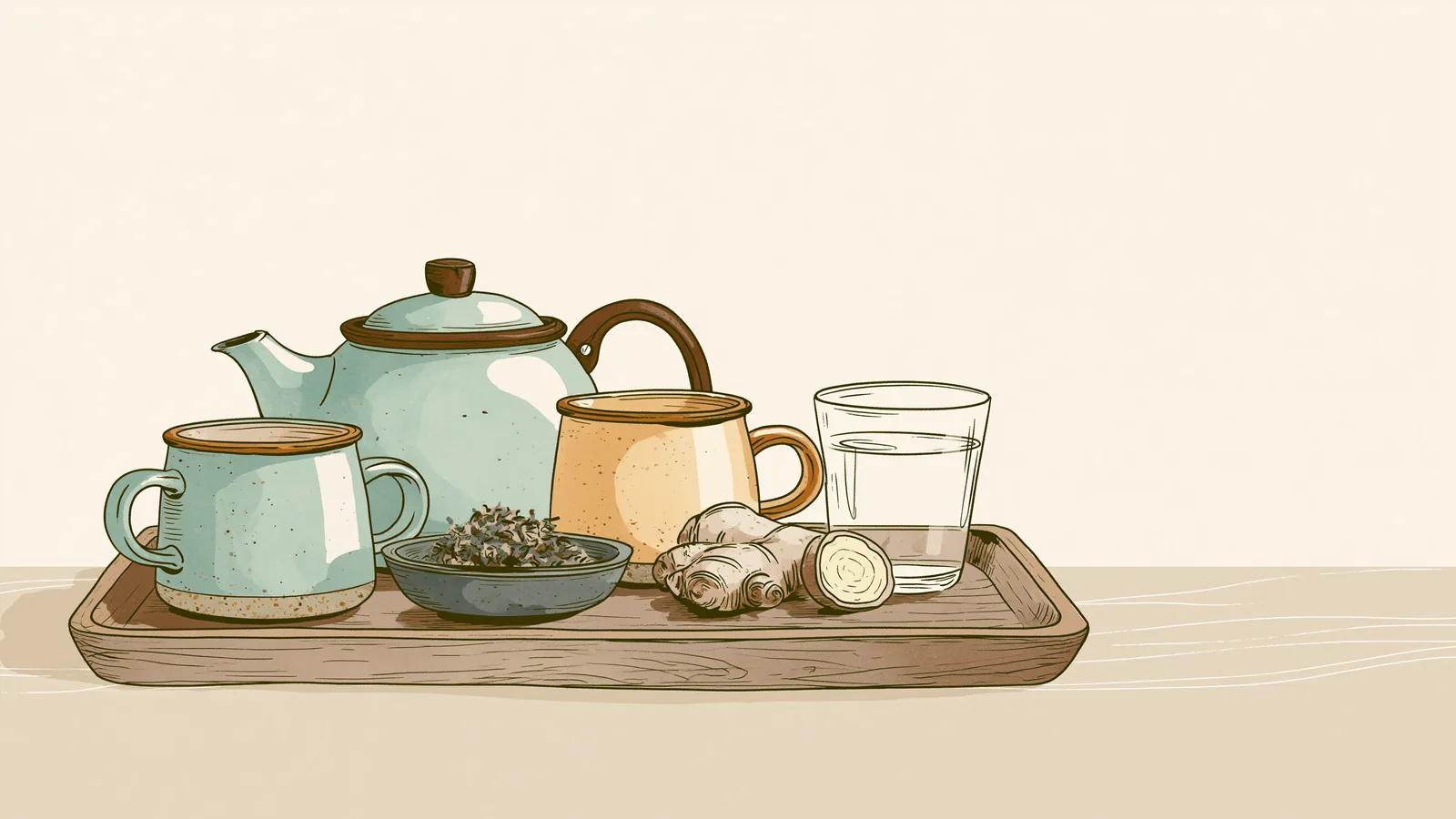
Drinks. This is mostly about comfort and hydration, with ginger tea pulling double duty given the evidence above. Warm drinks are soothing, staying hydrated helps with the bloating that rides along with cramps, and cutting back on excess caffeine and alcohol in that window can take the edge off for some. We put together the specifics in the best tea and drinks to ease her cramps.
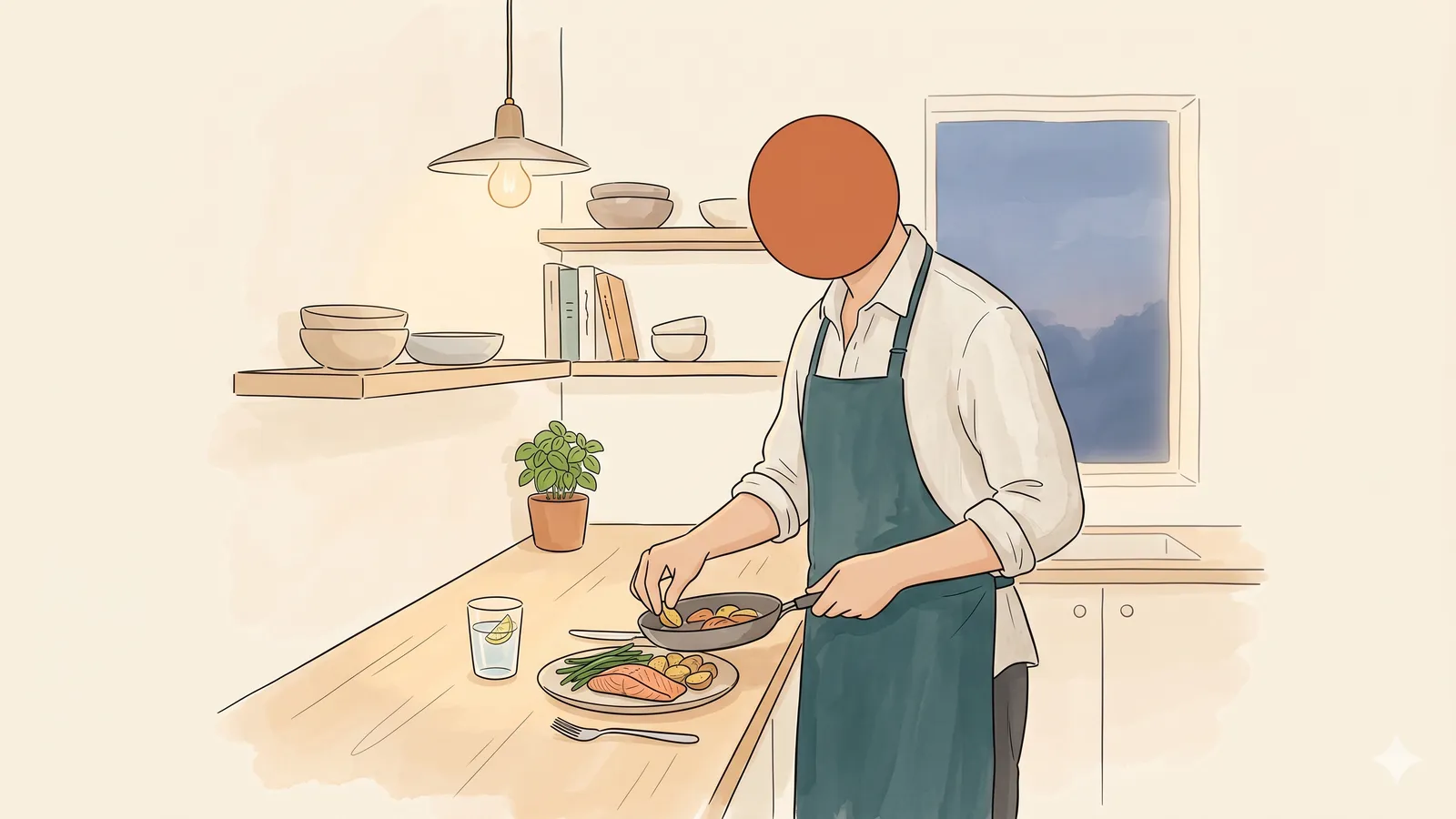
Food. An anti-inflammatory lean during her period, more omega-3-rich fish, leafy greens, nuts, and less of the heavily processed, high-salt stuff that worsens bloating, is a reasonable long game (UPMC HealthBeat, 2025). But honestly, in the moment, the best food is the food she will actually eat when she feels rough. Sometimes that is a nutritious bowl of something warm. Sometimes it is toast and chocolate, and that is fine. Your job is not nutrition policing. It is making sure she does not have to cook. We have a partner cooking guide in what to cook for her when she has cramps, and a get-ahead-of-it stock list in the best foods to have at home before her period.
Sleep, rest, and position
We already saw that sleep and pain run in a loop, where bad pain wrecks sleep and bad sleep worsens the next day’s pain (PMC, 2023). That makes protecting her sleep on cramp nights one of the higher-leverage things you can do, and it is almost entirely in your control.
The setup is simple. A slightly warmer bed or a heat source on her belly, a cool and dark room, water within reach, and a painkiller timed so it is working when she is trying to fall asleep rather than wearing off at 3 a.m. The classic curled-up fetal position takes pressure off the abdominal muscles and is a genuine comfort move, not just a habit. We laid out the full nighttime routine in how to help her sleep through period cramps.
Rest during the day matters too, though “rest” does not mean lying stiff as a board for twelve hours, which we saw can backfire. It means permission. A lot of people feel guilty resting, like they should be powering through. You giving a clear, no-strings “I have got the rest of today, go lie down” removes that guilt, and the guilt is often as heavy as the cramp.
The stuff that is overrated
In the spirit of not wasting your money or her hopes, a quick reality check on things that get more hype than their evidence supports. This is not “these never help anyone.” It is “do not treat these as your main plan.”
Some herbal teas beyond ginger, most detox and “hormone balancing” products, and a lot of the supplement aisle have thin or mixed evidence for cramps specifically. The broader problem, which researchers have flagged directly, is a real gap between how common period pain is and how few genuinely well-studied treatments exist, which leaves a vacuum that marketing happily fills (Reproduction and Fertility, 2025). If a product promises to erase cramps and costs a fortune, be skeptical. The boring stuff, heat, timed NSAIDs, movement, sleep, is where the evidence actually lives.
That said, do not turn skepticism into dismissal. If she finds that a particular tea, a certain stretch, or a comfort ritual genuinely helps her, that is worth something even where the trial data is thin, because comfort and a sense of control matter when you are in pain, and there is no prize for being the guy who fact-checks her hot water bottle. The line to hold is simple: let the well-evidenced tools be the backbone of the plan, and let the comfort extras be extras, not the thing you are betting a rough day on. Where you do want to be actively skeptical is anything expensive that promises a cure, or anything that steers her away from seeing a doctor when the red flags are there.
Back, legs, and joints: the pain that is not in her belly
Cramps get all the attention, but for a lot of people the period brings aches that show up nowhere near the uterus, and partners often miss these because they do not look like “cramps.”
Lower back pain is extremely common, because the same uterine contractions and prostaglandins that cause belly cramps refer pain into the lower back, and the muscles there tense up in response. For some people the back ache is actually the main event. We covered it in period back pain. Leg aches, especially in the thighs, come from the same referred-pain mechanism plus prostaglandins affecting circulation and muscle, which we explained in period leg cramps. And some people get genuine joint aches around their period, tied to the hormonal shifts and inflammation of the cycle, which we broke down in period joint pain.
The reason to know this: when she says her back is killing her or her legs ache, and it lines up with her cycle, you do not need to treat it as a separate mystery. Same root cause, same toolkit. Heat on the lower back works just as well as heat on the belly. A gentle back rub covers double duty. And it saves you from the classic mistake of dismissing a period symptom because it is not the textbook one.
When you cannot fix it, and that is the job
Most guides skip this next part, and it might be the most important. Some months, none of it is enough. You have done the heat, the painkiller is in, the room is dark, and she is still in pain. Your instinct will be to feel useless. That instinct is wrong, and the science says so.
The presence of a supportive partner measurably reduces how much pain a person feels. In controlled experiments, active support from a romantic partner during painful stimulation lowered both the reported pain and the body’s stress response, and this happened partly through presence itself, not just through anything clever the partner said (PubMed, 2023). More recent work found that supportive company, in person or even remotely, reduced acute pain compared with facing it alone (The Journal of Pain, 2025). Being there is not a consolation prize, it is a documented painkiller with data behind it.
So when you cannot fix it, you switch modes. You stop trying to solve and you start being present. That means sitting with her without narrating solutions, letting her set the terms, and resisting the very male urge to make her pain a problem for you to conquer. “I cannot take it away, but I am not going anywhere” is a complete sentence and often the right one. We wrote a whole quiet guide to this, including a short script for the moment, in how to be supportive when you cannot fix her pain.
Worth naming the trap directly, because nearly every guy walks into it. We are wired to treat pain as a problem statement that demands a solution, so when the solutions run out we feel like we have failed and, worse, we sometimes start acting frustrated, which she reads as being frustrated with her. That is the moment support quietly turns into pressure. The reframe that fixes it: your job on a bad month was never to end the pain. It was to make sure she was not alone in it. Judged against that job, sitting quietly with a hand on her back counts as a win, not a fallback. The men who get this right measure a bad month by whether she felt alone, not by whether the pain stopped.
One caution that trips a lot of guys up: sometimes she wants to be left alone, and that is not rejection. Presence does not always mean hovering. Sometimes the most supportive presence is being in the next room, phone on, ready, having said “shout if you need me.” Read the room, ask once what she wants, and believe her answer.
What to say, and the four things to never say
Words are a bigger part of this than most guys expect. You can do everything else right, hand over the heat and the painkiller, and still step on a landmine with one careless sentence. When someone is in pain and running low on patience, language lands harder than usual. So it is worth having a few good lines ready and knowing the ones that reliably backfire.
Start with what works, because it is short. “That sounds awful, I am sorry” beats almost anything clever. “What would help right now, or do you just want me here?” hands her control instead of guessing. “I have got dinner, do not think about it” removes a task. Notice that none of these try to fix the pain or explain it back to her. They validate, they offer, they take load off. That is the whole trick, and it is why a validating response tends to calm things faster than a problem-solving one when someone is hurting.
Now the four that reliably make it worse. First, anything that questions whether it is really that bad: “it is just cramps,” “are you sure it is that painful.” You are not in her body, and doubting her pain is its own small injury. Second, the unsolicited fix: “have you tried yoga,” “you should really see someone,” delivered while she is mid-cramp. There is a time for that conversation, and it is not now. Third, making her pain about you: sulking that plans got canceled, or acting like her being unwell is an inconvenience you are nobly tolerating. Fourth, the classic dismissal, “is it that time of the month,” used to wave away a real feeling. That one poisons trust fast.
If you want the fuller field guide to this, we wrote the worst things to say on her period and its companion, what to say when she has PMS. There is also an art to giving her room without disappearing, which we covered in how to give her space. The theme across all of them is the same one running through this whole guide: lead with belief, not solutions.
The mental load nobody assigns you
Here is a subtle thing that separates decent partners from genuinely great ones. It is not just doing the tasks when asked. It is carrying some of the remembering, so she does not have to run the whole operation from a hospital bed of her own making.
Think about what usually happens. She is the one tracking when her period is due. She is the one noticing the painkillers are low and adding them to the list. She is the one who knows a big work week is landing right on day one and quietly bracing. All of that noticing is invisible labor, and it does not stop just because she feels terrible. When you pick up even part of it, you are not being a hero, you are redistributing a load that was silently sitting entirely on her.
What this looks like in practice: knowing roughly when her period is coming without being told, so the supplies are stocked before she has to ask. Clocking that the hard days are near and pre-emptively clearing the calendar of things you can move. Refilling the hot water bottle when you see it go cold instead of waiting for a request. The difference between “let me know if you need anything” and actually anticipating is enormous, because the first one still makes her manage you, and management is the last thing she wants when she is doubled over.
This is exactly the kind of remembering that is genuinely hard to do from memory, which is a big part of why we built PeriodBro. A quiet heads-up two days out that her period is likely starting, with a nudge about what tends to help, converts all this invisible tracking into something you just handle. The point is not the app for its own sake. The point is that she stops being the only person in the relationship who has to keep the whole cycle in her head.
Helping when you are not in the room
Plenty of the time, she gets hit with cramps while you are at work, on a trip, or otherwise not physically there. The good news, from that same body of research, is that support reduces pain even at a distance (The Journal of Pain, 2025). A well-timed text is not nothing. It is a smaller dose of the same medicine.
The trick is doing it without being useless or annoying. A check-in that says “thinking about you, no need to reply, hope the heat is helping” carries warmth and asks nothing of her. You can also do logistics from afar: order the groceries so she does not have to, handle a call she was dreading, move a plan so she is not forced to rally. Handling one concrete task from your phone can lift a real weight. We put the do’s and don’ts together in how to help her with cramps when you are not there.
A few small rules keep remote support on the right side of the line. Keep it low-demand, so a text she can ignore beats a call she has to take. Be specific rather than vague, since “want me to grab your prescription on the way home” is worth ten “let me know if you need anything” messages, because the open-ended offer quietly hands her a task, deciding what to ask for, at the exact moment she has no energy to decide. And do not fish for reassurance that you are being a good partner while she is the one in pain. The whole move is that it costs her nothing and tells her she is on your mind.
When cramps come with a heavy period
Cramps and heavy bleeding often travel together, and the combination deserves its own note because it changes what “help” looks like. Heavy periods, medically called menorrhagia, mean soaking through a pad or tampon every hour or two, passing large clots, or periods that run very long (ACOG). Beyond the cramps, heavy bleeding can leave her drained and lightheaded because it can lead to low iron.
Two things follow. First, on a heavy month, iron-friendly food and extra rest are not fussing, they are addressing a real physiological drain. Second, and this is the safety piece, heavy bleeding is one of those patterns worth a doctor’s look rather than white-knuckling forever, especially if it is new or getting worse. We wrote a partner guide to the whole experience in how to support her through a heavy period. If exhaustion is a bigger theme than pain some months, that low-iron angle is often why, and it connects to what we cover in period fatigue.
Care packages and gifts that are not useless
If you want to put your care into something physical, do it well. The failure mode is generic: a random box of chocolates and a “feel better.” The upgrade is a care package built from this guide, meaning it is actually functional. A good hot water bottle or wearable heat patches, ginger tea, her painkiller of choice already stocked, comfortable socks, dark chocolate because sometimes she just wants it, and something genuinely restful.
The point is not the money, it is the evidence that you paid attention. A gift that shows you understand what she is dealing with lands completely differently from a panic-bought bouquet. We assembled thoughtful, non-useless options in thoughtful gifts for someone with period cramps and a full build in the period care package for her.
If it is your daughter, not your partner
Not every reader here is supporting a partner. Some of you are dads, and your daughter just started getting cramps, and you feel completely out of your depth. First: the fact that you are reading this puts you ahead of most. The biology is identical to everything above, but the relationship and the delivery are different.
With a daughter, the emphasis shifts to normalizing without prying, keeping the house stocked so she never has to ask, and knowing when cramps are bad enough to see a doctor rather than being brushed off with “that is just periods.” The dismissal risk is real and starts young, which is exactly the culture the research on under-treatment describes (JMIR, 2025). A father who takes it seriously changes the story she tells herself about her own pain. We wrote it up specifically for dads in how to help your daughter with period cramps.
A couple of things land differently with a teenager than with a partner. Keep it matter-of-fact rather than making a big emotional event of it, because your calm is contagious and teaches her that this is ordinary, not shameful. Stock a heating pad and painkillers where she can reach them privately, so she is never forced to announce that she is in pain to get help. And take the doctor question seriously early, because severe pain in a teenager is worth attention, not a shrug, and the same 2026 guidance that pushes for earlier diagnosis applies to her too (ACOG, 2026). If a trusted woman in her life can be part of the conversation, great, but do not use “that is her mother’s department” as a reason to check out. Kids clock which parents treat this as beneath them.
When it is more than cramps: the doctor conversation
We come back to the red flags, because there is genuinely new and hopeful information here that could matter to someone you love.
For years, the tragedy of conditions like endometriosis was the delay. People with disease-driven period pain often waited many years and multiple doctors to get diagnosed, partly because confirming endometriosis traditionally required surgery (World Health Organization). That meant a lot of real suffering got filed under “bad cramps” for far too long.
That is changing. In early 2026, the American College of Obstetricians and Gynecologists published new clinical guidance designed specifically to shorten the time to an endometriosis diagnosis. The headline shift is that clinicians are now encouraged to make a presumptive diagnosis based on symptoms, history, and examination, and to start treatment without waiting for surgery to confirm it (ACOG, 2026). The same guidance explicitly names the symptoms that should make a doctor think endometriosis: significant period pain, chronic pelvic pain, pain with deep intercourse, and bowel or bladder pain that tracks with the cycle (ACOG, 2026).
The guidance also puts a name to why so many people got missed for so long. It directly flags that symptoms were too often dismissed, normalized, or misattributed, and that this kind of dismissal prolongs suffering and damages people psychologically, not just physically (ACOG, 2026). In other words, the profession is now formally acknowledging the exact “just deal with it” culture that likely shaped how she thinks about her own pain. That is a reason for optimism, and a reason to take her seriously the next time she wonders aloud whether this is more than normal.
Why does this matter to you, the partner? Because it means the old advice of “just wait and see” is now officially outdated. If her pain fits the red-flag pattern we described, she does not have to accept years of being brushed off. She can walk into an appointment, describe the symptoms clearly, and reasonably expect to be taken seriously and offered treatment sooner. And you can help her do exactly that.
Practically, being useful in the doctor conversation looks like this. Help her track the pattern beforehand, when it hurts, how bad, what it stops her doing, what does not respond to painkillers, so she walks in with specifics instead of “it is bad.” Offer to come along or to take notes, if she wants that. And back her up if she gets dismissed, because being told “that is normal, dear” is still common and a second voice saying “no, this is not normal for her” can change the visit. The deeper framing of where a partner fits in all of this is in is her period pain normal. None of this makes you a doctor. It makes you the person who helped her get to one.
Your month-by-month playbook
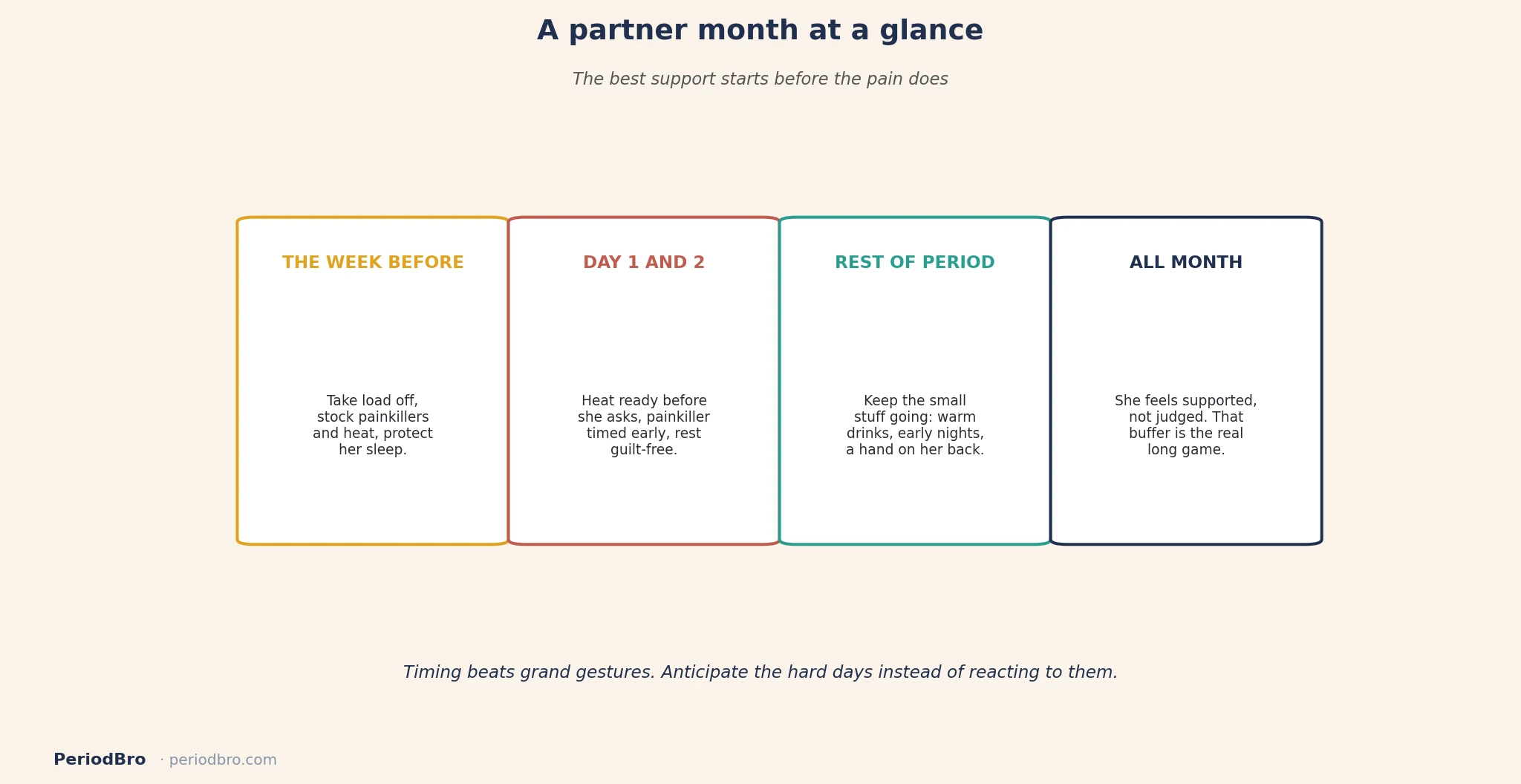
Let us turn all of this into something you can actually run, because knowledge you do not use is just trivia. The trick that separates guys who are good at this from guys who mean well is timing: the best support starts before the pain, not after. That is why understanding her cycle helps, and it connects to the bigger picture we lay out in the luteal phase explained for men.
The week before. This is your setup window. Take some load off so she goes into her period less stressed and better slept, since those are the two amplifiers you can influence (Mayo Clinic). Quietly check the supplies: painkillers stocked, hot water bottle findable, a few easy meals on hand. If she takes preventive supplements like omega-3, this is when they are already doing their work.
Day one and two. Peak cramp window. Heat ready before she asks. Remind her, once and gently, about timing the painkiller early. Cover the tasks so rest is guilt-free. Offer a slow walk, not a workout. Keep the tone light and the pressure at zero.
The rest of the period. Cramps usually ease after the first day or two, but fatigue, back ache, and low mood can linger. Keep the small stuff going, warm drinks, an early night, a hand on her back, without making a production of it. Consistency beats grand gestures here.
All month. The relationship-level work. She feeling genuinely supported, not judged for her pain, is its own buffer against how bad the hard days feel. That is the real long game, and it is the whole idea behind becoming a better partner through her cycle. If you want the ground-level biology behind all of it, the menstrual cycle guide for men is the primer.
This is also, honestly, why we built PeriodBro. Remembering where she is in her cycle, and what tends to help on which day, is a lot to hold in your head. An app that quietly tells you “her period is likely starting in two days, here is what tends to help” turns all of this from a thing you have to memorize into a thing you just do.
Common questions
How long do period cramps usually last?
For most people with ordinary cramps, the worst is the first day or two of the period, easing off after that, and they often start a few hours before bleeding begins (ACOG). Pain that lasts most of the period, or shows up long before it and lingers after, is one of the patterns worth a doctor’s look.
What actually helps period cramps the fastest?
The fastest reliable combination is an NSAID painkiller taken early, before the pain peaks, plus heat on the belly or lower back. Both have solid evidence, and heat in particular held its own against NSAIDs in a large 2025 review (PMC, 2025). Timing is the difference maker.
Are really bad cramps normal?
Painful periods are common, but pain that stops her living her life, keeps getting worse, barely responds to painkillers, or comes with very heavy bleeding is worth getting checked (ACOG). New 2026 guidance is specifically aimed at catching conditions like endometriosis sooner rather than dismissing severe pain (ACOG, 2026).
Can I really do anything, or is this just her problem?
You can do a lot. Beyond the practical tools, the simple presence of a supportive partner has been shown to measurably lower pain in controlled studies (PubMed, 2023). Set up the heat, time the painkiller, take the load off, and just be there. It counts more than it looks.
Why does exercise get recommended if moving hurts?
Two different timescales. Regular exercise across the month lowers how bad cramps get over time (PMC network meta-analysis), which is prevention. During a bad day, only gentle movement is on the table, an easy walk or light stretching, not a workout. Never push her to exercise through severe pain.
Is it PMS, cramps, or something else?
Cramps are the physical pain of the period itself. The mood and body symptoms in the days before are PMS, and a more severe version, PMDD, is a separate thing worth knowing about. We sort out the differences in the difference between PMS and PMDD.
Do supplements like ginger or fish oil actually do anything?
Some do, modestly, and slowly. Omega-3 fish oil has a meta-analysis showing it reduced pain and painkiller use over two to three months (Omega-3 meta-analysis), vitamin D has a review pointing the same way (PMC), and ginger has repeatedly beaten placebo in trials. They are a preventive play, not an in-the-moment rescue, and she should check with a pharmacist if she takes other medication.
She says heat helps more than pills. Is that normal?
Completely. For a meaningful share of people, NSAIDs do not fully work, and heat performed comparably to NSAIDs in a large 2025 review (PMC, 2025). If heat is her main tool, that is a valid plan, not her doing it wrong. Set up the heat without needing her to justify it.
How do I know when to push her to see a doctor?
Push gently when you see a pattern, not a single bad month: pain that is worsening over time, barely responds to painkillers, lasts most of the period, comes with very heavy bleeding, or shows up with pain during sex or between periods (ACOG). Newer 2026 guidance is built to catch these sooner, so the appointment is worth more than it used to be (ACOG, 2026).
This guide is for general education and support, not medical advice. Everyone’s body is different, and period pain that is severe, worsening, or paired with heavy bleeding or other red-flag symptoms should be evaluated by a healthcare professional. When in doubt, the answer is always to see a doctor.