
When She Cancels Plans on Her Period: How to Take It
The text lands two hours before you were supposed to leave. She is not coming. Again, and again on roughly the same week of the month. When your girlfriend cancels plans on her period, the question underneath your reaction is usually the same one: is this real, or is this avoidance wearing a medical costume?
It is real, and there is a large pile of data saying so. What follows is what the numbers actually show and, more usefully, how to answer that text without making the evening worse for both of you.
The scale of it, in numbers
The largest study of its kind surveyed 32,748 women about menstrual symptoms and productivity. More than 80% reported working through symptoms at reduced capacity, adding up to an estimated 8.9 days of lost productivity per year, against 1.3 days of outright absence. Around 14% had taken time off, and close to 38% said they could not perform their regular daily activities.
A separate survey of 1,867 US employees found 45.2% reporting absenteeism, averaging 5.8 days across the previous twelve months.
Cleveland Clinic puts the baseline underneath those figures: almost 50% of menstruating people report at least one PMS symptom, and about 20% have symptoms severe enough to disrupt daily life. One in five is not a rare case. It is most likely someone in every friend group you have.
What is actually happening on a cancelled evening
Rarely one dramatic symptom. Usually a stack of small ones that individually sound trivial and together make a restaurant unappealing: cramps, fatigue that sleep does not fix, bloating that makes half her clothes uncomfortable, a headache, and a fuse that is shorter than she wants it to be.
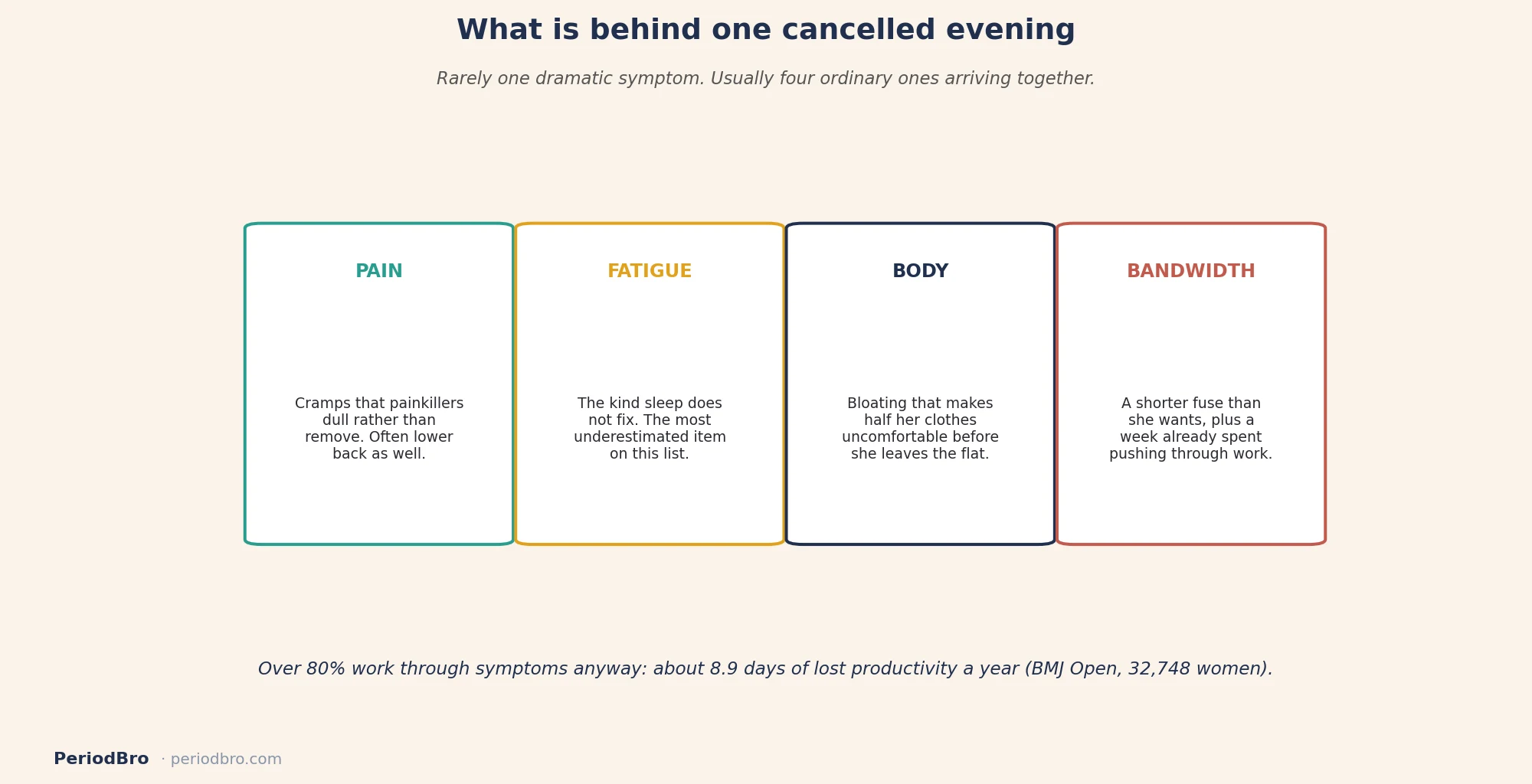
The energy piece is the one partners underestimate most, and we went into it properly in period fatigue. There is also a specific worst day in most cycles, usually the first or second, and knowing which one it is explains a lot of the pattern. That is the subject of the worst day of her period.
Cancelling costs her something too, which is easy to miss from where you are standing. Presenteeism data exists precisely because most people push through rather than pull out, and she has probably already spent the week doing exactly that at work. By the time she cancels on you, she has usually run out of the reserve she was spending on everyone else.
How to answer the text
You have about thirty seconds and one message. It matters more than it seems, because your reply either confirms that she can be honest with you or teaches her to invent a better excuse next time.
Good version: “No problem. Want company or want the flat to yourself?” It accepts without interrogation and hands her the next decision, which is the one thing she can still control.
Versions to skip: anything that opens with “again?”, anything that asks her to justify it, anything that performs disappointment so she has to manage your feelings on top of her own. Our list of the worst things to say on her period covers the rest.

The offer that usually works
Replacing the plan beats mourning it. Same evening, different shape: takeaway at hers instead of the restaurant, a film instead of the bar, you dropping off food and leaving instead of staying. Give her two options and let her pick, or none if she wants none.
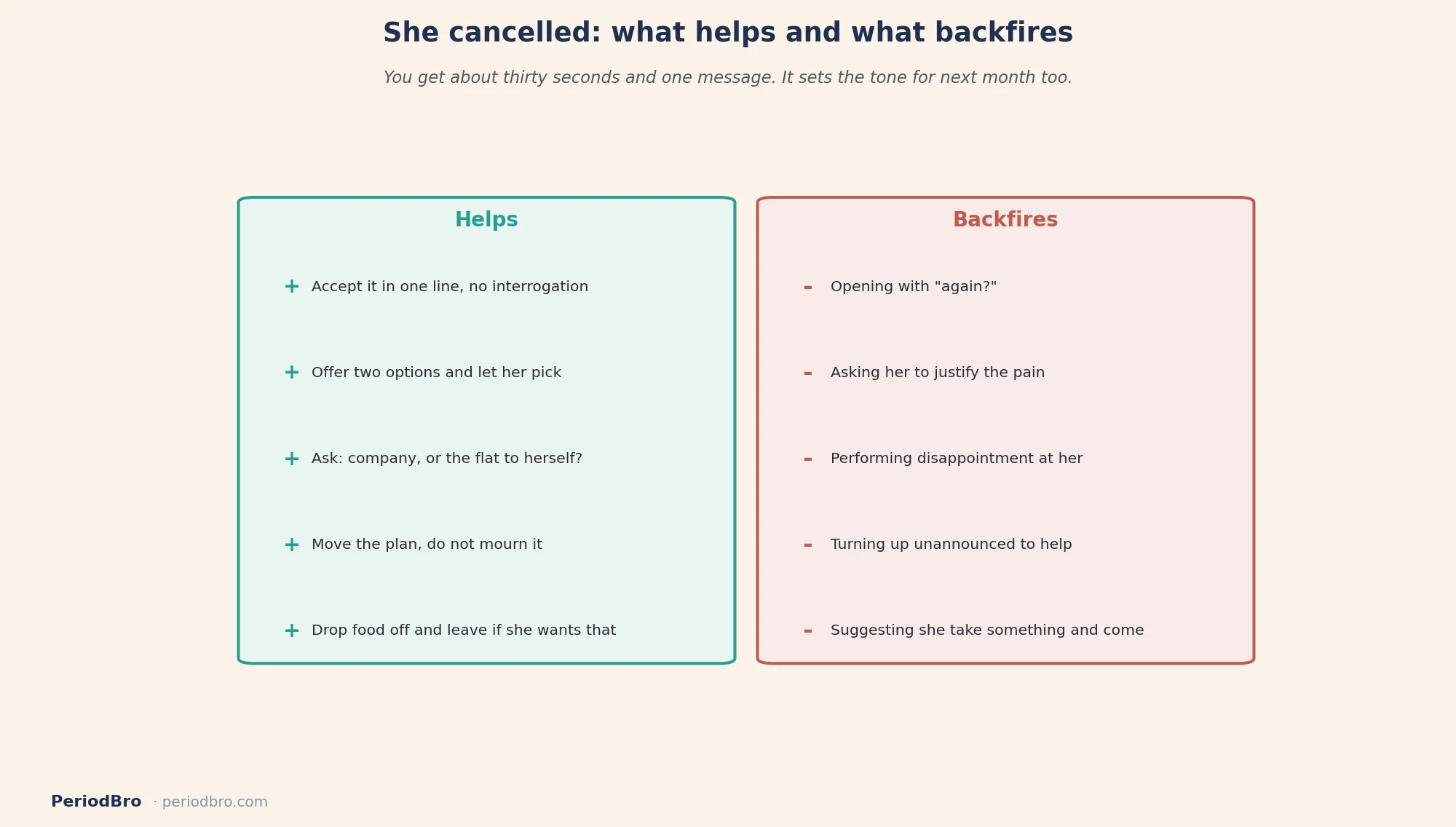
Read the ask correctly, though. Sometimes cancelling means “come over and do nothing with me” and sometimes it means “I want to be horizontal and alone and not perform anything for anybody.” Guessing wrong in the generous direction is still guessing wrong, and giving her space is a skill of its own. Asking which one it is takes one sentence.
If you are not in the same place, a decent text does more than you would expect, and we collected the ones that land in what to text her on her period.
When the pattern is worth a conversation
Most cancelled evenings are ordinary. Some point at something that deserves attention, and the marker is functional impairment rather than mood. If she is losing multiple days every single cycle, missing work regularly, or if the pattern is escalating over months, that belongs in front of a clinician.
Two specific things justify raising it. Pain that stops her functioning is not something to endure annually, and symptoms severe enough to affect her relationships and work every cycle are how PMDD presents. Neither is a diagnosis you make. Both are reasons to suggest an appointment once, gently, and then let it go.
There is a version of withdrawal that is not about the period at all, and the difference is whether it tracks the calendar. We drew that line in when she pulls away.
Why knowing the date fixes the feeling
A guy I know used to get quietly annoyed roughly once a month and could never have told you why. When he finally connected the cancellations to a date rather than a mood, the annoyance disappeared inside a week, without anything about her changing. He had stopped being surprised.
Knowing which week you are in converts a personal slight into a weather forecast, and weather is hard to take personally. Stop scheduling the things that matter for that week, keep the low-effort options ready, and the cancellations stop reading as a referendum on the relationship.
Plan the month so there is less to cancel
The best fix runs upstream of the text. If you know roughly which week is hers, the concert, the dinner with your parents, and the weekend away stop landing on it by accident. That alone removes most of the cancellations, because the plans that survive are the ones she can actually do.
Two habits carry it. Check the week before you book anything that costs money or involves other people, and keep a default low-effort option standing so the evening has somewhere to go rather than evaporating. Neither takes effort once the calendar is in front of you.
The other half is what you do with the plans that do get cancelled. Rebooking it yourself, within a day or two, does more for the relationship than any amount of understanding expressed at the time. It says the evening mattered and the cancellation did not cost her anything with you, which is the message she is actually checking for.
If you want the full map rather than the one week, start with being a better partner through her cycle.
Common questions
Is she really in that much pain, or avoiding me?
Check the calendar over three months. If the cancellations cluster on the same cycle days, it is the cycle. If they are scattered, that is a different conversation and not one this article can settle.
How often is too often?
The published data has women losing around nine days of productive capacity a year to symptoms. A day or two off per cycle is unremarkable. Consistently losing most of a week is worth a doctor’s opinion.
Should I still show up with food?
Ask first. Half the time it is exactly right and half the time she wants nobody in the flat, and one message tells you which.
What if I had really been looking forward to it?
Say so once, later, without attaching it to the cancellation. Disappointment is fair. Charging her for it in the moment is not.
Can she just take something and come?
Sometimes, and she has probably already considered it. Painkillers help cramps and do nothing for fatigue or nausea, which is often the actual blocker.
This article is general information, not medical advice. Pain or symptoms that regularly stop her functioning are worth a clinician’s attention rather than a coping strategy.