
What to Say (and Not Say) When She Has PMS
Most of us don’t fumble the PMS week because we don’t care. We fumble it because we open our mouths with good intentions and the wrong words fall out. You want to help, you say something reasonable-sounding, and somehow it lands like a slap. If you’ve ever wondered what to say when she has PMS – and what to stop saying – this is the cheat sheet I wish someone had handed me years ago.
Quick distinction first, because it matters. This is about the premenstrual window – the days before her period, when hormones are dropping and moods run closer to the surface. That’s different from the period itself, which I covered separately. And it’s different from the deeper “why does this even happen” explainer. This piece is just the words: what actually helps coming out of your mouth, and what quietly makes things worse.
First, get the frame right

Before any script works, you need the right mental model, because she can hear your assumptions underneath your words. PMS isn’t a choice or a performance. After ovulation, estrogen and progesterone fall, and that hormonal drop is what drives the irritability, the low mood, the short fuse (Cleveland Clinic). It’s biology on a schedule, and it eases within a few days of her period starting. If you treat her feelings as a problem to debate, you’ve already lost. If you treat them as real weather she’s moving through, the right words come a lot easier. For the full picture of the mechanism, here’s understanding PMS from a partner’s perspective.
And this isn’t you against her. It’s the two of you against a rough few days. Hold that, and you’ll stop sounding like a lawyer and start sounding like a teammate.

What not to say (and why it backfires)
“Are you on your period or something?” The all-time classic, and the fastest way to make any feeling she has instantly invalid. It tells her you’ve decided her emotion isn’t real – it’s just hormones, so it doesn’t count. Even when the timing is obvious, naming it like a gotcha is a trap. I said a version of this exactly once, years ago, mid-disagreement. The fight stopped being about the dishes and became about the fact that I’d just dismissed her as a hormone with legs. Fair enough.
“Calm down.” No human in the history of being upset has ever calmed down because they were told to. It reads as an order and an accusation – that she’s overreacting and you’re the rational one. Skip it entirely.
“You’re being irrational.” Maybe the feeling is amplified. That doesn’t make it fake. Telling someone their emotion is illogical doesn’t talk them out of it – it just adds “and now I feel alone in it” on top.
“Just tell me what to do.” Sounds helpful, actually puts the work on her. Now she has to manage her own bad day and project-manage you. During a low-energy stretch, that’s the last thing she has bandwidth for.
“Everyone gets like this, it’s fine.” Meant as reassurance, heard as a brush-off. Generalizing her feeling into “everyone” erases the specific thing she’s actually dealing with right now. She doesn’t want to be a statistic; she wants to be seen.
Nothing at all. Going silent and tiptoeing around her isn’t neutral – it reads as withdrawal, like you’ve decided she’s too much to deal with. Absence speaks, and it usually says the wrong thing.
What to say instead
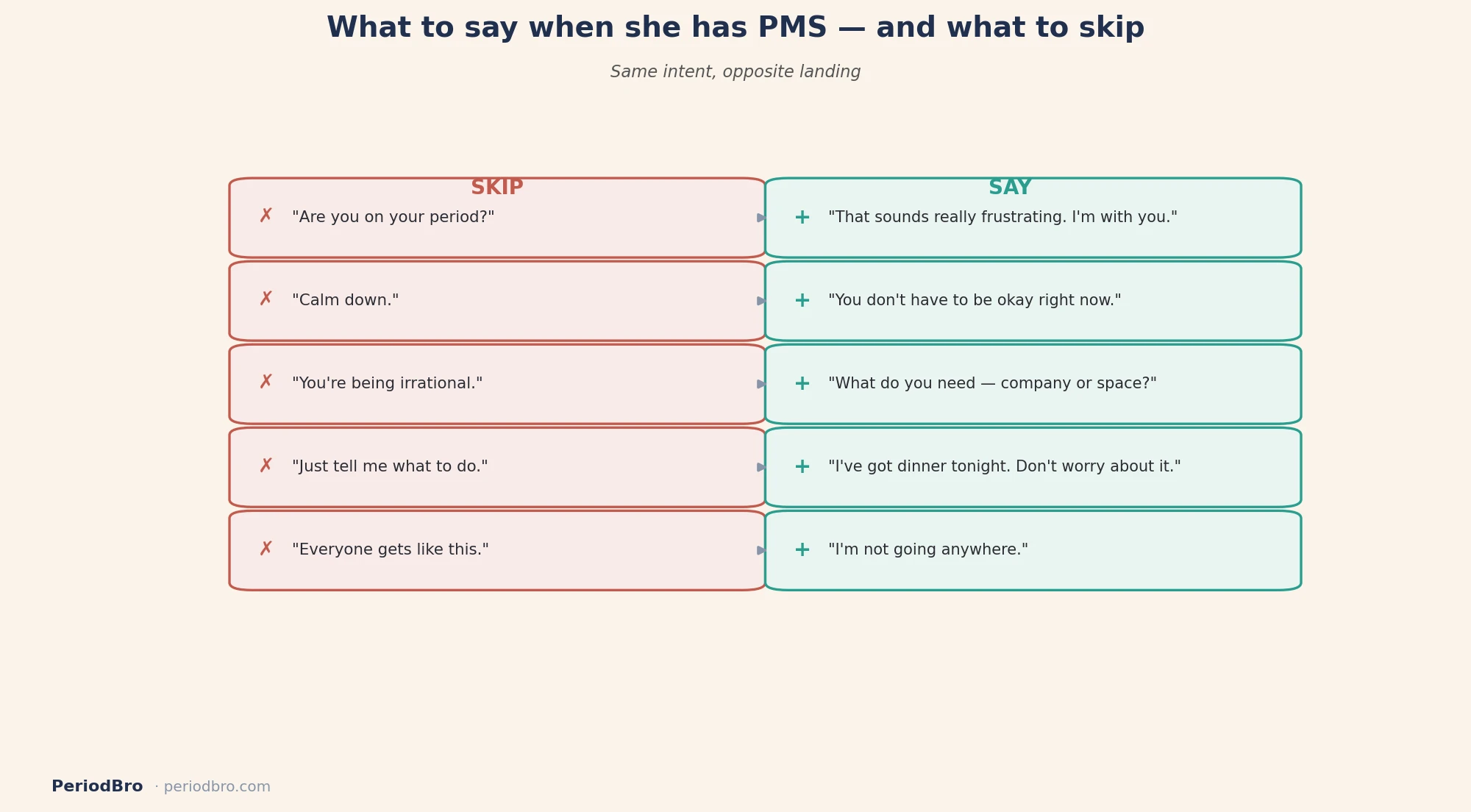
“That sounds really frustrating. I’m with you.” Validation first, every time. You’re not agreeing she’s right about everything – you’re agreeing the feeling is real. That single move defuses more tension than any clever fix.
“What do you need right now – company or space?” This is the most useful question in your arsenal, because it hands her control without making her do the planning. Two easy options, either answer is fine. And then you actually honor the answer.
“I’ve got dinner tonight. Don’t worry about it.” Take one concrete thing off her plate without being asked. Quiet, practical help lands harder than any speech – and research on PMS specifically finds that supportive partner involvement is associated with an easier time of it (StatPearls, NIH). Don’t announce it like a favor. Just do it.
“You don’t have to be okay right now.” Permission to feel bad without performing okayness is a genuine gift. It tells her she doesn’t have to hold it together for your comfort.
“I’m not going anywhere.” Underneath a lot of premenstrual low mood is a flicker of “I’m too much.” Steady reassurance that you’re staying put – calm, not anxious – quiets that better than any logic.
“Want me to just sit with you?” Not every hard moment needs talking through. Offering plain company – no agenda, no problem-solving, maybe a show on in the background – gives her somewhere soft to land without any demand to explain herself.
How you say it matters as much as what you say

Here’s the part the scripts can’t cover: tone. You can say every “right” line on this list and still blow it if it comes out clipped, sarcastic, or like you’re reciting from a manual to get the moment over with. Words are maybe half of it. The other half is whether your face and your voice match – whether you’re actually slowing down and paying attention, or just deploying phrases to defuse her so you can get back to your evening. She can tell the difference instantly. A clumsy sentence delivered with real warmth beats a perfect one delivered like a hostage negotiation. So before you reach for any line, take the half-second to actually arrive: put the phone down, turn toward her, soften your shoulders. The body language is the opening line.

When it tips into a real argument
Sometimes the words aren’t enough and you end up in a fight you didn’t mean to start. That’s its own skill, and the move is almost always to slow down rather than win. Don’t litigate the facts in the heat of it; lower the temperature first and come back to the issue when the storm passes. I broke that down here: how to handle PMS arguments without making them worse.
And know the ceiling on what you’re dealing with. Ordinary PMS is rough but it passes. If the days before her period bring something far heavier every single month – despair, rage, a sense of crisis that derails her life – that may be something more than PMS, and it’s worth understanding the difference between PMS and PMDD. The words in this article still apply, but the situation deserves real care, not just a good script.
The one principle under all of it
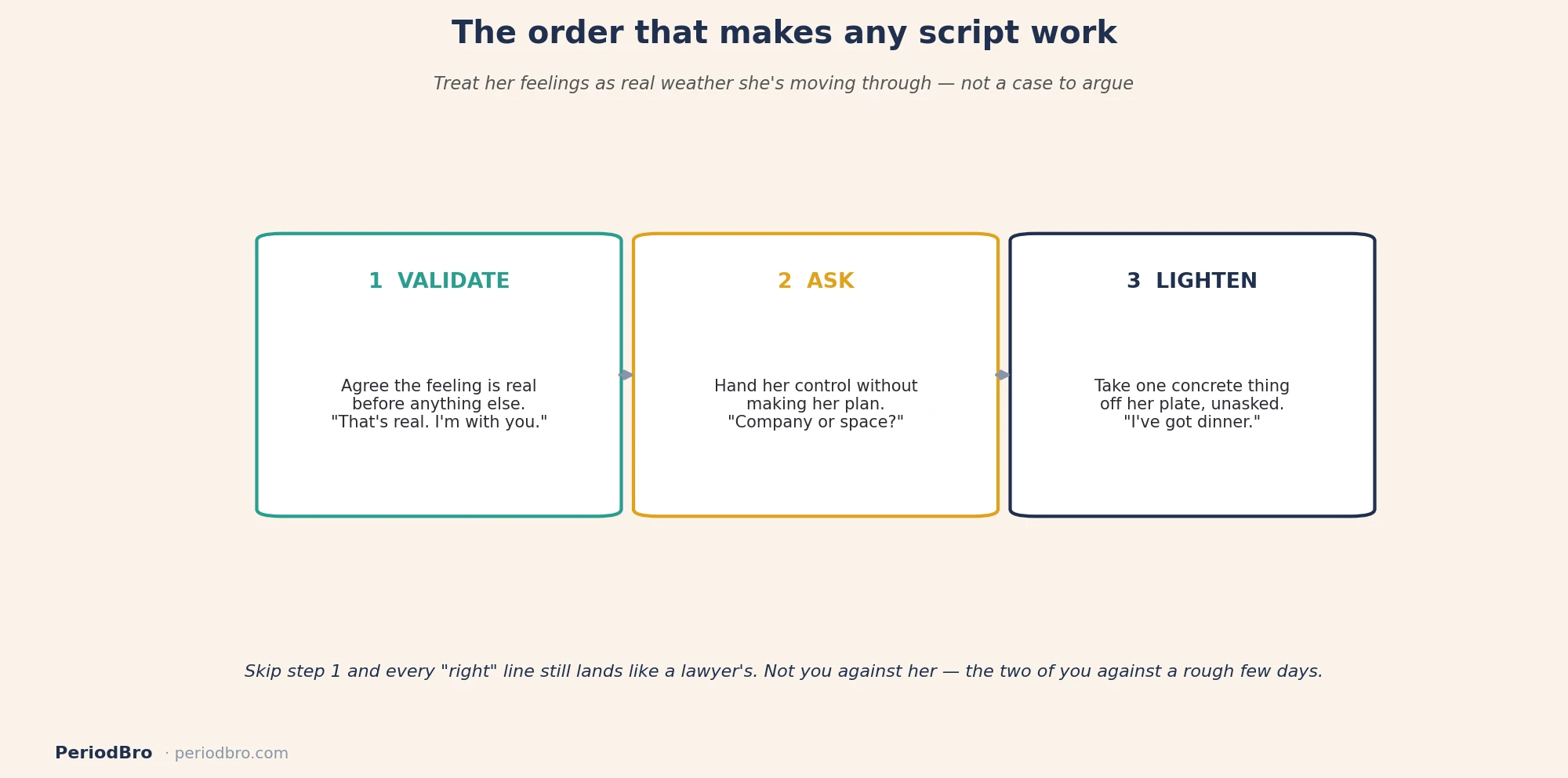
If you forget every specific line here, keep this: lead with the feeling, not the fix. Almost every wrong thing on the “don’t say” list is a version of jumping to solve or to argue. Almost every right thing is a version of “I see you, the feeling’s real, I’m here.” Most premenstrual symptoms are exactly that predictable and that human – the large majority of menstruating people get some, and they pass as hormones rebound after the period starts (ACOG). You’re not solving a crisis. You’re being good company through a hard few days.
The thing that makes all of this easier is simply knowing the week is coming before it arrives, so the mood shift doesn’t catch you flat-footed. That’s what PeriodBro is for – a quiet heads-up about where she is in her cycle, so you can show up with the right words ready instead of reaching for the wrong ones.