
Period Leg Cramps: Why Her Legs Ache Before and During Her Period (and How to Help)
I used to think the achy-legs thing had nothing to do with her cycle. A day or two before her period she’d be on the couch shifting around, pressing her thumb into the back of her thigh, and I’d ask if she’d tweaked something at the gym. She hadn’t. It took me embarrassingly long to connect the dots: the heavy, crampy legs showed up on roughly the same schedule every month, right alongside the cramps I already knew about.
If you’ve noticed the same pattern in someone you love, you’re not imagining it. Period leg cramps are one of the quieter parts of a cycle, the kind nobody warns you about because they don’t fit the cartoon version of “cramps.” But the ache is real, it has a clear biological cause, and there are a handful of genuinely useful things you can do about it.
What’s actually happening in her legs
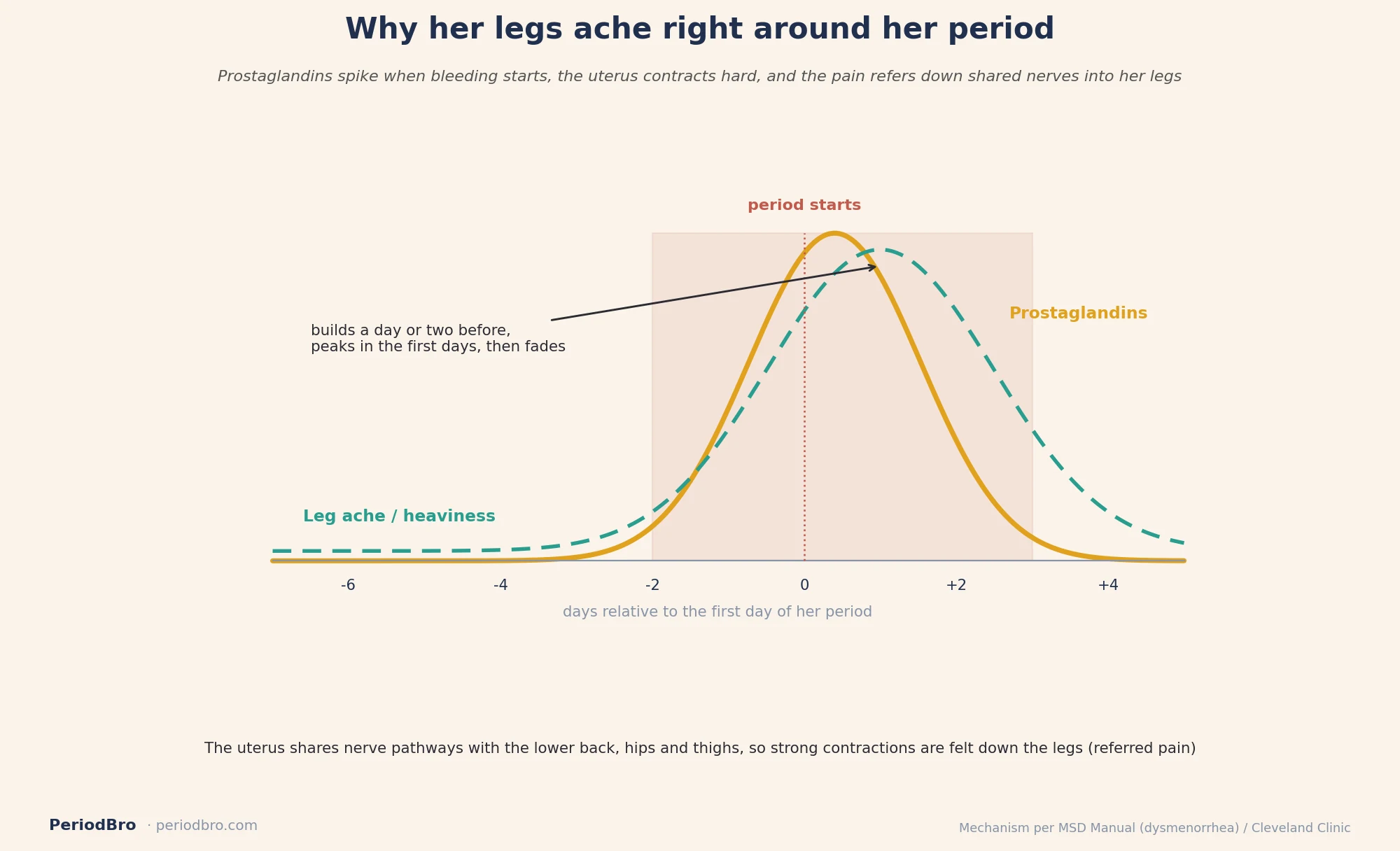
Here’s the short version. When a period starts, the lining of the uterus releases chemicals called prostaglandins. Prostaglandins make the uterus contract so it can shed that lining, and the higher the levels, the stronger the contractions and the more pain she feels. Cleveland Clinic describes prostaglandins as one of the main drivers of menstrual cramps, and notes that higher levels mean stronger cramping (Cleveland Clinic).
So far that explains belly cramps. The leg part is about wiring. The uterus shares nerve pathways with the lower back, hips, and thighs, so when it’s contracting hard, the pain signal can travel along those shared routes and get felt somewhere else entirely. Doctors call this referred pain. The MSD Manual’s clinical entry on dysmenorrhea, the medical word for painful periods, puts it plainly: the pain is spasmodic and “may radiate to the back or thigh” (MSD Manual). That’s why she can have an achy, dragging feeling down her legs without anything actually being wrong with the legs themselves.
A couple of other things pile on. Fluid retention tends to peak around the start of a period, which can make her legs feel heavy or swollen. And the general inflammation and dip in comfort that comes with menstruation can leave the big muscles of the thighs and calves feeling stiff and tired. None of it is dangerous on its own. It’s the same storm that causes the cramps you already understand, just showing up in a place that surprised both of you.
So period leg cramps are normal?
For most people, yes. Painful periods are extremely common. The clinical literature estimates that a large majority of menstruating people experience some degree of dysmenorrhea, and that the pain frequently spreads beyond the lower belly into the back and legs (StatPearls, NCBI). The period-tracking app Clue, writing up the research on this, notes that lower back and leg pain are a recognized part of the cramp picture for a meaningful share of people, not some rare freak symptom (Clue).
The timing matters more than the location. This kind of leg pain tracks the cycle. It tends to build in the day or two before bleeding starts, peak in the first day or two of the period, and then ease off. If you’ve read up on the luteal phase, this is the same back half of the cycle where a lot of the rougher symptoms cluster. The leg ache is just one more thing on that list, and like the others, it usually fades as the period winds down.
It’s worth saying clearly: this overlaps with the same machinery behind her cramps and even her menstrual migraines, which are also driven in part by prostaglandins and hormone shifts. If she gets the whole package some months, that’s not her body malfunctioning. It’s one underlying process showing up in several places at once.
What actually helps
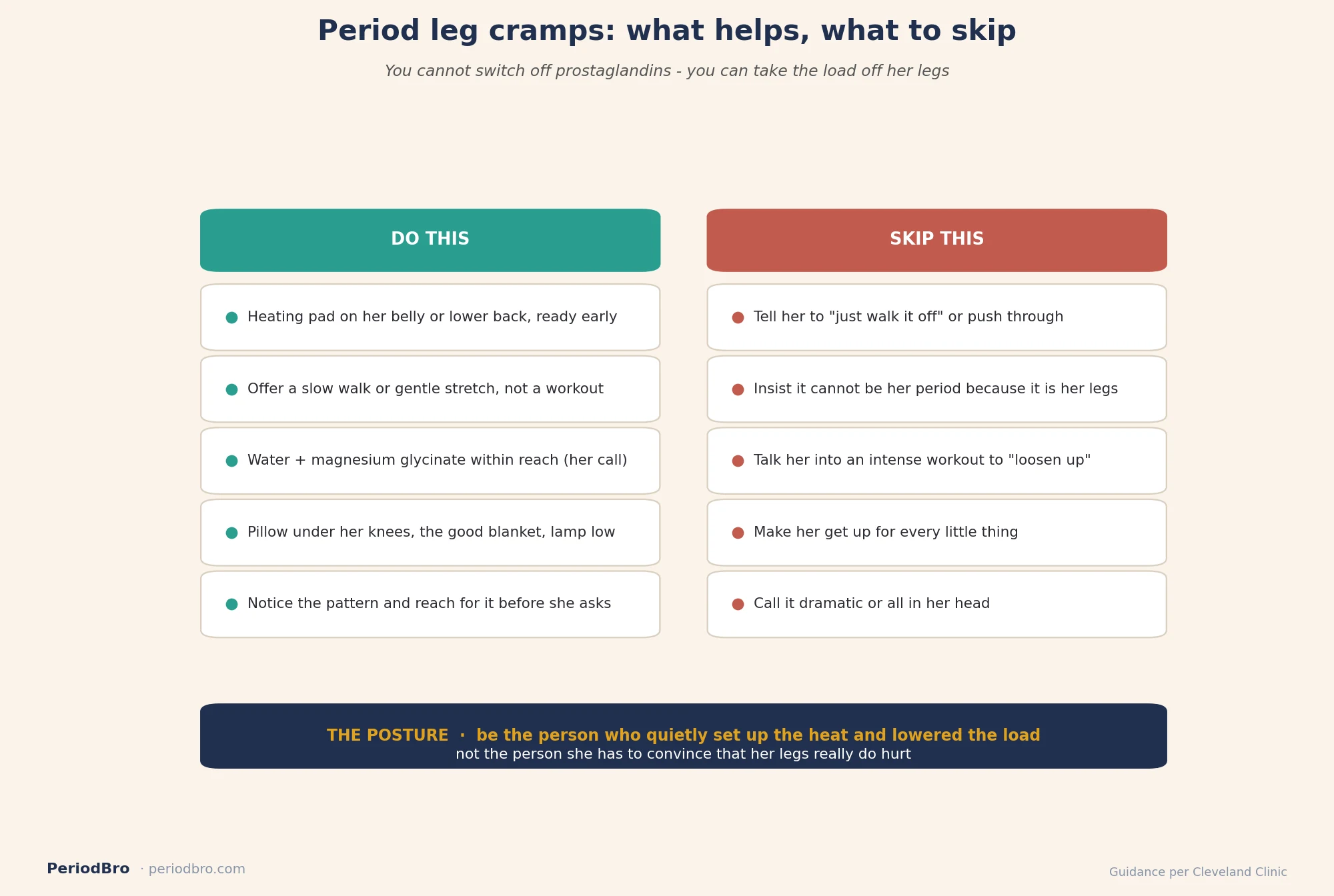
You can’t switch off prostaglandins by force, but you can take real pressure off her legs. None of this is heroic. It’s mostly about lowering the load and being the person who notices before she has to ask.
Heat, generously applied. A heating pad or hot water bottle on the lower belly or lower back relaxes the muscles and eases the contractions that are sending pain down her legs. A warm bath does the same for tired thighs and calves. Heat is one of the most reliable, side-effect-free tools you have, and it’s the easiest thing to set up before she gets to the worst of it. (If you want the practical version of this, we went deep on it in our guide to the best pain relief for period cramps.)
Gentle movement, not a workout. Lying completely still can leave the legs stiffer. A slow walk, some easy stretching, or just changing position helps blood move and can take the edge off. The key word is gentle. The goal is to loosen things up, not to push through.

Magnesium, with honest expectations. Magnesium gets talked about a lot, and the evidence is promising but modest. Cleveland Clinic’s ob-gyn coverage explains that magnesium can relax the uterine muscle and lower prostaglandin production, which is exactly the mechanism behind the leg ache. Their honest caveat is that the studies are small and mixed, and the effect, when it shows up, tends to be on the smaller side. They point to magnesium glycinate as the form that’s absorbed best (Cleveland Clinic). So it’s worth a try, not a miracle. Don’t oversell it to her.
Over-the-counter anti-inflammatories. Standard NSAIDs like ibuprofen or naproxen work by lowering prostaglandins at the source, which is why they tend to outperform plain paracetamol for this specific kind of pain. They work best taken a little ahead of the worst of it rather than once she’s already in deep. She knows her own body and any medications she’s on, so this is her call, not yours.
And the quiet stuff. A pillow under her knees. The good blanket. Her water bottle filled without being asked. Taking the thing off her plate that she was dreading. You don’t have to fix the pain to make the evening better, and honestly, trying to fix it isn’t the assignment. We wrote a whole piece on how to be supportive when you can’t fix her pain, because that turns out to be most of the job.
If you’ve already learned how the same instincts apply to period back pain, good news: the playbook for legs is basically the same. Heat, gentle movement, lower the load, stay close.
When period leg pain is worth a doctor’s look
Most of the time this is ordinary referred pain that fades with the period. But there are a few patterns that deserve more than a heating pad, and knowing them is part of showing up well.
Pay attention if the leg pain is severe and consistent month after month, comes with numbness, pins-and-needles, or weakness in the leg or foot, or follows a clear cyclical rhythm that lines up tightly with her period every single time. A small number of people have endometriosis tissue near the sciatic nerve, which can cause leg pain that flares with the cycle and shouldn’t be brushed off as “just cramps.” The Endometriosis Foundation of America notes that cyclical nerve symptoms in the legs are a real, under-recognized pattern worth investigating (EndoFound). If her leg pain has that clockwork cyclical quality and the usual remedies aren’t touching it, that’s a conversation with her doctor, not a reason to panic.
Separately, there’s one pattern that isn’t about periods at all and is genuinely urgent: pain in one leg with swelling, redness, or warmth in that single leg, especially with any chest pain or shortness of breath. That can signal a blood clot and needs same-day medical attention. It’s rare, it’s not what we’re describing here, but it’s worth knowing the difference so you’re not waved off a real emergency because everyone assumed it was period stuff.
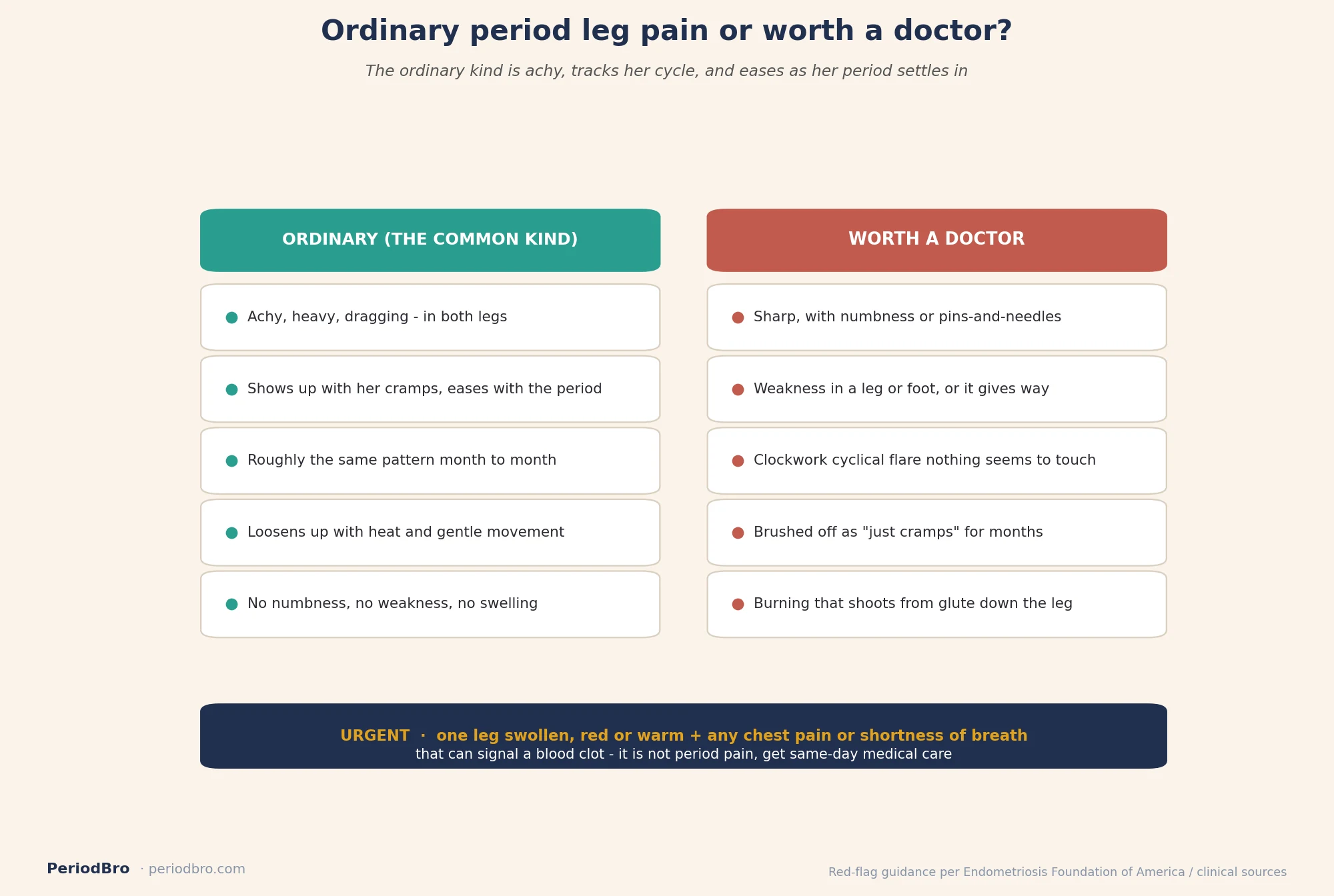
The honest summary: cyclical, both-legs, eases-with-the-period leg ache is almost always benign. One-sided swelling, neurological symptoms, or pain that breaks the usual pattern earns a professional opinion.
One thing to remember
The single most useful thing you can do isn’t a remedy at all. It’s noticing the pattern before she has to explain it for the hundredth time. When you can quietly clock that her legs are heavy because her period’s about to start, and you reach for the heating pad without being asked, you’ve taken a real weight off her, the physical kind and the other kind.
That’s the whole idea behind tracking a cycle as a partner. Not to manage her, but to stop being caught off guard by something that runs on a schedule. If you want a calm, private way to see these patterns coming, that’s exactly what we built PeriodBro for.
This article is for general information and isn’t medical advice. Period symptoms vary a lot from person to person, and anything severe, one-sided, or out of the ordinary deserves a real conversation with a healthcare provider.