
Period Heart Palpitations: Why Her Heart Races Around Her Period (and How to Help)
The first time I noticed it, we were just sitting on the couch. She put her hand flat on her chest, went quiet for a second, then said her heart was doing “that fluttery thing” again. Her period was a few days out. I said the unhelpful thing – “are you okay?” – and she was. But it kept happening, same week every month, and I had no idea it was connected to her cycle at all.
If your partner has ever told you her heart is racing, pounding, or skipping in the days before her period, you’re not imagining a link. It’s a real thing, it has real causes, and most of the time it’s harmless. But there are a couple of versions worth taking seriously, and knowing the difference is exactly the kind of thing a partner can actually be useful for.
What period heart palpitations actually are
A palpitation is just the feeling of your own heartbeat when you normally wouldn’t notice it. Too fast, too hard, an extra thump, a flutter, a skipped beat. Cleveland Clinic describes them as the sensation that your heart is racing, pounding, or fluttering, and notes that most are harmless and short-lived, lasting a few seconds to a few minutes.
The reason period heart palpitations show up around the period specifically is that several things that trigger palpitations – hormone shifts, low iron, stress, even an extra coffee to push through a rough day – tend to stack up in that same window. So a heartbeat she’d usually never feel suddenly announces itself, right when she already feels off.
Worth saying up front: feeling your heart for a few seconds is not the same as a heart problem. The vast majority of these episodes are her body reacting to a normal hormonal cycle, not a sign that something is broken. The job here is to know which version you’re looking at, and that mostly comes down to what else is happening alongside the racing.
Why her heart speeds up before her period
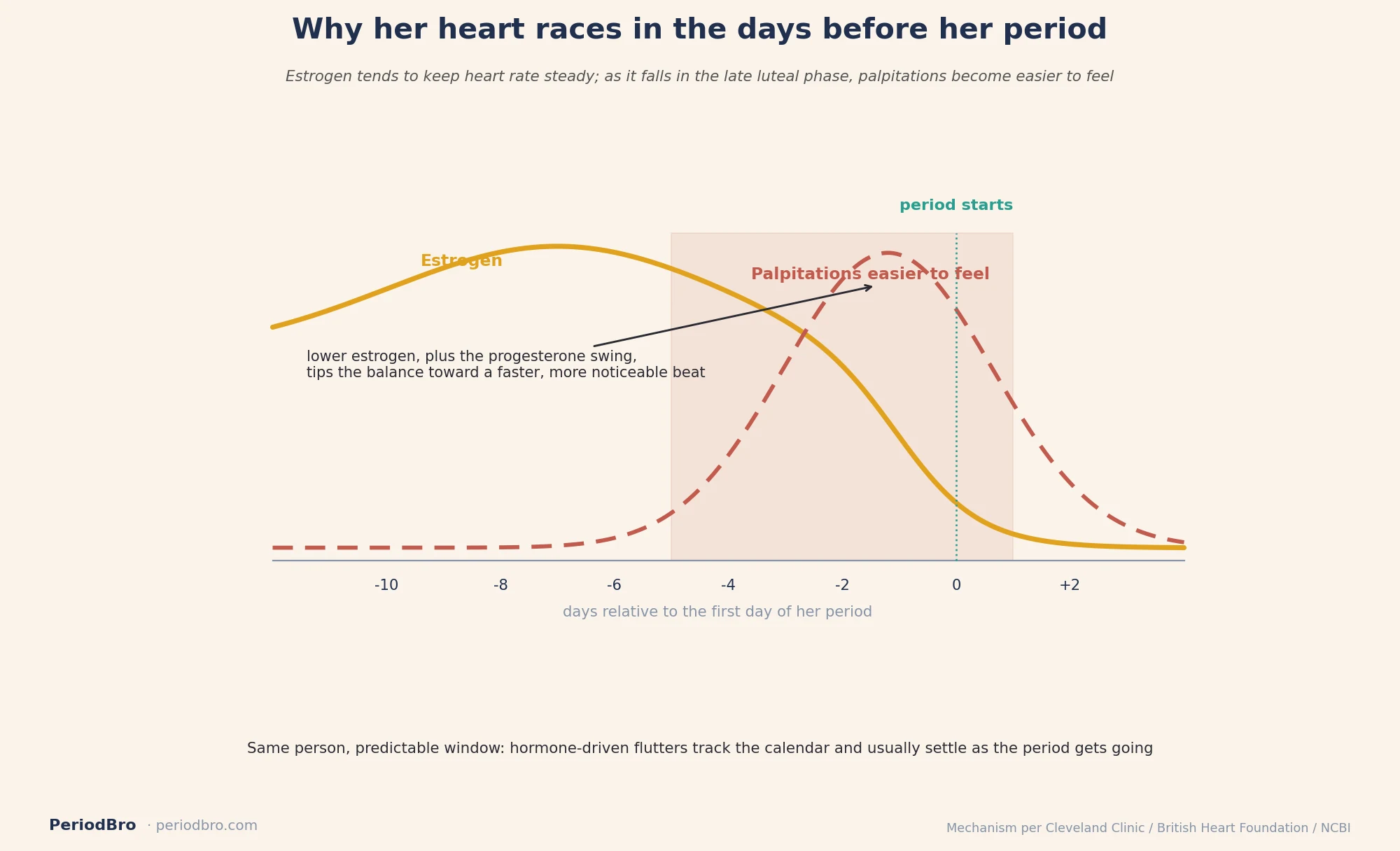
The hormone part is the piece most people never hear about. Estrogen and progesterone don’t just run the reproductive system; they also influence how the heart and blood vessels behave. Broadly, estrogen tends to keep heart rate steady, while progesterone can nudge it up. In the late luteal phase – the week or so before her period – estrogen falls and that balance shifts, which is when a lot of people first notice their heart acting up.
This isn’t fringe. A review in the journal Cardiology looking at supraventricular tachycardia and the menstrual cycle found that some women’s racing-heart episodes genuinely cluster at specific points in the cycle, tracking the rise and fall of those hormones. For most people it’s far milder than that – a flutter, not a full episode – but the underlying wiring is the same. The British Heart Foundation lists hormonal changes right alongside caffeine, alcohol, and stress as common, ordinary triggers for palpitations.
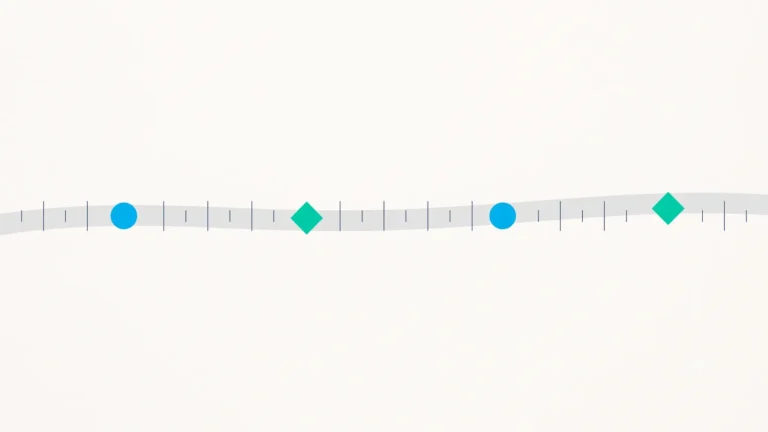
The practical takeaway: if her heart does this on a schedule, roughly the same days each cycle, the schedule itself is a clue. Hormone-driven period heart palpitations track the calendar; a true heart-rhythm problem usually doesn’t care what week it is. That pattern is one of the most reassuring things you can both notice together.
The low-iron reason nobody mentions
Here’s the version that’s worth real attention, because it hides as “just my period again.”
If her periods are heavy, she’s losing iron every month. When iron stores run low, her blood carries less oxygen per beat, so the heart compensates the only way it can – it beats faster and harder to move the same oxygen around. That compensatory speed-up is exactly what gets felt as palpitations. Mayo Clinic lists a fast or irregular heartbeat among the classic signs of iron-deficiency anemia, along with fatigue, breathlessness, and looking pale.
Heavy bleeding is the most common reason menstruating people end up iron-deficient in the first place. ACOG notes that heavy menstrual bleeding can lead to anemia and the tiredness and weakness that come with it. So if her heart racing comes bundled with deep fatigue and lightheadedness, and her periods are genuinely heavy, that’s not four separate mysteries. It’s likely one thread – iron – and it’s very fixable once it’s actually looked at.
This is a good thing to gently raise, because the fix often starts with a simple blood test and some dietary or supplement changes through her doctor, not a cardiology workup. Iron-driven period heart palpitations tend to ease once her levels come back up, which is part of why catching them is worth it.
When it’s anxiety doing the talking
There’s also a loop that catches a lot of couples. PMS can crank up anxiety in the back half of the cycle, and anxiety is one of the most common drivers of palpitations there is. Then the palpitation itself feels alarming, which spikes the anxiety, which keeps the heart going. Cleveland Clinic describes exactly this kind of feedback loop, where worry and a pounding heart feed each other.
What matters for you here: when she’s in that loop, your calm is contagious in the literal sense. Panicking with her, or peppering her with “should we go to the ER,” usually pours fuel on it. Steady, low-key presence does the opposite.

What actually helps
You can’t change her hormones, but the things that turn an ordinary flutter into a bad afternoon are surprisingly within reach. Most of this is just removing friction during her vulnerable week.
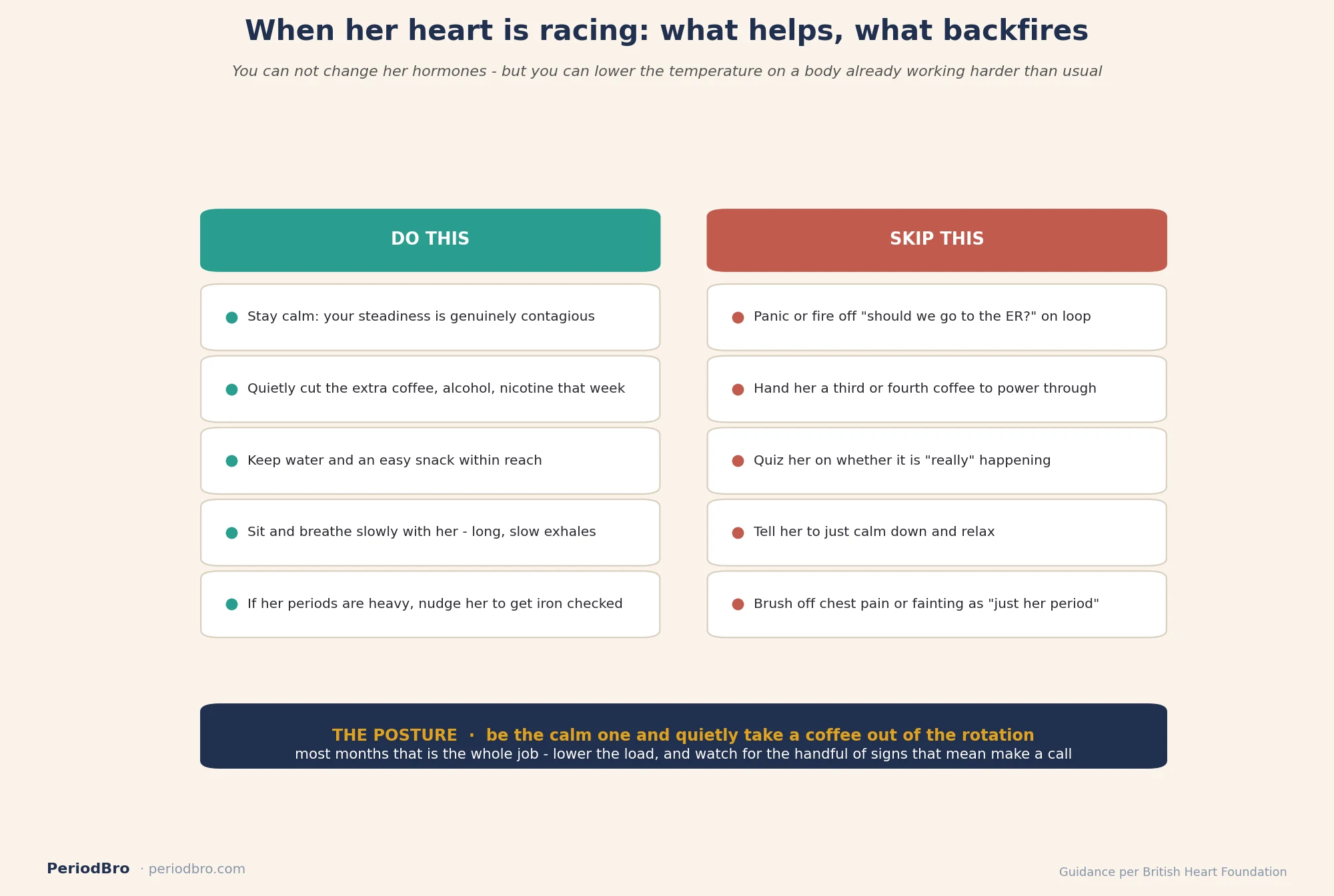
Believe her and stay calm. “That sounds horrible, I’m right here” beats “are you sure it’s not nothing” every time. Your steadiness is doing real work.
Quietly cut the obvious triggers in that window. The British Heart Foundation points straight at caffeine, alcohol, and nicotine. If she’s reaching for a second or third coffee to power through the low-energy days, that’s the exact wrong week for it. Suggesting decaf, making it yourself, or just not putting a fourth cup in front of her is a small move that helps.
Keep water and easy food around. A blood-sugar dip can pile onto everything else, so a snack and a glass of water genuinely take the edge off.
Slow it down together. If her heart’s pounding and she’s spun up, sit with her and breathe slowly – long exhales. You doing it next to her makes it easy to follow.
If her periods are heavy, push gently on the iron question. Iron-rich food helps, but the real move is getting it checked by her doctor rather than guessing. This is the single most useful thing on the list if heavy bleeding is in the picture.
Track the window with her. When you can both see that the flutters land in the same few days every cycle, it gets a lot less scary – and a shared cycle tracker like PeriodBro makes that pattern obvious instead of something she has to carry alone in her head.
When period heart palpitations are worth a doctor’s look
This is the part to actually memorize, because it’s the one thing a partner being in the room can change.
Most palpitations are harmless. But Cleveland Clinic is clear that some pairings are red flags. Treat it as urgent – call emergency services, don’t drive around looking for parking – if her racing heart comes with any of these:
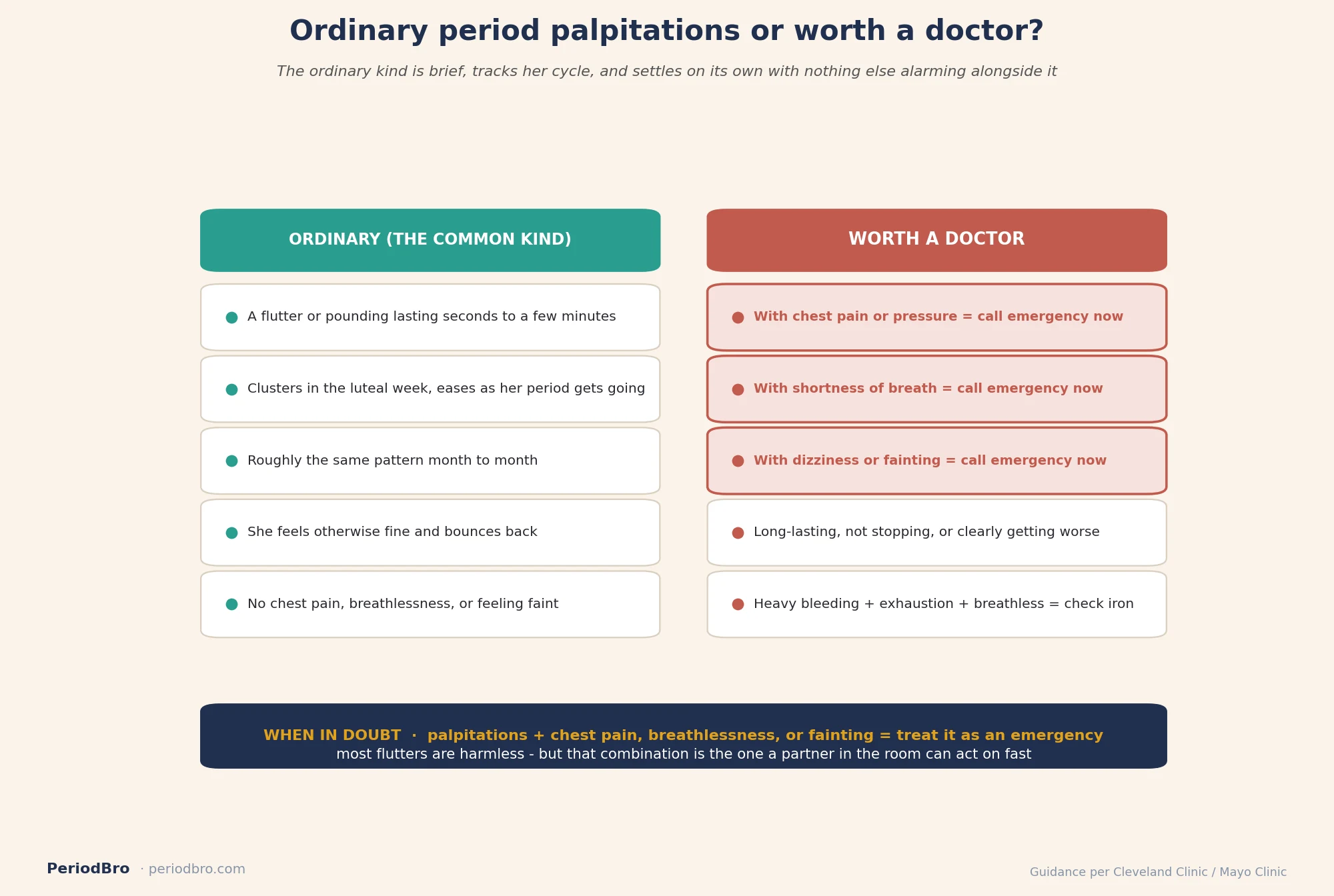
- Chest pain or pressure
- Shortness of breath or trouble breathing
- Dizziness, feeling like she might pass out, or actually fainting
Those combinations can signal a rhythm problem that needs to be checked right then, not next week.
Short of an emergency, book a regular doctor’s visit if the palpitations last a long time and don’t settle, keep happening, are clearly getting worse, or if she has a history of heart problems. The British Heart Foundation lists those same prompts. And if the racing heart travels with heavy bleeding, real exhaustion, and breathlessness, ask the doctor specifically about iron and anemia – that’s the cluster that’s easy to dismiss and easy to treat.
If you remember one thing
In the week before her period, be the calm one and quietly take a coffee out of the rotation. That’s it. You’re not diagnosing anything; you’re lowering the temperature on a body that’s already working harder than usual, and you’re paying enough attention to spot the handful of signs that mean it’s time to make a call. That’s not nothing. Most months, that’s the whole job.

This article is for general information and isn’t medical advice. Heart symptoms can be serious – if your partner has palpitations with chest pain, shortness of breath, or fainting, treat it as an emergency, and for anything ongoing, talk to a qualified clinician.