
Period Blood Clots: Why She Passes Them During Her Period (and When It’s Worth a Doctor’s Look)
The first time I saw one, I genuinely didn’t know what I was looking at. She’d left the bathroom door open, called me in, and pointed at the toilet with this flat, tired look. There was a dark, jelly-like clump in the bowl, bigger than I thought blood could ever be. My brain went straight to the worst place. She just said, “it’s fine, it happens,” and went back to bed. I spent the next hour quietly reading, because “it’s fine” and the size of that thing did not match up in my head.
If you’ve been there – that small jolt of worry you didn’t want to make a big deal of – this is for you. Most of the time clots are completely ordinary. But there’s a clear line where they start to mean something, and knowing it makes you genuinely useful instead of just worried.

What period blood clots actually are
Menstrual blood isn’t only blood. As the lining of her uterus sheds, her body releases natural anticoagulants – chemicals that keep that blood thin enough to flow out smoothly. On a light day, those thinners keep up and everything stays liquid. On a heavy day, especially the first day or two, the flow can come faster than the anticoagulants can handle. Blood pools, sits long enough to coagulate, and leaves as a gel-like clot. As Cleveland Clinic puts it, a clot usually isn’t a sign that something tore or broke. It’s mostly a sign of volume and timing.

Color varies too – bright red, dark maroon, almost brown – depending on how fast it’s moving. Slower blood has more time to oxidize, so it darkens. None of that, on its own, is a problem. The texture can look alarming the first time you see it precisely because nobody ever showed you what a normal heavy day actually looks like.
Timing-wise, clots cluster on the days the flow is heaviest, which for most people is the start of the period. That’s the back end of the cycle her body has been building toward all month. If you’ve read our explainer on the luteal phase, this is where it cashes out: the lining that thickened over the previous two weeks now sheds, and the heaviest shedding is where clots are most likely to show up.

What’s normal, and what’s not
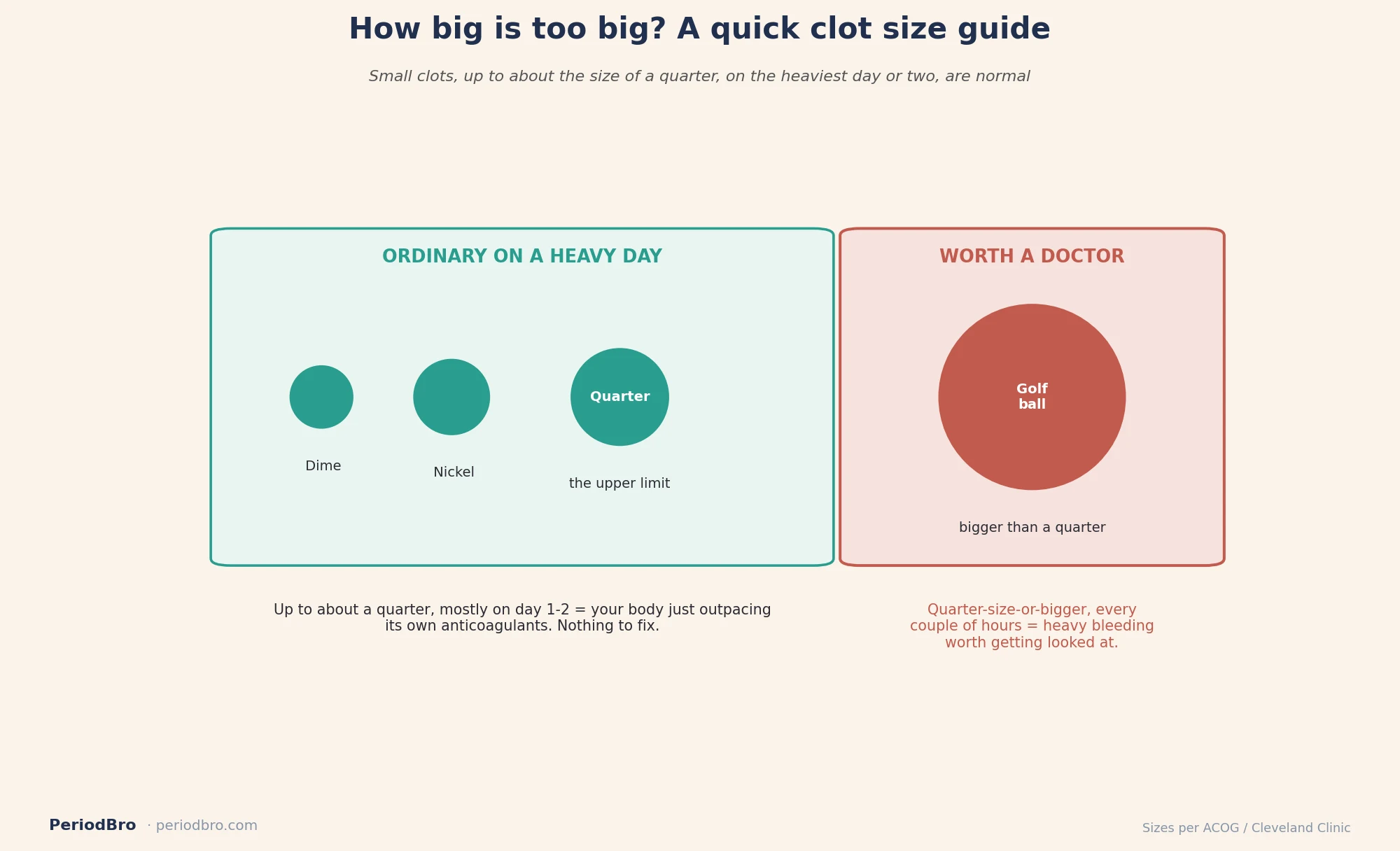
Here’s the rule worth memorizing. Small clots, up to about the size of a quarter, on the heaviest days, are normal. Plenty of people pass them every single cycle and never think twice. The line the American College of Obstetricians and Gynecologists draws for heavy menstrual bleeding is pretty concrete: clots the size of a quarter or larger, soaking through a pad or tampon every hour for several hours in a row, bleeding that lasts more than seven days, or having to get up at night to change protection.
Golf-ball-sized clots, or quarter-size-or-bigger ones every couple of hours, sit squarely in that “worth mentioning to a doctor” territory. You don’t need to become a clot inspector. But knowing roughly where a normal heavy day ends and heavy bleeding begins is genuinely useful, because there’s a decent chance she doesn’t know the line either.
Why period blood clots can matter more than they look
Here’s the part that surprised me most. A lot of women have bled heavily their whole lives and been told – or just quietly assumed – that it’s normal. If your period has always been like this, you have no other period to compare it to. Heavy is just Tuesday.
That matters because heavy bleeding quietly drains iron. A single heavy cycle can cost 30 to 40 milligrams of iron, and over months that adds up fast. As many as six in ten people with heavy menstrual bleeding end up iron deficient or anemic, according to a review of clinical guidelines published in the National Library of Medicine. And iron deficiency doesn’t announce itself dramatically. Per Mayo Clinic, it shows up as being tired all the time, weak, dizzy, short of breath on the stairs, headachy.

So if she’s passing big clots and also dragging through every afternoon, those two things are very likely connected. I’ve written more on the exhaustion side in our piece on period fatigue and the lightheaded side in period dizziness – both of those often trace back to the same heavy-bleeding-plus-low-iron loop. The clots aren’t the disease. They’re the visible flag on top of it.
What can be behind heavier clots
Most heavy, clotty periods don’t have a scary cause. But because the fix is often straightforward, it’s worth her getting checked rather than white-knuckling it for years. A few of the common things a doctor looks for, per Cleveland Clinic’s menorrhagia overview:
Fibroids – benign growths in the uterus that create extra surface to bleed from and little pockets where blood collects and clots before it leaves. Adenomyosis – when lining tissue grows into the muscular wall, thickening the uterus and making periods heavier, longer, and more painful. Polyps, hormonal shifts, or thyroid issues that tip the lining toward overgrowth. And a bleeding disorder like von Willebrand disease, which the CDC notes is more common than most people realize and often first shows up as heavy periods.
None of this is something you diagnose from the bathroom doorway, and you shouldn’t try. The point is the opposite: heavy clotting is a normal, ordinary reason to see a doctor, not a weird one. And there are real treatments, from iron to medication that reduces the bleeding itself.

How to actually show up for her
You can’t change her flow. But there’s a surprising amount you can do that lands.
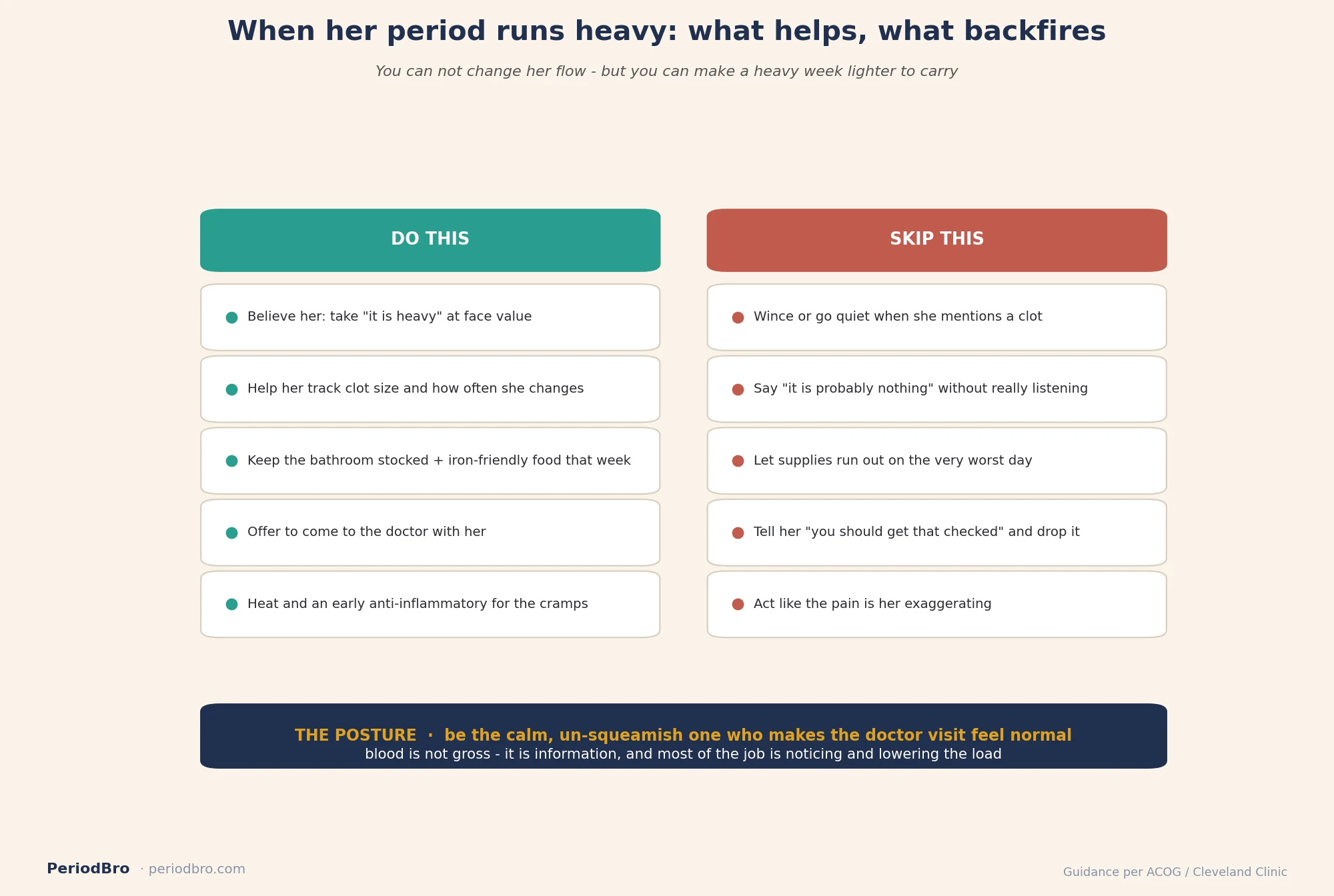
Believe her, and don’t be squeamish. If she tells you it’s heavy, take it at face value. Wincing or going quiet when she mentions a clot teaches her to stop telling you things, which is exactly backwards from what you want. Blood is not gross. It’s information.
Help her see the pattern. If she isn’t sure whether her periods are “too heavy,” the honest answer is often “I’ve never actually tracked it.” You can. Note roughly how often she’s changing protection on the worst days, and whether clots are showing up bigger than a quarter. That’s the precise information a doctor asks for, and walking in with it makes the visit shorter and far more useful. (It’s also, not by accident, the kind of thing the app is built to make easy.)

Don’t forget the pain that often rides along. Heavier, clottier periods frequently come with stronger cramps, because the uterus is contracting harder to push everything out. The same playbook that works for cramps works here too – heat, an over-the-counter anti-inflammatory taken early, and not making her justify how much it hurts. Our guide on how to help with period cramps goes deeper on that side.
Keep her stocked and fed. Heavy days mean more supplies, more laundry, and more iron walking out the door. Keep the bathroom stocked so she’s never caught short, and lean toward iron-friendly food that week – red meat, beans, lentils, leafy greens, with a little vitamin C alongside to help it absorb.
Make the doctor visit a normal thing, not a scary one. “The heavy-bleeding thing might be worth a quick check, and I’ll come with you if you want” beats “you really need to get that looked at.” Same information, completely different weight on her shoulders.
When period blood clots are worth a doctor’s look
It’s time to actually make a call if any of these are true:
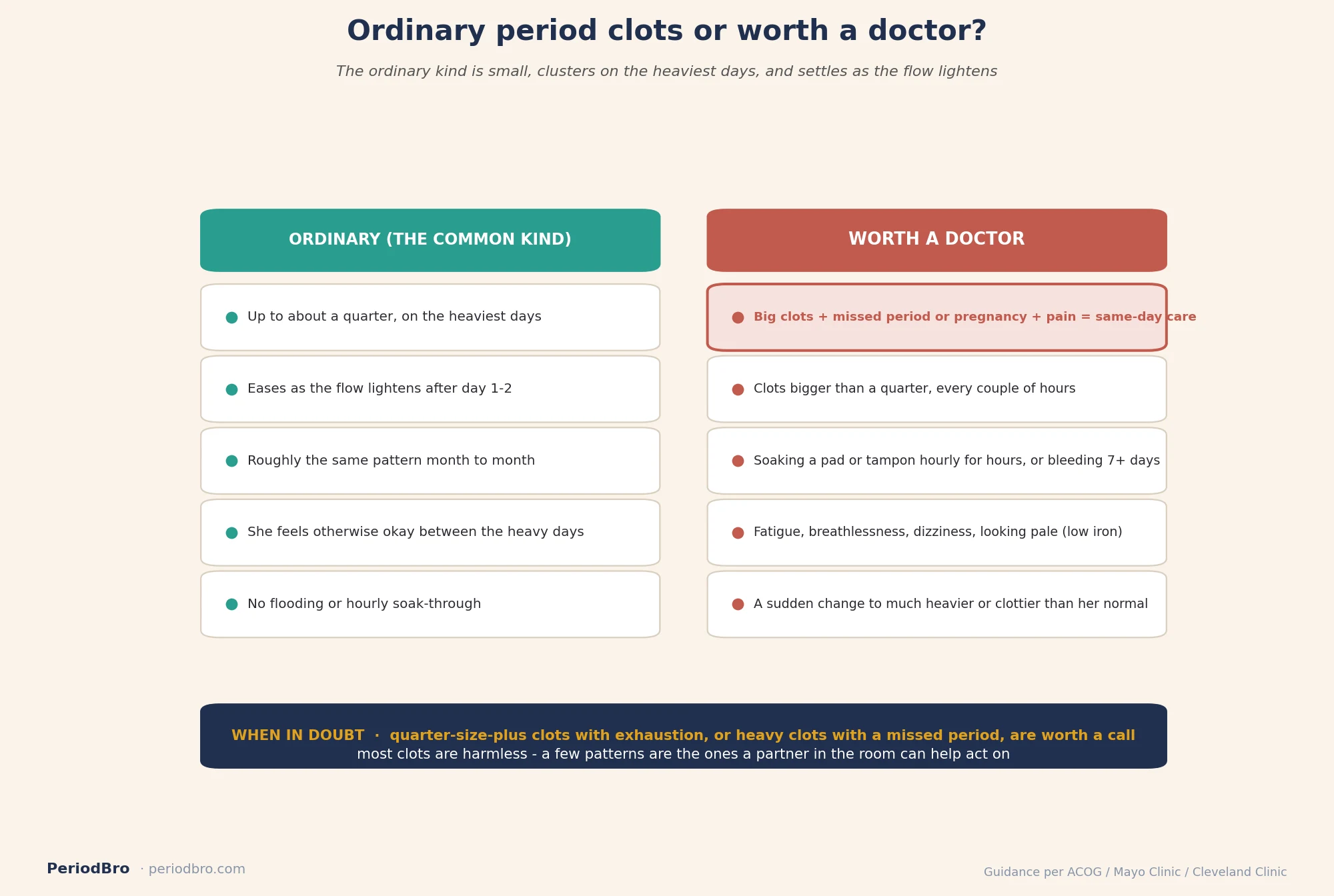
Clots are regularly bigger than a quarter, or she’s passing them every couple of hours. She soaks through a pad or tampon every hour for several hours, bleeds more than seven days, or wakes up at night to change protection. She’s showing the iron-deficiency signs – constant fatigue, breathlessness, dizziness, looking pale. Or her pattern suddenly changes, becoming much heavier or much clottier than her normal.
And one that’s genuinely urgent: large clots together with a missed or late period, or a known pregnancy, plus cramping or pain, can be a sign of miscarriage and deserve same-day medical care, not a wait-and-see. When in doubt there, don’t wait.
If you remember one thing
A clot the size of a quarter on a heavy day is just her body doing its job. A clot bigger than that, every cycle, with exhaustion riding shotgun, is worth a conversation – first with you, then with a doctor. You don’t have to fix her period. You just have to be the person who noticed, believed her, and made the next step feel easy.
If you want help spotting her patterns before she does – which days run heavy, when the energy tends to crash, what to have ready – that’s exactly what PeriodBro is built for.

This article is for general education and isn’t medical advice. Period blood clots have a wide normal range, but heavy bleeding can point to treatable conditions. If anything here sounds like her, encourage her to talk with her own doctor.