

Her Period After a Miscarriage: What to Expect
The hospital sent her home with a leaflet and a follow-up number, and neither of them covered the thing she’s asking you at eleven at night: when does her body go back to normal. The honest answer has two parts, because her cycle and her head run on completely different timelines, and only one of them has numbers attached.
The period after miscarriage has a documented range, and so does everything leading up to it. Knowing the range won’t fix the other part, but it stops the two of you guessing at something already well studied, and it gives you a job that’s genuinely useful.

What the period after miscarriage usually does
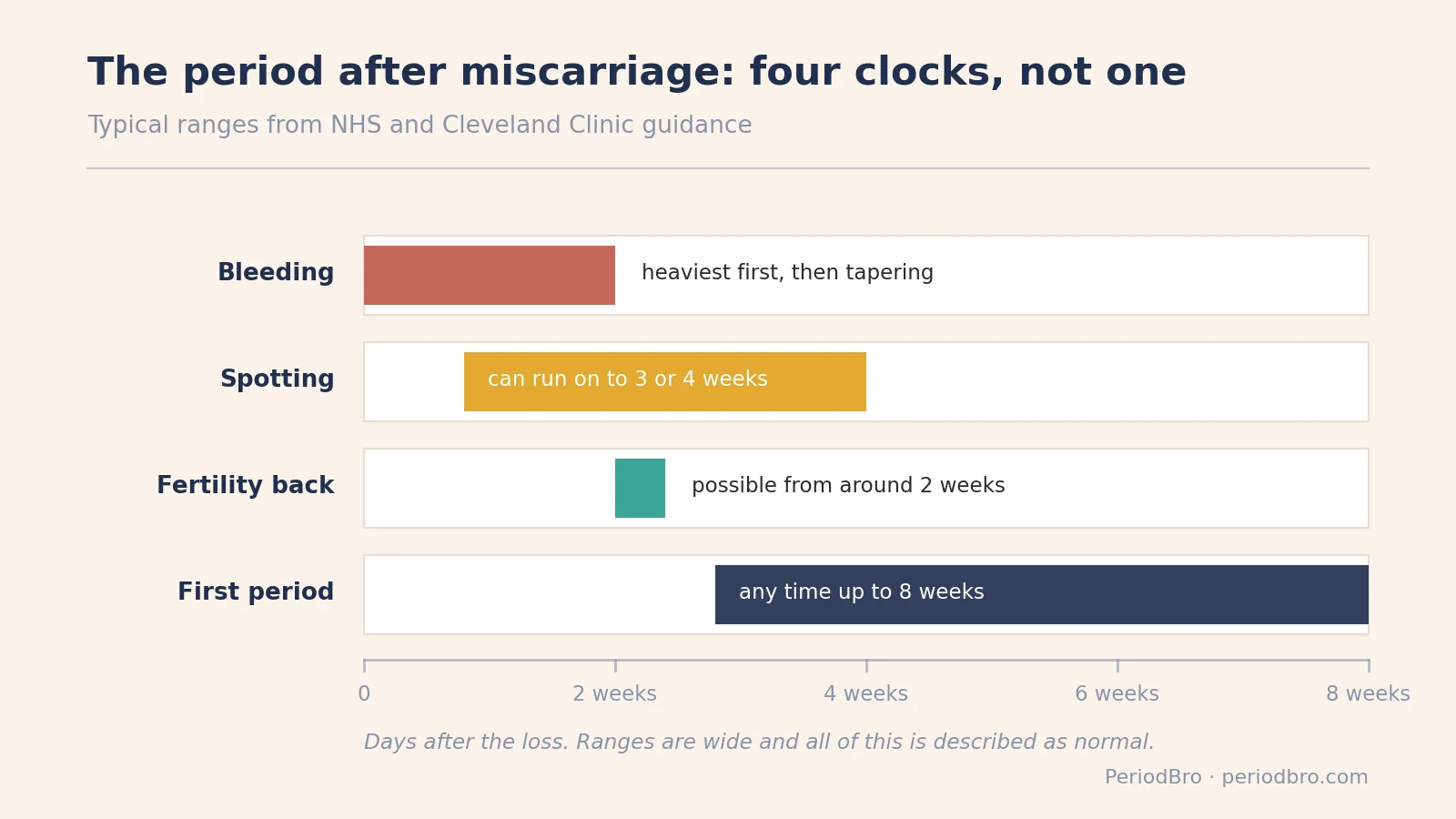
The bleeding from the loss itself comes first, and it isn’t the period. It’s heaviest at the start and tapers, and the NHS puts it at up to two weeks, while Cleveland Clinic notes that light spotting can run on for three or four. Both are described as normal, which tells you how wide the range is.
Then a gap. Then the first real period, and it can look nothing like her old ones. The way a cycle restarts after a pregnancy follows a similar pattern of taking its time.
The NHS says it can take up to eight weeks to arrive, and that it may take a few months before her cycle looks like her cycle again. Longer, shorter, heavier, more painful, all common on the way back.
The number that surprises most couples sits inside that gap: fertility can return around two weeks after the loss, before any period has shown up. Cleveland Clinic states it plainly. Ovulation comes first, the bleed comes second, so the first cycle can happen with no visible marker at all.
That single fact answers a lot of the questions that arrive at eleven at night.
Why a pregnancy test can still read positive
Pregnancy hormone doesn’t vanish when the pregnancy ends. It falls over days and weeks, and a home test can keep showing two lines for a while afterwards.
This catches people badly. She tests because she wants confirmation that it’s over, gets a positive, and spends an evening in a place she doesn’t need to be. If a clinic has told you they’re tracking her levels, let the clinic do it. Home tests aren’t built for measuring a decline.
Same logic in the other direction later on. Once things have settled, a test is only meaningful with a missed period to compare it against, and she may not have a reliable one to miss yet.

How it was managed changes what the weeks look like
ACOG’s practice bulletin on early pregnancy loss says patients should be offered the full range: expectant management, meaning waiting for the body to complete it on its own; medical management with tablets; or a short surgical procedure. All three are legitimate. Which one she had shapes how long the bleeding lasted and how many appointments follow.
If tablets were used, the combination matters. A 2018 trial in the New England Journal of Medicine randomised 300 women and found that mifepristone before misoprostol completed the process in 83.8% of cases against 67.1% for misoprostol alone, and cut the need for a follow-up surgical procedure from 23.5% down to 8.8%. If she was given misoprostol on its own and it didn’t work first time, that’s a known rate, not a failure of her body.
Worth knowing before the follow-up appointment, because “it didn’t work” lands very differently when you know roughly a third of the time it doesn’t.
The waiting rule that turned out not to hold
Somebody will tell her to wait three months, or six, before trying again. That advice traces back to a World Health Organization recommendation built largely on one large study, and it hasn’t held up.
A systematic review in Human Reproduction Update pooled sixteen studies covering more than a million women. Conceiving within six months of a miscarriage was associated with a lower risk of a further miscarriage, not higher, at a risk ratio of 0.82, and a lower risk of preterm delivery at 0.79. Stillbirth, low birthweight and pre-eclampsia showed no difference either way. The authors said outright that the guidance should be revised.
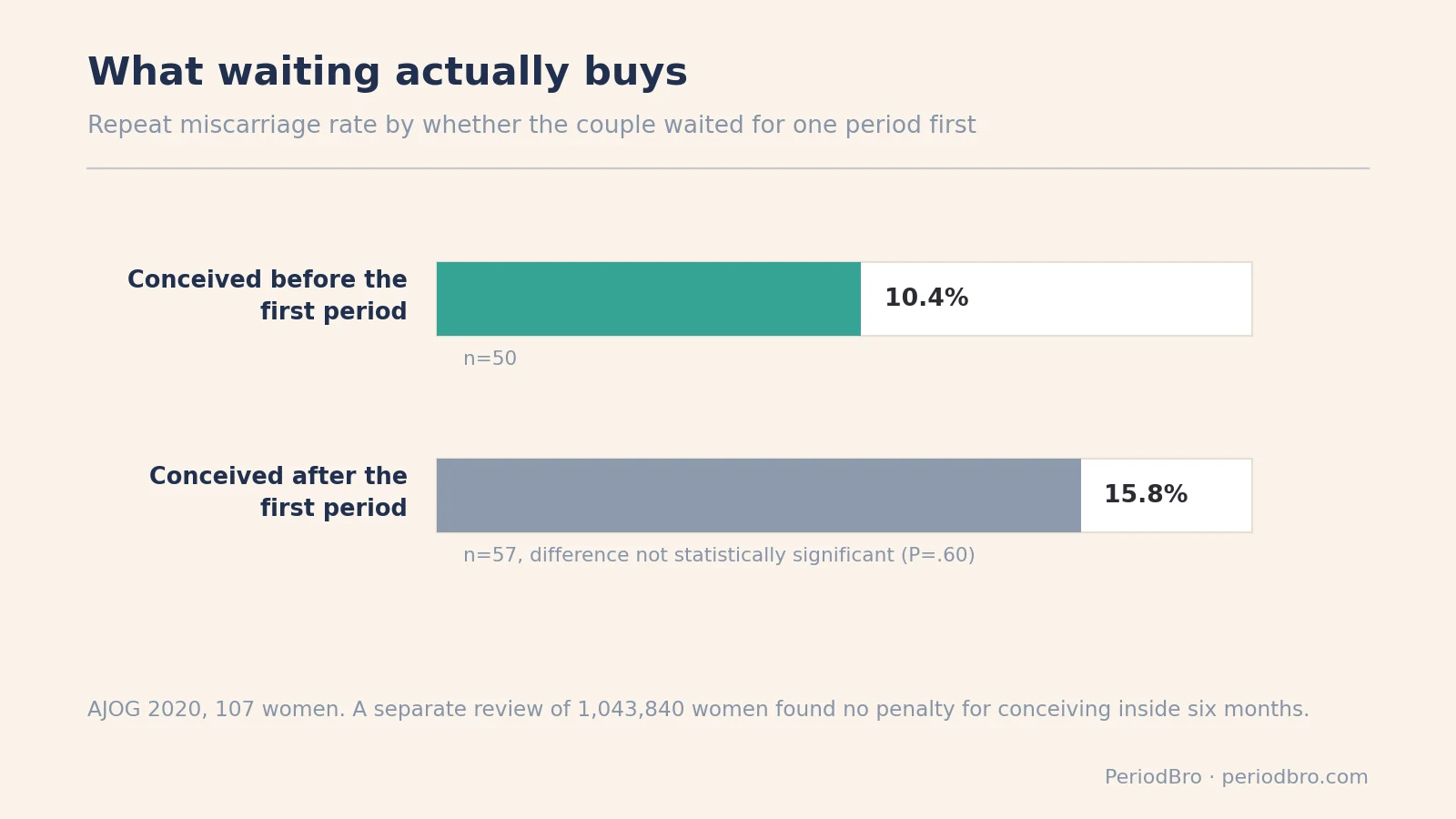
The narrower question, whether to wait for one period first, got tested too. A 2020 cohort of 107 women compared those who conceived before their first post-miscarriage period against those who waited for it. Repeat miscarriage ran at 10.4% in the group that didn’t wait and 15.8% in the group that did, a difference that wasn’t statistically significant, with no gap in gestational age at delivery or birthweight.
None of that is a recommendation to hurry. It’s a reason to stop treating a calendar as a medical requirement, and to let her decide on readiness rather than arithmetic. If tracking is part of how you approach this, expect the first cycles to be unreliable data.

Your grief and hers are on different schedules
A Swedish study followed 103 women and 78 male partners at one week and again at four months after a miscarriage. Grief scores and depressive symptoms came down over those four months for both. What didn’t come down was the emotional experience itself: the sense of isolation, of having lost a baby, of the whole thing having been devastating. That persisted past the four-month mark.
Men’s scores were lower across the board. That’s the finding, and it’s easy to misread in two directions. It doesn’t mean you’re not allowed to be wrecked by this. It also doesn’t mean her being further down than you at month three is a sign something’s wrong with her.
The study also flagged what made it harder: no existing children, a previous miscarriage, or a history of fertility treatment. If any of those apply, the timeline stretches, and that’s expected rather than alarming.
What actually helps in the first month
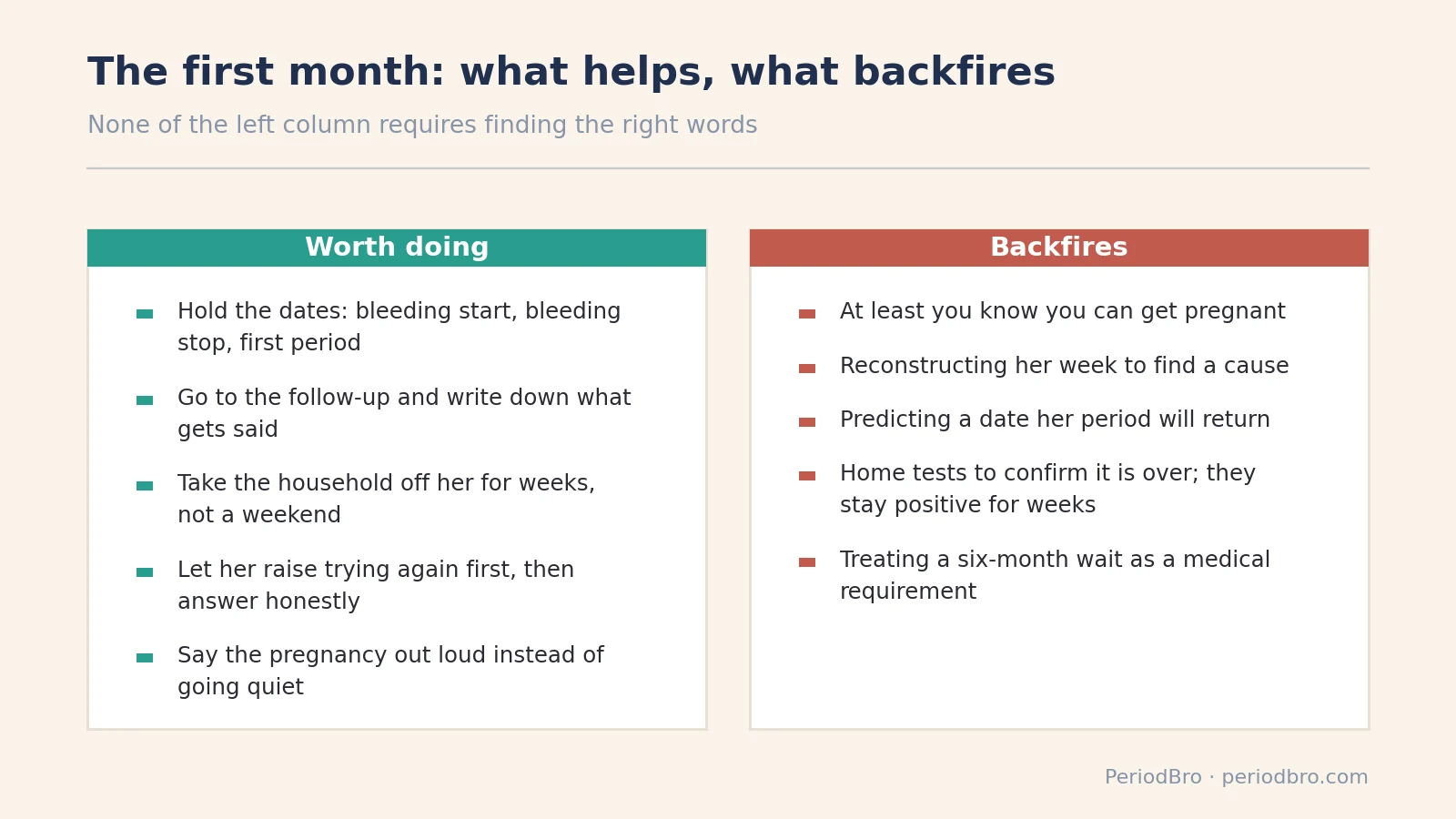
Hold the calendar. Write down the day the bleeding started, the day it stopped, and the day the first period arrives. She should not have to reconstruct those dates from memory in a consulting room while trying to hold it together. That’s your job now, and it’s the single most useful thing you’ll do.
Go to the follow-up. Write down what gets said, because half of it evaporates on the drive home.
Take the household off her. Not for a weekend. For a few weeks. Bleeding for two weeks while running a normal life is its own drain, and it comes on top of everything else.
Ask before you talk about trying again. The gap between the two of you on that question is usually weeks wide, and whoever raises it first gets read as having moved on. If she asks you first, answer honestly instead of managing her.
Say the pregnancy out loud. People go quiet around a loss, and to her that silence can sound like the pregnancy never counted for anything.
What to skip
Skip “at least you know you can get pregnant.” It’s true and it’s useless, and it lands as a reason she shouldn’t be sad.
Skip the cause hunt. She’ll do this on her own at three in the morning: the coffee, the flight, the gym session. Most first-trimester losses come down to a chromosomal problem in that specific pregnancy, and no reconstruction of her week changes it.
Skip the timeline predictions. You don’t know when her period will come back and neither does she. “Up to eight weeks” is what the guidance says, and telling her it’ll be fine by a specific date sets up a small failure on that date.
Skip pushing her back into normal life on a schedule. Giving her room and going quiet aren’t the same move.
When to call someone
Call the clinic the same day for bleeding that gets heavier instead of lighter, or restarts after stopping; clots bigger than a golf ball; a fever; pelvic pain that carries on for more than a week; or dizziness, weakness or a racing heart, which can signal blood loss. Cleveland Clinic lists all of these as reasons to get seen.
Beyond the first month, the period after miscarriage is the thing to watch. Book an appointment if her periods haven’t returned within a couple of months, if they come back much heavier or much more painful than her old normal, or if the low mood isn’t lifting at all. Recurrent loss, meaning three or more, is its own pathway with its own testing, and it’s worth asking for by name.
If her cycle stays scrambled once things have settled, a late period and spotting between periods both have ordinary explanations too, and they’re worth ruling in or out rather than watching.
This article is general information, not medical advice. Care after early pregnancy loss varies by country and by circumstance. Anything specific to her bleeding, her cycle or her recovery belongs with the clinic that treated her.