How to Help Her With Cramps When You Are Not There
You’re at work, on the road, or just across town, and she texts that her cramps are bad. When you can’t be in the room, figuring out how to help girlfriend with cramps over text is the whole question, and the answer is: you can do more than you’d think. A lot of what eases a rough period is stuff you can set in motion from your phone, and the part she’ll remember is that you didn’t leave her on read.
The first time this happened to me I sent back “oh no, feel better” and put my phone down, because what could I do from an office forty minutes away. She told me later that reply landed like I’d checked a box and moved on. She hadn’t wanted a fix. She’d wanted to not feel alone with it. Since then I’ve worked out that there’s a fair amount you can do from a distance, and none of it takes more than a few taps.
Your words do more than you think
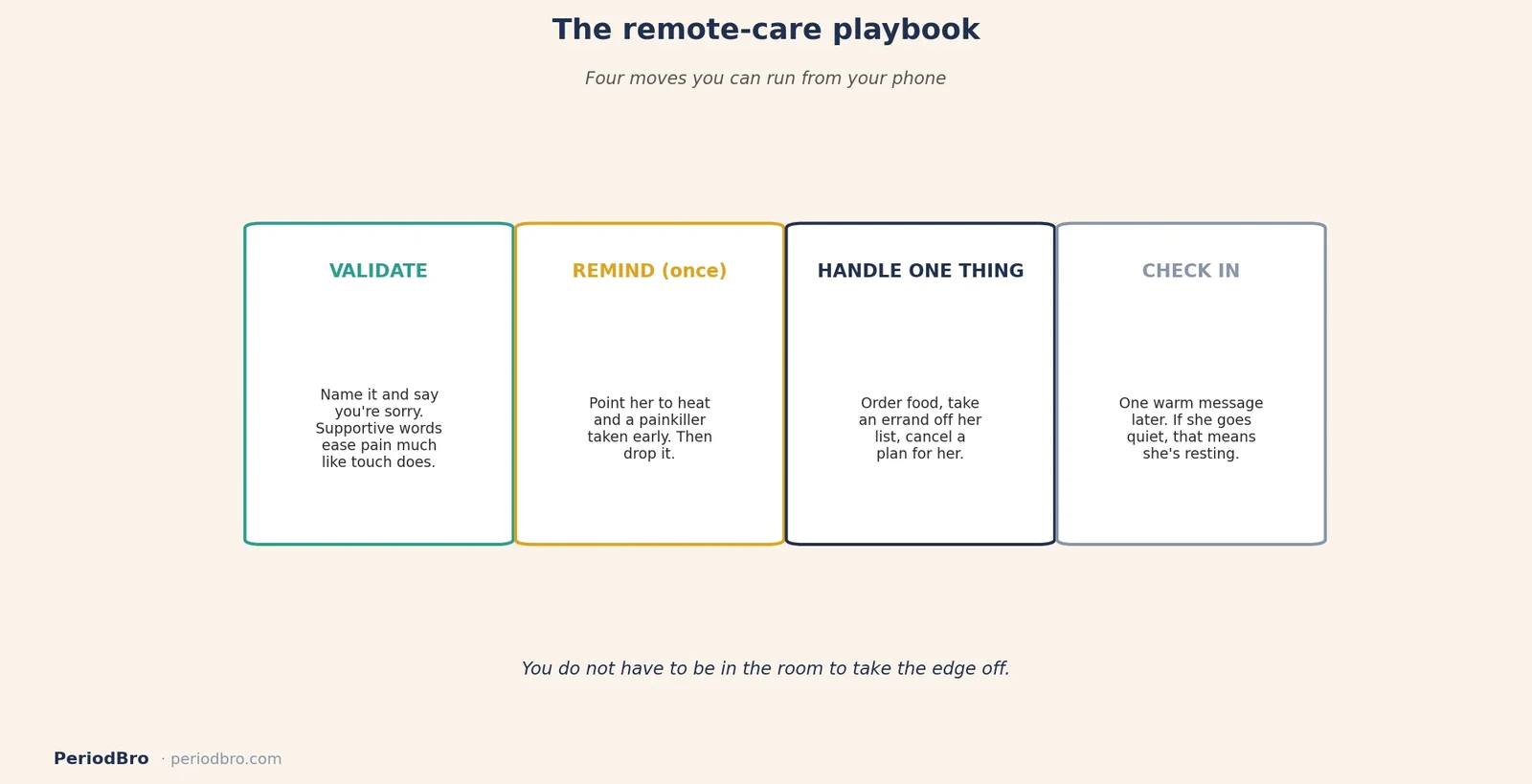
Here’s the part that surprised me. You don’t have to be in the room to take the edge off. In a study on pain and partner support, researchers found that supportive speaking reduced the pain a person felt to a similar degree as physical touch did (pain and active partner support, PubMed). Your voice, or in this case your text, is doing real work, not just filling the silence.
The other half of it is validation. When someone in pain feels heard instead of brushed off, they regulate the stress of it better, and the whole experience gets easier to carry (the role of validation in pain, Frontiers). So a message that says “that sounds awful, I’m sorry you’re dealing with it” is not a throwaway line. It’s the thing that’s actually helping.
How to help girlfriend with cramps over text
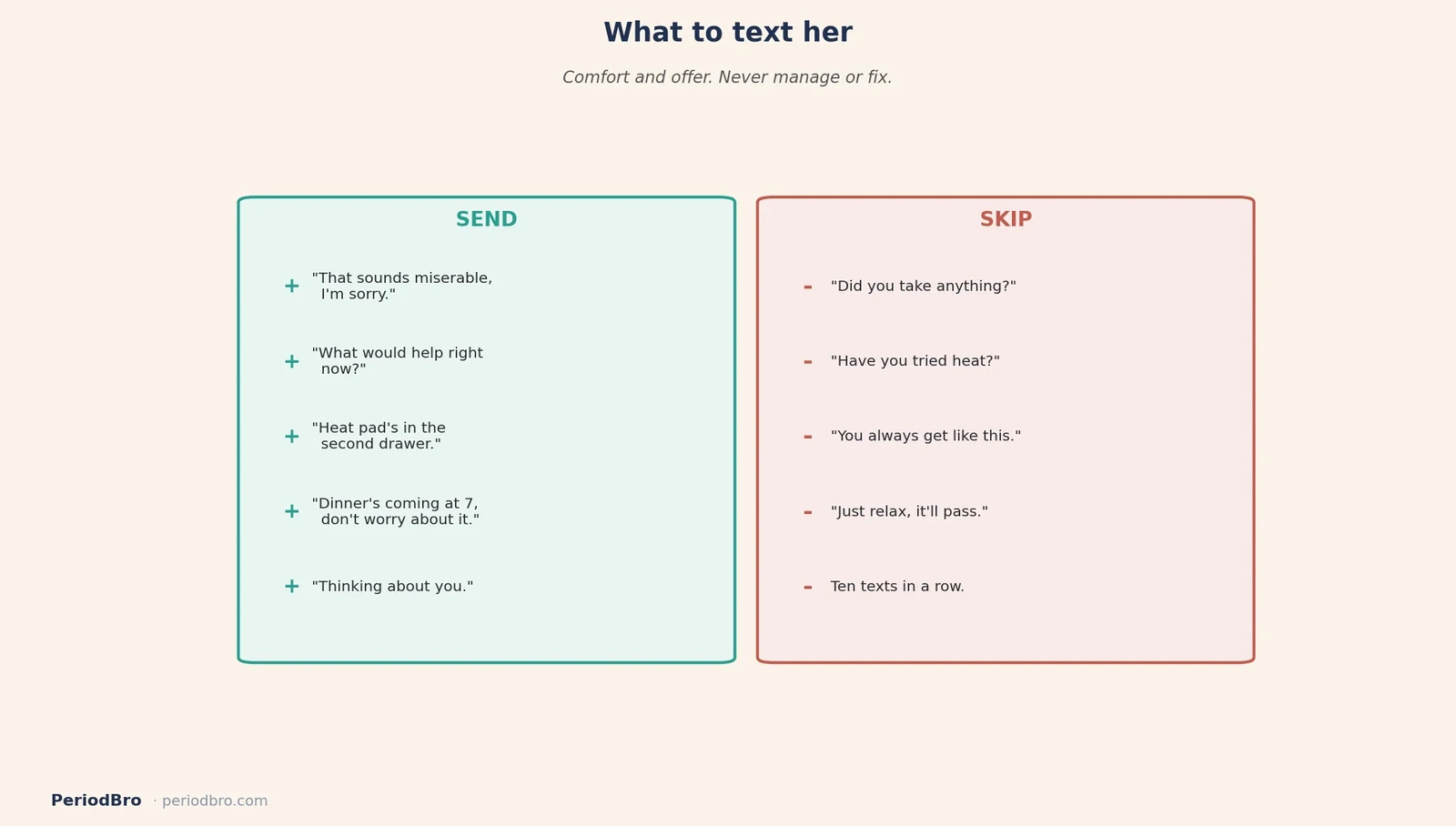
The trap is trying to be useful in a way that reads as nagging or fixing. “Did you take anything?” sounds like care in your head and lands like a checklist to her. “Have you tried heat?” turns her pain into a problem for you to solve, which is not what she asked for. And anything in the neighborhood of “you always get like this” turns a bad day into an argument.
What works is short, warm, and low-pressure. “That sounds miserable, I’m sorry.” “What would help right now, or do you just want me to not blow up your phone?” “Heat pad’s in the second drawer if you want it.” You’re offering, not managing. The one question worth asking is what she needs, because guessing is how you end up doing the wrong thing with good intentions.
Handle one real thing without being asked
Words matter, but doing one concrete thing from your phone is what turns a nice text into a memory. You’ve got a whole toolkit in your hand. Order her dinner so she doesn’t have to stand at a stove. Have a heating pad or her favorite snack delivered. Text the friend you were both meeting to say you’re staying in, so she doesn’t have to be the one to cancel. If there’s an errand she was dreading, quietly take it off her list and tell her it’s done.
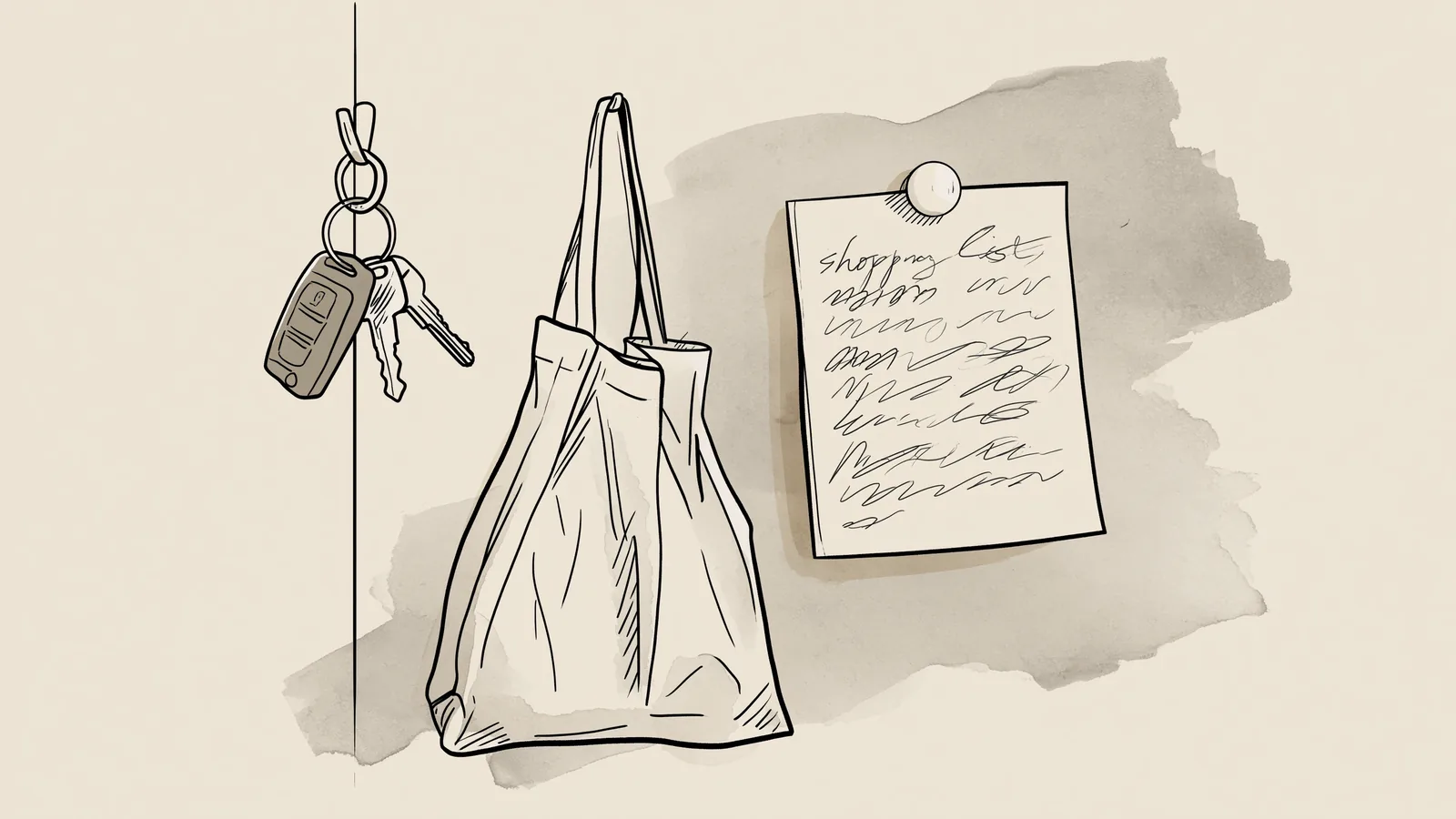
The move is to remove a decision or a task, not to add one. “Want me to order food?” is good. Just ordering the food she always gets and texting “dinner’s coming at 7, don’t worry about it” is better, because now she doesn’t even have to choose. Pain is exhausting, and every small thing she doesn’t have to manage is a genuine relief.
Remind her of what works, without hovering
You can nudge her toward the stuff that actually helps, as long as you do it as an offer and not a lecture. Two things have real evidence behind them. Painkillers like ibuprofen work best taken early, before the cramps peak, because they block the prostaglandins that drive the pain rather than fighting it after it’s built up (Mayo Clinic on menstrual cramps). And a heating pad is not a placebo. In trials, continuous low-level heat relieved period pain about as well as ibuprofen did (topical heat for dysmenorrhea, PubMed).
So a text like “heat pad’s in the drawer, and there’s ibuprofen in the cabinet if you haven’t taken any” is useful, once. Staying hydrated helps too, since dehydration makes cramps and headaches worse. The rule is you say it one time and then drop it. The second reminder is nagging, and nobody in pain wants to feel managed from a distance.

Check in once, then let her rest
The last piece is knowing when to go quiet. One warm follow-up later in the day is thoughtful. “Thinking about you, hope the heat’s helping, home by six.” Ten messages asking if she’s okay is its own kind of pressure, because now she has to keep reassuring you while she feels terrible. If she goes quiet, that’s usually good news. It means she’s resting, which is exactly what you wanted.
None of this requires you to be a hero or to fix anything. It’s a handful of small, deliberate moves that add up to a simple message: I know you’re hurting, I’m paying attention, and you’re not in it by yourself. That’s the whole thing.
Common questions
What if she doesn’t text back? Usually that’s a good sign, not a bad one. It means she’s resting, sleeping, or just doesn’t have the energy to keep a conversation going, and none of those need your intervention. Send one warm message that doesn’t demand a reply, something like “no need to answer, just thinking about you,” and then leave her be. Blowing up her phone to make sure she’s okay puts the work of reassuring you back on her.
Should I leave work and go home? Sometimes, but ask instead of assuming. For some people, having you show up early is a huge relief. For others, it makes them feel like they’ve caused a fuss, which adds guilt on top of pain. A quick “want me to come home, or are you good?” lets her tell you, and either answer is fine.
She says she’s fine but clearly isn’t. What do I do? Take her word for it out loud, and leave the door open. “Okay, but the offer stands if that changes.” Pushing her to admit she’s not fine turns your concern into pressure. Most of the time she knows you can tell, and just knowing you’d help if she asked is the reassurance she’s after.
When you’re actually home, the rundown of what actually helps with cramps and this hands-on guide to easing her cramps cover the in-person side. And if you want to stop being caught off guard, the reason I keep a loose eye on her cycle is so I already know a rough day might be coming before the text arrives, which makes it easy to show up before she has to ask.
This article is for general information and isn’t medical advice. Severe, sudden, or unusual period pain should be checked by a healthcare professional.