Traveling on Her Period: A Partner’s Playbook
You booked the trip four months ago. Two days before the flight she does the math out loud and her period is going to land somewhere in the middle of it. There is a version of that conversation where you both quietly brace for a ruined week, and a version where it is just a logistics problem. Traveling on her period is almost entirely the second thing, if somebody plans for it.
That somebody can be you, and it takes about twenty minutes of planning. What actually changes on the road, what goes in the bag, and how to handle the plans without turning yourself into a nurse or a martyr.
Her cycle may not do what the calendar promised
First thing to know before you plan anything around a predicted date: travel itself can move the date.
Cycles are run by hormones that take their cues from the body clock, and travel wrecks the body clock. A review of shift work, jet lag and female reproduction found that people working evening, night, or irregular shifts report altered cycle length in both directions, more menstrual pain, and changes in how long and how heavily they bleed. Those effects held up even when the studies controlled for health, lifestyle, and job environment.
Long-haul travel is a short, sharp version of the same disruption. Stack that on top of the ordinary causes of an off-schedule cycle, and Cleveland Clinic lists stress, illness, big weight changes, and heavy exercise among them, and a trip is a fairly efficient way to hit several at once.
The practical takeaway is simple. Pack as if the period could arrive a few days either side of the prediction, and do not treat the app’s date as a booking confirmation. We went into the rest of the reasons a cycle slips in why her period is late.

What goes in the bag when you are traveling on her period
The rule that saves the trip: her supplies go in the carry-on, not the checked bag. Bags get delayed, and a delayed bag on day one of a period is a genuinely bad start to a holiday.
Beyond that, a small kit does most of the work. Her usual products in the quantity she would use at home plus roughly half again, because heat, walking, and disrupted sleep can make a cycle heavier than her baseline. Painkillers she already knows work for her. A spare pair of underwear sealed in a bag. Wipes. A couple of nappy sacks for disposal, which matters more than you would think in places where bathroom bins are not a given.
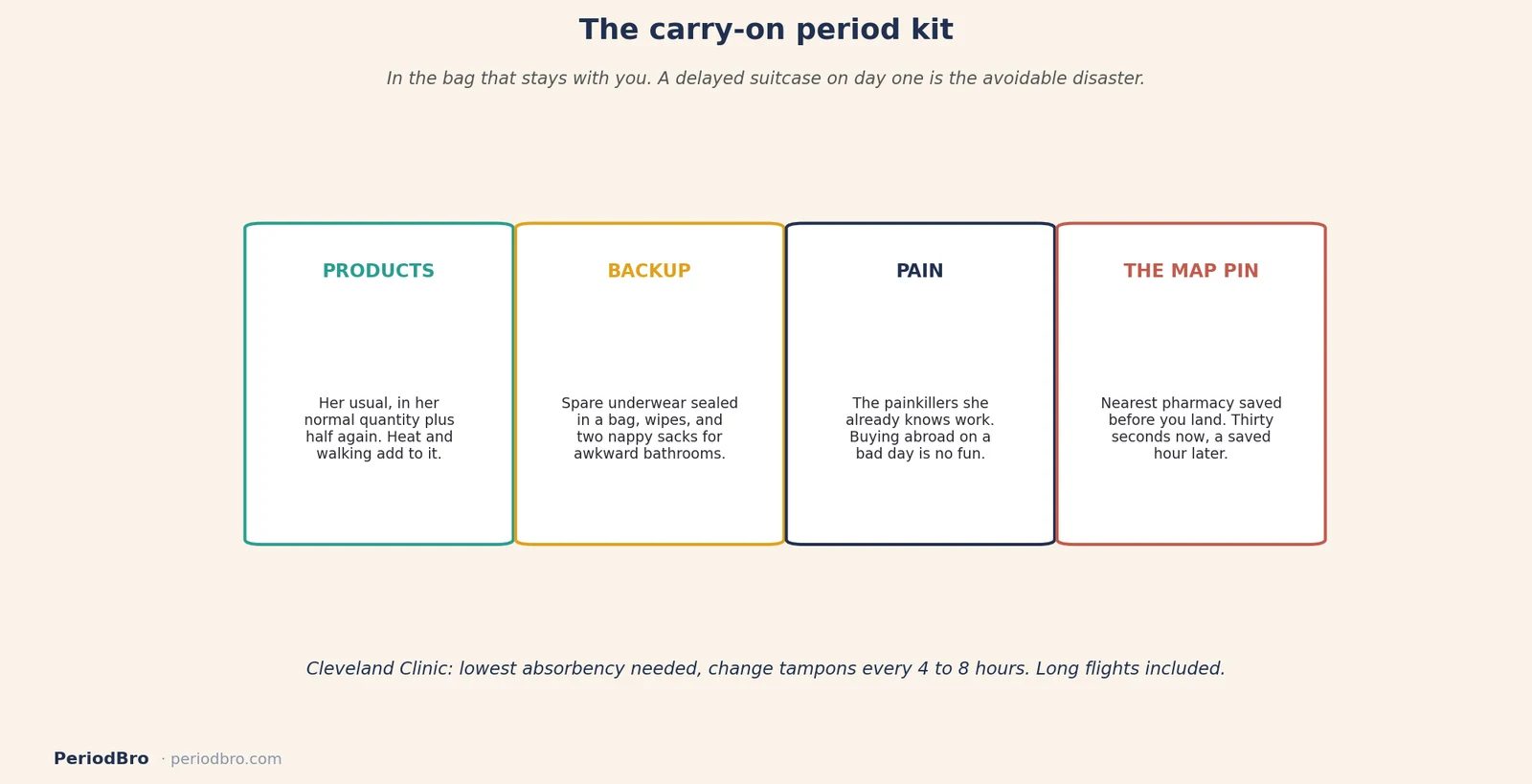
One safety note worth carrying with you, because travel days are exactly when it gets ignored. Cleveland Clinic advises using the lowest absorbency needed and changing tampons every four to eight hours, and notes that anything left in the vagina too long raises the risk. A twelve-hour flight is not a reason to stretch that, and it is a fair reason for her to plan around a different product for the flying day.
If she uses a cup, the thing that catches people out abroad is the sink. Somewhere to rinse in private is not guaranteed in an airport bathroom or a hostel, and wipes cover the gap.
Flights, long drives, and the seat you pick
Book the aisle, which sounds too small to mention and is worth more than most of what follows. An aisle seat is the difference between getting up when she needs to and doing timing calculations around the person asleep by the window.
Water is the other one. Cabin air is dry, dehydration makes cramps and headaches worse, and the free drinks trolley comes around on somebody else’s schedule. Fill a bottle after security.
For a long drive, plan stops at a frequency that assumes she needs them, without announcing why you are stopping. Every couple of hours is normal for anyone. Nobody needs a running commentary about whose bladder or cycle is setting the itinerary.
Heat is the sleeper problem on a hot-country trip. A heat pack is useless in 35 degrees, so the useful version of comfort is a cool room, water, and a scheduled nothing-happening block in the middle of the day. Our guide to helping with cramps when you are not there covers the remote version of the same problem.

The plans are the actual problem, not the period
Most trips go sideways over sunk cost rather than biology. You paid for the hike, the boat, the tasting menu, the 6am transfer. She feels awful and also feels guilty about the money, so she says she is fine, does the thing anyway, and the day gets worse for both of you.
The fix is in the booking rather than in how either of you feels about it. Build the itinerary with one flexible day and one thing you are happy to lose. Book refundable where the price difference is small. Then, when a day needs to change, changing it is a decision you already paid for rather than an argument about whether she is being difficult.
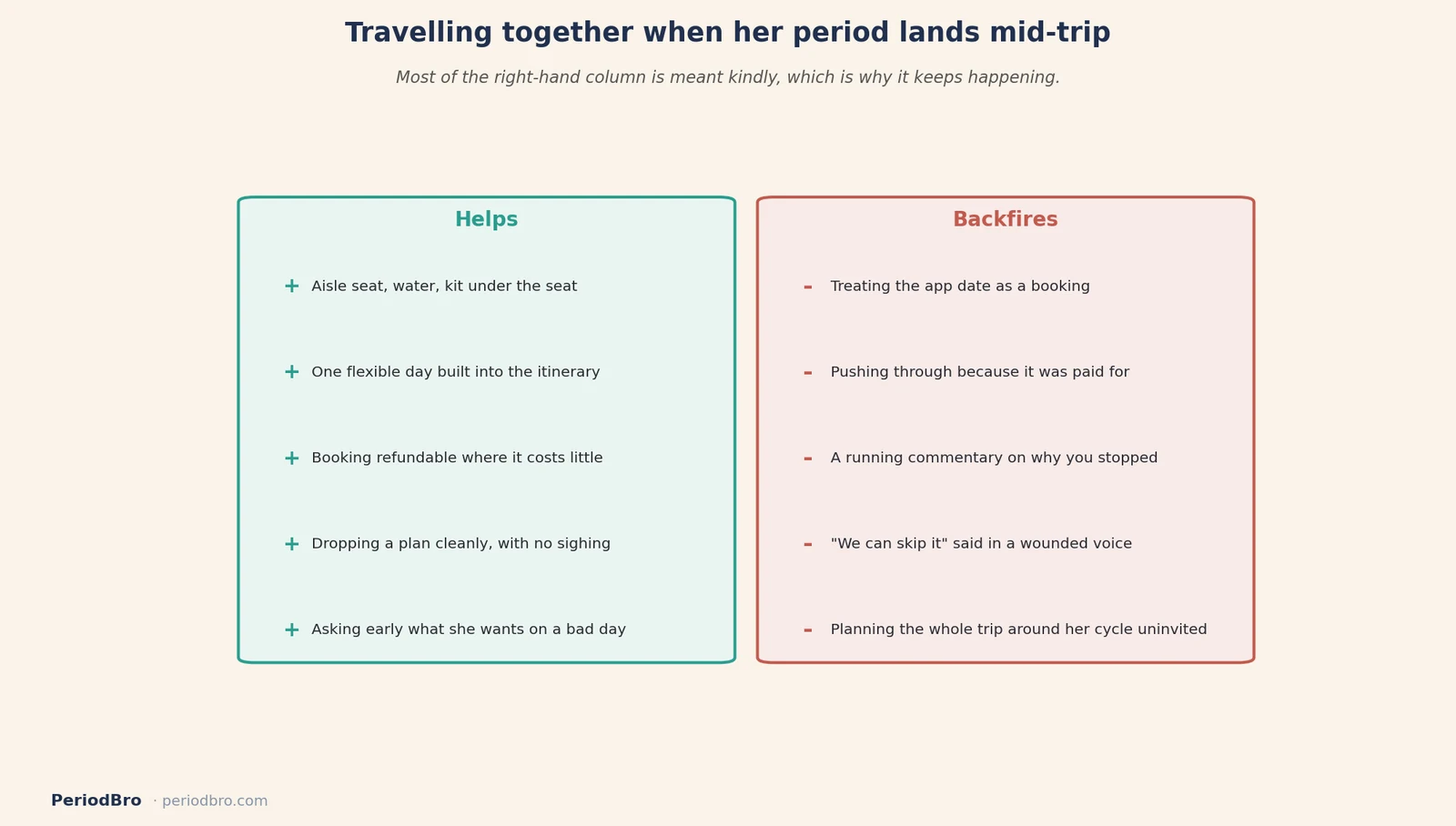
When something does get dropped, drop it cleanly. No sighing at the view you are not seeing, no “it’s fine, honestly” delivered in a tone that means the opposite. Swap in something low-effort and say you would rather do the good version of the trip later than the miserable version now. That is the same principle as taking it well when she cancels plans at home, with a bigger price tag attached.
Abroad, the small stuff is different
Products are not universal. Applicator tampons are common in some countries and hard to find in others, brands and absorbency labels differ, and pharmacy hours in much of the world are not a 24-hour proposition. If she has a product she relies on, bring it rather than assuming a shop will have it.
Two more things worth knowing before you land. Where the nearest pharmacy is, which takes thirty seconds on a map app and saves a stressful hour later. And whether the plumbing takes paper, because in a lot of countries it does not, which changes disposal.
None of this needs a conversation. It is the kind of thing you can just quietly know.
The five-minute conversation before you book
Have it once, early, in the planning stage rather than at the airport. Three questions cover it.
Does she want the itinerary planned around the likely dates, or would she rather not organise the trip around her cycle at all? Both are legitimate answers and getting this wrong in either direction is the actual mistake. Some people want the hike moved. Some people find the whole idea of a period-shaped holiday worse than the period.
What does she want from you on a bad day: company, space, or logistics handled? Ask now, because giving her space and being attentive are opposite moves and guessing wrong on day three of a trip is a long way from home.
And is there anything she would rather you just handled without discussing it? Usually there is. Usually it is small. Usually it is the thing she would never ask for.
Common questions
Can travel actually delay her period?
It can shift it. Circadian disruption is associated with changes in cycle length in both directions, alongside stress and disrupted sleep and eating, which are all standard features of a trip. Plan for a window, not a date.
Should we plan the trip around her cycle?
Ask her rather than deciding. Some people want the demanding days moved off the likely bad days. Others would rather book the trip they want and deal with whatever lands.
Is swimming on her period okay?
Yes, with a tampon or a cup. That is a personal call and not a medical prohibition, and it is worth checking before you book the day that is entirely water.
What if she gets her period unexpectedly while away?
This is what the carry-on kit is for. If it happens and there is no kit, a pharmacy or a supermarket solves it in ten minutes, and going yourself is a genuinely useful thing to do.
What about long flights specifically?
Aisle seat, water, supplies in the bag under the seat and not in the overhead bin, and a product choice that does not depend on getting to a bathroom on a fixed schedule.
She says she is fine and clearly is not. Do I push?
Do not push. Change the plan yourself and make it about you. “I’m wrecked, let’s do this tomorrow” gives her an exit without making her ask for one. We wrote a whole piece on the worst day of her period along these lines.
Is there anything I should be worried about medically?
Bleeding much heavier than her normal, severe pain that is not her usual, fever, or feeling faint are worth a doctor rather than a wait-and-see, wherever you happen to be. Travel insurance details are the boring thing to check before you go rather than after.
The trip does not need to be planned around her period. It needs to be planned in a way that survives one. That is a lower bar, and it is mostly about a small bag and one flexible day. The rest of the year, the same principle applies at home.
This article is general information, not medical advice. Severe pain, bleeding much heavier than her usual, fever, or feeling faint should be assessed by a clinician, including while travelling.