The Best Period Tracker for Boyfriends: How to Actually Choose (2026)
You typed “period tracker” into the app store, and now you’re staring at forty pink apps that all seem to be built for someone who isn’t you. You’re not the one with the cycle. You just want to stop being caught off guard, to be a little more useful on the rough days, and maybe to stop asking “wait, is it that week?” out loud like an idiot. None of the listings speak to that.
So let’s cut through it. Here’s how to actually pick a period tracker as a boyfriend, what to look for, and the one question you have to answer before you download anything.
What a “period tracker for boyfriends” even is
Most tracking apps are built for the person who menstruates. They log flow, predict the next period, and flag ovulation for people who are trying to conceive or avoid it. Useful, but that’s her tool, for her body. What you want is different. You want a read on where she’s at so you can show up better, without turning into someone who monitors his girlfriend.
That splits into a few different products that all get lumped under one search term. Some apps give the partner a companion view: gentle tips and a heads-up about big moments, but not her raw data. Some let her share her actual cycle with you if she opts in. And some are just your own private notes, tied to nothing, that nudge you at the right time. They look similar in the store. They are not the same thing.
The best period tracker for a boyfriend is not the one with the most features
Here’s the mistake most guys make: they treat this like buying headphones and go for the longest spec sheet. Wrong instinct. The best period tracker for a boyfriend is the one you’ll still open in a month, that tells you something you can act on, and that doesn’t make you feel like you’re spying.
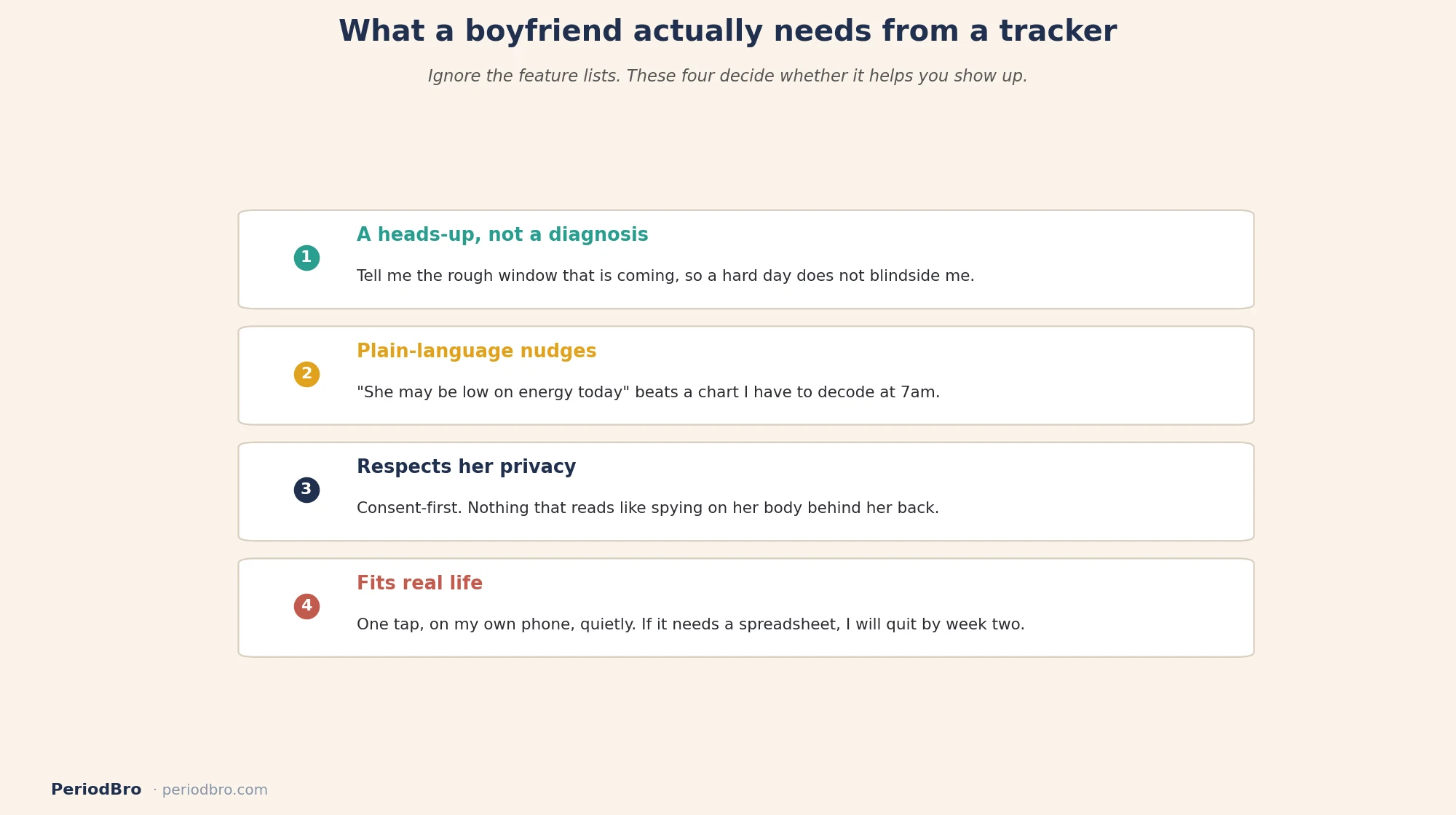
Four things matter, and almost nothing else does. You want a heads-up, not a diagnosis, so a hard day doesn’t blindside you. You want plain-language nudges, because “she may be low on energy today” beats a chart you have to decode at 7am. You want something that respects her privacy. And you want something that fits real life: one tap, on your own phone, done. If it needs the enthusiasm of a spreadsheet hobbyist, you’ll quit by week two, and an app you’ve quit helps no one.
Notice what’s not on that list: fertility windows, BBT charts, symptom analytics ten layers deep. That’s her domain if she wants it. Your job is lighter and, in a way, harder. You’re not tracking to know more than her. You’re tracking to be more present.
The consent question you have to answer first
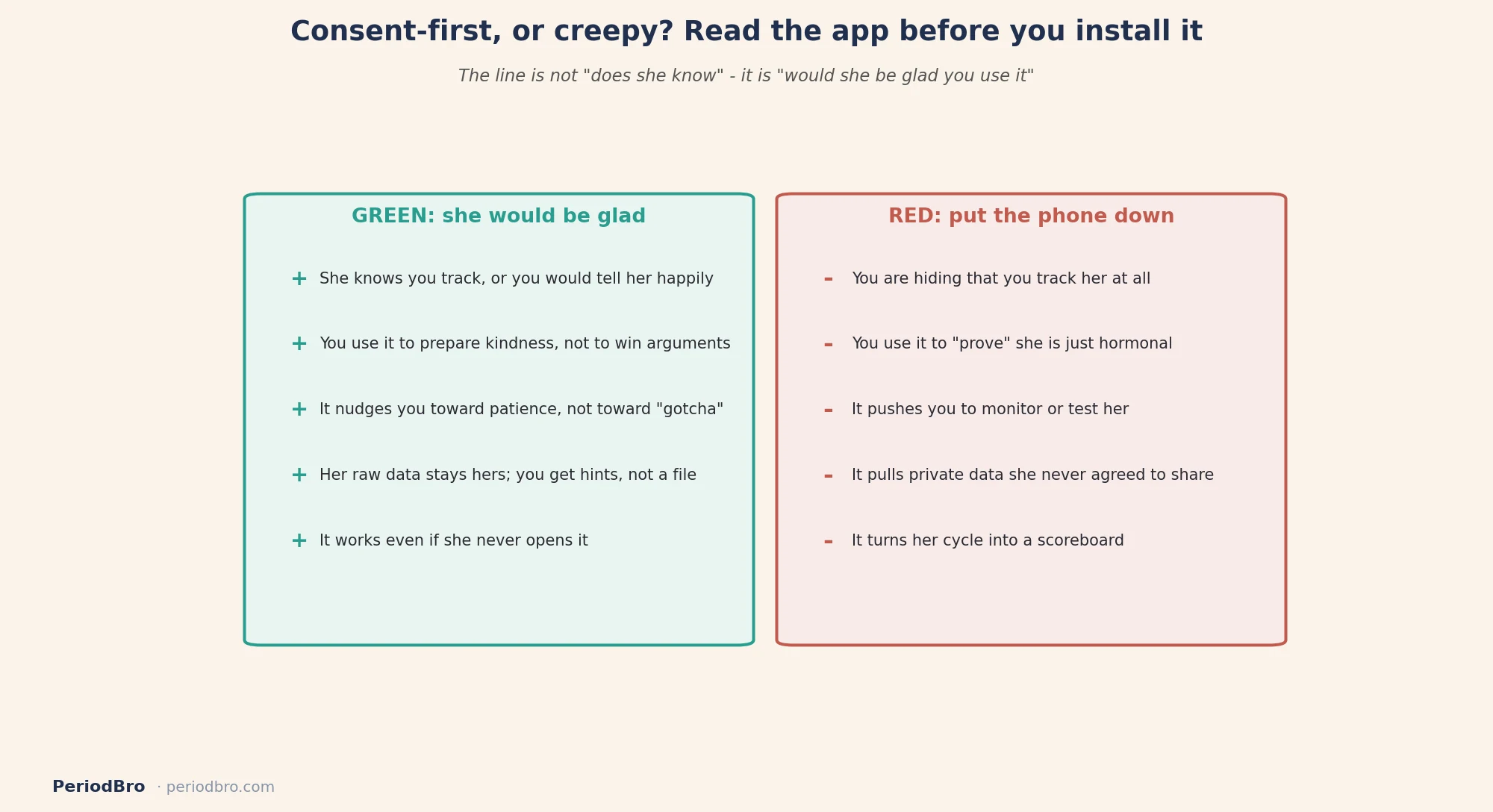
Before you compare a single feature, answer this: would she be glad you’re doing it? That’s the whole test. Not “does she technically know,” not “is it legal.” Would she, if she saw your phone, feel cared for or feel surveilled?
This matters more than it used to. Period-tracking data is genuinely sensitive, and privacy researchers have repeatedly flagged how loosely some cycle apps handle personal information, a concern that only sharpened after the fall of Roe put reproductive data under a legal microscope in the US (Mozilla’s privacy researchers have written about exactly this). So the app you pick shouldn’t just be kind to your relationship. It should be careful with data, ideally storing things locally rather than shipping her cycle to some ad server.
The line between caring and creepy is simple to feel and easy to cross. If you’re using an app to prepare a little kindness, to be patient on a predictable low day, to buy the right thing at the store, you’re on the right side of it. If you’re using it to “prove” she’s just being hormonal, to win a fight, or to monitor her behind her back, put the phone down. No app fixes that, and the good ones won’t help you do it.
If you want the longer version of how to do this cleanly, we’ve written a whole piece on how to track her cycle without being creepy, and one on tracking her cycle with consent. Read one of them before you commit to anything.

Match the app to where your relationship actually is
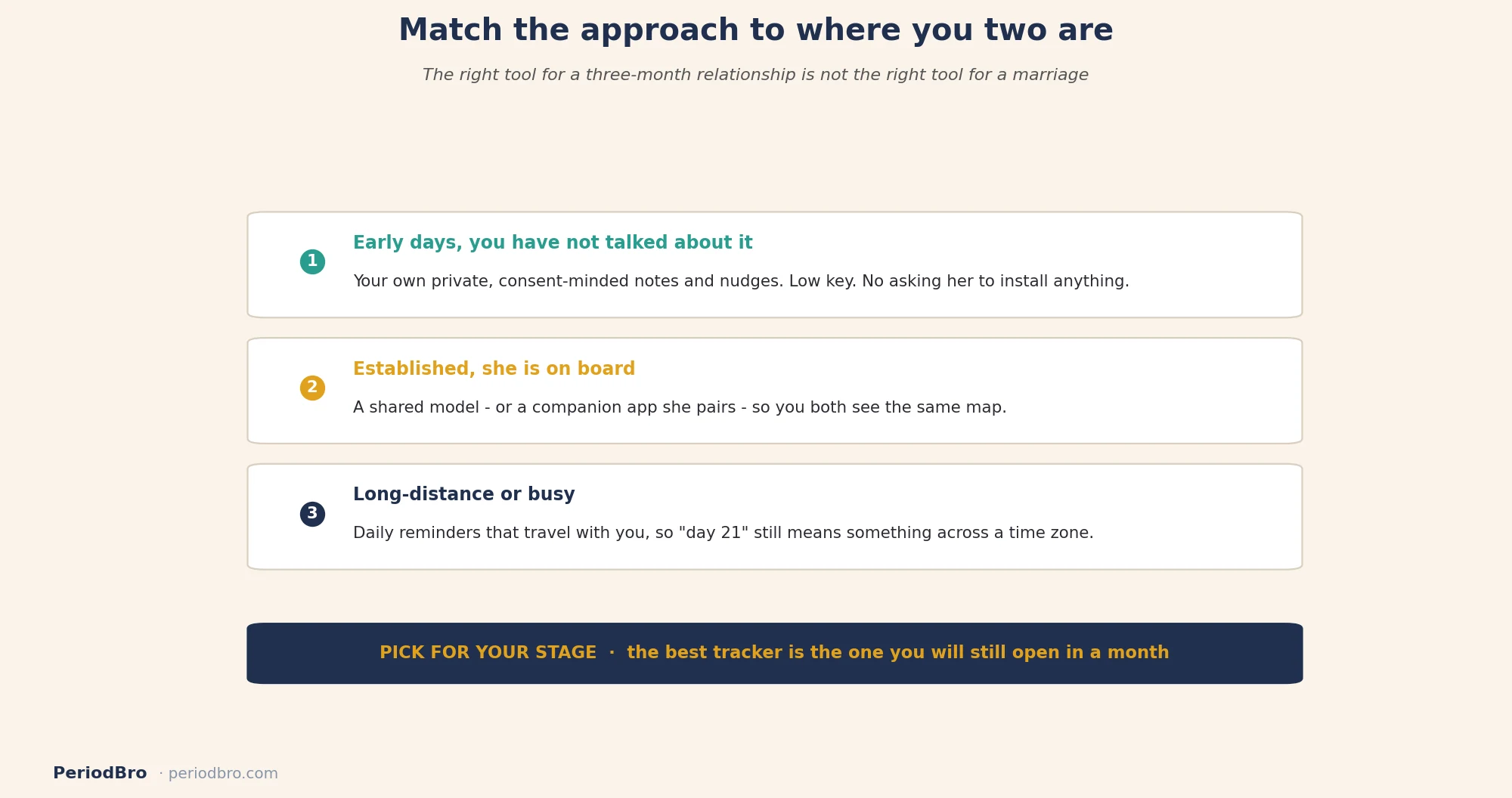
There’s no single winner here, because the right tool depends on where you two are. The best period tracker for a three-month relationship is not the best one for a marriage, and pretending otherwise is how guys end up with the wrong thing.
If you’re in the early days and you haven’t talked about any of this, you want your own private, consent-minded notes and nudges. Low key, on your phone, no asking her to install anything or hand over data. It keeps you thoughtful while the relationship is still finding its feet. If you’re established and she’s on board, you can step up to a shared model, or a companion app she pairs, so you’re both looking at the same map. And if you’re long-distance or just slammed, you want daily reminders that travel with you, so “day 21” still means something even across a time zone.
This is also why the biggest name isn’t automatically your answer. A companion mode bolted onto an app built for her is fine for light education. But if you want private nudges, or you’re a guy who also wants to keep an eye on the calendar for a daughter or another person you care about, most of the big apps simply can’t do that. They’re built around one user and one cycle. That’s the gap worth checking before you pick.
The features that sound impressive but you can skip
App listings are built to make you feel like you need everything. You don’t. As a partner, most of the headline features are noise. Fertility and ovulation prediction down to the hour is aimed at people trying to conceive, not at you trying to be thoughtful. Deep symptom analytics with charts and averages are her business if she wants them, and frankly they’re the kind of thing that tips you toward playing amateur doctor, which never ends well.
Same goes for anything that gamifies her cycle into streaks and badges, or that pings you with a dozen notifications a day. You want one quiet, useful nudge, not an app that turns caring about her into another thing demanding your attention. And be wary of any tracker that asks for more access than it needs: her contacts, her location, permission to share data with “partners” you’ve never heard of. A period app has no business with any of that.
The honest filter is this. If a feature helps you be a bit kinder or a bit less surprised, it earns its place. If it’s there to impress you in the store or to make the company money off data, ignore it. The whole value of a tracker for a boyfriend is that it’s small, quiet, and pointed at one thing: helping you show up. Everything else is decoration, and decoration is exactly what makes you quit the app in three weeks.
So which one should you actually download?
Start from what you’re trying to do, not the store rankings. Want light education while she keeps her own app? A companion mode works. Want to see her real cycle and she’s up for sharing? Pick something with proper partner sharing. Want private notes and daily nudges on your own phone, maybe for more than one person in your life? That’s the lane we built PeriodBro for, and it’s the one the big apps skip.
Whatever you choose, the point was never the app. The point is that you stop guessing, and start showing up on purpose. If you want the deeper background, our guide to being a better partner through her cycle walks through the whole picture, and the menstrual cycle phases explained for men if you want to actually understand what the app is nudging you about. Understanding beats guessing, and a cheap little tool that makes you a bit more thoughtful is one of the better trades you’ll make in a relationship.
PeriodBro is a support tool for partners, not a medical or fertility-planning app. It doesn’t diagnose anything, and it’s not a substitute for advice from a qualified healthcare professional.