Period Acne: Why She Breaks Out Before Her Period (and How to Help)
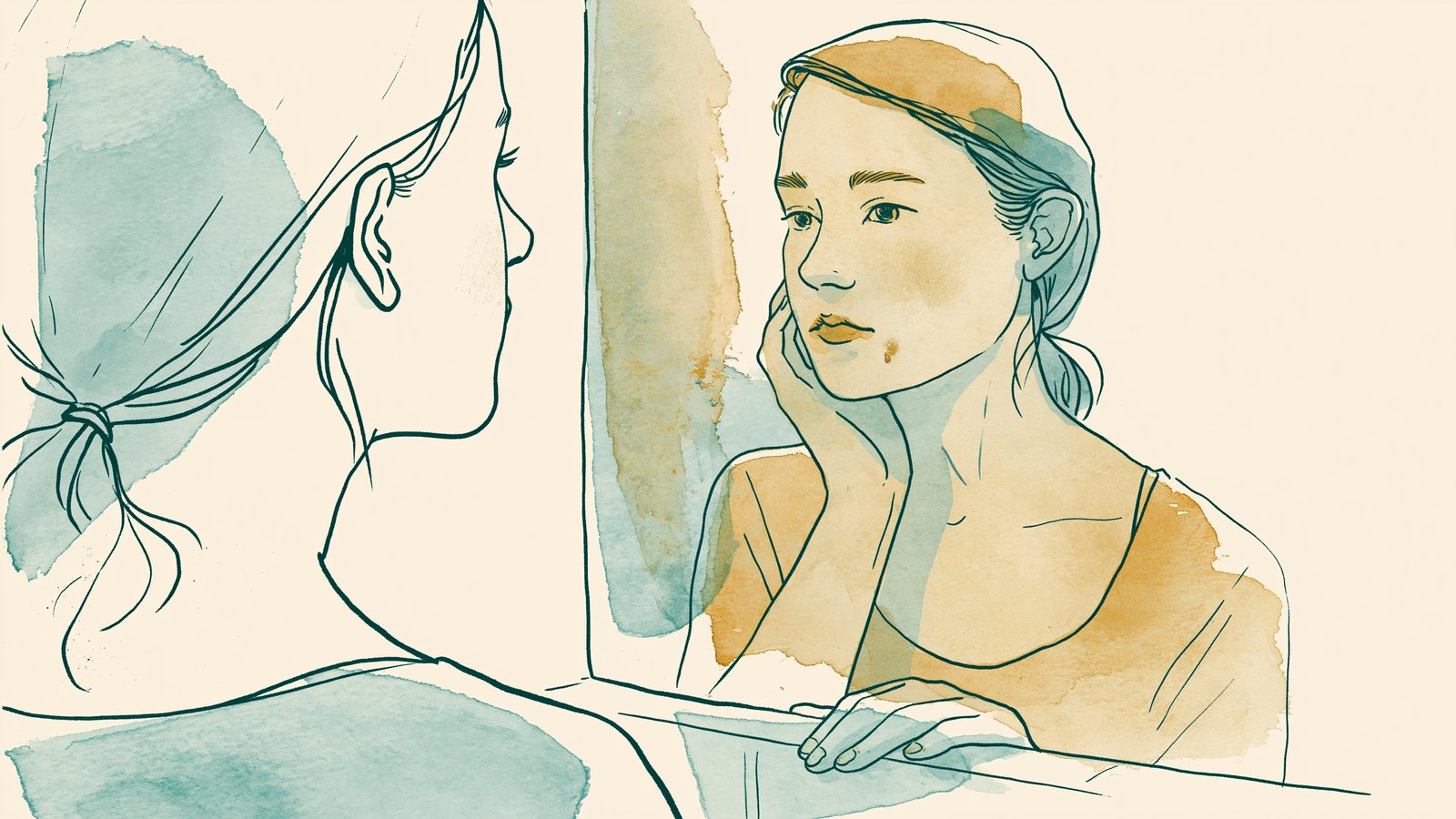
A few days before her period, the same spot on her jaw shows up like it has a calendar. She knows it’s coming. She covers the bathroom mirror with one hand, sighs, and reschedules the dinner you were both looking forward to. None of that is vanity. Her skin is doing something on a hormonal clock, and the worst thing you can do is treat it like a flaw she should have prevented.
Period acne is one of the most predictable things a body does, and one of the easiest to handle badly as a partner. I learned that the slow way. Early on, I thought “helping” meant noticing out loud and offering a fix, so one month I handed someone a spot cream I’d read about and said something I meant as supportive. The look on her face taught me more than any article could: she hadn’t asked me to grade her skin, and my “help” had just told her I’d been looking. It took me a while to understand that the kindest move was almost always to say nothing about it at all. Here’s what’s actually going on, and how to be useful without turning her face into a topic of conversation.
What period acne actually is
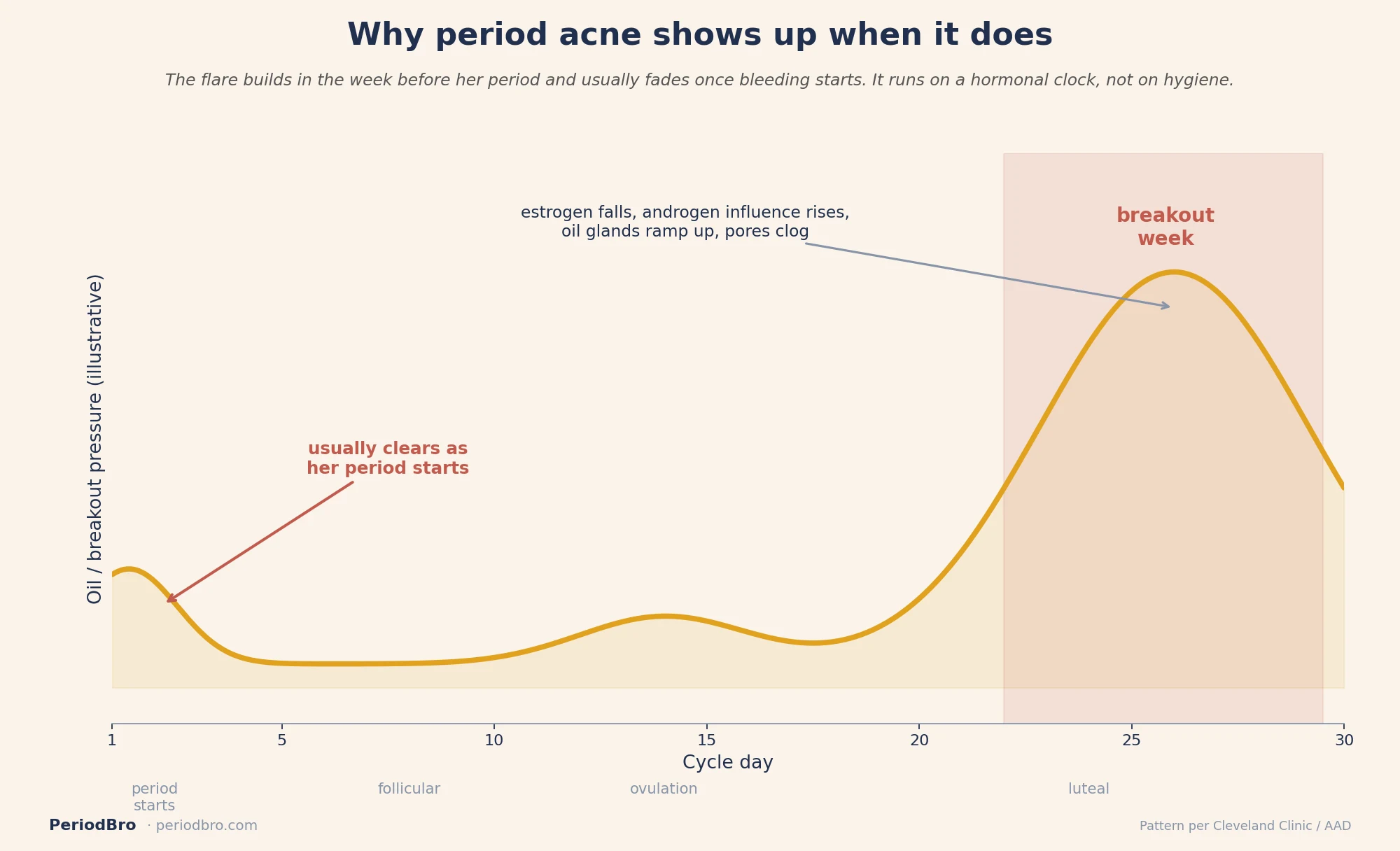
Period acne is the breakout that flares in the week or so before her period and usually fades once bleeding starts. It isn’t bad luck or bad hygiene. It’s the predictable result of where she is in her cycle.
The driver is the luteal phase, the stretch between ovulation and her period. After ovulation, progesterone rises and then, in the back half of that window, both progesterone and estrogen fall as the body gets ready to menstruate. That shifting balance leaves androgens, the so-called “male” hormones that every body makes, with more relative influence. Androgens tell the skin’s oil glands to produce more sebum, the thick oil that keeps skin lubricated (Cleveland Clinic).
More oil plus the dead skin cells that line every pore is a recipe for a clog. Bacteria that normally sit harmlessly on the skin get trapped behind that clog, the body sends inflammation to deal with them, and you get the red, sometimes painful bump that shows up right on schedule (Mayo Clinic). The luteal phase also tends to make skin a little more reactive and inflamed overall, which is why a breakout in that window can look angrier than a stray pimple at another time of the month. If you want the bigger picture of what that phase does to her body and mood, the luteal phase explained for partners covers the whole stretch.
Why it lands on her jaw and chin
Hormonal breakouts have a signature address. They tend to cluster on the lower third of the face: the chin, the jawline, and sometimes down onto the neck. That’s because the oil glands in that area are especially responsive to hormonal signals, so when androgens ramp up oil production, that’s where it shows first (American Academy of Dermatology).
The timing is just as reliable as the location. In one survey of women who get premenstrual breakouts, the large majority reported their flare starting within about seven days before their period (Perimenstrual Flare of Adult Acne, NCBI). So if you’ve quietly noticed that her skin and her mood seem to shift around the same point each month, you’re not imagining a pattern. They’re both downstream of the same hormonal turn, which is also why hormones can drive her mood in that same premenstrual window.
How common is period acne, really
Common enough that “why do I always break out before my period” is one of the most-asked questions in any dermatology office. Estimates vary a lot depending on who’s studied and how, but the range lands somewhere between roughly half and three-quarters of women with acne reporting a premenstrual flare. One large epidemiological survey in France found that about 78% of adult women with acne noticed it worsening before their period (PubMed). Interestingly, premenstrual flares seem to get more common with age, not less, so this isn’t a teenage problem she should have outgrown (NCBI).
Why does the prevalence matter to you? Because it reframes the whole thing. This isn’t a personal failing or a sign she’s “letting herself go.” It’s one of the most ordinary things a cycling body does, and millions of people manage it every single month. Your job is not to fix her skin. It’s to make sure the breakout costs her as little as possible in stress, confidence, and energy, the same way you’d show up for any other premenstrual symptom.

What actually helps (and the one rule that matters most)
Start with the rule that outranks everything else: do not comment on her skin. Not to point it out, not to suggest a product, not even to reassure her that “you can barely see it.” She has a mirror. She already knows. Drawing attention to it, even kindly, makes her self-conscious about a thing she didn’t ask you to evaluate. Respond to how she’s feeling, not to how her face looks.
From there, the useful moves are small and practical:
Don’t let it shrink her plans without a quiet alternative. If she cancels the dinner, don’t push. Offer the low-key version instead: takeout at home, a movie, an early night. You’re protecting the time together, not the restaurant reservation.
Make the boring logistics disappear. If she’s heading to the pharmacy for a spot treatment or a fresh cleanser, grab it on your way home so she doesn’t have to. Keep the basics stocked so a breakout week never adds an errand.
Guard her sleep and her stress. Both make skin worse, and both are things you can actually influence. Take a chore off her plate. Handle the thing that was going to keep her up. A calmer week tends to be a calmer face, and you don’t have to mention skin once to make that happen.
Read the cancelled plans correctly. If she suddenly doesn’t want to go to the party, the breakout might be the reason even if she names something else. That’s not her being shallow. Feeling like the most visible thing about you is a flare on your jaw is genuinely draining. Meeting that with “no problem, let’s do whatever feels good” instead of “you look fine, come on” tells her you get it without making her explain.
Never play dermatologist. Resist the urge to suggest she “just” drink more water, cut out chocolate, or try the routine your sister swears by. Unsolicited skincare advice lands as criticism dressed up as help. If she wants to talk through what’s working, listen. Otherwise, stay in your lane.
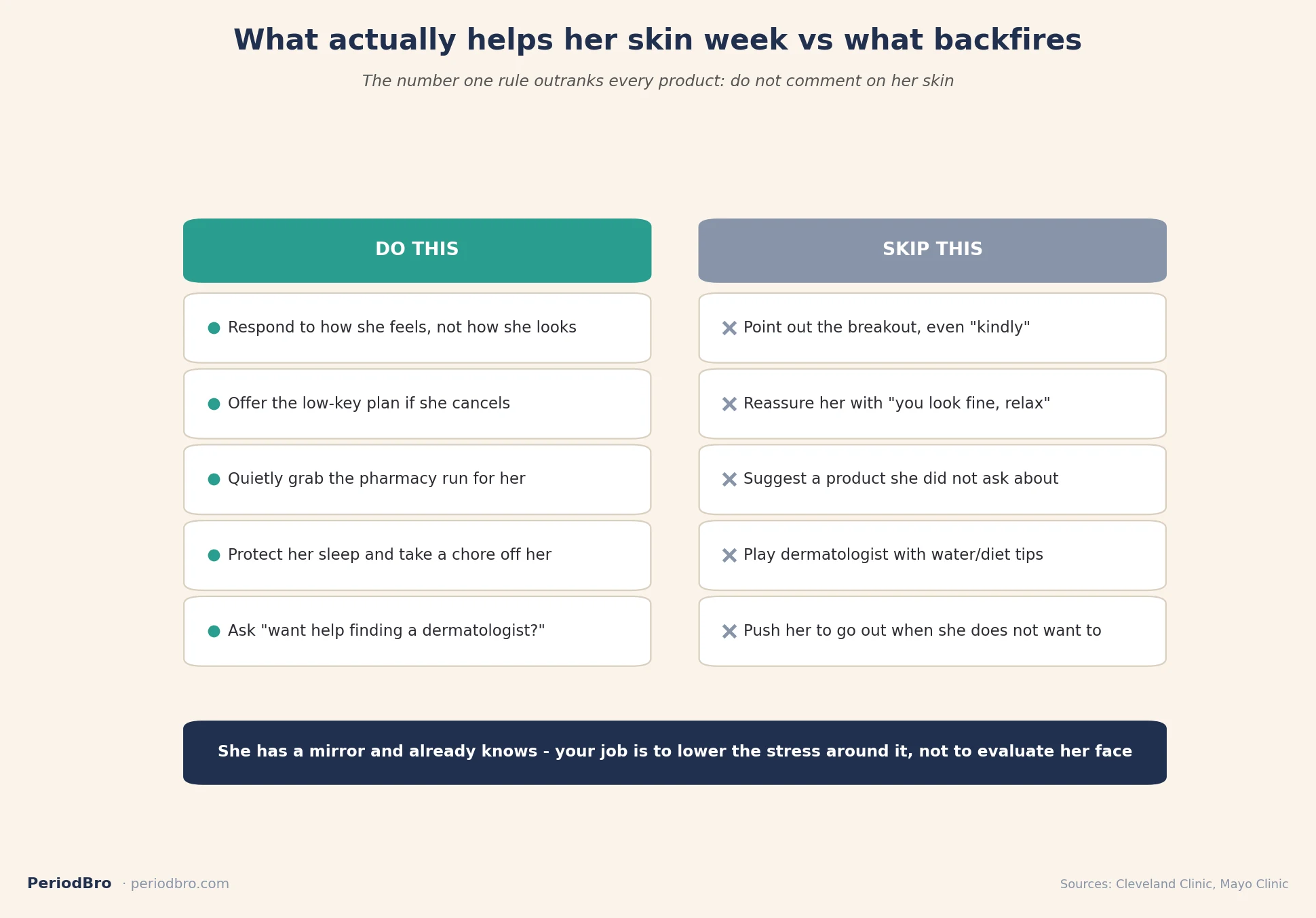
The throughline is the same one that runs under every cycle symptom: the breakout is hers to manage, and your role is to lower the friction around it. That mindset is the whole of being a better partner through her cycle.
When her period acne is worth a dermatologist’s look
Most period acne is ordinary and rides out the cycle. But a few patterns are worth a real medical conversation, and knowing them means you can gently support her in booking the appointment rather than waiting it out forever.
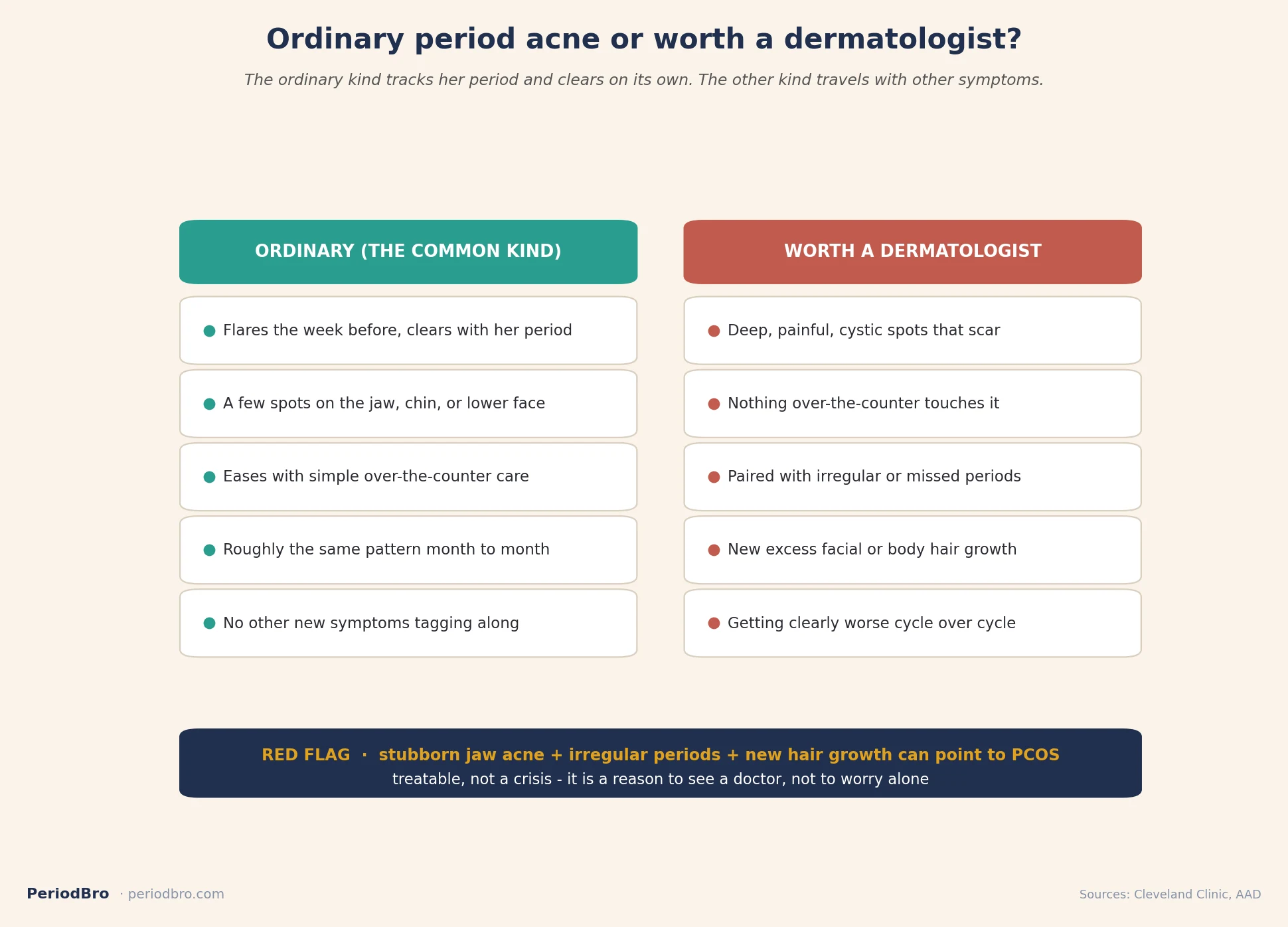
Flag it as worth a doctor if the breakouts are severe, deeply cystic, and scarring, or if over-the-counter products never make a dent. The bigger signal is acne that travels with other symptoms: persistent breakouts along the jaw and lower face paired with irregular or missed periods, unexpected weight changes, or new excess hair growth on the face or body. Together, those can point to an underlying hormonal condition like polycystic ovary syndrome (PCOS), where higher androgen levels drive both the skin and the cycle changes (Cleveland Clinic, PCOS).
None of that is a crisis, and you should not be the one to diagnose it. The point is simply that there are good treatments for stubborn hormonal acne, from prescription topicals to hormonal therapy that the American Academy of Dermatology notes works especially well for women with jaw-and-chin breakouts. A dermatologist can sort the ordinary from the worth-investigating. If she’s frustrated and stuck, “want me to help you find someone?” is a better sentence than any home remedy you could offer.
If you remember one thing
Period acne is a hormonal event with a schedule, not a hygiene problem and definitely not something for you to evaluate. So the single most useful thing you can do is the quietest one: notice the week, lighten her load, and say nothing about her face. Bring the easy dinner, run the errand, protect the early night, and let her skin be her business.
If you want to stop guessing where she is in her cycle and start seeing the breakout week coming the way she does, that’s exactly what PeriodBro is built for: turning the pattern into a heads-up so you can show up before she has to ask.

This article is general information for partners, not medical advice. Persistent, severe, or scarring acne, or breakouts paired with irregular periods, weight changes, or excess hair growth, are worth a conversation with a doctor or dermatologist.