Period Lasting Longer Than 7 Days: What It Means and When to Worry
A buddy of mine called me on a Sunday night, a little embarrassed, to ask a question he didn’t want to google in front of his wife. She was on day nine of her period. She’d said it was “just a long one” and gone back to her book, but he’d noticed the box of pads under the sink was nearly empty and she looked wiped out. He wanted to know if a period lasting longer than 7 days was normal or something he should push on.
One long period usually isn’t an emergency. When it keeps happening, it deserves a closer look. Doctors have a fairly clear line for what counts as too long, and there are a handful of usual suspects behind it. Below is what that line is, what tends to cause it, and how to bring it up without sounding like you’re keeping score.
What counts as a long period
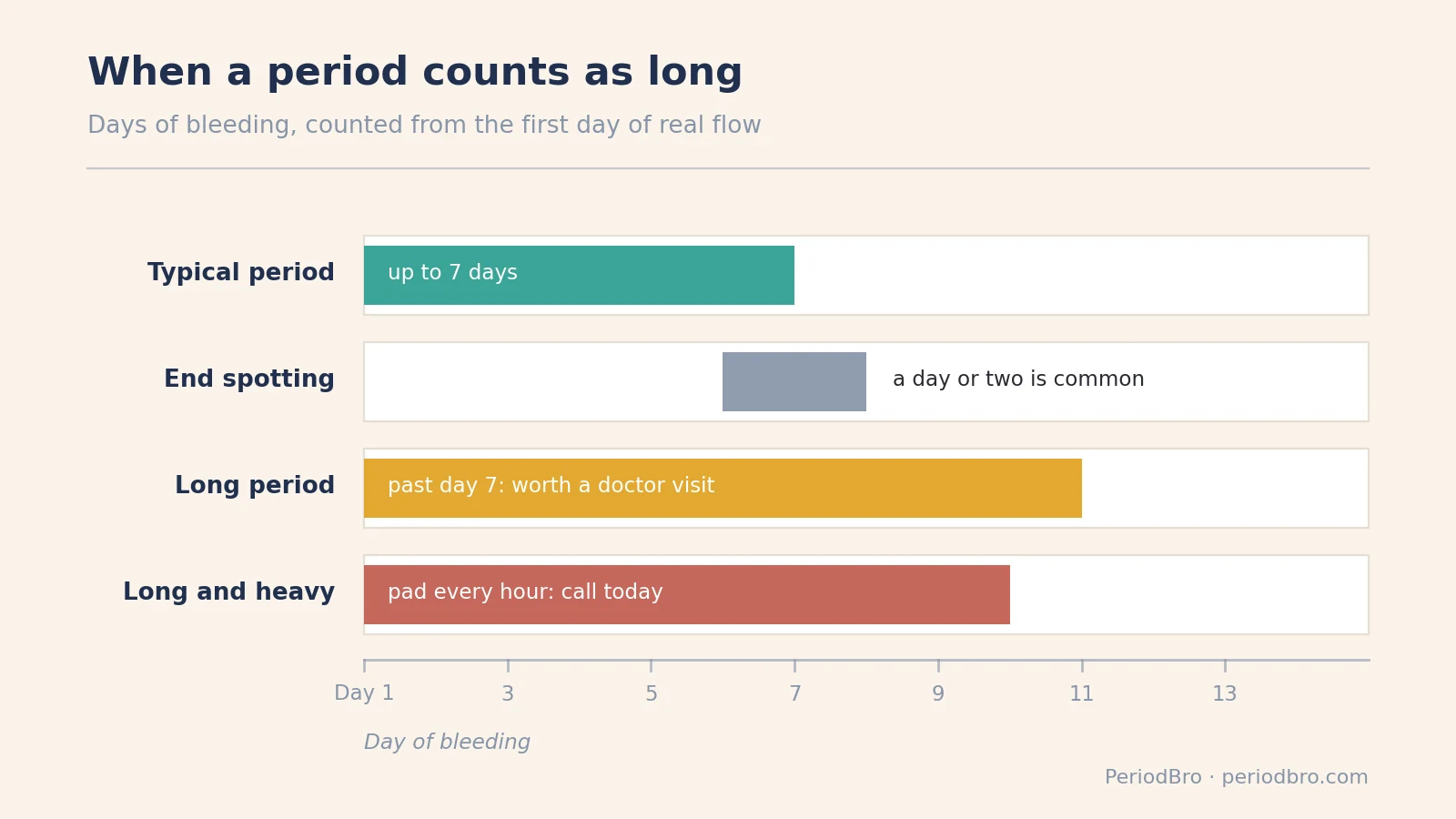
ACOG, the main professional body for gynecologists in the US, says a normal period generally lasts up to 7 days. Bleeding that goes on longer than that, or that soaks through one or more pads or tampons every hour for several hours in a row, falls under heavy menstrual bleeding (ACOG). The older medical name is menorrhagia, which you’ll still see on a lot of clinic websites.
Counting matters here, and it’s easy to get wrong. Day one is the first day of real flow, the kind that needs a pad or tampon. A day or two of light brown spotting at the very end is common and usually just old blood clearing out. If she’s still needing proper protection on day eight, that’s the long period doctors mean.
Length and heaviness often travel together. Cleveland Clinic lists both as signs of menorrhagia: bleeding for more than seven days, or changing a pad every hour (Cleveland Clinic). A period can be long without being heavy, though, and that version is easier to ignore for months.
Why a period lasting longer than 7 days happens
There’s rarely one obvious cause, and a doctor usually works through a list. The main groups look like this.
Hormones and ovulation. When she doesn’t ovulate in a given cycle, progesterone never rises the way it normally would. The uterine lining keeps building on estrogen alone, and when it finally sheds, it can come out slowly and for longer. This is common in teens whose cycles are still settling and in women in their 40s heading toward menopause. We wrote about it in anovulatory cycles explained. PCOS and thyroid problems can cause the same pattern, and thyroid and periods covers that side.
Something in the uterus. Fibroids, polyps and adenomyosis can all stretch out bleeding. Fibroids are non-cancerous growths in the muscle wall of the uterus. Polyps are small growths in the lining. Adenomyosis is when lining tissue grows into the muscle. ACOG lists all three among the common structural causes of abnormal bleeding (ACOG). If you want more on either of the big two, see fibroids and heavy periods or adenomyosis for partners.
Birth control. A copper IUD often makes periods longer and heavier, especially in the first months. Starting, stopping or switching a hormonal method can throw bleeding off for a while, and so can missed pills. How birth control changes her cycle goes method by method.
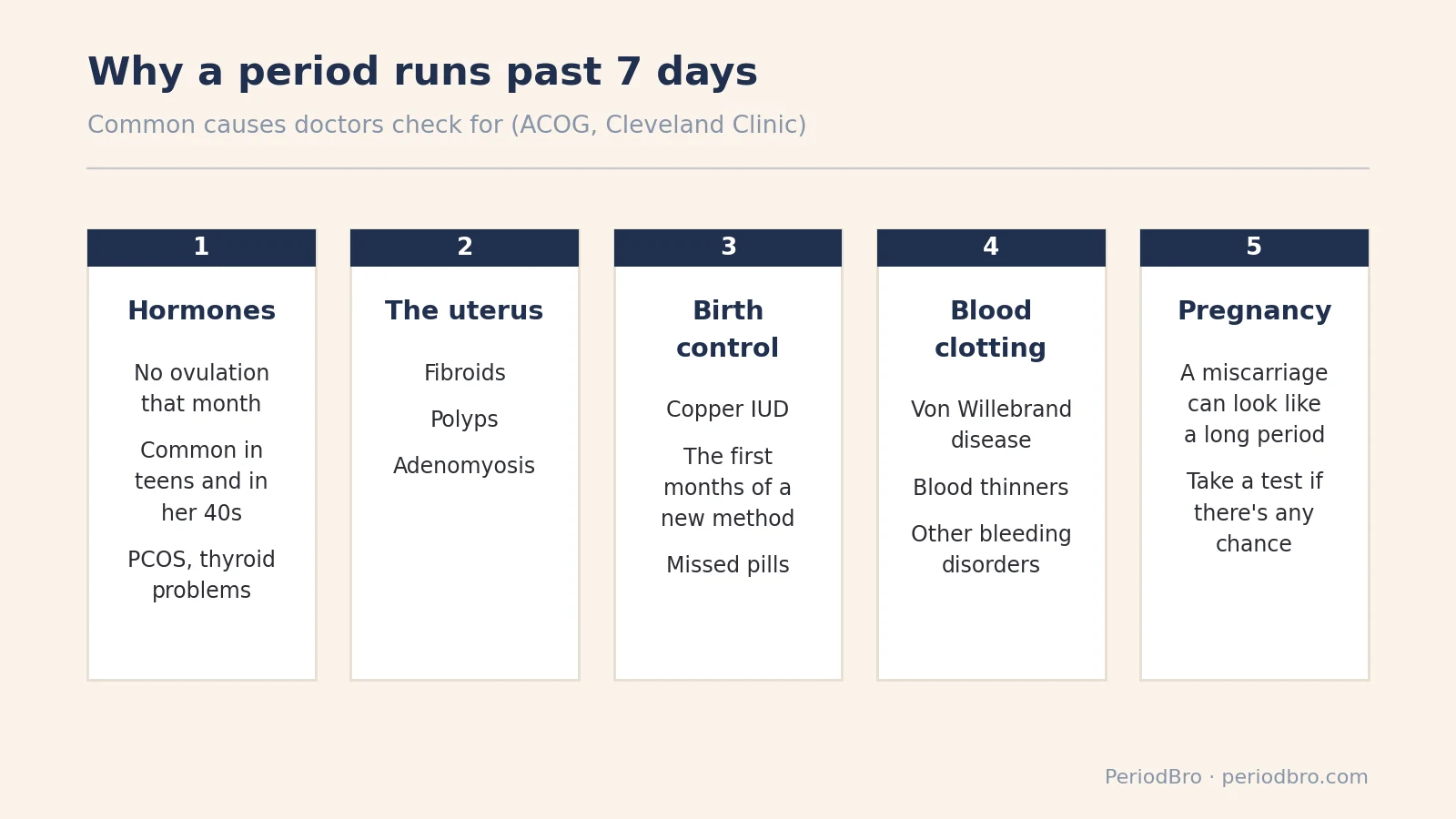
Blood that doesn’t clot well. Doctors and patients both miss this one. Von Willebrand disease is the most common inherited bleeding disorder, and the CDC lists heavy or long periods as one of its most common signs in women (CDC). Many women live with it for years because they assume their periods are just like that. If she’s always had long periods, bruises easily, or bleeds a lot after dental work, mention it to her doctor. Blood thinners can also lengthen periods.
Pregnancy. An early miscarriage can look like a late, long, heavy period. If there’s any chance she could be pregnant, a test is a sensible first step. Her period after a miscarriage covers what usually comes next.

The iron problem that often gets missed
Bleeding for nine or ten days every month adds up. A lot of women with long periods end up low on iron and don’t link the two. They just feel tired, cold, a bit short of breath on the stairs, and figure that’s work or age. Johns Hopkins lists anemia as one of the main complications of heavy or prolonged bleeding (Johns Hopkins Medicine).
If her long periods come with tiredness that doesn’t lift, it’s worth asking the doctor for a ferritin test along with a blood count. Ferritin shows iron stores, and it can be low well before a standard anemia test flags anything. We went deeper on this in iron deficiency and heavy periods.
What a doctor will usually do
Knowing the steps takes some of the dread out of booking the appointment. Most visits for long periods start with questions: how many days, how heavy, any clots, any change from her usual pattern, any chance of pregnancy. Expect a pelvic exam, a pregnancy test and blood work. Cleveland Clinic lists a pelvic ultrasound as a common next step to look for fibroids or polyps (Cleveland Clinic). What happens at a pelvic ultrasound walks through it, if she wants to know beforehand.
Treatment depends on the cause. It might be a hormonal IUD or pill to thin the lining, a non-hormonal medicine like tranexamic acid taken only on bleeding days, iron for the anemia, or a procedure to remove a polyp or fibroid. Which one fits depends on what the tests show and whether she wants to get pregnant soon.
The best thing she can bring to that appointment is a record. Start date, end date, the heavy days, roughly how often she changed protection. Two or three months of that tells a doctor more than “my periods are kind of long.” If you already share cycle data, you can help keep it. If you don’t, offering to log it is a decent way in, and tracking her cycle without being creepy has the ground rules.

When to call today
Most long periods can wait for a normal appointment. A few signs can’t.
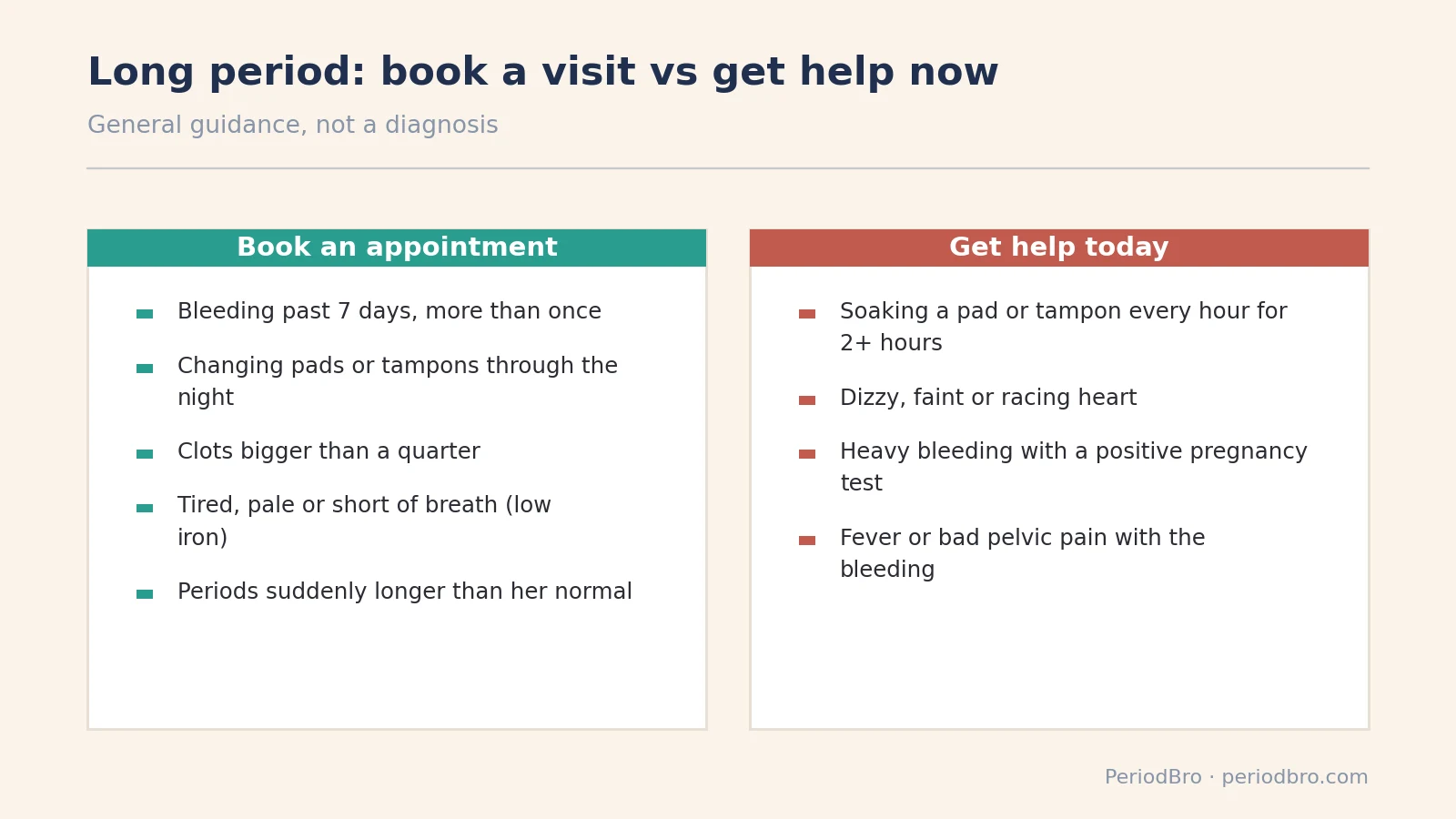
- She’s soaking through a pad or tampon every hour for two hours or more.
- She feels dizzy, faint, or her heart is racing.
- She has heavy bleeding and a positive pregnancy test, or bad one-sided pain.
- Fever or severe pelvic pain comes with the bleeding.
Any of those means calling her doctor that day, or going to urgent care or the ER if it’s after hours. ACOG’s guidance on heavy bleeding uses that same soaking-every-hour marker (ACOG).
How to bring it up without making it weird
She knows her period is long. She’s the one living it. What she might not have is the energy to deal with it, or a sense that it’s worth a doctor’s time. A lot of women have been told for years that heavy, long periods are normal, and some have been brushed off when they asked. We wrote about that in when a doctor dismisses her period pain.
Skip the diagnosis. Say what you noticed and offer help. Something like “You’ve seemed really drained this week. Want me to book you in somewhere, or come along?” lands better than “Nine days isn’t normal, you know.” Then handle the practical stuff: restock supplies before they run out, take dinner off her list, and keep iron-rich meals in the rotation. How to help with heavy periods has more ideas.
What happened with my buddy
He didn’t lecture her. He told her he’d noticed she looked exhausted, said he’d been reading about long periods, and asked if she wanted him to find a gynecologist with evening hours. She was quiet for a minute and then admitted her periods had been getting longer for about a year. An ultrasound found a fibroid. She’s on treatment now, her periods are back to five or six days, and the thing she mentioned most was how much less tired she feels.
A period lasting longer than 7 days once in a while is usually nothing. When it becomes her normal, it’s worth a visit, and a partner who notices, keeps a record and offers to help with the logistics makes that visit a lot more likely to happen. For the bigger picture of how her cycle works, start with menstrual cycle phases explained for men.
PeriodBro provides educational information and is not a substitute for professional medical advice. Always consult a qualified healthcare provider for personal medical decisions.